
Key Takeaways
- A 2023 Environmental Science & Technology study estimated up to 79 million microplastic particles a year can come off a single plastic cutting board, plus close to 50 grams of plastic mass.
- The safest non-toxic cutting boards are solid hardwood (maple, walnut, cherry, acacia) or bamboo bonded with food-safe, formaldehyde-free glue and finished with mineral oil or beeswax.
- Skip plastic boards (polyethylene and polypropylene), antimicrobial coatings like Microban, formaldehyde glues, and any brand that won’t say what’s in the board. We rounded up 17 plastic-free picks across wood, bamboo, titanium, and recycled composite, with the Totally Bamboo Kona Groove as our top non-toxic pick for 2026.
The cutting board sits on the counter, takes the brunt of every meal you cook, and almost never gets a second thought. The catch is what’s happening when the knife hits the surface. Researchers ran controlled chopping experiments in 2023 and found that a single plastic cutting board can shed somewhere between 14 and 79 million tiny plastic particles a year, straight onto the food you’re prepping.
A non-toxic cutting board fixes that at the source. The right one is made from solid hardwood, bamboo, glass, titanium, or food-grade silicone, finished with a natural oil (if needed) and bonded with a food-safe glue that doesn’t contain formaldehyde. This guide walks through why the plastic version is the problem, what to actually look for in a safer board, the materials and chemicals to skip, and 17 plastic-free picks across every price point and cooking style.
Why Plastic Cutting Boards Are a Microplastics Problem
Plastic cutting boards shed tens of millions of microplastic particles into food during normal chopping, and their knife-scarred surfaces retain bacteria better than wood does. A non-toxic wood or bamboo board removes both problems at once.
Sitting on the counter in most American kitchens, there it is: a colorful polyethylene cutting board scratched into a maze of knife grooves. It looks fine. It’s cheap, lightweight, and dishwasher-safe. The trouble is what comes off the surface every time the blade lands.
How Many Microplastics Your Board Actually Shed
The numbers run bigger than most people expect. Researchers at North Dakota State University conducted controlled chopping experiments and tracked particles emitted from the board. They found that a polyethylene cutting board can release between 14.5 and 71.9 million microplastic particles a year. A polypropylene board can release roughly 79.4 million. By mass, that works out to about 7-50 grams of plastic per person per year from polyethylene boards and around 49 grams from polypropylene.
Fifty grams is about the weight of a credit card and a half. That’s the plastic load a single board can hand off into a year of cooking, mostly as particles small enough to ride your knife straight into the next dish.
Microplastics have since been turning up in places they shouldn’t, including human blood, lung tissue, and placentas. The science on long-term health effects is still catching up. The simple move is to stop adding to the pile from a source you control.
BPA, BPS, and the Chemicals Hidden in the Plastic
Microplastics aren’t the only concern with a plastic board. Plastic can also contain or leach chemical additives like BPA, BPS, and phthalates, all of which the Environmental Working Group flags as endocrine disruptors that can mess with hormones. “BPA-free” labels usually swap in chemically similar substitutes that behave the same way in the body. Heat and oils, both routine in a working kitchen, speed up that leaching.
Composite or “paper” boards aren’t automatically safer either. Many are bonded with phenolic resin, a cured plastic, and some less reputable brands use formaldehyde glues that have no business in a food-contact surface.
Why a “Sanitized” Plastic Board Still Isn’t Clean
Plastic gets recommended for raw meat because, in theory, it can go in the dishwasher and come out germ-free. The catch shows up after about six months of real use. Once the surface is criss-crossed with knife scars, those grooves are deep enough to harbor bacteria and too shallow for hot water to fully sanitize. A series of UC Davis studies led by Dean Cliver in the 1990s found that scarred plastic boards were almost impossible to manually disinfect, while wood boards naturally pulled bacteria below the surface, where they died off.
A scuffed plastic board ends up the worst of both worlds: it sheds microplastics into your food, and it holds bacteria in its scars. A solid wood board does neither.
Don’t Miss: How to Avoid Microplastics in Everyday Life The cutting board is one source. Bottled water, tea bags, takeout containers, and synthetic clothing are the other big ones. Our full guide walks through 15 easy swaps that cut your daily exposure. Read more →What Makes a Cutting Board Non-Toxic
A non-toxic cutting board is made from solid, food-safe material (hardwood, bamboo, or glass), bonded with food-safe glue that contains no formaldehyde, finished with a natural oil (such as mineral oil or beeswax), and free of antimicrobial chemical coatings.
Not every wooden board on the shelf is automatically safer than plastic. The marketing is generous, and the labels can be vague, which is exactly why it helps to know what to actually look for. Four things carry the weight: the material, the glue, the finish, and how transparent the brand is about all three.
Solid Material, Not Composite
The biggest single factor is whether the board is made from a single piece of solid material or a composite of fibers and resin. Solid hardwoods (maple, walnut, cherry, acacia, beech, birch) and bamboo are both naturally non-toxic if they’re bonded and finished properly. Composite “wood fiber” boards are made by pressing paper or fiber pulp with phenolic resin, which is technically a cured plastic. They’re FDA-approved for food contact and a step up from soft plastic boards, but they’re not in the same category as a solid hardwood. If you’re chasing fully plastic-free, skip past anything that says “wood fiber composite” or names a brand like Richlite.
Food-Safe Glues, No Formaldehyde
A “solid wood” board the size of a butcher block is almost never one piece of wood. Most are made by gluing strips together with food-safe wood glue, and the gold standard is Titebond III Ultimate, an FDA-approved PVA glue rated for indirect food contact. Cheap bamboo and pressed-board cutting boards sometimes use urea-formaldehyde or melamine-formaldehyde resins instead. Those release formaldehyde, a known carcinogen, into the food layer over time. The fix is simple: buy from a brand that names its adhesive, or at least confirms it’s formaldehyde-free.
Natural Finishes Only
A bare wood board is porous and will warp fast without a finish. Safe finishes are food-grade mineral oil, pure beeswax, fractionated coconut oil, and pure tung oil. Avoid boards labeled “polyurethane finish” for the cutting surface. Polyurethane is a synthetic coating that’s fine on furniture and a hard no for raw food prep.
✨ Tip
Glossy and Plasticky
If a wood board feels glossy and plasticky to the touch, that’s usually a polyurethane or lacquer topcoat. A properly oiled board feels smooth and slightly waxy, not slick.
Skip the Antimicrobial Coatings
Some plastic boards advertise built-in Microban or “antimicrobial protection.” That coating contains added chemicals like triclosan or silver compounds, neither of which you want migrating into your food. A wood or bamboo board doesn’t need a chemical antimicrobial because the material itself is naturally hostile to bacteria, especially once it’s properly seasoned.
✅ Best Materials and Features for a Non-Toxic Cutting Board
The best non-toxic cutting boards are made from solid hardwood, bamboo, tempered glass, or pure titanium, bonded with food-safe PVA glue (or no glue at all), finished with food-grade mineral oil or beeswax, and sold by brands that clearly list every material.
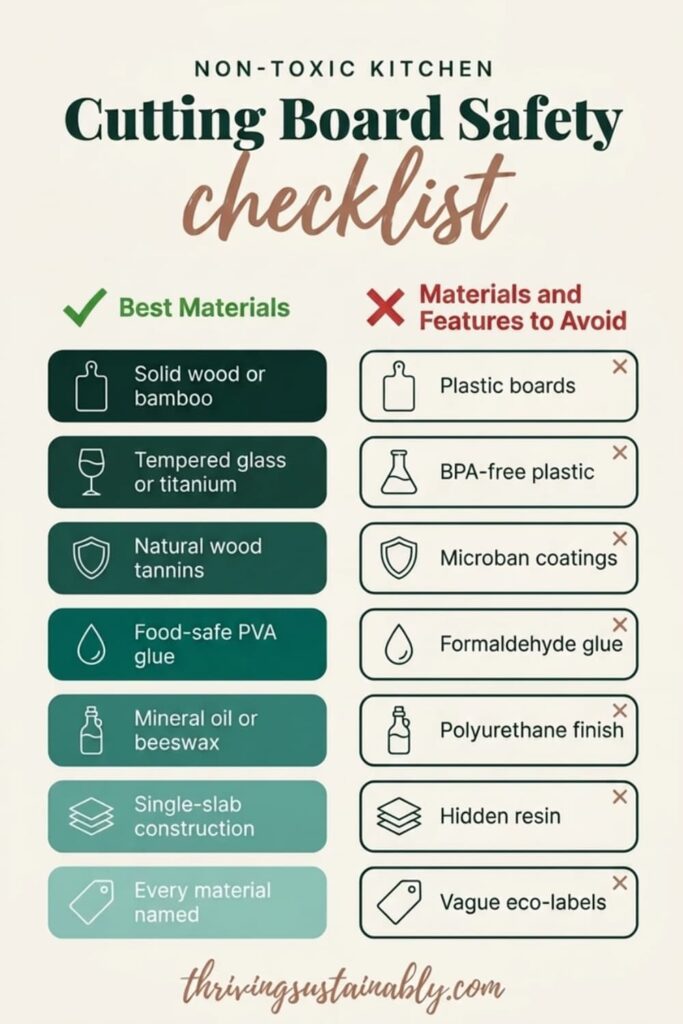
A non-toxic cutting board is what’s left after you take out the chemicals and shortcuts. Every item below is the direct positive answer to a matching item in the “Materials and Features to Avoid” list further down. Read them side by side.
- Solid hardwood, bamboo, tempered glass, or pure titanium. Instead of polyethylene or polypropylene plastic. Wood and bamboo don’t shed microplastics; glass and titanium are inert and shed none.
- Solid wood or bamboo, where “BPA-free” is just the default. Instead of “BPA-free” plastic, which is almost always swapped for chemically similar BPS or BPF that behave the same way in the body.
- Naturally antibacterial wood tannins. Instead of antimicrobial chemical coatings like Microban, triclosan, or silver-ion treatments. A properly seasoned wood board is naturally resistant to bacteria.
- Food-safe PVA glue, like Titebond III, or a single-slab board with no glue. Instead of formaldehyde-based adhesives (urea-formaldehyde, melamine-formaldehyde), which can release formaldehyde into the food layer over time.
- Food-grade mineral oil, pure beeswax, fractionated coconut oil, or pure tung oil. Instead of polyurethane or lacquer finishes on the cutting surface. Synthetic coatings are meant for furniture, not raw food prep.
- Single-slab construction, or composite brands that name phenolic resin openly. Instead of composite boards that bury the resin under vague “wood fiber” language.
- Brands that publish the wood species, the adhesive (or “no glue”), and the finish. Instead of vague eco-language like “natural,” “non-toxic,” or “eco-friendly,” with no material breakdown.
❌ Materials and Features to Avoid
The cutting board features to avoid are polyethylene and polypropylene plastic surfaces, antimicrobial chemical coatings like Microban, formaldehyde-based or unnamed adhesives, polyurethane and lacquer finishes, and any board the brand can’t describe in plain detail.
A few specifics worth catching before you click buy. If a board has any of these, it doesn’t make the non-toxic cut.
- Polyethylene or polypropylene plastic boards. The cheap, colorful boards in every grocery store. This is the source of the 14 to 79 million microplastic particles a year.
- “BPA-free” plastic. Almost always swapped for BPS or BPF, chemically similar and similarly disruptive in the body.
- Antimicrobial chemical coatings. Microban, triclosan, and silver-ion treatments add chemical exposure to a tool you eat off of every day.
- Formaldehyde-based adhesives. Urea-formaldehyde and melamine-formaldehyde glues release formaldehyde into the food layer over time.
- Polyurethane or lacquer-finished cutting surfaces. Synthetic coatings meant for furniture, not raw food prep.
- Composite boards that hide the resin. Some brands are transparent about phenolic resin; others bury it. If the materials list says only “wood fiber” with no other detail, treat that as a red flag.
- Vague eco-language with no material breakdown. “Natural,” “non-toxic,” and “eco-friendly” are not materials. If the brand can’t or won’t say what the board is bonded and finished with, walk past it.
✨ Tip
Check This One Thing
If you can only check one thing before buying, check the glue. A brand that tells you plainly which adhesive it uses, and that the adhesive is formaldehyde-free, has already cleared the hardest bar.
How to Choose the Right Non-Toxic Cutting Board
Choose a non-toxic cutting board that matches your cooking style, prioritizing solid hardwood or bamboo with named, food-safe glue and a natural finish, and using FSC, NSF, or USDA-organic certifications as third-party backup for the brand’s claims.
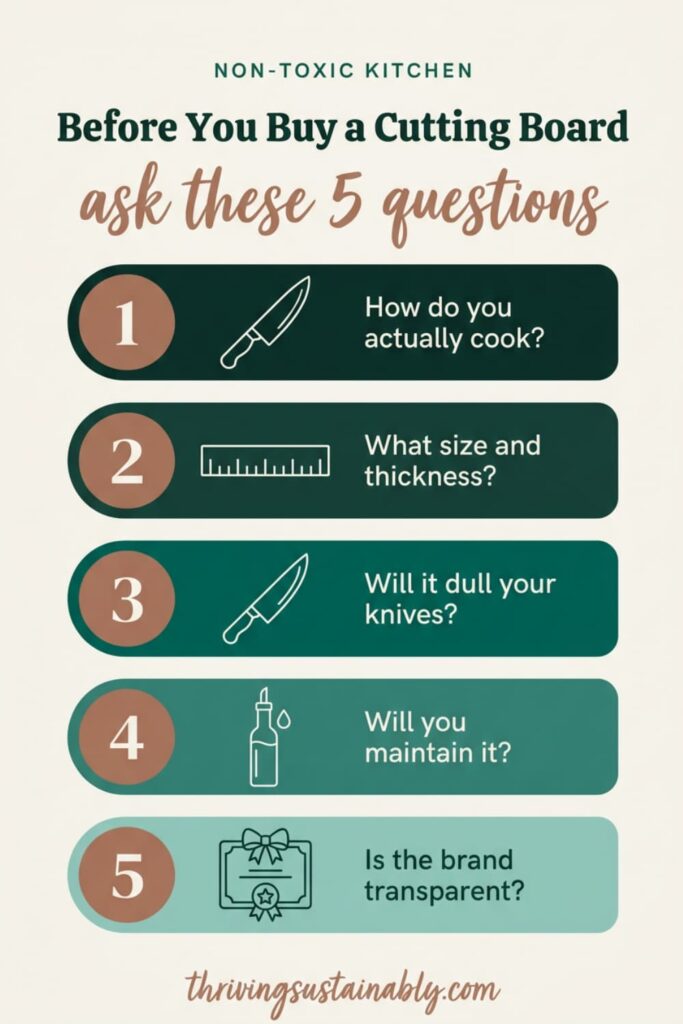
A non-toxic cutting board is only useful if you actually reach for it. Buy the wrong size, the wrong material for your cooking style, or one that needs more babysitting than you’ll give it, and it ends up in the back of the cabinet while the scratched plastic one stays on the counter. A few honest questions before you buy will save you that round trip.
Start With How You Actually Cook
How often you prep raw meat is the first fork in the road. If you butcher chicken thighs or break down a whole fish even once a week, plan for a dedicated meat-only board (or a multi-board set with one assigned to poultry) so you can keep juices off your salad greens. Cross-contamination is the single biggest food-safety risk in a home kitchen, and a separate board is the easiest fix.
For mostly-vegetable cooks, a single big hardwood or bamboo board covers everything. If you also bake, add a smaller cherry or walnut prep board for slicing fruit and herbs without dragging out the heavyweight.
Size and Thickness
Most home cooks reach for one of three sizes. A small prep board (about 8 by 10 inches) handles fruit, herbs, and quick slicing. For everyday cooking, a medium daily driver (about 12 by 16 inches) covers most jobs. Meanwhile, a large carving board or butcher block (18 by 24 inches or larger) is built for breaking down meat, kneading dough, or serving. If you can only buy one, then the medium size wins.
Thickness matters more than people expect. A board thinner than three-quarters of an inch tends to warp, slide on the counter, and chatter under heavy chopping. Aim for at least 1 inch on a daily-use hardwood board, and 1.5 to 2 inches if you want full end-grain butcher-block stability.
Knife-Friendliness
Wood hardness is measured on the Janka scale, and the higher the number, the rougher the surface is on your knife edge. Softer hardwoods (cherry, walnut, beech) are kinder to a chef’s knife but show knife marks faster. Harder hardwoods (hard maple, acacia) are more durable but a touch tougher on the blade. Bamboo is significantly harder than maple, making it more scratch-resistant but more prone to dulling a good knife.
End-grain boards are the gentlest of all. The wood fibers stand on end like a forest of upright straws, so the blade slips between fibers instead of slicing across them. If you’ve invested in a quality chef’s knife, an end-grain hardwood board will pay you back in fewer trips to the sharpener.
Maintenance Reality Check
The honest question is how much board care you’ll actually do. A solid wood or bamboo board needs handwashing after every use, drying on its edge, and a coat of food-grade mineral oil once a month. If you can commit to that, you’ll get decades out of it. If you know you won’t, a phenolic-resin composite is dishwasher-safe and zero-maintenance, but it isn’t fully plastic-free in the strict sense and isn’t on this roundup.
✨ Tip
Remind Yourself
A board that goes 8 to 10 weeks without oil starts to dry out at the edges. Set a phone reminder for the first of the month, or keep the mineral oil and a soft cloth in the same drawer as your dish towels so they live where you’ll see them.
Certifications and Brand Transparency
Third-party certifications are useful when a brand backs up its claims. Three to look for:
Forest Stewardship Council (FSC) certification for wood or bamboo means the raw material comes from responsibly managed forests, with no clear-cutting or illegal logging. NSF International certification on a cutting board means it’s been independently tested for food-safety standards. USDA Organic on bamboo (rare, but it exists) means no synthetic pesticides or fertilizers were used in the growing.
Even better than certifications: a brand that plainly publishes its material, adhesive, and finish. If the listing names the wood species, the glue (Titebond III, formaldehyde-free PVA, and so on), and the finish (mineral oil, beeswax, tung oil), you don’t need a third-party seal to know what you’re buying. Vague language (“eco-friendly,” “natural finish,” no glue spec) is the red flag, no matter how many badges the box has.
How to Care for a Non-Toxic Cutting Board
Care for a non-toxic wood or bamboo cutting board by hand-washing with hot soapy water, drying on edge, oiling monthly with food-grade mineral oil or a beeswax cream, and keeping it out of the dishwasher and away from harsh chemicals.
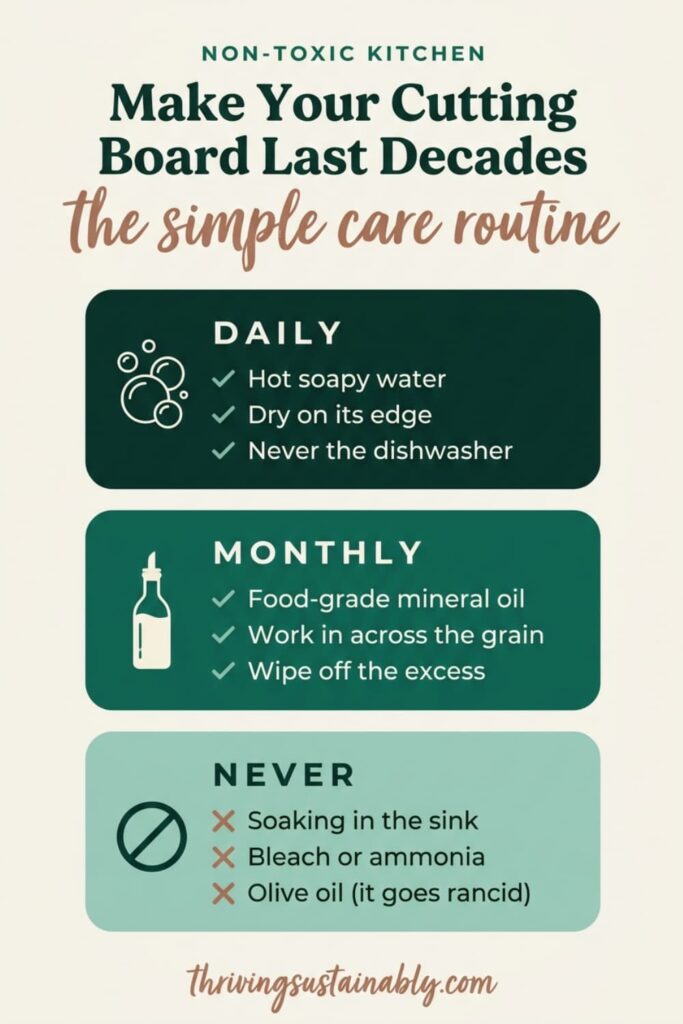
A good wooden board outlasts cheap plastic by decades, but it asks for a few minutes of routine attention. Here’s what actually matters.
🧽 Daily Cleaning
After every use, wash the board with hot soapy water and a soft sponge, rinse, and stand it on its edge or prop it at an angle so air reaches both sides. Never soak it, and never leave it sitting in a sink full of water. Above all, keep it out of the dishwasher. Heat and prolonged moisture are ultimately what warp, crack, and split a wood board.
For raw meat, wipe the board with a diluted white vinegar solution (1 part vinegar, 4 parts water) after the soapy wash, then rinse and dry. That’s plenty for home-cook food safety.
🛢️ Monthly Oiling
Once a month, give the board a generous coat of food-grade mineral oil or a mineral-oil-and-beeswax board cream. Apply with a soft cloth, work it in across the grain, let it sit overnight, then wipe off the excess in the morning. The board should look slightly waxy, not glossy or pooled. Oil more often if the wood starts looking pale or feels dry to the touch.
🚫 What to Avoid
A short list of board killers: dishwashers, prolonged soaking, bleach, ammonia, kitchen disinfectant sprays, polyurethane finishes, vegetable or olive oils (they go rancid), and storing the board flat in a damp drawer. If you’ve used a kitchen oil like olive or canola on a board before, scrub it with soap and warm water, let it dry fully, then start fresh with mineral oil.
✨ Tip
If It Stinks Do This
If your wood board has picked up a stubborn onion or garlic smell, sprinkle it with coarse salt, scrub with half a lemon, rinse, and dry. The salt acts as a gentle abrasive, and the lemon neutralizes the odor.
The 17 Best Non-Toxic Cutting Boards for 2026
The 17 best non-toxic cutting boards in 2026 cover solid hardwood (maple, walnut, teak, cherry, acacia, and olivewood), bamboo, pure titanium, and one recycled-chopstick composite. Sixteen are fully plastic-free with named materials and food-safe finishes, and the one composite pick is flagged clearly on its card.
These 17 boards cleared the non-toxic checklist in the earlier section of this guide. Solid material, named food-safe adhesive (or no adhesive at all), natural finish (or no finish needed), and a brand willing to be specific about what’s in the board. Nobody paid to be on this list. Each card breaks down the material so you can see the call for yourself.
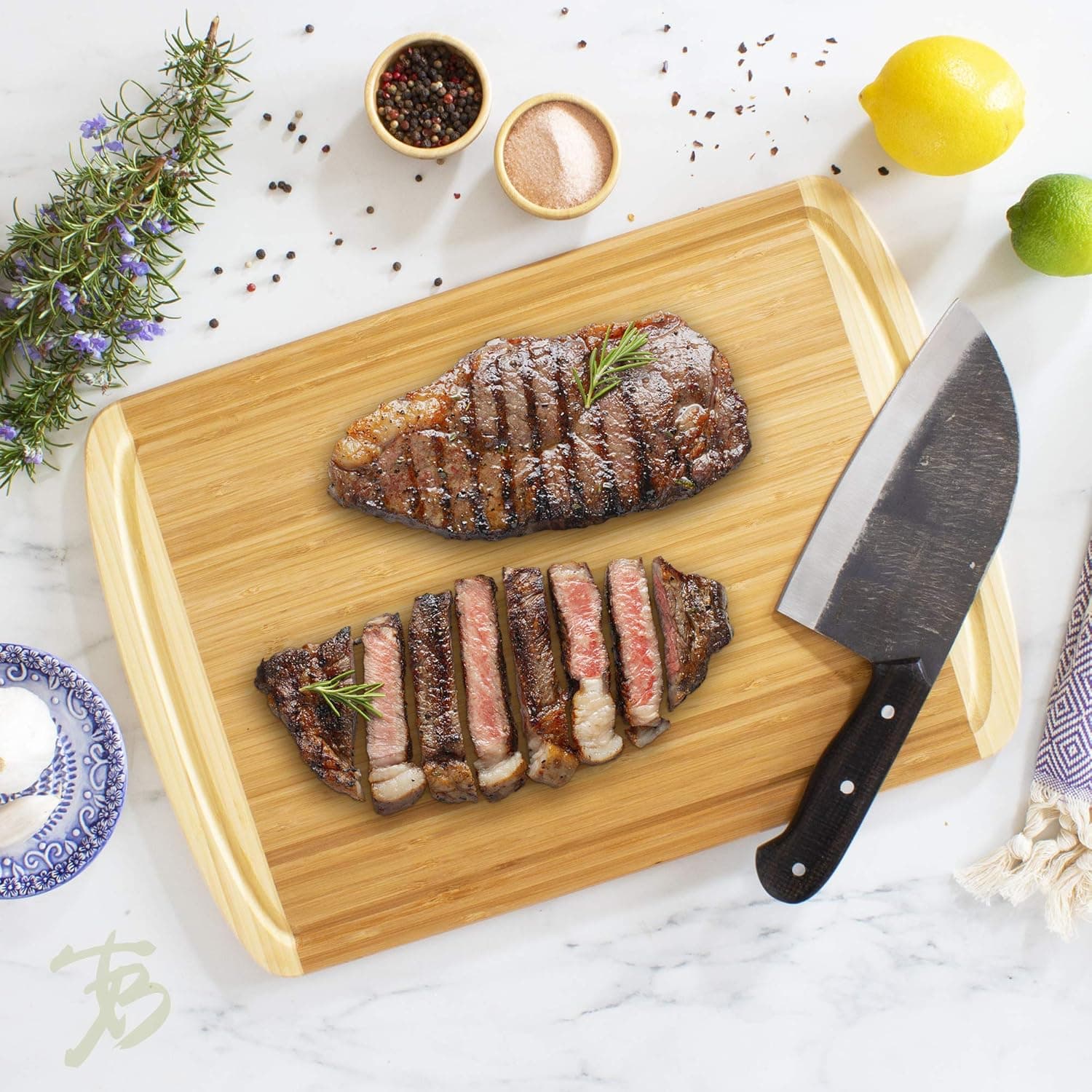
Renewable Moso bamboo, food-safe glue, juice groove
$
The Totally Bamboo Kona Groove is the easy entry point into a non-toxic kitchen. The 18 by 12.5-inch board is built from sustainably harvested Moso bamboo, bonded with a food-safe formaldehyde-free adhesive, and finished with food-grade mineral oil. A wide juice groove around the rim catches drips from cutting fruit or roasted meat.
In practice, bamboo is harder than most hardwoods, so it resists deep knife scarring better than maple, and it’s a fast-renewing grass that grows several feet a day. Totally Bamboo publishes its material specs plainly and has been making non-toxic kitchen tools since 1995. Hand wash, oil it monthly, and this board will outlive several rounds of the plastic boards it replaces.
Body
Moso Bamboo
✓ Plastic FreeAdhesive
Food-Safe, Formaldehyde-Free
✓ Plastic FreeFinish
Food-Grade Mineral Oil
✓ Plastic FreeHardware
None
✓ Plastic FreePros
- Formaldehyde-free glue, food-grade mineral oil finish
- Plus renewable bamboo, harder than maple
- Most affordable bamboo pick
Cons
- Bamboo is harder on knife edges than softer hardwoods
- Also hand wash only, never the dishwasher
- Needs monthly oiling to prevent drying
Overall, the easiest, most affordable way to swap your plastic board for a truly non-toxic one, with the brand’s material specs out in the open. Best entry-level bamboo pick.
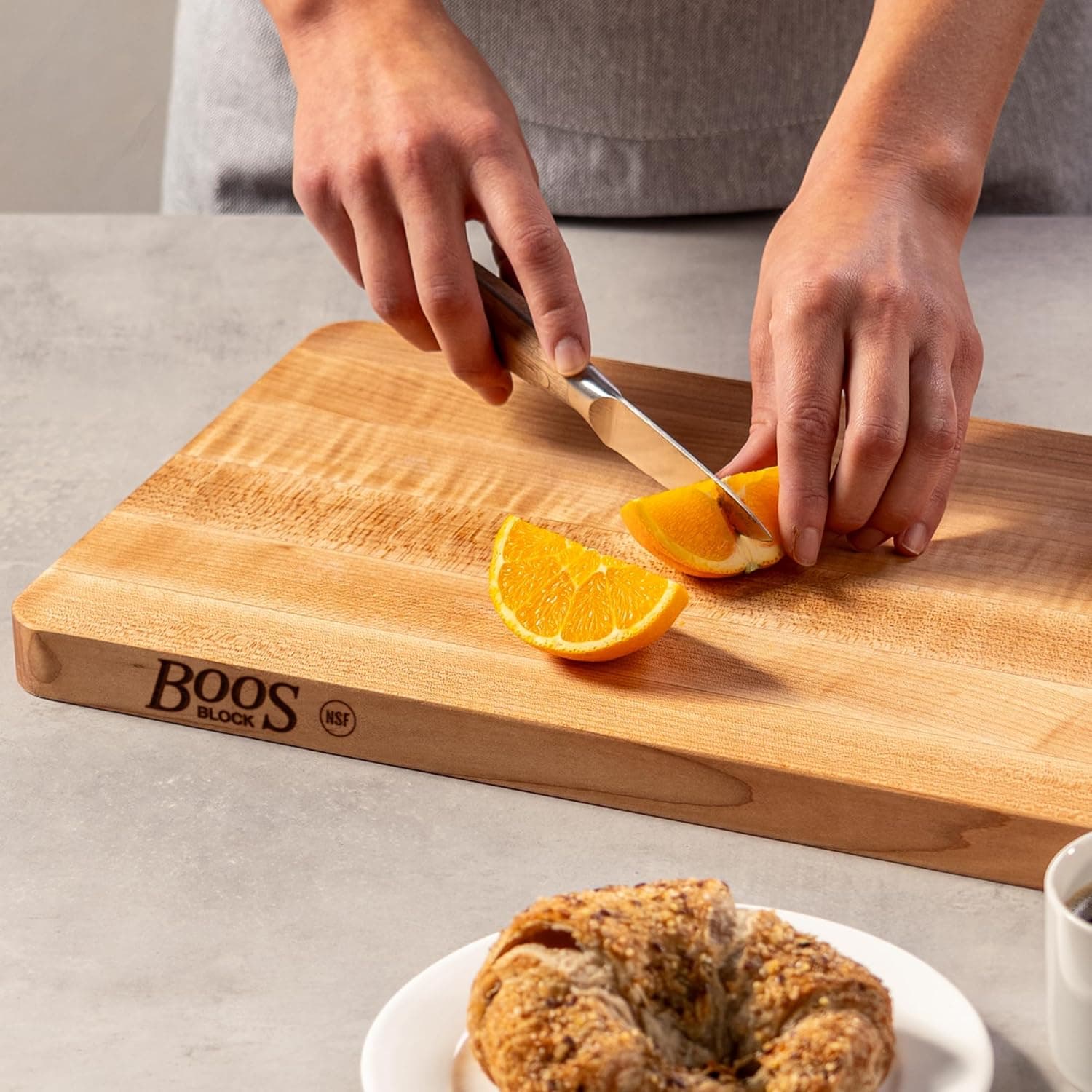
American hard maple, edge-grain, made in the USA
$
The John Boos Chop-N-Slice is the cutting board the food industry has trusted since 1887. The 16 by 10-inch reversible edge-grain board is made from solid American hard maple, bonded with food-safe wood adhesive, and finished with the brand’s mineral oil and beeswax blend. Every board is made in Effingham, Illinois.
Notably, maple is the gold standard non-toxic cutting board wood for a reason: hard enough to resist knife scarring, soft enough to keep your blade sharp longer, and naturally inhibits bacteria. Boos boards are the ones you see in serious home kitchens and on professional cooking shows, and they hold up to decades of use with monthly oiling.
Body
Solid Hard Maple
✓ Plastic FreeAdhesive
Food-Safe Wood Glue
✓ Plastic FreeFinish
Mineral Oil + Beeswax
✓ Plastic FreeHardware
None
✓ Plastic FreePros
- Solid American hard maple, the industry standard
- Plus reversible edge-grain, gentle on knives
- Made in the USA since 1887, lifetime brand
Cons
- Heavier than bamboo, about 4.5 pounds
- Also needs proactive monthly oiling to prevent cracks
- Hand wash only, never soak or dishwasher
In short, the classic, made-in-America maple board that quietly outlasts every plastic board you’ll ever own. Best everyday hardwood pick.
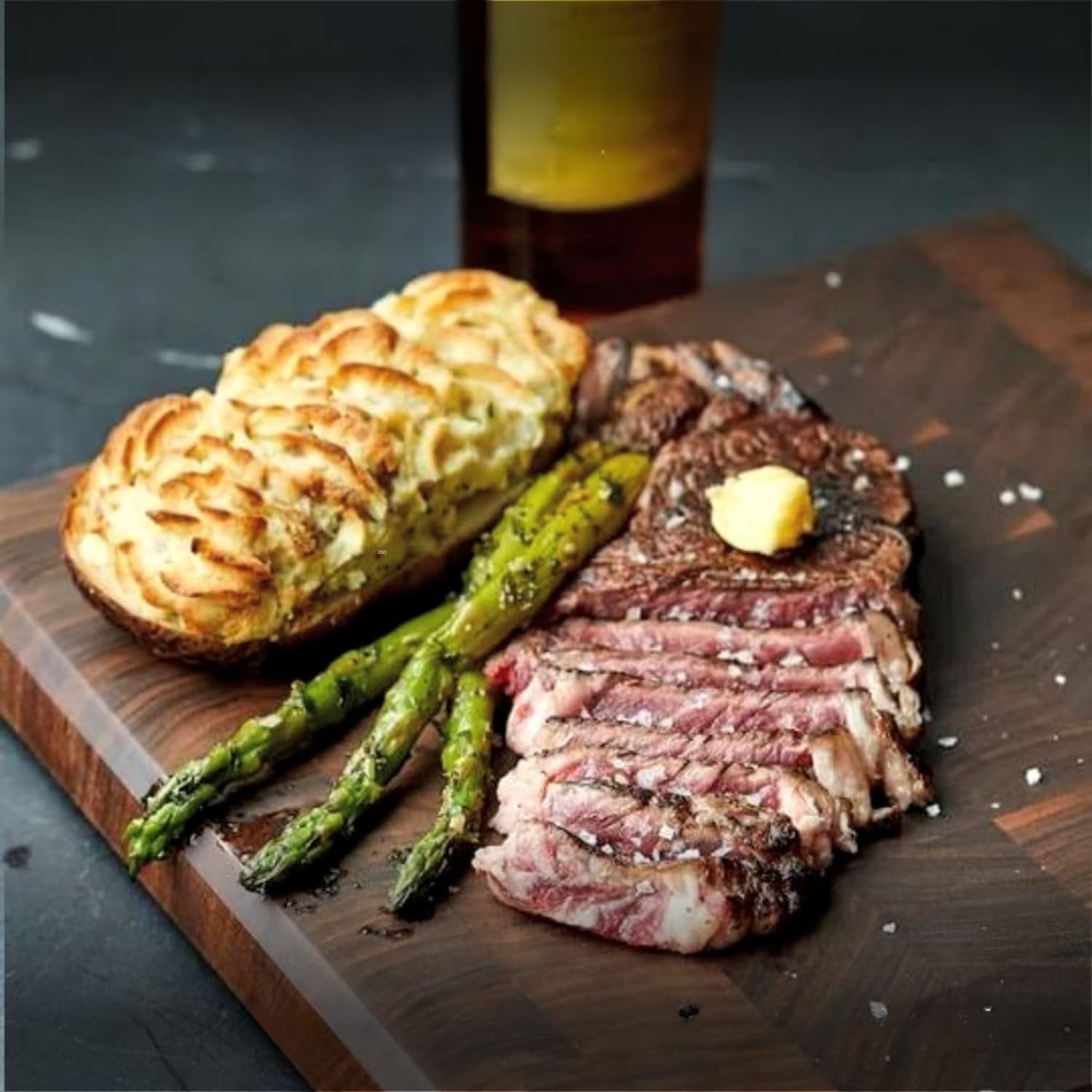
Handcrafted end-grain butcher block, the heirloom pick
$$$
The BoardSmith Maple End-Grain board is what serious cooks save up for. End-grain construction means the wood fibers face up like the ends of pencils stood on a table, which lets the knife edge slip between the fibers instead of slicing across them. The board self-heals between cuts, scars far less than edge-grain, and is dramatically gentler on knife edges.
Beyond the build itself, the Boardsmith has been making butcher blocks since 2005, now from a 7,500-square-foot shop in Frisco, Texas. Every board uses only FAS-grade American hard maple from FSC-certified sustainable forestry, bonded with food-safe Titebond III glue, and finished with mineral oil and beeswax. The price is real, but so is the lifespan: properly cared for, an end-grain butcher block runs 30 to 50 years.
Body
End-Grain Hard Maple
✓ Plastic FreeAdhesive
Food-Safe Titebond III
✓ Plastic FreeFinish
Mineral Oil + Beeswax
✓ Plastic FreeFeet
Non-Slip Wood
✓ Plastic FreePros
- End-grain self-heals between cuts
- Plus easiest on knife edges of any board on this list
- Handcrafted heirloom build, decades of use
Cons
- Significantly higher upfront price
- Also heavy, not great as a portable prep board
- Demands consistent oiling, especially the first year
All told, if you cook every day, prep raw meat regularly, and want a non-toxic cutting board that will outlast your range, this is the buy-once, keep-forever pick. Best premium splurge for serious cooks.
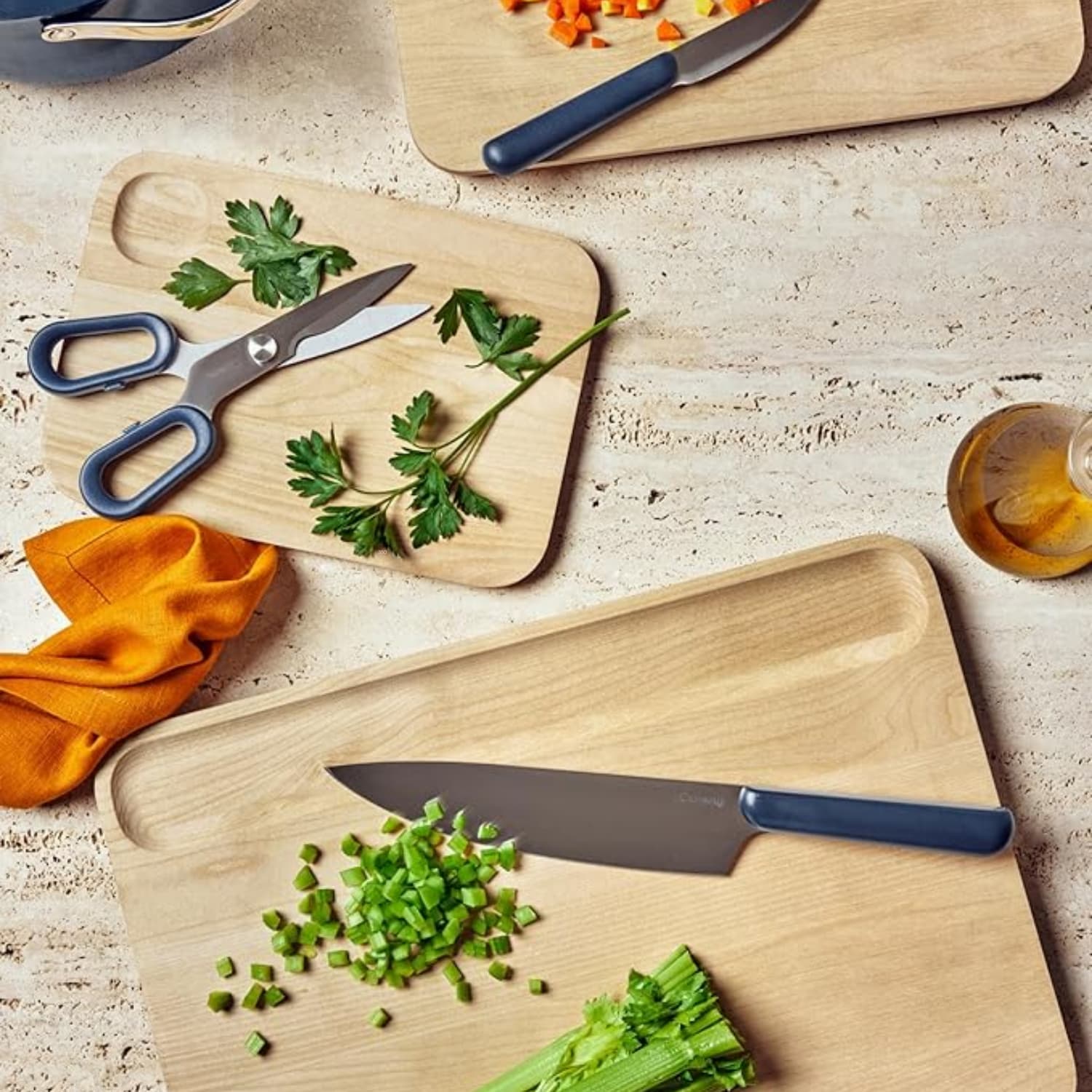
FSC-certified birch, 4-piece set with holder, mineral oil + wax finish
$$$
The Caraway 4-Piece Cutting Board Set is a complete plastic-free starter kit for the kitchen. The set includes three reversible boards (small, medium, large) plus a storage holder, all crafted from FSC-certified birch wood and finished with food-safe mineral oil and beeswax. Caraway built its brand on non-toxic ceramic cookware, and the cutting boards extend the same philosophy: no plastics, no BPA, no BPS, no PFAS.
In everyday use, birch is a tighter-grained hardwood than maple, naturally antimicrobial thanks to its tannins, and gentle enough on knives that you won’t be sharpening every week. The reversible double-sided design means you can keep one face for raw meat and the other for produce without buying a second set. Caraway publishes the FSC certification and finish ingredients openly on every product page.
Body
FSC-Certified Birch
✓ Plastic FreeAdhesive
Food-Safe Wood Glue
✓ Plastic FreeFinish
Mineral Oil + Beeswax
✓ Plastic FreeCertifications
FSC Certified
✓ VerifiedPros
- FSC-certified birch with third-party backing
- Plus Caraway’s non-toxic ethos extends to the boards
- Multi-size set covers every prep need plus storage
Cons
- Premium price for the full set
- Also birch is slightly softer than maple, may show marks sooner
- Reversible design has no juice groove
Ultimately, the complete starter set from one of the most recognized non-toxic kitchen brands, with FSC backing and Caraway’s signature clean-ingredient ethos. Best plastic-free starter set.
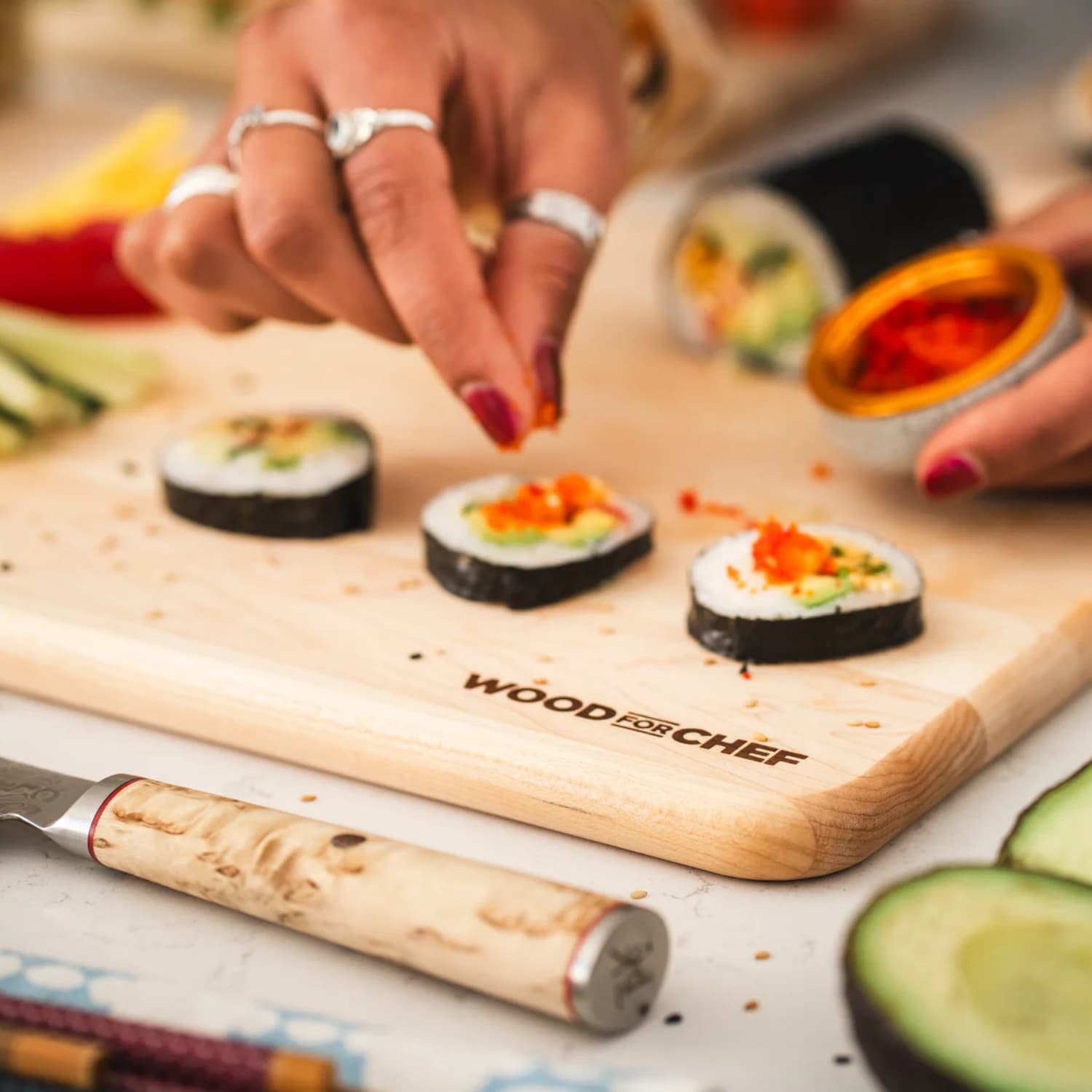
100% FSC-certified maple, minimalist design, sold through Grove Collaborative
$$
The WoodForChef Mizu Minimalist Cutting Board Set is the FSC maple set at an accessible price point. Each board in the kit is crafted from 100% FSC-certified hard maple, finished with food-safe oil, and shaped with a minimalist aesthetic that doubles as a serving piece. Sold through Grove Collaborative, the carbon-neutral marketplace that vets every brand it carries.
Notably, maple is the gold-standard cutting board wood: hard enough to resist deep knife scars, soft enough to stay gentle on the blade, and naturally antimicrobial through its tannins. The minimalist set delivers a complete kitchen starter at a more accessible price than larger maple butcher block sets.
Body
100% FSC-Certified Maple
✓ Plastic FreeAdhesive
Food-Safe Wood Glue
✓ Plastic FreeFinish
Food-Safe Oil
✓ Plastic FreeCertifications
FSC + Grove-Vetted
✓ VerifiedPros
- 100% FSC-certified hard maple
- Plus sold through Grove Collaborative, a vetted sustainable marketplace
- Minimalist design doubles as a serving set
Cons
- Hand wash only, no dishwasher
- Also smaller boards than a full butcher block
- Requires monthly oiling for longevity
For the money, an FSC-certified maple set from a Grove-vetted brand at a more accessible price than larger butcher block sets. Best FSC maple starter set.
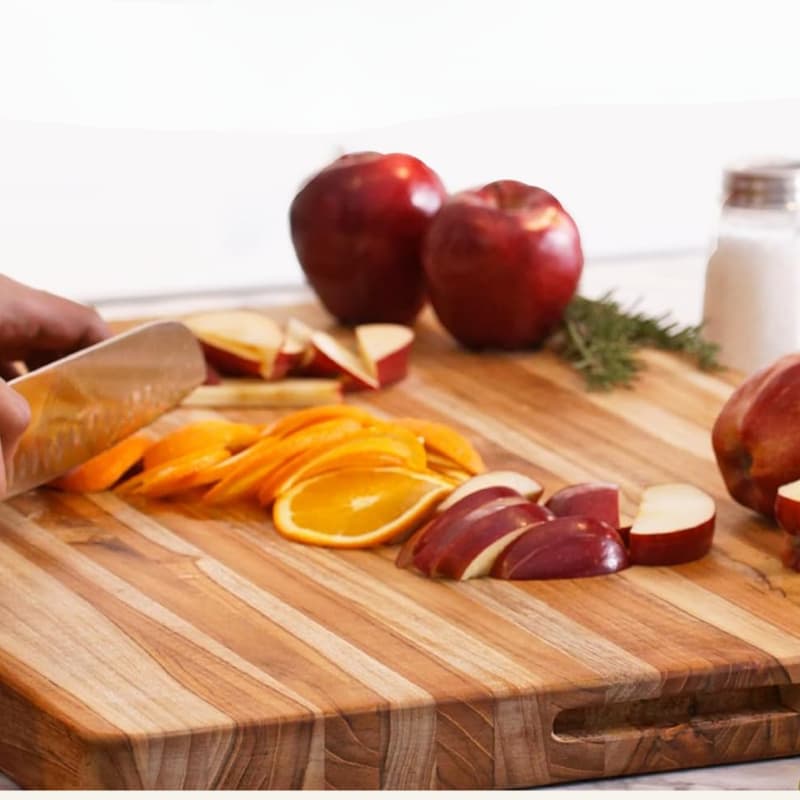
FSC-certified plantation teak, edge-grain, mineral oil finish
$$
The Teakhaus by Proteak cutting board is the sustainable answer to teak. Proteak runs Forest Stewardship Council-certified plantations in Central America, so the teak you’re chopping on came from a managed plot rather than a clear-cut tropical forest. Teak is naturally oily and water-resistant, so it shrugs off moisture better than maple and needs less frequent oiling.
On the materials side, the boards are bonded with food-safe, formaldehyde-free adhesive and pre-finished with food-grade mineral oil. Sizes run from small prep boards to the large carving sizes professional cooks reach for. The board is a workhorse that’s a little easier to maintain than maple but still gentle enough on knife edges.
Body
FSC Plantation Teak
✓ Plastic FreeAdhesive
Food-Safe, Formaldehyde-Free
✓ Plastic FreeFinish
Food-Grade Mineral Oil
✓ Plastic FreeCertifications
FSC Certified
✓ VerifiedPros
- FSC-certified plantation teak, no tropical clear-cuts
- Plus teak’s natural oils mean less oiling than maple
- Reasonably priced for FSC-certified hardwood
Cons
- Edge-grain, scars more than end-grain
- Also teak has natural silica that can dull edges over time
- Hand wash only, no dishwasher
Bottom line, the lower-maintenance teak pick, with FSC certification that backs up the sustainability claim. Best non-toxic teak pick.
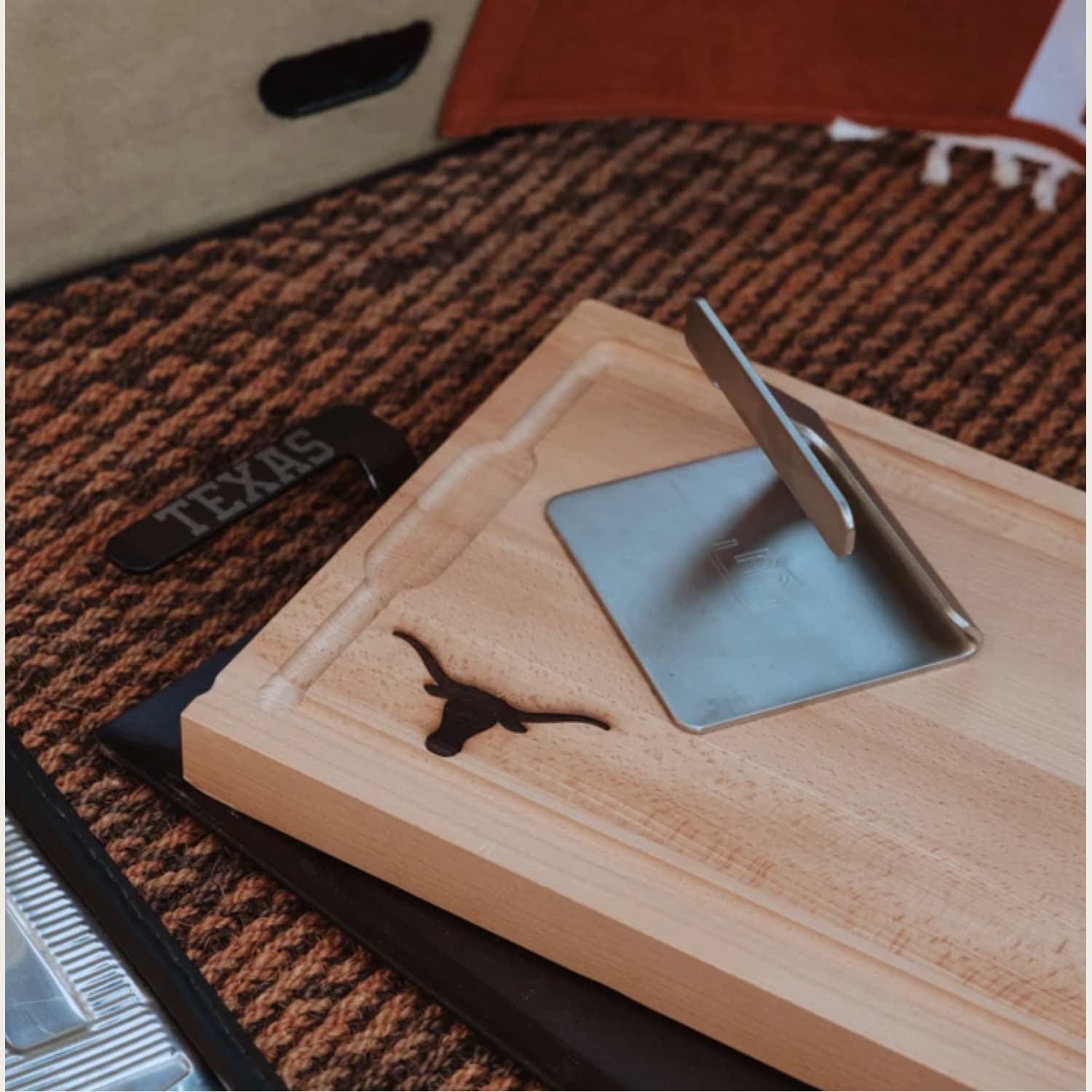
Solid steamed maple, two-handed pro workstation, made in USA
$$
The Made In Butcher Block is the chef’s-kitchen pick. It’s a thick, two-handed maple workstation with side handles, a juice groove on one side, and a flat charcuterie face on the other. The 17.75 by 11.75-inch board is crafted from steamed maple wood (the steam process strengthens the wood and resists warping) without any synthetic sealants.
For upkeep, Made In sells a separate board conditioner (coconut oil, organic carnauba wax, beeswax, lemon essential oil) for monthly maintenance. The block is heavy enough that it stays put on the counter without needing rubber feet. Made In Cookware built its reputation on professional-grade cookware, and the butcher block carries the same craftsmanship.
Body
Solid Steamed Maple Wood
✓ Plastic FreeAdhesive
Food-Safe Wood Glue
✓ Plastic FreeFinish
Steam Finished, No Synthetic Sealant
✓ Plastic FreeConditioner
Coconut Oil, Beeswax, Carnauba (sold separately)
✓ Plastic FreePros
- Thick pro workstation, reversible juice groove and flat
- Plus steamed maple resists warping, no synthetic sealants
- Made in USA, professional-grade craftsmanship
Cons
- Conditioner is sold separately
- Also heavy, demands real counter space
- Specific glue type not publicly named, confirm with Made In if it matters
In the end, a professional-grade maple butcher block from a respected cookware brand, made in USA with no synthetic sealants. Best pro-kitchen maple pick.
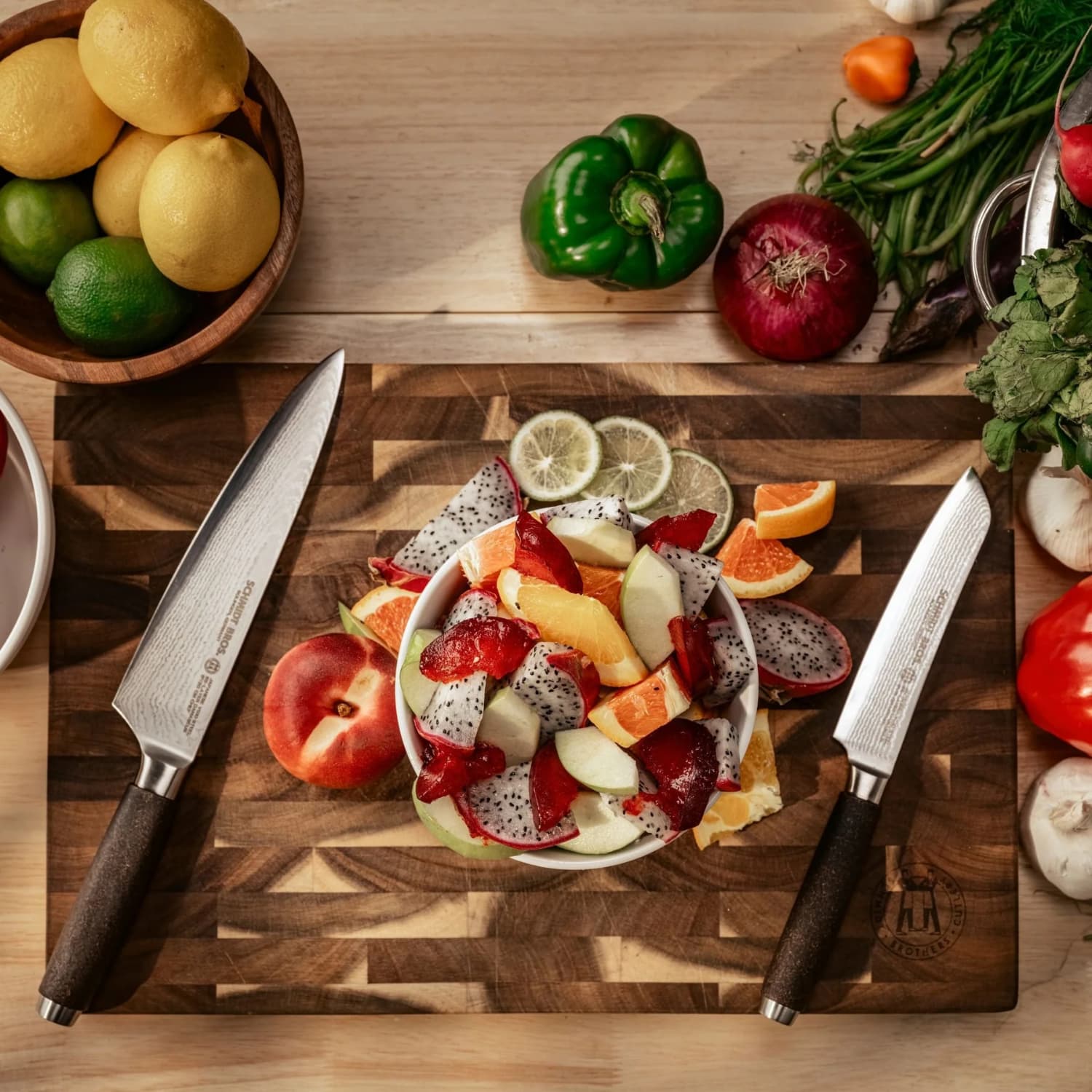
FSC-certified acacia, end-grain construction, professional grade
$$
The Schmidt Bros 18-inch Acacia End-Grain Cutting Board is the acacia answer to a maple end-grain block. End-grain construction means the wood fibers stand up so the knife edge slides between them, leaving fewer visible marks and being significantly gentler on a chef’s knife. Schmidt Brothers only sources wood from FSC-certified sustainable forests.
Beyond the boards, Schmidt Bros built its reputation on professional-grade cutlery, and the cutting boards carry the same craftsmanship. Acacia is naturally water-resistant thanks to its high oil content, so it needs less frequent oiling than maple, and the dark grain pattern works as a serving piece too. Hand-finished with food-safe wood oil and easy to maintain.
Body
FSC-Certified Acacia (End-Grain)
✓ Plastic FreeAdhesive
Food-Safe Wood Glue
✓ Plastic FreeFinish
Food-Safe Wood Oil
✓ Plastic FreeCertifications
FSC Certified
✓ VerifiedPros
- FSC-certified end-grain construction
- Plus acacia is naturally water-resistant, low maintenance
- Cutlery brand’s craftsmanship extends to the boards
Cons
- Mid-range price point
- Also acacia is harder than maple, slightly tougher on knives
- Hand-wash only, no dishwasher
On balance, an FSC-certified end-grain acacia board from a respected professional cutlery brand. Best acacia end-grain pick.
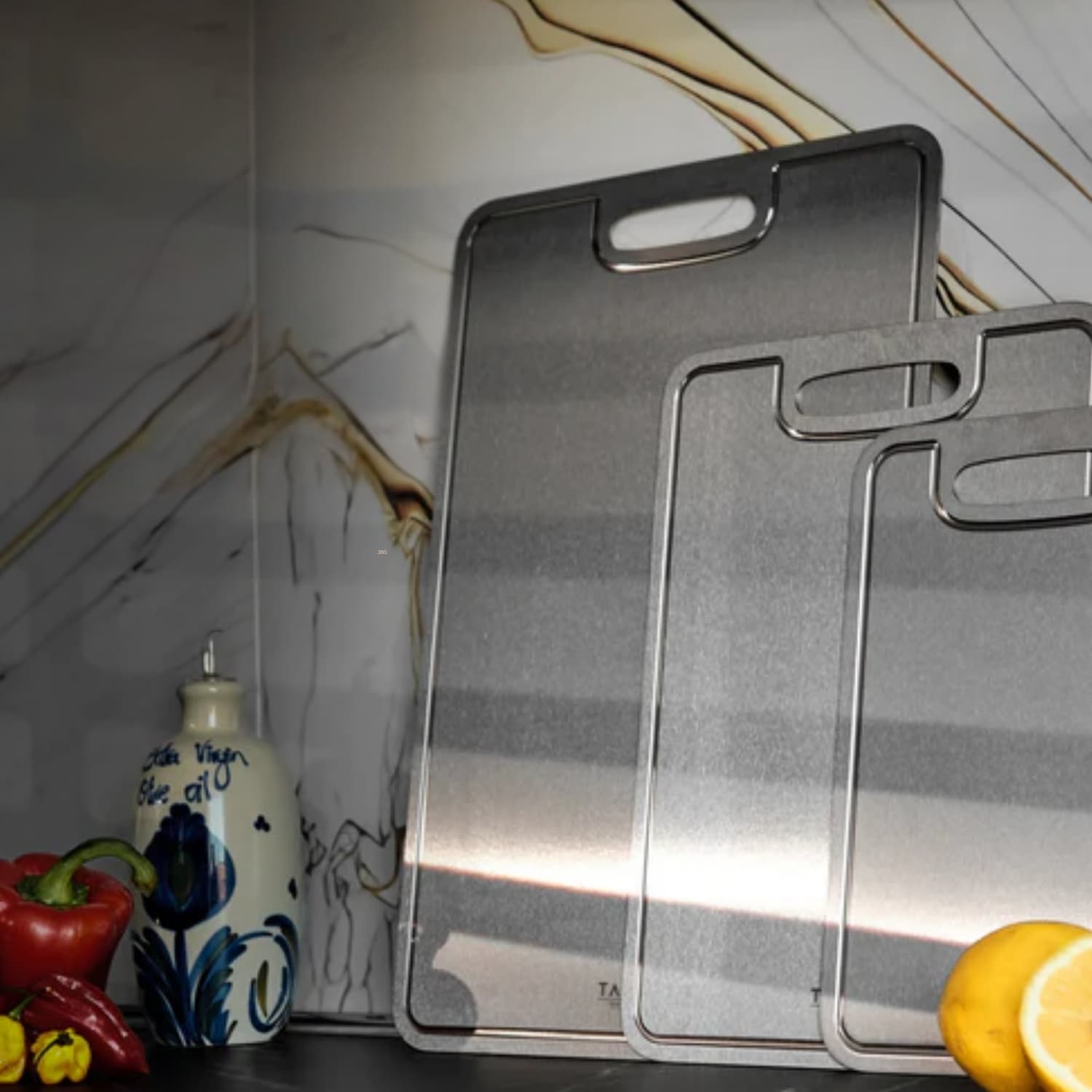
Certified 100% pure titanium, naturally antimicrobial, lifetime tool
$$$
The Taima Pure Titanium Cutting Board V2 is the certified-titanium pick. Where the titanium-board category is full of knock-offs (steel with a thin titanium coating sold as solid titanium), Taima publishes third-party certification confirming 100% pure titanium construction. Titanium is fully inert, naturally antimicrobial without any added chemical coating, and will never warp, crack, shed microplastics, or wear out.
In addition, the V2 design refines the original with smoother edges and an updated profile. It’s expensive upfront, but it’s also a literal lifetime tool: no oiling, no warping, no replacement. Use it as a sanitizable raw-meat board for cooks who want zero porosity, zero coatings, and zero anything that could leach into food.
Body
100% Certified Pure Titanium
✓ Plastic FreeAdhesive
None
✓ Plastic FreeFinish
None (Naturally Inert)
✓ Plastic FreeCertifications
Third-Party Titanium Certified
✓ VerifiedPros
- Certified pure titanium, not a steel-coated knock-off
- Plus fully inert, won’t leach or shed anything into food
- Effectively lifetime tool, won’t warp or wear out
Cons
- Premium price point
- Also brutal on knife edges, dulls blades quickly
- Loud and unforgiving under heavy chopping
Overall, the certified pure-titanium pick for cooks who want a literal lifetime tool with zero porosity, zero coatings, zero shed. Best lifetime inert pick.
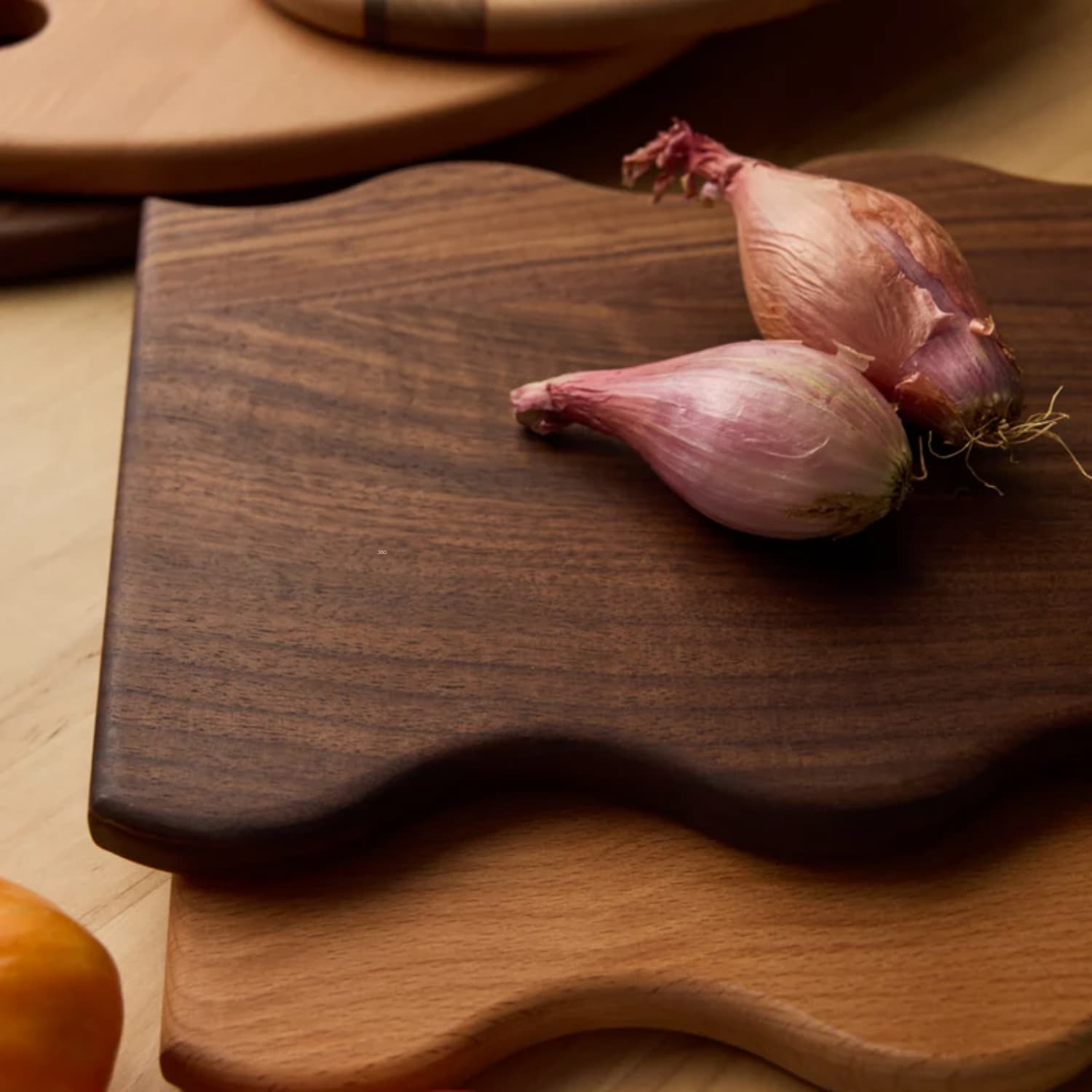
Reclaimed hardwood, B Corp + Climate Neutral certified, zero-waste construction
$$
The Avocado Zero Waste Cutting Board is from the B Corp certified brand best known for organic mattresses. Avocado built the cutting board around its zero-waste ethos: each board is made from reclaimed and offcut hardwood that would otherwise end up as workshop scrap. The wood species varies by batch, but every board is solid hardwood (no plywood, no composite).
On top of that, the brand publishes its certifications openly: B Corp, Climate Neutral, and 1% for the Planet. Each board is hand-finished with food-safe oil and ships with care instructions. The zero-waste story is not marketing language: Avocado’s workshop actually uses offcuts that other manufacturers throw away.
Body
Reclaimed Solid Hardwood
✓ Plastic FreeAdhesive
Food-Safe Wood Glue
✓ Plastic FreeFinish
Food-Safe Oil
✓ Plastic FreeCertifications
B Corp, Climate Neutral, 1% for the Planet
✓ VerifiedPros
- B Corp, Climate Neutral, and 1% for the Planet certified
- Plus reclaimed wood zero-waste construction
- Hand-finished from one of the most third-party certified sustainable brands
Cons
- Wood species varies by batch (each board is unique)
- Also premium price point
- Hand wash only, no dishwasher
In short, a truly zero-waste board from one of the most third-party certified sustainable brands on the list. Best reclaimed-wood pick.
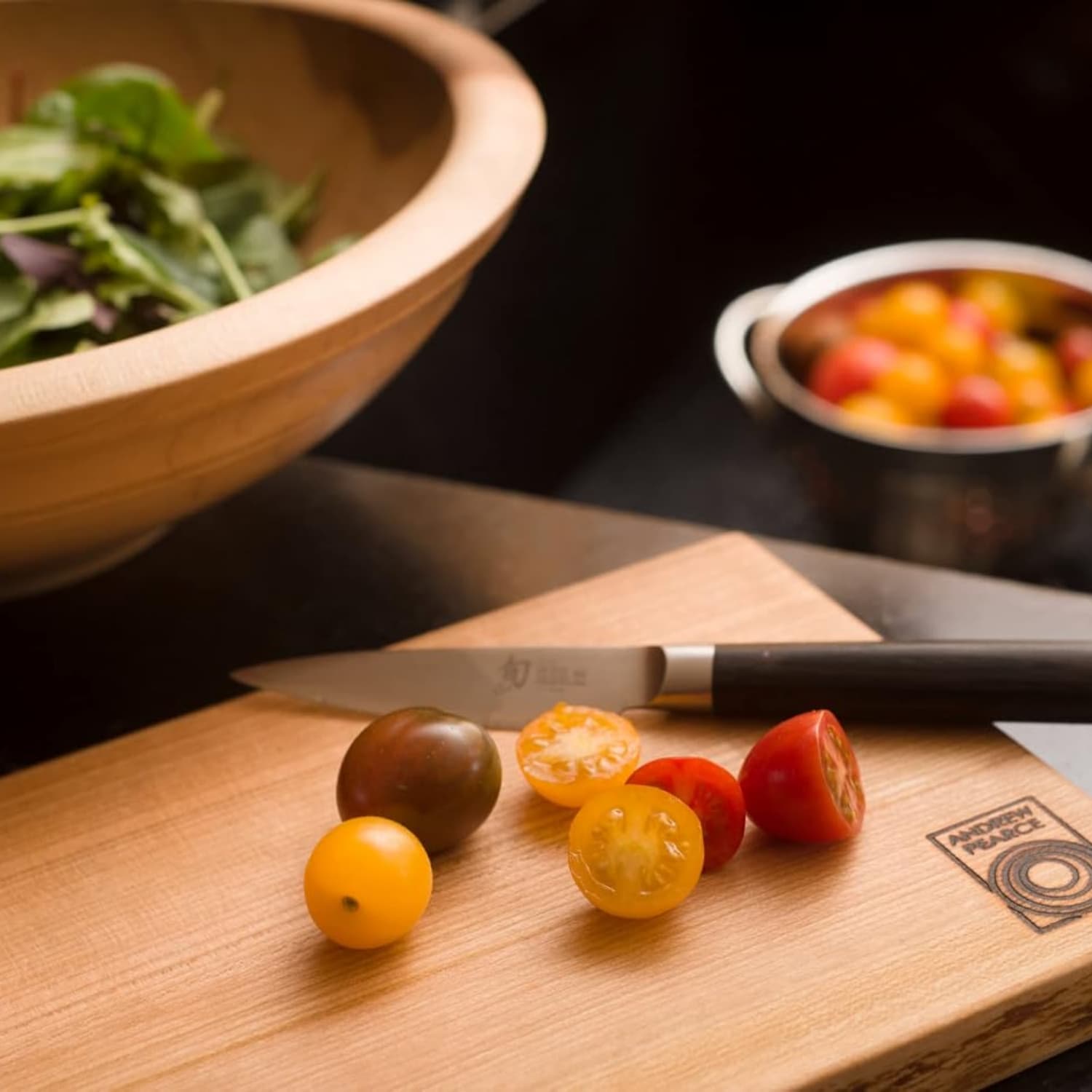
Quarter-sawn cherry or walnut, single piece, made in Vermont
$$
The Andrew Pearce Live Edge cutting board is a serving board you can also chop on. Each one is a single piece of quarter-sawn cherry or walnut with a natural live edge running down one side, kiln-dried and hand-finished in Hartland, Vermont. Single-piece construction means no glue, anywhere.
For the finish, the brand uses their allergen-friendly walnut wood oil. Worth flagging: walnut is a tree nut, so anyone in the household with a tree-nut allergy should pick a board finished with mineral oil instead. For everyone else, the heirloom quality and zero-glue construction are hard to beat at this price.
Body
Single-Piece Cherry or Walnut
✓ Plastic FreeAdhesive
None (single piece)
✓ Plastic FreeFinish
Walnut Wood Oil (tree-nut allergen)
✓ Plastic FreeHardware
None
✓ Plastic FreePros
- Single piece of wood, no glue or bonding
- Plus handmade in Vermont, kiln-dried hardwood
- Doubles as a serving board with the live edge
Cons
- Walnut wood oil finish is a tree-nut allergen
- Also sized as a prep or serving board, not a full carving station
- Cherry shows knife marks faster than maple
All told, a handmade Vermont cutting board that doubles as a serving piece, with the live edge and natural wood finish doing all the work. Best live-edge pick.
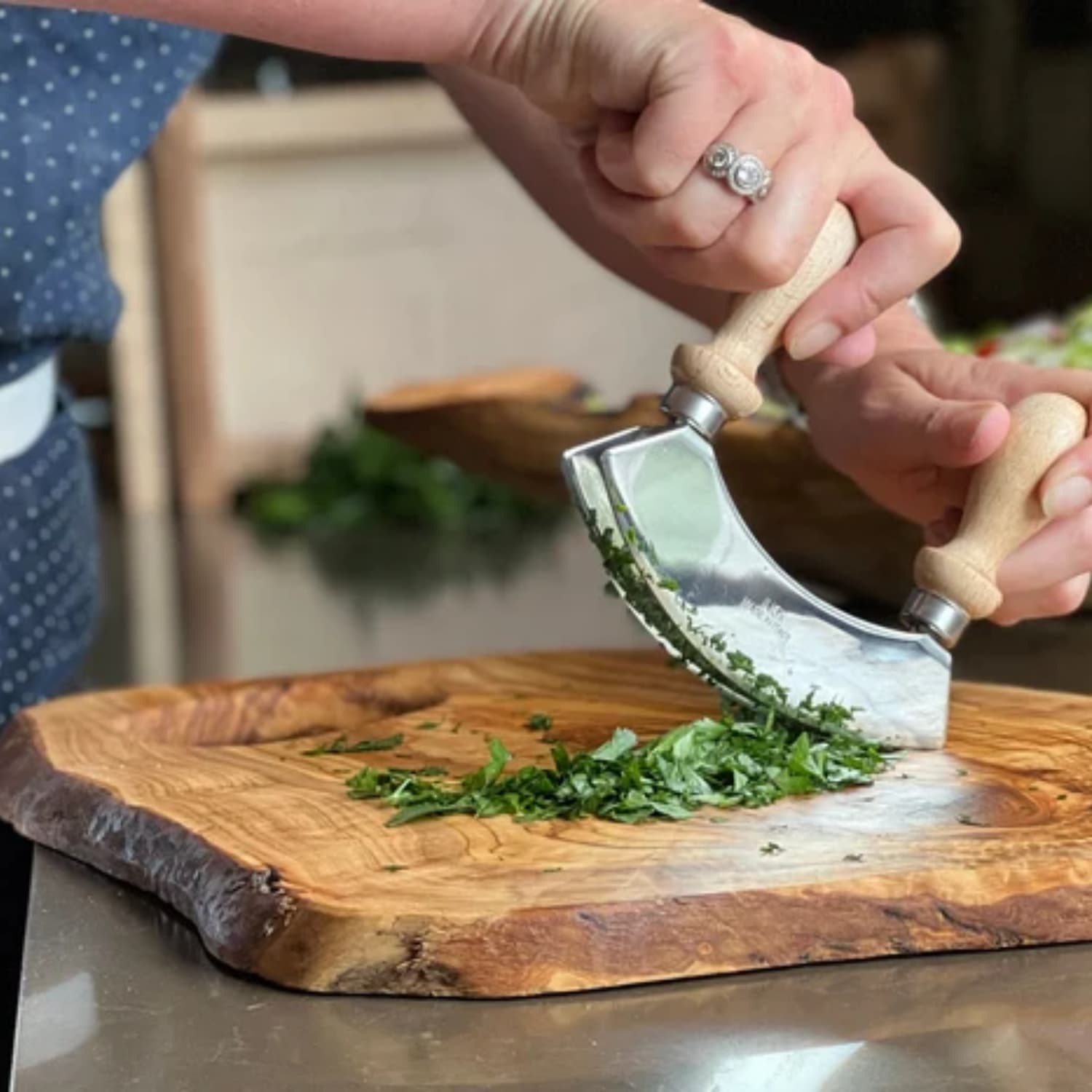
Single piece of Italian olivewood, handcrafted in Umbria, women-owned
$$$
The Verve Culture Italian Olivewood Board is a single piece of solid olivewood, cut and shaped by artisans in Italy’s Umbria region. One piece of wood means no glue anywhere, the same zero-adhesive construction that makes single-slab boards the cleanest option in this guide. Olivewood is also one of the densest cutting woods you can buy, so it shrugs off knife scarring that would mark up a softer board.
Beyond the wood, Verve Culture is a women-owned brand that works directly with the family workshops behind its goods, and each board carries its own grain swirls and outline, so no two are alike. The brand recommends a wipe of olive oil or food-grade mineral oil whenever the surface starts to look dry.
Body
Single-Piece Solid Olivewood
✓ Plastic FreeAdhesive
None (single piece)
✓ Plastic FreeFinish
None Stated, Oil At Home
✓ Plastic FreeHardware
None
✓ Plastic FreePros
- Single piece of wood, zero glue anywhere
- Plus dense olivewood resists knife scarring
- Handcrafted in Italy by a women-owned brand
Cons
- Each board varies in size and shape
- Also premium price for the large size
- Needs regular oiling, hand wash only
Ultimately, a one-of-a-kind single slab of Italian olivewood that works as hard as it looks. Best single-piece statement board.
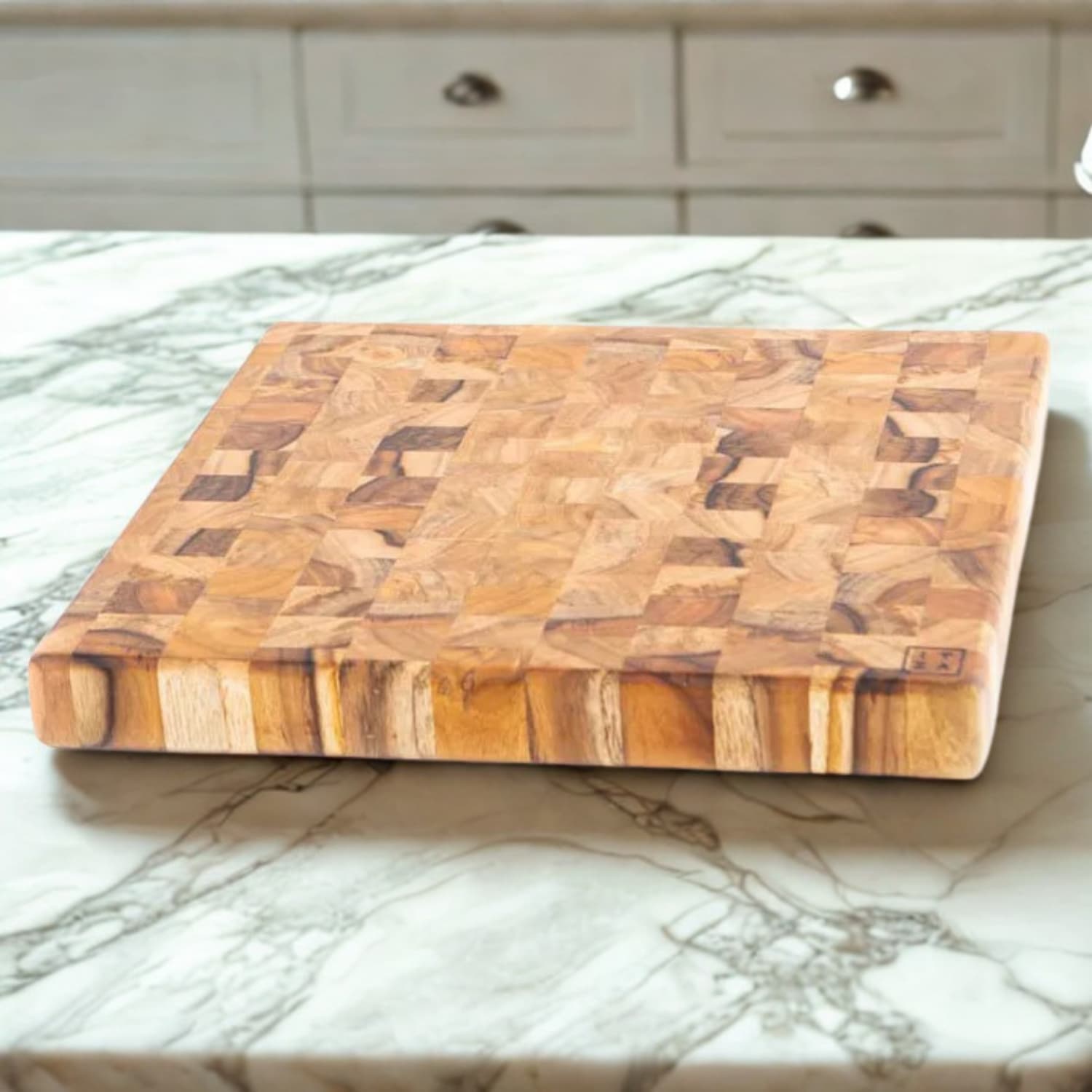
Sustainably sourced exotic hardwood, handcrafted butcher block
$$
The Itza Wood Butcher’s Block is the exotic hardwood pick for cooks who want a board with character. Itza Wood specializes in dense tropical hardwoods (often ziricote, granadillo, or katalox) that resist knife scarring better than maple, with grain patterns that work as a permanent serving statement. The butcher block construction makes it a workhorse for heavy chopping.
In addition, each board is handcrafted from sustainably sourced exotic hardwood, bonded with food-safe glue, and finished with mineral oil and beeswax. The trade-off with exotic hardwoods is they cost more per board than maple, but they’re harder and last longer too. Worth confirming the specific wood species with the seller before buying if it matters to you.
Body
Exotic Hardwood (varies by batch)
✓ Plastic FreeAdhesive
Food-Safe Wood Glue
✓ Plastic FreeFinish
Mineral Oil + Beeswax
✓ Plastic FreeHardware
None
✓ Plastic FreePros
- Dense exotic hardwood resists scarring better than maple
- Plus beautiful grain patterns, doubles as a serving piece
- Handcrafted butcher block construction
Cons
- Exotic hardwood species varies by batch (confirm before buying)
- Also premium price for exotic hardwood
- Hand wash only, no dishwasher
For the money, a handcrafted exotic hardwood butcher block for cooks who want a board with serious character and durability. Best exotic hardwood pick.
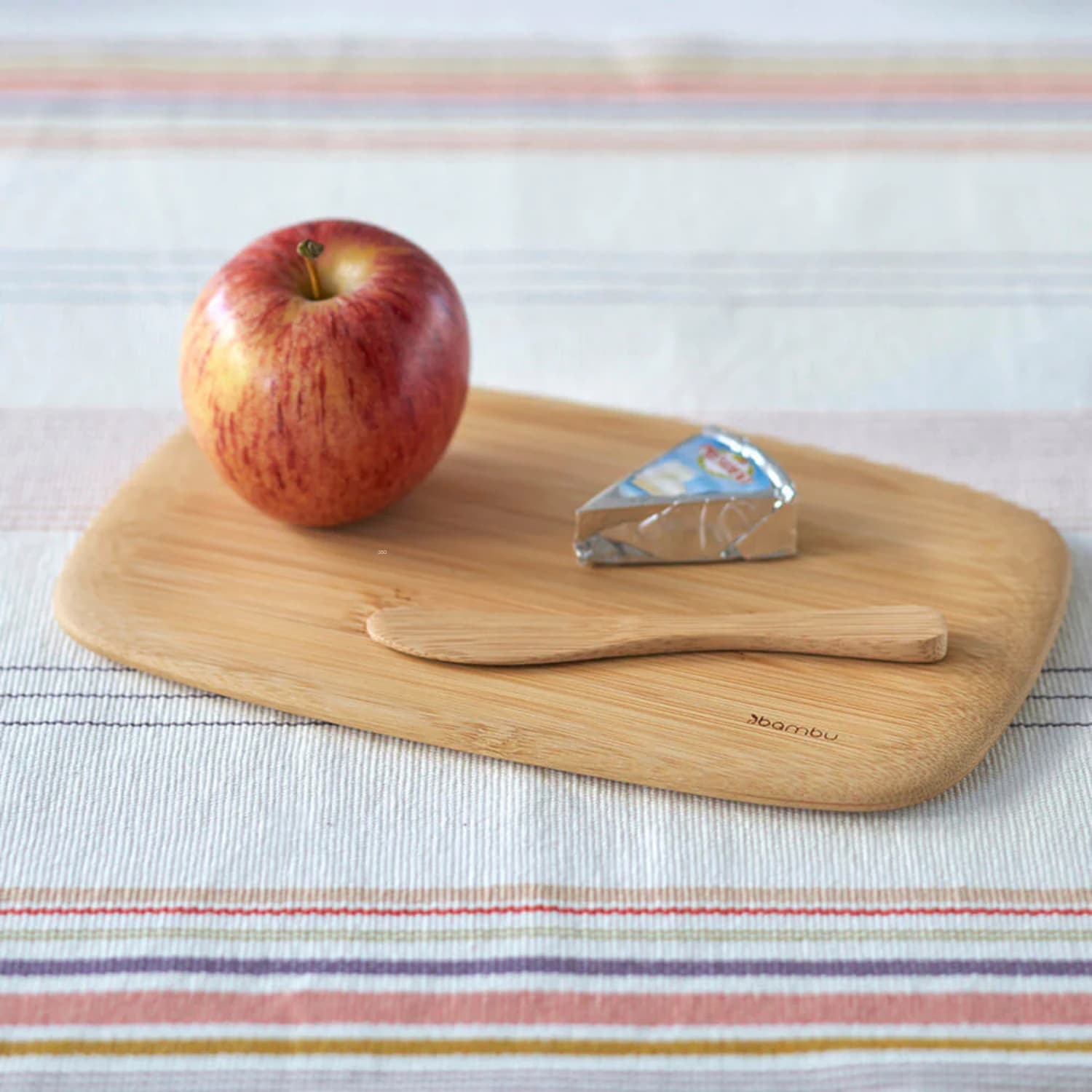
USDA-organic and FSC-certified bamboo, B Corp since 2003
$
The Bambu Classic Bamboo Cutting Board is from one of the first US brands to specialize in bamboo home goods. The company has been certifying its bamboo as USDA Organic, FSC, and B Corp since 2003, which puts them well ahead of the bamboo-board pack on transparency. Sold through Grove Collaborative at one of the friendliest entry prices on this roundup.
On the materials side, each board is bonded with a food-safe, formaldehyde-free adhesive and pre-finished with food-grade oil. Bambu also publishes its supply chain and certifications openly, and donates a minimum of 1% of sales to environmental organizations. It’s one of the easiest ways to swap out a plastic board for a credentialed non-toxic option.
Body
Organic, FSC-Certified Bamboo
✓ Plastic FreeAdhesive
Food-Safe, Formaldehyde-Free
✓ Plastic FreeFinish
Food-Grade Oil
✓ Plastic FreeCertifications
USDA Organic, FSC, B Corp
✓ VerifiedPros
- USDA-organic, FSC-certified, AND B Corp triple third-party backing
- Plus heritage brand, certified since 2003
- One of the most affordable entry points on the roundup
Cons
- Bamboo dulls knife edges faster than soft hardwoods
- Also hand wash only, no dishwasher
- Smaller size than a full butcher block
Bottom line, the most thoroughly certified bamboo board on this list, at a budget-friendly price. Best certified budget pick.
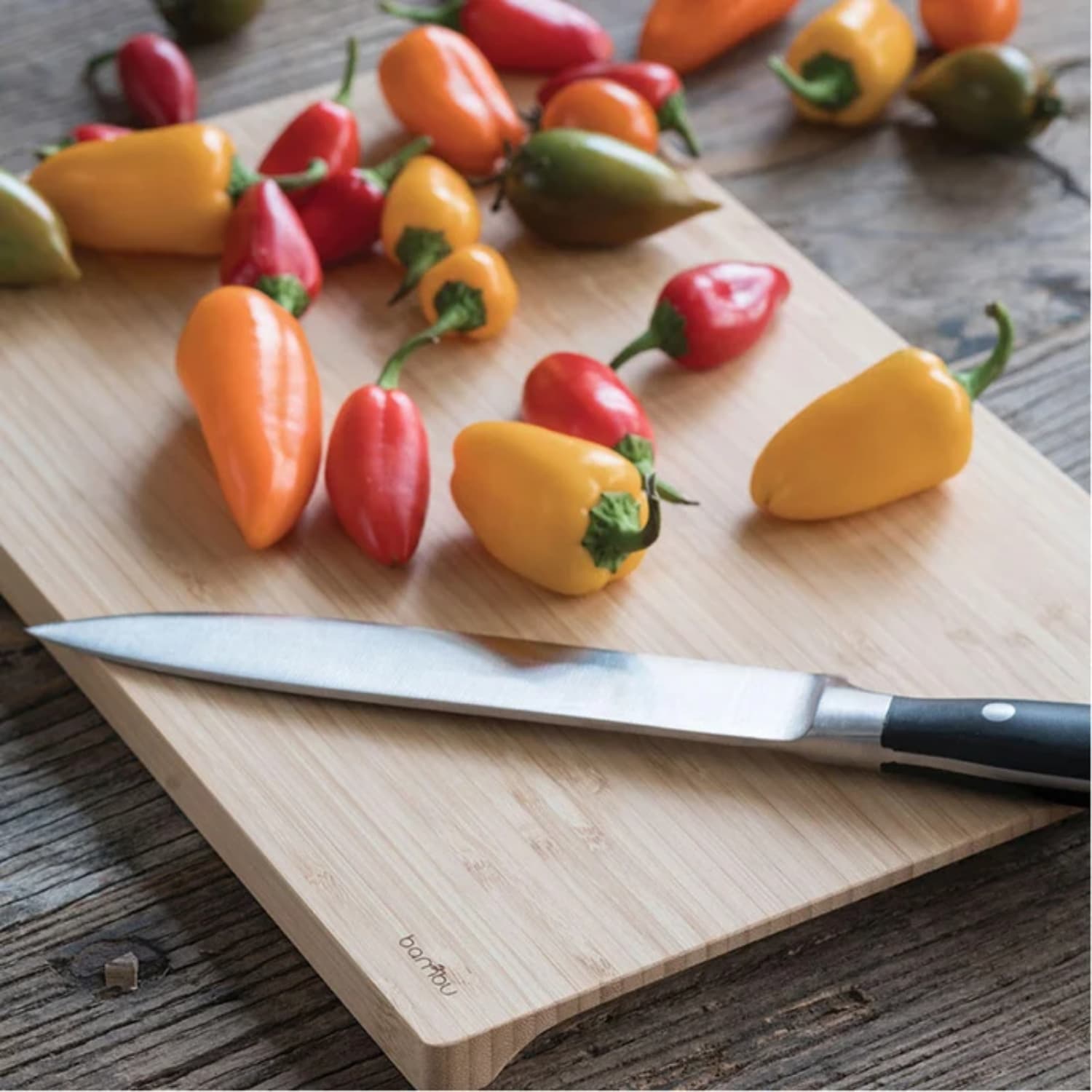
Organically harvested bamboo, formaldehyde-free glue, plant-oil finish
$
The Bambu Undercut Bamboo Cutting Board is the organic bamboo pick that names every single input. The board is made from organically harvested bamboo, bonded with a water-based glue that’s free of formaldehyde and heavy metals, and finished with a food-safe oil blend of sunflower, soybean, and thistle oils. That level of material transparency is exactly what this guide asks brands for.
In practice, the Undercut gets its name from the carved handhold running under each end, so wet hands can carry it from counter to sink without fumbling. It comes in two prep-friendly sizes, and like the Bambu classic board above, it’s backed by the brand’s B Corp and Climate Neutral certifications.
Body
Organically Harvested Bamboo
✓ Plastic FreeAdhesive
Water-Based, Formaldehyde-Free
✓ Plastic FreeFinish
Sunflower, Soybean + Thistle Oils
✓ Plastic FreeCertifications
B Corp, Climate Neutral, 1% for the Planet
✓ VerifiedPros
- Every material named, down to the oils in the finish
- Plus water-based glue, free of formaldehyde and heavy metals
- Carved handholds make it easy to carry and hang
Cons
- Prep-board sizes only, no butcher block option
- Also bamboo is harder on knife edges than soft hardwoods
- Hand wash only, no dishwasher
In the end, the organic bamboo pick with every input named, from the glue to the finishing oils. Best organic bamboo prep board.
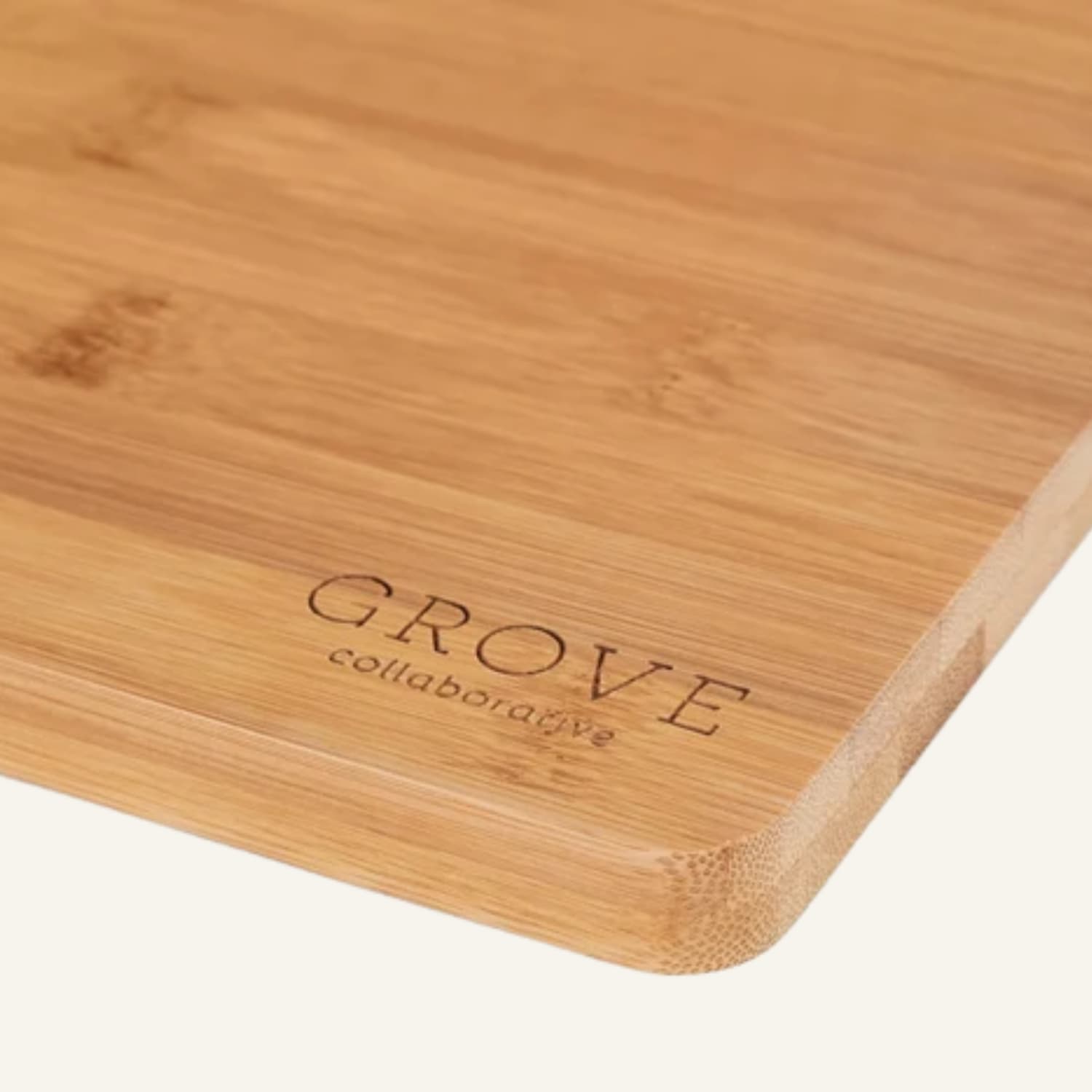
100% bamboo, compact prep size, from a Certified B Corp
$
The Grove Co. Bamboo Prep Board is the grab-first board for small jobs: an apple, a lemon, a handful of herbs. Grove makes it from 100% bamboo, which the brand describes as ultra-durable, easy on knives, and naturally antibacterial. Grove Co. is a Certified B Corp and a 1% for the Planet member, and ships its products in plastic-free packaging.
Still, one honest gap remains: Grove doesn’t publish which adhesive bonds the bamboo strips or what finish the board arrives with, so we flagged both in the breakdown below. The compact 10 by 7.5 inch footprint stores anywhere, and Grove’s care instructions are the usual routine, hand wash and condition with mineral oil monthly.
Body
100% Bamboo
✓ Plastic FreeAdhesive
Not Published
⚠ Ask GroveFinish
Not Published, Oil Monthly
⚠ Ask GroveCertifications
B Corp, 1% for the Planet
✓ VerifiedPros
- 100% bamboo from a Certified B Corp
- Plus lowest price on the entire roundup
- Compact size covers everyday small jobs
Cons
- Adhesive and finish aren’t published on the listing
- Also too small for big chopping jobs
- Hand wash only, needs monthly oiling
On balance, a budget-friendly everyday prep board from a B Corp, with one transparency gap to know about. Best small-job prep board.
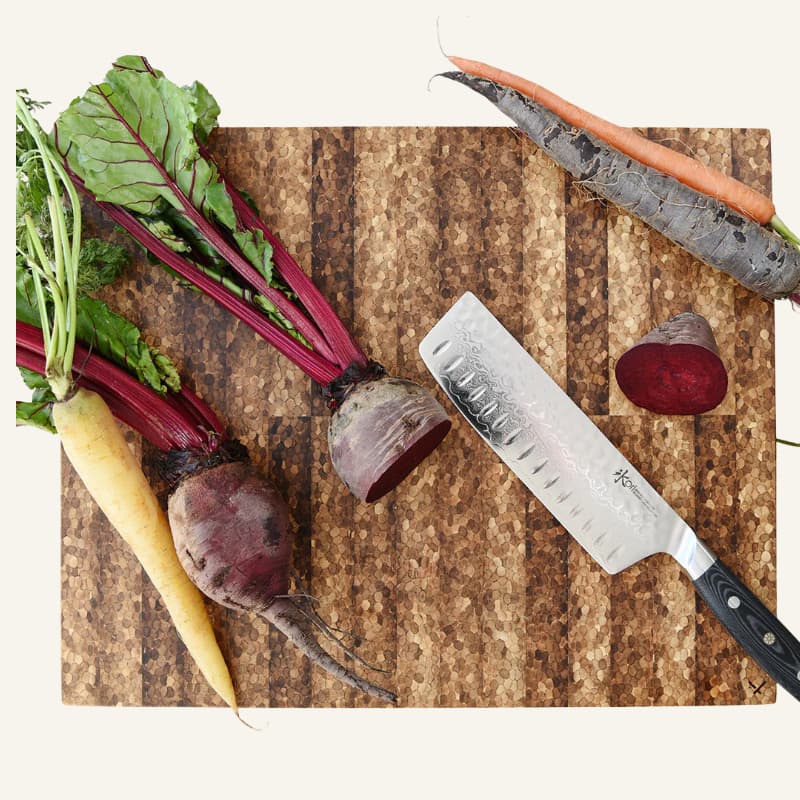
Certified B Corp, recycled chopsticks, carbon-negative manufacturing
$$
The ChopValue Cutting Board is the most environmentally interesting board on this list. Each board is made from compressed, recycled chopsticks (yes, real ones, collected from restaurants) bonded with a water-based acrylic resin and pressed into a dense composite that’s harder than maple, stronger than oak, and as durable as teak. ChopValue is a Certified B Corp running carbon-negative microfactories around the world.
That said, the water-based acrylic resin binder is a polymer, which is why we marked this Mostly Plastic Free rather than fully plastic-free. The resin is urea-free and formaldehyde-free, which is more than most composite boards can say. If your priority is supporting a truly innovative sustainable brand and you accept the resin trade-off, this is the most environmentally interesting pick on the roundup.
Body
Recycled Chopsticks (compressed)
✓ Plastic FreeBinder
Water-Based Acrylic Resin (formaldehyde-free)
⚠ Cured PolymerFinish
None Needed
✓ Plastic FreeCertifications
Certified B Corp, Carbon Negative
✓ VerifiedPros
- Certified B Corp, carbon-negative manufacturing
- Plus made from recycled chopsticks (closed-loop sustainability)
- Urea- and formaldehyde-free water-based resin
Cons
- Acrylic resin binder, not strictly plastic-free
- Also not dishwasher safe, hand wash only
- Limited size options compared to solid wood boards
Overall, the most environmentally interesting board on this list, from a Certified B Corp turning single-use chopsticks into carbon-negative cutting surfaces. Best sustainable innovation pick.
FAQs on Non-Toxic Cutting Boards
End-grain boards are gentler on knives and self-heal between cuts, but they cost more and need more diligent oiling, especially in the first year. Edge-grain boards are firmer, cheaper, easier to maintain, and still plenty gentle on a knife. For most home cooks, an edge-grain hard maple board is the sweet spot. If you chop daily and care about preserving an expensive chef’s knife, end-grain is worth the upgrade.
A well-maintained hardwood or bamboo board can last 10 to 30 years, and an end-grain butcher block can stretch further. Replace any wooden board if it develops deep cracks where food residue gets stuck, if it splits all the way through, or if the surface stays sticky and smells bad, no matter how much you scrub. Try resurfacing and re-oiling a tired board before deciding it’s done; many can be sanded smooth and given a second life.
Yes. Keeping a dedicated board for raw meat, poultry, and fish is the single biggest food-safety move in a home kitchen, far more important than the board’s material. Cross-contamination from raw chicken to a salad ingredient is one of the most common sources of foodborne illness. Color-coded or labeled sets, or a multi-board set like the Caraway cutting board set, make this easy without buying boards one at a time.
A butcher block is a thicker, heavier version of a cutting board, usually 2 to 4 inches thick and made from end-grain wood, so it can handle a cleaver. A regular cutting board is thinner (often under an inch), lighter, and built for everyday slicing and dicing. Butcher blocks are great as a fixed kitchen station; cutting boards are easier to move around and store.
Cracks usually mean the board has dried out. The wood loses moisture, shrinks unevenly, and splits along the grain. Catch it early, and a deep oiling session can rescue a board that’s just looking dry. Wash the board, let it dry fully, then apply a generous coat of food-grade mineral oil with a cloth, let it soak in overnight, and wipe off the excess. Repeat over several days until the wood stops drinking the oil. A full split that goes through the board is harder to fix; a cabinet maker can sometimes resurface it, but most boards at that point are done.
Glass and marble are inert, dishwasher-safe, and easy to sanitize, but they’re a poor daily driver choice for one reason: they’re brutal on knives. The hard surface chips knife edges, dulls blades fast, and means you’ll be sharpening (or replacing) good knives much sooner. Use a glass or marble board as a serving platter or a designated raw-meat surface if you really want one, but not as your main chopping board.
Bioplastic boards (made from sugarcane, corn, or other plant-derived polymers) are a real improvement over petroleum-based plastic boards on the environmental front, since they biodegrade rather than accumulate. The catch is that they’re still plastic by chemical composition. A sugarcane-derived biopolymer is a thermoplastic, similar to polyethylene, so the board still sheds microparticles when you chop on it.
The shed is biodegradable rather than permanent, which matters for the planet, but it’s not the same as zero-shed. I tried one myself. The surface still felt like plastic, and it was rough enough on my knife that I went back to a maple board after a week. If your priority is keeping plastic particles out of your food, a solid wood, bamboo, glass, or titanium board is a stronger pick. If your priority is reducing petroleum plastic in landfills, a bioplastic board is a step in the right direction.
Final Thoughts About Non-Toxic Cutting Boards
Swapping a plastic cutting board for a solid wood or bamboo one is one of the highest-impact kitchen changes you can make. It removes a daily source of microplastics, sidesteps chemical additives and antimicrobial coatings, and gives you a tool that lasts for decades instead of years.
A cutting board doesn’t seem like a big-deal kitchen item until you do the math on how often you actually use it. Three meals a day, every day, every chop, every slice. That’s a lot of contact between your food and a single surface. If the surface is shedding microplastics, you’re eating them. If it’s solid maple or bamboo, you’re not.
The bright side is that this is one of the easier swaps to make. A non-toxic cutting board doesn’t cost much more than a plastic one, the care routine is a few minutes a month, and the board you buy now will probably still be on your counter a decade from now.
Don’t Miss: Alternatives for Plastic Wrap: 9 Reusable Swaps That Work Your new cutting board is one kitchen swap. Plastic wrap clinging to your leftovers is the next one. Beeswax wraps, silicone lids, and 7 more swaps that actually keep food fresh. Read more →📚 References
- Ak, N. O., Cliver, D. O., & Kaspar, C. W. (1994). Cutting boards of plastic and wood contaminated experimentally with bacteria. Journal of Food Protection, 57(1), 16-22. https://doi.org/10.4315/0362-028X-57.1.16
- Jenner, L. C., Rotchell, J. M., Bennett, R. T., Cowen, M., Tentzeris, V., & Sadofsky, L. R. (2022). Detection of microplastics in human lung tissue using μFTIR spectroscopy. Science of The Total Environment, 831, 154907. https://www.sciencedirect.com/science/article/pii/S0048969722020009
- Leslie, H. A., van Velzen, M. J. M., Brandsma, S. H., Vethaak, A. D., Garcia-Vallejo, J. J., & Lamoree, M. H. (2022). Discovery and quantification of plastic particle pollution in human blood. Environment International, 163, 107199. https://www.sciencedirect.com/science/article/pii/S0160412022001258
- Yadav, H., Khan, M. R. H., Quadir, M., Rusch, K. A., Mondal, P. P., Orr, M., Xu, E. G., & Iskander, S. M. (2023). Cutting boards: An overlooked source of microplastics in human food? Environmental Science & Technology, 57(22), 8225-8235. https://doi.org/10.1021/acs.est.3c00924
More Non-Toxic Kitchen and Plastic-Free Living Reads
- How to Avoid Microplastics: 15 Easy Swaps
- What Are Microplastics? A Simple Guide to Hidden Plastic Pollution
- How to Remove Microplastics from Your Body and Home
- Plastic-Free Water Bottles: 8 Picks Without the Hidden Plastic
- Alternatives for Plastic Wrap: 9 Reusable Swaps That Work
- How to Tell If Plastic Is BPA-Free
- How to Spot Greenwashing: 9 Sneaky Tricks Brands Use
- How to Reduce Plastic Use: A Plain-English Starting Guide