

Key Takeaways
- The fastest way to spot greenwashing is to check whether a green claim is specific, measurable, and backed by a real third-party certification, since vague words like “eco-friendly” and “natural” have no legal definition in the US.
- A 2010 TerraChoice audit found 95% of products with green claims committed at least one of seven “sins of greenwashing,” and a 2020 European Commission sweep found 42% of online green claims were exaggerated, false, or deceptive.
- Documented cases against Keurig, Walmart, Kohl’s, H&M, KLM, and Coca-Cola show the same playbook over and over: hidden trade-offs, fuzzy recycling claims, and “sustainable” labels with no numbers behind them.
You’re standing in the cleaning aisle holding a bottle with a green leaf on the front, the word “eco-friendly” in friendly cursive, and a little globe icon next to something nice about the planet. It looks like the responsible choice. But somewhere in the back of your mind, a quiet voice says, wait, what does any of this actually mean?
Trust that voice. When a research lab called TerraChoice audited “green” home products back in 2010, it found that 95% of them made misleading or unsupported claims. The number hasn’t really improved. A 2020 European Commission sweep found 42% of online green claims were exaggerated, false, or deceptive. So that flicker of doubt you feel at the shelf isn’t paranoia, it’s pattern recognition.
Spotting greenwashing is a skill, and it doesn’t take long to pick up. This guide walks through 7 red flags that recur on packaging, the certifications that actually matter, and brands that have been caught by real regulators. By the end, you’ll be able to scan a label in about 30 seconds and determine whether the claim is real or just well-designed.
What Is Greenwashing?
Greenwashing is the practice of making a product, service, or company appear more environmentally friendly than it actually is, usually through vague language, misleading images, or unverified claims that exaggerate a small green feature while hiding a much higher environmental cost.
Jay Westerveld, a researcher and environmental activist, coined the term “greenwashing” in 1986 after noticing that hotels that asked guests to reuse towels “to save the environment” were the same hotels expanding their footprint and ignoring far larger waste streams. Forty years later, the playbook hasn’t changed much. A company picks one small green feature, photographs a leaf next to it, and asks you to believe the whole brand is on your side.
Genuine sustainability looks different. It’s specific, measurable, and covers the entire life of a product, not just the box. A truly sustainable claim usually answers four questions on its own:
- What exactly was changed or reduced?
- By how much, compared to what?
- Who verified it?
- What’s the trade-off?
If a label can’t answer those four questions, treat the claim as marketing, not fact.
Why companies greenwash
The short answer is that “green” sells. PwC’s 2024 Voice of the Consumer survey, covering more than 20,000 shoppers across 31 countries, found that consumers are willing to pay 9.7% more on average for sustainably produced or sourced goods. That’s a real premium, and the cheapest way for a brand to capture it is to add a leaf to the packaging.
The longer answer is that genuine sustainability work is expensive and slow. Switching to recycled content, rebuilding a supply chain, paying for third-party audits, or reformulating a product takes years and millions of dollars. Adding the word “eco” to a label takes an afternoon. The math, for too many brands, points one way.
Why Greenwashing Has Exploded
Greenwashing has exploded because climate concern is at record highs, sustainability marketing now drives sales premiums of 9% or more, and most current regulations still let brands make vague green claims without proof, though that’s changing fast under new EU and US rules.
Walk through any grocery store right now and count the leaves. The little green flourishes on the packaging are everywhere, even on products that have nothing especially green about them. Three things are happening at once, and they’re feeding each other.
Shoppers Care More Than They Used To
People want to make better choices than they did a decade ago. Climate stories are in the news every week, microplastics keep showing up in headlines about human health, and shoppers who never thought twice about a plastic bottle are now standing in the aisle reading labels. That shift in attention is real, and brands have noticed.
Brands Have Figured Out the Premium
That attention is worth money. When buyers care about sustainability, brands can charge more for products that look sustainable, whether or not anything has actually changed behind the scenes. Adding a leaf icon and a softer color palette is one of the cheapest ways to make a product feel premium. The marketing team can do it in a week. Rebuilding the supply chain to back it up would take years.
The Rules Are Still Loose (For Now)
The third piece is that nobody is really stopping any of this. When the European Commission, the UK’s Competition and Markets Authority, and the Netherlands’ ACM ran a joint sweep of online stores in 2020, they screened 1,095 websites and found 42% of green claims were “exaggerated, false or deceptive,” with another 53% offering vague or unfounded information. That’s the world that turned “eco-friendly” into a sticker instead of a promise.
The Rules Are Catching Up, Slowly
There is some good movement in 2026. The EU’s Empowering Consumers for the Green Transition Directive (Directive 2024/825), adopted in March 2024, bans vague green claims such as “eco-friendly,” “climate neutral,” and “biodegradable” unless a brand can substantiate them. Member states have until March 2026 to write the directive into national law, with full consumer-level enforcement starting September 2026.
In the US, the Federal Trade Commission is rewriting its Green Guides (last updated in 2012) to tighten rules on recyclability, carbon-neutral marketing, and ESG labels. The final version is still in draft as of early 2026.
Until the rules are fully in force, the work sits with you. Spotting greenwashing yourself is the closest thing to consumer self-defense the market currently offers.
The 7 Most Common Greenwashing Tactics
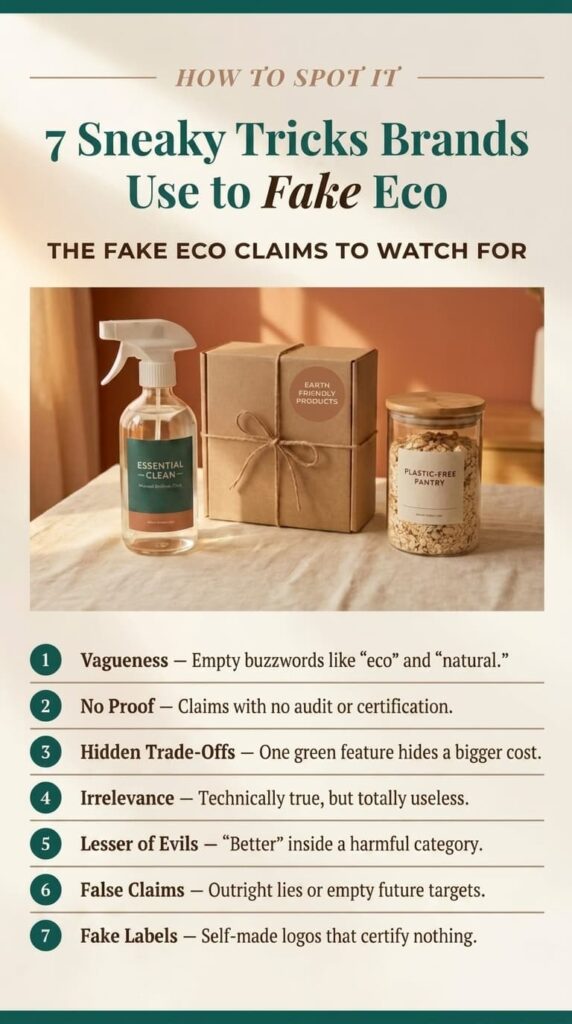
The seven most common greenwashing tactics are vagueness, no proof, hidden trade-offs, irrelevant claims, lesser-of-two-evils framing, outright false claims, and worshipping fake or self-made eco labels, according to the foundational 2010 TerraChoice “Sins of Greenwashing” audit.
Once you know what to look for, the same handful of moves show up everywhere. A research lab called TerraChoice gave each of them a name back in 2010 after testing 5,296 products with green claims and finding that 95% committed at least one offense. They called the list the “Sins of Greenwashing,” and it still holds up better than almost anything written since. You’ll see these seven repeat across every industry below.
1. Vagueness
A claim is so broad it could mean almost anything. “Eco-friendly,” “natural,” “green,” “sustainable,” “clean,” and “earth-conscious” are the headliners. None of these has a legal definition in the US, and most don’t have one in the EU either (yet). If the label doesn’t define what’s eco about it, assume nothing is.
2. No Proof
The claim might be specific, but the brand offers no way to verify it. “Made with 50% recycled material” sounds great until you realize there’s no audit, no certification, and no public sourcing data to back it up. A real claim names the certification or links to a published report.
3. Hidden Trade-Offs
A product is marketed as green based on one feature, while a much higher environmental cost is ignored. A “compostable” cup that’s only compostable in an industrial facility nobody has access to. A “natural” cleaner that ships in a virgin plastic bottle from across the country. A bamboo t-shirt that was processed into rayon with a heavy chemical bath. The one green attribute distracts from the rest of the footprint.
4. Irrelevance
The claim is technically true but useless. “CFC-free” on a product made decades after CFCs were banned. “Non-toxic” in a category where toxicity wasn’t an issue to start with. “BPA-free” on a product that swapped BPA for a chemical cousin that may not be any safer. The claim sounds protective, but it isn’t doing any real work.
5. Lesser of Two Evils
The claim is true within a category that’s environmentally damaging as a whole. “Organic” cigarettes, “fuel-efficient” SUVs, “sustainable” beef. The product might be marginally better than its peers, but the category itself is the actual problem.
6. False Claims
The claim is simply not true. A product wearing a logo that isn’t certified to display. A company stating a target it has no plan to hit. The Coca-Cola lawsuit currently making its way through DC courts hinges on exactly this question: whether the company’s repeated “100% recyclable by 2025” promises were aspirational or actionable.
7. Worship of False Labels
The brand creates a logo that appears to be an official certification but is actually self-issued. A leaf, a globe, a tree, the word “approved” in a circle. If you can’t find the label on a public certifying body’s site (FSC, USDA Organic, Fair Trade, B Corp, etc.), it’s almost certainly a self-made graphic with no audit behind it.
Pin It for Later, Spot All 7 Tricks 📌
How to Spot Greenwashing on a Label
To spot greenwashing on a label, check for specific numbers, look up any certification logos at their source, scan the ingredient or material list for hidden trade-offs, and ignore any vague words like “eco” or “natural” that aren’t tied to a measurable claim.
Once you know the seven tactics, spotting them on a real label takes about 30 seconds. Here’s the practical checklist to run through next time something on the shelf catches your eye.
Step 1: Read the green word, then ask, “compared to what?”
“Reduced plastic,” “lower carbon,” “more sustainable” are comparative claims. They only mean something if the label tells you what they’re being compared to and by how much. “30% less plastic than our 2019 packaging” is a real claim. “Lower plastic” is not.
Step 2: Look up every certification logo at its source
If a label shows an FSC, USDA Organic, GOTS, OEKO-TEX, B Corp, EWG Verified, or Energy Star logo, you can check the registry on each organization’s website to confirm the brand is actually certified. If the logo is a leaf inside a circle with the brand’s name, that’s a self-issued mark and means nothing.
Step 3: Scan for hidden plastic
This is the one that catches the most shoppers. “Plant-based,” “bamboo,” “natural fiber,” and “biodegradable” labels regularly hide plastic. Rayon and viscose are made from plant cellulose, but their processing uses harsh chemicals, and the resulting fibers are functionally synthetic. “Bioplastic” products often require industrial composting to break down. PVA, the film many “plastic-free” laundry detergent sheets dissolve into, is a water-soluble synthetic polymer that almost always ends up in waterways. If you see a green word next to a soft plastic, slow down.
Step 4: Check the ingredient or material list
The fastest greenwashing tell is a mismatch between the front and back of the package. “Eco” hand soap with a list of sulfates and synthetic fragrance. “Natural” sunscreen with chemical UV filters and parabens (see our non-toxic sunscreen guide for the cleaner list). “Sustainable” activewear that’s 90% recycled polyester and still sheds microplastics in every wash.
Step 5: Check the brand’s track record, not the product
A single “sustainable” product line from a brand that builds its business on disposability is almost always a marketing experiment, not a shift. H&M’s Conscious Collection was a clean example. The collection got the marketing, but the parent company’s overall production volume kept growing year after year.
Step 6: Check the timeline
“Carbon neutral by 2050.” “100% recyclable by 2030.” Long-term targets are easy to set and hard to enforce. Real commitments name a baseline year, an interim milestone (2025, 2027, 2030), and a third party that’s auditing progress. If the only date on the page is a decade out, treat the claim as a wish.
✨ Tip
Still Doubtful
Take a photo of any label that gives you doubt and look it up at home. The pressure of a checkout line is exactly when greenwashing works best.
How to Spot Greenwashing in Plastic and Packaging Claims
Plastic and packaging greenwashing usually shows up as fuzzy recyclability claims, “ocean plastic” sourcing that isn’t verified, bioplastic that requires an industrial composter, or “plastic-free” labels on products that swap one plastic for another.
Plastic is where greenwashing hits hardest, because it is where shoppers pay the most attention and where the underlying recycling system is most broken behind the scenes. A 2017 study in Science Advances by Roland Geyer and colleagues found that only about 9% of all plastic ever made has actually been recycled. Current US plastic recycling rates are in the single digits, with most of it ending up in landfills, incinerators, or the environment, according to organizations like Beyond Plastics. So when a label says “recyclable,” it’s leaning on a system that, in practice, processes a tiny slice of what goes into it.
“Recyclable” doesn’t mean recycled
A product can legally be labeled “recyclable” if there’s any facility anywhere that could theoretically recycle it. Whether your local curbside program actually accepts it is a separate question. The Keurig case is the cleanest example. In 2024, the SEC charged Keurig with making inaccurate statements about K-Cup recyclability after it turned out the company’s two largest recycling-partner conversations included direct pushback that the pods weren’t commercially recyclable in curbside programs. Keurig paid a $1.5 million SEC penalty in 2024 on top of a separate $10 million class-action settlement in 2022 and a $3 million Canadian Competition Bureau penalty.
The practical takeaway: a “recyclable” label is a claim about possibility, not reality. Check your local recycling guidelines before letting that label influence your purchase.
Watch for “ocean plastic” and “ocean-bound plastic”
Both phrases sound similar, but they mean very different things. “Ocean plastic” should mean material pulled from the ocean. “Ocean-bound plastic” is a much looser term and usually means plastic collected from areas within 50 km of a coastline that might have ended up in the ocean. Neither claim is illegal, but the second one is often used in marketing to imply the first. Look for third-party certification (OBP Certification, Plastic Bank traceability) before believing the label story.
Bioplastic is not the same as compostable at home
PLA, PHA, and other bioplastics are usually made from plants like corn or sugarcane, which sounds great. The catch is that most need temperatures around 140°F sustained for days to break down, which only happens in industrial composters. In a home compost or a landfill, they behave almost identically to regular plastic. The Biodegradable Products Institute (BPI) and TÜV “OK Compost HOME” are the two certifications to look for if home composting is what you need.
“Plastic-free” sometimes means “different plastic”
A growing number of “plastic-free” products contain synthetic polymers that don’t look or feel like plastic. PVA film in laundry sheets is the most common example. Some “compostable” produce bags are still made from petroleum-based blends. Some “paper” coffee cups have a thin polyethylene lining. If a label says “plastic-free,” check the ingredients or material list and search for “polymer,” “polyethylene,” “polypropylene,” “polyvinyl,” or “polyester.”
How Greenwashing Looks in Different Industries
Greenwashing shows up in every industry, but the specific tactics vary: fashion leans on recycled content and vague “conscious” labels, food and drink lean on packaging claims, aviation leans on offsets and SAF, and finance leans on ESG fund labels that often hold the same fossil holdings as conventional funds.
The mechanics of greenwashing repeat, but each industry has its own dialect. Once you can hear the pattern in one, you start spotting it everywhere.
👗 Fashion
Fast fashion is the case study most people think of first. The fashion sector is widely estimated to be responsible for a significant share of global carbon emissions and a notable share of global microplastic pollution from synthetic textiles. The two greenwashing patterns to know:
- Recycled content claims. A garment can be labeled “made with recycled polyester” even if only a tiny share of the fabric is recycled. The 2022 Norwegian Consumer Authority ruling against H&M’s Conscious Collection landed on exactly this point: the brand didn’t disclose how much recycled material was in each garment, leaving shoppers with the impression that the whole product was somehow sustainable.
- “Capsule” or “conscious” sub-lines. A small green-labeled collection inside a brand that’s otherwise high-volume and disposable. The collection generates the marketing, but the broader business model doesn’t change. H&M ultimately committed in August 2022 to removing the “Conscious” and “Conscious Choice” labels from its website to settle concerns from the Dutch regulator.
The cleanest fashion alternatives don’t need to advertise. They publish their materials list, factory list, fiber percentages, and care instructions. If a brand can’t tell you what its clothes are made of in plain language, the green label on the hangtag isn’t worth much.
🍽️ Food and beverage
Food and drink greenwashing usually targets packaging and ingredient framing.
- Packaging claims. “Recyclable,” “made with plant-based materials,” and “compostable” claims on packaging that, in practice, end up in landfill.
- “Natural” and “clean” framing. Both terms are unregulated in the US for most food categories. A “natural” sports drink can contain synthetic colors and added sugars.
- Carbon-neutral product labels. Often backed by carbon offsets of varying quality. Investigations of major offset programs have repeatedly raised concerns that a large share of forest-protection credits doesn’t represent real emissions reductions. The EU’s 2024 directive now bans carbon-neutral product claims that rely on offsetting.
The Innocent Drinks case in the UK is the textbook example in the food and beverage. In 2022, the Advertising Standards Authority banned an Innocent TV ad for suggesting that buying its drinks helped “fix up” the planet. The regulator’s logic: the ad implied a net-positive environmental impact across the product’s life cycle, which Innocent couldn’t substantiate.
✈️ Aviation
Aviation greenwashing tends to revolve around sustainable aviation fuel (SAF), carbon offsetting, and fleet renewal. The 2024 District Court of Amsterdam ruling against KLM is the case to know. The court found that 15 of 19 claims in KLM’s “Fly Responsibly” campaign were misleading because measures such as SAF use and tree-planting offsets only marginally reduced flights’ emissions and gave consumers the false impression that flying KLM was sustainable. SAF currently accounts for less than 1% of global jet fuel, and the energy required to produce it sustainably is itself a constraint.
If you see an airline market a single flight or route as “carbon neutral,” check whether the underlying offsets are gold-standard verified and whether the airline publishes its lifecycle calculations. If neither is true, the marketing is doing the work that the engineering hasn’t.
💰 Finance and ESG
ESG (Environmental, Social, Governance) fund labels have been among the fastest-growing categories of greenwashing. Investigative reporting and SEC enforcement actions over the past few years have shown that many funds carrying ESG labels hold nearly the same fossil fuel companies as standard index funds, and several large asset managers have been fined for ESG misstatements. The EU’s Sustainable Finance Disclosure Regulation (SFDR) now requires fund managers to publish detailed sustainability data, and the EU is working on a rewrite of its “Article 8” and “Article 9” fund definitions.
Practical check: look at the actual top 10 holdings of any “sustainable” or “ESG” fund. If the names match a regular S&P 500 fund, the label is doing more work than the portfolio.
🧴 Personal care
Personal care greenwashing leans heavily on “natural,” “clean,” and “non-toxic” framing. None of those words has a legal definition in the US. A “natural” shampoo can contain synthetic fragrance and sulfates. “Non-toxic” makeup can still contain undisclosed PFAS, talc impurities, or hormone-disrupting preservatives. Our non-toxic makeup checklist and plastic-free shampoo guide walk through which ingredient flags actually matter and which databases (EWG’s Skin Deep, Think Dirty) are useful for verifying claims yourself.
Documented Greenwashing Cases You Should Know
The most useful documented greenwashing cases include the FTC’s $5.5 million settlements with Walmart and Kohl’s over rayon-as-bamboo claims, Keurig’s $14.5 million in combined settlements over K-Cup recyclability, the 2024 Dutch court ruling against KLM, the UK ASA’s ban of Innocent Drinks ads, and the ongoing Coca-Cola greenwashing lawsuit in Washington DC.
Real cases make the patterns concrete. Each of the following has been settled, ruled on, or formally accepted by a regulator or court, so the facts are public.
Walmart and Kohl’s, FTC bamboo case
The Federal Trade Commission announced settlements in April 2022 with Kohl’s ($2.5 million) and Walmart ($3 million) over “bamboo” textiles that were actually rayon. The FTC had warned both companies in 2010 that selling rayon as “bamboo” was illegal. The retailers continued marketing items as “sustainable,” “eco-friendly,” and “renewable,” even though the rayon manufacturing process uses toxic chemicals and releases hazardous pollutants. Combined penalty: $5.5 million, the largest of its kind under the FTC’s penalty-offense authority.
The lesson: “Bamboo” textiles are almost always rayon. If a label says “bamboo” without “100% bamboo fiber,” assume it’s chemically processed.
Keurig, K-Cup recyclability
Keurig faced three separate actions over the same set of recyclability claims. In 2022, it paid a $10 million US class-action settlement and a $3 million Canadian Competition Bureau penalty for misleading recyclability marketing. In 2024, the SEC charged Keurig with making inaccurate statements in its 2019 and 2020 annual reports about K-Cup recyclability, after it turned out two of the largest US recycling companies had told Keurig directly that pods couldn’t be commercially recycled. Keurig settled for an additional $1.5 million SEC penalty.
The lesson: “Recyclable” labels deserve healthy skepticism, especially on small, mixed-material items like coffee pods, snack film, and beverage cartons.
H&M Conscious Collection
The Norwegian Consumer Authority concluded in 2019 that H&M’s Conscious Collection marketing breached Norwegian advertising law because the brand didn’t specify how much recycled material was actually in each garment. Dutch regulators followed with a similar finding. In August 2022, H&M committed to removing “Conscious” and “Conscious Choice” labels from its website and donating €500,000 to environmental causes.
The lesson: A “conscious” or “sustainable” sub-line from a fast fashion brand is usually a marketing test, not a structural change. The garment percentages are what matter.
KLM, “Fly Responsibly”
The District Court of Amsterdam ruled in March 2024 that 15 of 19 environmental claims in KLM’s “Fly Responsibly” campaign were misleading. The campaign, brought to court by Fossielvrij NL and supported by ClientEarth, was the first time a court ruled an airline’s sustainability marketing unlawful. The court ordered KLM to be “honest and concrete” in future advertising.
The lesson: “Sustainable aviation fuel,” tree-planting offsets, and fleet-renewal claims rarely move the underlying emissions math much. Treat airline sustainability marketing as marketing.
Innocent Drinks, “Little Drinks, Big Dreams”
The UK Advertising Standards Authority banned a 2021 Innocent TV ad after 26 complaints, including from the group Plastics Rebellion. The ad showed cartoon characters singing about “fixing up” the world while holding Innocent bottles. The ASA found that the ad implied buying Innocent products had a net-positive environmental impact across the product’s full lifecycle, which the company couldn’t prove.
The lesson: Any ad that implies buying a product helps the planet (not just “harms it less”) is making a much bigger claim than most brands can substantiate.
Coca-Cola, ongoing (2021 to present)
Earth Island Institute filed suit against Coca-Cola in 2021, alleging the company’s “World Without Waste” sustainability marketing misled consumers. The case was dismissed by a lower court, then revived in August 2024 by the DC Court of Appeals, which ruled that “even aspirational statements can be actionable” when they imply meaningful action. The case is now back in the DC Superior Court. Coca-Cola has been named the top plastic polluter for multiple years by the Break Free From Plastic coalition’s annual brand audit.
The lesson: Aspirational targets (“100% recyclable by 2025,” “half recycled content by 2030”) are increasingly being treated by courts as legally binding claims. If a brand publishes a target, watch whether it actually hits the milestones.
Shell, mixed rulings
The UK ASA ruled in 2023 that Shell’s UK clean-energy ads were misleading and ordered them pulled because they showed wind turbines and EV chargers while omitting the company’s overall fossil fuel business. A separate 2025 Shell ad was not upheld by the ASA, which highlights how case-by-case these rulings can be. Across 2025, only about 5% of ASA “green claim” decisions ruled in favor of the advertiser, according to Adfree Cities.
The lesson: Renewable-energy imagery from a fossil-heavy company is one of the most common forms of greenwashing. Check what percentage of the company’s actual revenue or investment goes to renewables before believing the imagery.
Certifications That Actually Mean Something
The most trustworthy environmental certifications are independently audited, publicly searchable, and apply to a specific product attribute, including FSC for wood and paper, GOTS for organic textiles, USDA Organic for food, Fair Trade for labor and farming practices, EWG Verified for personal care, B Corp for whole-company practices, and Energy Star for appliances.
Not every certification means something, but a few do. The standard you want to apply to any logo is: is it audited by a third party, can the brand’s certification be looked up in a public registry, and does it cover the specific attribute that’s being claimed?
The cleanest certifications to trust right now:
- B Lab B Corp for whole-company practices. Looks at workers, community, environment, and governance.
- Biodegradable Products Institute (BPI) for industrial compostable packaging.
- Cradle to Cradle Certified for full lifecycle (materials, energy, water, social fairness, circularity).
- Energy Star for appliances and electronics. Federal certification with a public product registry.
- EWG Verified for personal care. Tighter ingredient screening than typical “clean beauty” claims.
- Fair Trade Certified for food and apparel. Audits labor, pay, and farming standards.
- Forest Stewardship Council (FSC) for wood, paper, and packaging. Audits supply chain and forestry practices. Public certificate database.
- Global Organic Textile Standard (GOTS) for textiles. Requires at least 70% organic fiber and audits chemical use, water, energy, and labor practices.
- OEKO-TEX Standard 100 for textiles. Tests for the absence of harmful chemicals. Useful for “non-toxic fabric” claims.
- TÜV “OK Compost HOME” for products that compost in a home compost bin.
- USDA Organic for food and personal care. Federal certification with an actual auditor system.
Self-issued logos, “tested” claims with no certifying body, “approved” stamps, and “trusted” badges are not certifications. They’re graphics.
What to Do When You Spot Greenwashing
When you spot greenwashing, do four things: pause the purchase, look up the claim or certification at its source, report it to the relevant regulator (FTC, ASA, or state attorney general), and choose a brand that publishes its sourcing and certifications in plain language.
Catching a greenwashing claim and walking away from it is the most effective consumer move there is, because companies carefully measure response rates. Three or four further actions can stretch the impact.
Report it
US shoppers can report misleading green claims to the FTC, and state attorneys general also handle false advertising complaints. UK readers can file a complaint with the ASA online. Across the EU, the European Consumer Centres Network and national consumer authorities are the right channels.
Ask the brand directly
Email or DM the brand and ask for the specific data behind the claim. “Hi, your label says X% recycled. Can you share the third-party report that verified that?” If the brand can produce documentation, you’ve learned something. If it can’t, that’s also information.
Tell other people
Honest reviews on Amazon, Sephora, Target, and similar platforms remain among the most-read tools for correcting greenwashing. A specific review (with the exact label language quoted) is more useful than a vague one. Pinterest pin warnings and short-form social videos with the receipts work too.
Switch to a brand that publishes its data
The cleanest brands tend to over-share rather than under-share. Look for a “materials” page, a “factory list” or “supplier list,” a “sustainability report” with year-over-year numbers, and clear third-party certifications. If a brand publishes all four, the green claims on the front of the package are much more likely to be real.
Don’t Miss: Say No to Plastic, Simple Swaps to Protect Your Health and Home Once you’ve trained your eye to catch greenwashing, the room-by-room plastic swap list is the natural next read. Real product picks, no fake “eco” claims. Read more →Tools and Resources to Verify Eco Claims
The most useful tools for verifying eco claims are EWG’s Skin Deep and Food Scores databases for personal care and food ingredients, the FTC Green Guides for legal definitions, Good On You for fashion brand ratings, the Plastic Pollution Coalition’s brand database, and certifying body registries for individual logos.
A handful of free databases do the heavy verification work for you. Start with our own Sustainable Brand Directory, a running list of brands that publish their sourcing and hold real third-party certifications, so you’re not starting every search from scratch. Beyond that, the resources below are what I actually use when I’m checking a brand for the Thriving Sustainably guide.
- B Corp directory for whole-company certification lookup.
- Break Free From Plastic for annual brand-audit data on the top plastic polluters.
- Certification body registries (FSC, GOTS, USDA Organic, Fair Trade, etc.) for individual product lookups.
- EWG’s Food Scores for food product ingredients and processing scores.
- EWG’s Skin Deep database for personal care ingredient research.
- FTC’s Green Guides PDF for the current US legal definitions of environmental claims.
- Ocean Conservancy for International Coastal Cleanup data on which brands show up in beach litter most often.
- Plastic Pollution Coalition for plastic-specific brand commitments and reports.
For long-term shopping, follow one or two journalists and NGOs whose work you trust. ClientEarth, Beyond Plastics, the Changing Markets Foundation, and Greenpeace’s “Greenpeace Unearthed” all publish regular reports on specific cases of brand greenwashing.
Final Thoughts About How to Spot Greenwashing
Here’s the part nobody likes to say out loud. You can’t fact-check every product, and you shouldn’t have to. The system that lets brands write “eco-friendly” on a label without proof is the one that needs to change, and the EU’s 2024 directive, along with the FTC’s pending Green Guides update, are real steps in that direction. Until those rules are fully in force, a 30-second label check is the strongest tool a shopper has.
Pick one or two categories you buy often, do a quick audit of what’s actually in your cabinet, and replace the worst offenders with brands that publish their data. You’ll likely save money in the process, because the brands willing to put their numbers on the page tend to last longer and waste less.
Greenwashing works when you’re tired, distracted, and in a hurry. It stops working the second you ask a label what it actually means.
FAQs About How to Spot Greenwashing
In the US, greenwashing isn’t a standalone crime, but misleading environmental claims can violate the FTC Act, state consumer protection laws, and securities law if they appear in investor disclosures. The EU goes further: its 2024 Empowering Consumers Directive makes most forms of greenwashing illegal at the consumer level starting September 2026. UK advertising falls under the ASA, which enforces the CAP Code against misleading green claims.
A marketing slogan is general and emotional (“Made with care,” “For a better tomorrow”). Greenwashing is a marketing claim that points to a measurable environmental benefit but doesn’t actually deliver it (“100% recyclable,” “carbon neutral,” “made with bamboo”). The line is whether the claim is specific enough to be testable.
Mostly, yes. Buying second-hand from thrift stores, ThredUp, Poshmark, Depop, or local consignment shops sidesteps almost all new-product greenwashing because nothing new is being manufactured. The “what you already own is the most sustainable” principle holds across categories.
The term started that way, but you’ll also see “pinkwashing” (cause-marketing around breast cancer or LGBTQ+ rights), “social washing” (overstated diversity or labor claims), and “ethics washing” (vague AI ethics claims). The pattern is the same: a marketing claim that promises social good without substantiation.
Ask yourself: does the label give a number, a percentage, a baseline year, and a certifying body? If any of those four is missing, the claim is at least partly marketing. The more of the four that are present, the more credible the claim.
📚 References
- Advertising Standards Authority. (2022, February 9). ASA ruling on Innocent Ltd. Advertising Standards Authority. https://www.asa.org.uk/rulings/innocent-ltd-g21-1111827-innocent-ltd.html
- Advertising Standards Authority. (2023, June 7). ASA ruling on Shell UK Ltd. Advertising Standards Authority. https://www.asa.org.uk/rulings/shell-uk-ltd-g22-1170842-shell-uk-ltd.html
- Competition Bureau Canada. (2022, January 6). Keurig Canada to pay $3 million penalty to settle Competition Bureau’s concerns over coffee pod recycling claims. Government of Canada. https://www.canada.ca/en/competition-bureau/news/2022/01/keurig-canada-to-pay-3-million-penalty-to-settle-competition-bureaus-concerns-over-coffee-pod-recycling-claims.html
- Court of Amsterdam. (2024, March 20). FossielVrij NL v. KLM, District Court of Amsterdam judgment. Climate Litigation Database. https://www.climatecasechart.com/document/fossielvrij-nl-v-klm_0145
- District of Columbia Court of Appeals. (2024, August). Earth Island Institute v. Coca-Cola Company, 321 A.3d 654. DC Courts. https://www.dccourts.gov/sites/default/files/2024-08/Earth%20Island%20Institute%20v.%20Coca-Cola%2022-CV-0895F.pdf
- European Commission. (2021, January 28). Screening of websites for “greenwashing”: Half of green claims lack evidence. European Commission Press Corner. https://ec.europa.eu/commission/presscorner/detail/en/ip_21_269
- European Parliament and Council. (2024, February 28). Directive (EU) 2024/825 on empowering consumers for the green transition. EUR-Lex. https://eur-lex.europa.eu/eli/dir/2024/825/oj
- Federal Trade Commission. (2012). Guides for the use of environmental marketing claims (Green Guides), 16 CFR Part 260. Federal Trade Commission. https://www.ftc.gov/legal-library/browse/rules/green-guides
- Federal Trade Commission. (2022, April 8). FTC uses penalty offense authority to seek largest-ever civil penalty for bogus bamboo marketing from Kohl’s and Walmart. Federal Trade Commission. https://www.ftc.gov/news-events/news/press-releases/2022/04/ftc-uses-penalty-offense-authority-seek-largest-ever-civil-penalty-bogus-bamboo-marketing-kohls
- Geyer, R., Jambeck, J. R., & Law, K. L. (2017). Production, use, and fate of all plastics ever made. Science Advances, 3(7), e1700782. https://www.science.org/doi/10.1126/sciadv.1700782
- Netherlands Authority for Consumers and Markets. (2022, September). Commitment decision for H&M regarding sustainability claims. ACM. https://www.acm.nl/en/publications/commitment-decision-handm-regarding-sustainability-claims
- Norwegian Consumer Authority. (2019, August). Consumer Authority statement on H&M Conscious Collection marketing. Forbrukertilsynet. https://www.forbrukertilsynet.no/
- PwC. (2024, May). Consumers willing to pay 9.7% sustainability premium, even as cost-of-living and inflationary concerns weigh: PwC 2024 Voice of the Consumer Survey. PricewaterhouseCoopers. https://www.pwc.com/gx/en/news-room/press-releases/2024/pwc-2024-voice-of-consumer-survey.html
- Securities and Exchange Commission. (2024, September). SEC charges Keurig with making inaccurate statements regarding recyclability of K-Cup beverage pod. SEC.gov. https://www.sec.gov/newsroom/press-releases/2024-122
- TerraChoice Environmental Marketing. (2010). The sins of greenwashing: Home and family edition. UL Solutions. https://www.ul.com/insights/sins-greenwashing
🗨️ Have you spotted a greenwashing claim that fooled you at first? Drop the brand and the label wording in the comments. The more examples we collect, the easier it gets for everyone to read between the lines.