
Key Takeaways
- International Plastic Bag Free Day is observed every July 3, launched in 2008 by the Bag Free World coalition (led by Zero Waste Europe and GAIA) to push the world toward a ban on single-use plastic bags.
- The world uses around 5 trillion plastic bags a year, the average bag is used for only about 12 minutes, and a single bag can take up to 500 years to break down in the environment.
- More than 100 countries now restrict or ban single-use plastic bags. The easiest ways to take part are swapping in cotton totes, mesh produce bags, and a small foldable bag that lives in your purse.
You probably grab a plastic bag without thinking about it. Most of us do, sometimes a few times a week. Here’s the part that stops you in your tracks once you see it. The world uses an estimated 5 trillion single-use plastic bags a year. The average bag is in your hands for about 12 minutes, and that same bag can hang around in the environment for up to 500 years after it leaves the trash can.
That’s the whole reason International Plastic Bag Free Day exists. It falls on July 3 every year, and it’s a low-stakes nudge to skip plastic bags for a day (and maybe a little longer). This guide covers what the day is, who started it, why plastic bags became such a problem in the first place, and 9 easy ways to take part. Plus, the cloth, paper, and mesh alternatives are worth keeping in your car so the swap actually sticks.
What Is International Plastic Bag Free Day?
International Plastic Bag Free Day is a global awareness day observed every July 3 to push for a worldwide ban on single-use plastic bags and to encourage people, businesses, and governments to switch to reusable alternatives.
International Plastic Bag Free Day is held on July 3 every single year. It’s not a fixed-weekday holiday like Thanksgiving, so the date stays the same no matter what day of the week it falls on. In 2026, July 3 falls on a Friday, which means many brands and nonprofits time their content drops to hit that long weekend.
The day was launched in 2008 by the Bag Free World coalition, an initiative spearheaded by Zero Waste Europe along with the Global Alliance for Incinerator Alternatives (GAIA). The original goal was simple. Build enough public pressure to phase out single-use plastic bags worldwide, as single-use plastic straws and microbeads have been targeted by laws in many countries.
What the day looks like in practice depends on where you are. In some cities, supermarkets temporarily stop offering plastic bags at checkout. In others, environmental groups host beach cleanups, run bag-sewing workshops, or release new graphics and stats about plastic bag pollution. Brands, bloggers, and nonprofits tend to coordinate content drops around the date, too, which is part of why the day has grown beyond its activist roots.
Why Plastic Bags Are an Environmental Problem
Plastic bags are an environmental problem because they’re used for an average of just 12 minutes, can take up to 500 years to break down, and shed microplastics into soil and water throughout their degradation.
A plastic bag is one of the clearest examples of a product designed to be discarded almost the moment you get it. UN estimates put global single-use plastic bag use at around 5 trillion bags a year. That’s about 160,000 bags used every second. The average bag is used for roughly 12 minutes from the checkout counter to the kitchen bin, then it gets thrown out.
Once a bag leaves the trash can, it can take up to 500 years to fully break down in the environment, depending on where it ends up. The reason is the polyethylene the bag is made from. Polyethylene is a long-chain plastic that doesn’t biodegrade the way paper or food scraps do. Sunlight, heat, and friction slowly fragment the plastic into smaller and smaller pieces, which is exactly the problem.
Those smaller pieces become microplastics, which spread quickly. A 2017 study in Science Advances by Roland Geyer and colleagues estimated that of all the plastic ever produced globally, only about 9% has been recycled. The rest sits in landfills, drifts in waterways, or has already broken down into microplastic particles. Plastic bags are a meaningful chunk of that total because they’re light, easy to blow out of trash cans, and notoriously difficult to recycle in standard curbside programs.
The Wildlife Cost
Plastic bags are routinely mistaken for food by marine animals. Sea turtles are the most-cited example. A floating plastic bag looks remarkably like a jellyfish underwater, and turtles eat them by the thousands. Research published in Scientific Reports in 2018 found that a sea turtle has roughly a 22% chance of dying after ingesting just one piece of plastic, and the risk climbs to about 50% once 14 pieces have been swallowed. Plastic bags are also among the top items collected during the Ocean Conservancy’s annual International Coastal Cleanup, which records millions of pieces of beach trash collected by volunteers around the world.
The land impact is just as messy. Plastic bags clog storm drains, snag in trees, suffocate soil microbes when they fragment, and have been found in the stomachs of cows and goats in many countries that lack formal waste management systems.
Don’t Miss: Say No to Plastic, Simple Swaps to Protect Your Health and Home Plastic bags are just one piece of the puzzle. See the full room-by-room list of plastic swaps that actually move the needle. Read more →A Quick Timeline of Plastic Bag Bans Around the World
More than 100 countries have introduced laws restricting or banning single-use plastic bags, with Bangladesh being the first nation to pass a full ban in 2002, and the European Union, Kenya, Rwanda, and many U.S. states following with major restrictions.
The plastic bag ban movement predates International Plastic Bag Free Day itself. Here’s the shorthand version of how the global crackdown unfolded.
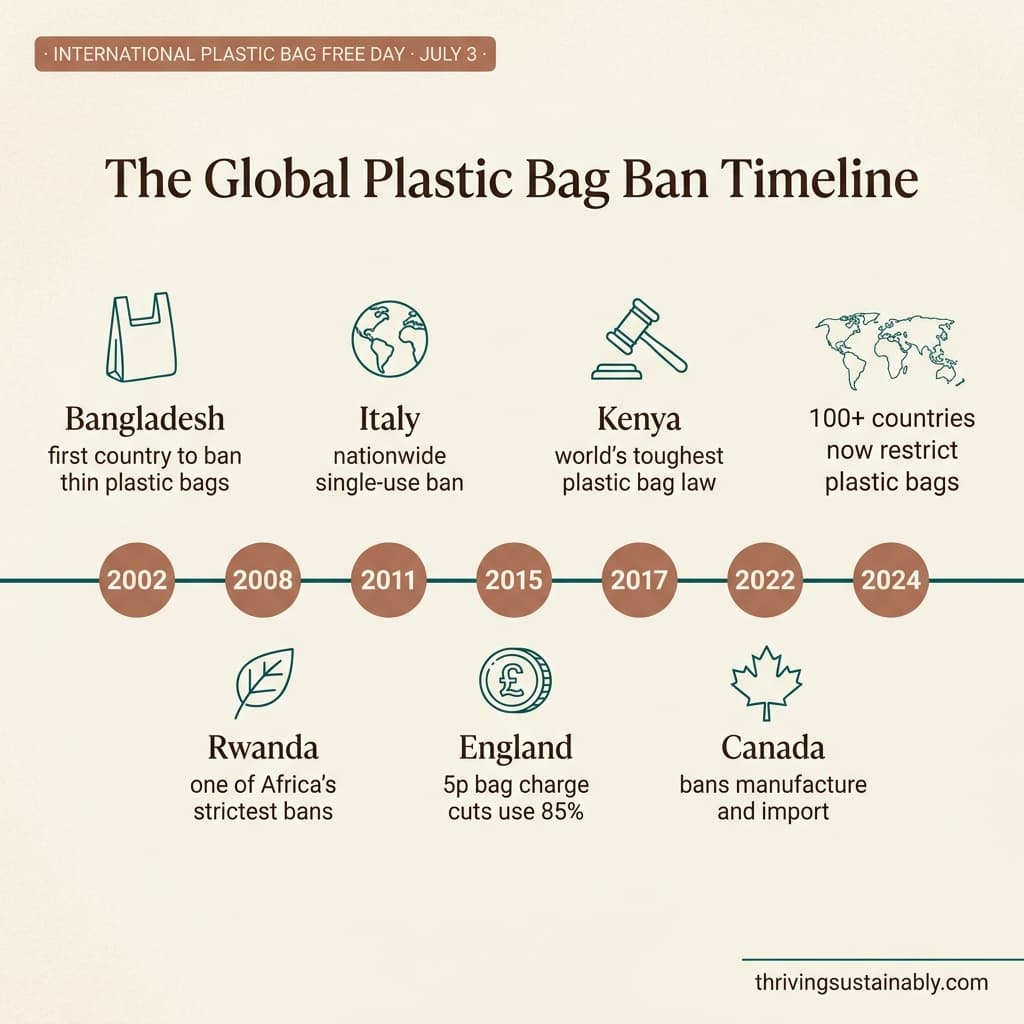
- In 2002, Bangladesh became the first country in the world to ban thin single-use plastic bags after they were found to be clogging the drainage system and worsening monsoon-season flooding.
- 2008 International Plastic Bag Free Day launches. Around the same time, Rwanda introduced one of the strictest bans on the African continent.
- In 2011, Italy banned single-use plastic shopping bags nationwide
- In 2015, England introduced a 5-pence charge on carrier bags at large retailers. Bag use at major supermarkets drops by about 85% within the first year, according to UK government data.
- 2017, Kenya passed what is considered the world’s toughest plastic bag law, with fines and even jail time for manufacturing, importing, or selling single-use plastic bags.
By 2024, a UNEP review found that more than 100 countries had some form of national plastic bag restriction in place, ranging from full bans to fees to manufacturing limits.
9 Ways to Take Part in International Plastic Bag Free Day
The easiest ways to take part in International Plastic Bag Free Day are to refuse plastic bags at every store you visit that day, keep reusables in your car and bag, and post one swap on social media to nudge your network to do the same.
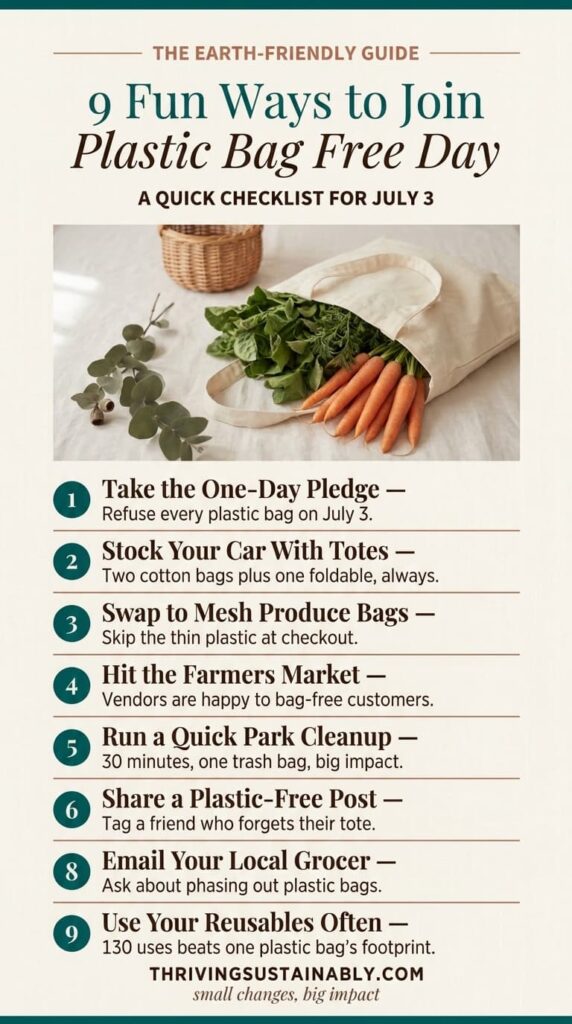
You don’t have to host a beach cleanup to participate. Here are nine simple ways to mark July 3, from “do it in 60 seconds” to “build a habit that sticks all year.”
Love These Ideas? Pin It! 📌
1. Take the No-Plastic-Bag Pledge for the Day
Commit to refusing every single-use plastic bag on July 3. That includes the produce bags at the grocery store, the bag the pharmacy hands you for one box, and the bag the takeout place wraps your order in. One day is enough to start noticing how often plastic bags get pushed at you without asking.
2. Stock Your Car and Bag With Reusables
The number-one reason people fall back on plastic bags is that they forgot the reusable ones at home. The fix is to keep two or three cotton totes in your car, a foldable bag in your purse or backpack, and a small set of mesh produce bags clipped to your main shopping tote.
3. Swap Plastic Produce Bags for Mesh or Cotton
The thin plastic produce bags at the grocery store are among the most wasteful items in the store. They’re used for the eight-minute trip from the produce section to the checkout, then they get tossed. Cotton or organic mesh produce bags wash easily, last for years, and weigh almost nothing on the scale.
4. Bring Your Own Bag to the Farmers Market
Farmers’ markets are some of the easiest places to skip plastic, since most vendors are happy to drop fruit and vegetables straight into your tote or basket. A wicker market basket also looks beautiful and lasts for decades with light care.
5. Run a Mini Beach, River, or Park Cleanup
If you live near water, July 3 falls right around peak beach season in the Northern Hemisphere, which means visible plastic bag litter. A 30-minute cleanup with one trash bag and a pair of work gloves can collect dozens of pieces of plastic, including bags caught in branches or buried in sand.
6. Share a Plastic Bag Free Day Graphic on Social
A simple graphic with one of the stats from this article (5 trillion bags a year, 12-minute average use, 500-year decay) is the kind of post that nudges your network without lecturing them. Tag a friend who keeps forgetting their tote, or share what swap you’re making this year.
7. Sew or Upcycle a Tote From a Pillowcase
A cotton pillowcase plus two simple seams becomes a reusable shopping bag in about 20 minutes. This is a low-stakes way to use up linens you’d otherwise toss, and the result tends to be much sturdier than a thin store-bought tote.
8. Write to Your Local Grocer or Lawmaker
If your city or state doesn’t have a plastic bag ban or fee yet, July 3 is a natural day to send a one-paragraph email to your local representative or to your favorite grocer’s customer service line. The script is short: ask what the timeline looks like for phasing out single-use plastic bags at checkout.
9. Make Your Reusables Last
Reusable bags only pay off if you actually keep using them. A cotton tote needs to be reused about 130 times to beat the carbon footprint of a single-use plastic bag, according to a Danish Environmental Protection Agency analysis published in 2018. The takeaway isn’t that totes are worse, it’s that the longer you use one, the better the math gets. Wash totes when they get dirty, repair small tears, and rotate them so no single bag wears out too fast.
✨ Tip
Easy Reminder
Keep your reusables somewhere you can’t forget them. A hook by the door or a permanent spot in the driver ‘s-side door pocket works far better than the back of a closet.
Best Plastic Bag Alternatives for Every Kind of Shopping
The best plastic bag alternatives are organic cotton totes for groceries, cotton or mesh produce bags for fruit and vegetables, foldable nylon-free pouch bags for daily errands, and bulk muslin bags for grains, flour, and pantry refills.
Not every reusable bag fits every shopping situation. Here’s how to match the bag to the trip.
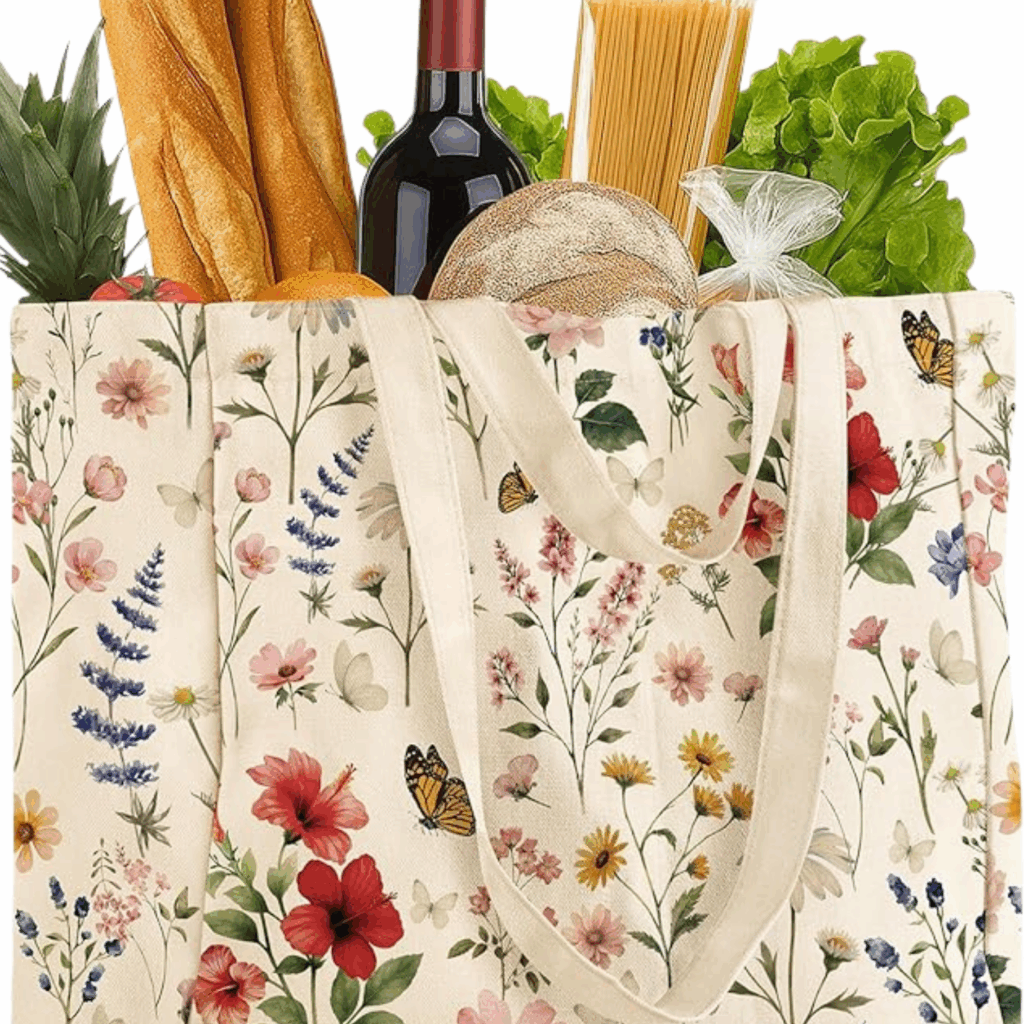
🛍️ Cotton or Canvas Totes (Best for Grocery Runs)
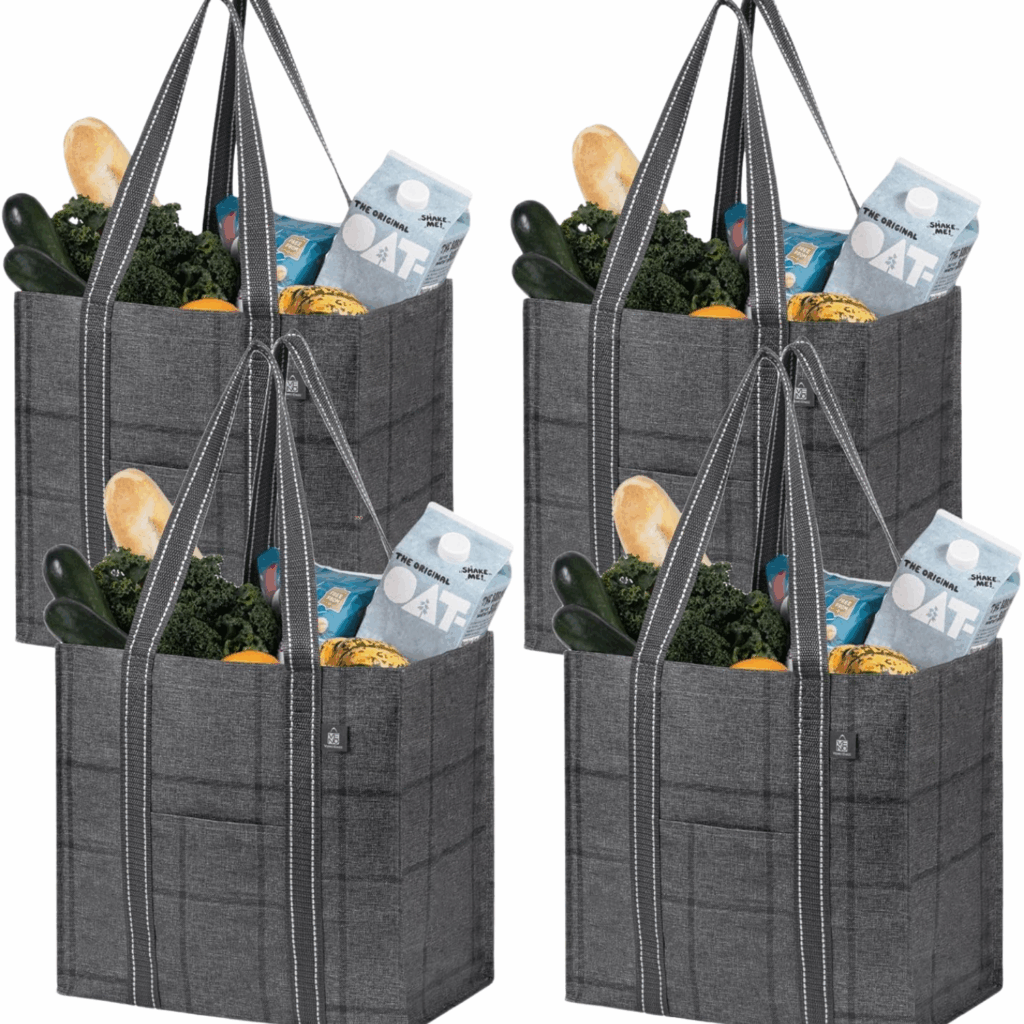
A heavyweight organic cotton or canvas tote handles a full bag of groceries without sagging, washes well, and lasts for years if you don’t overload it with cans. Look for double-stitched handles and unbleached cotton.
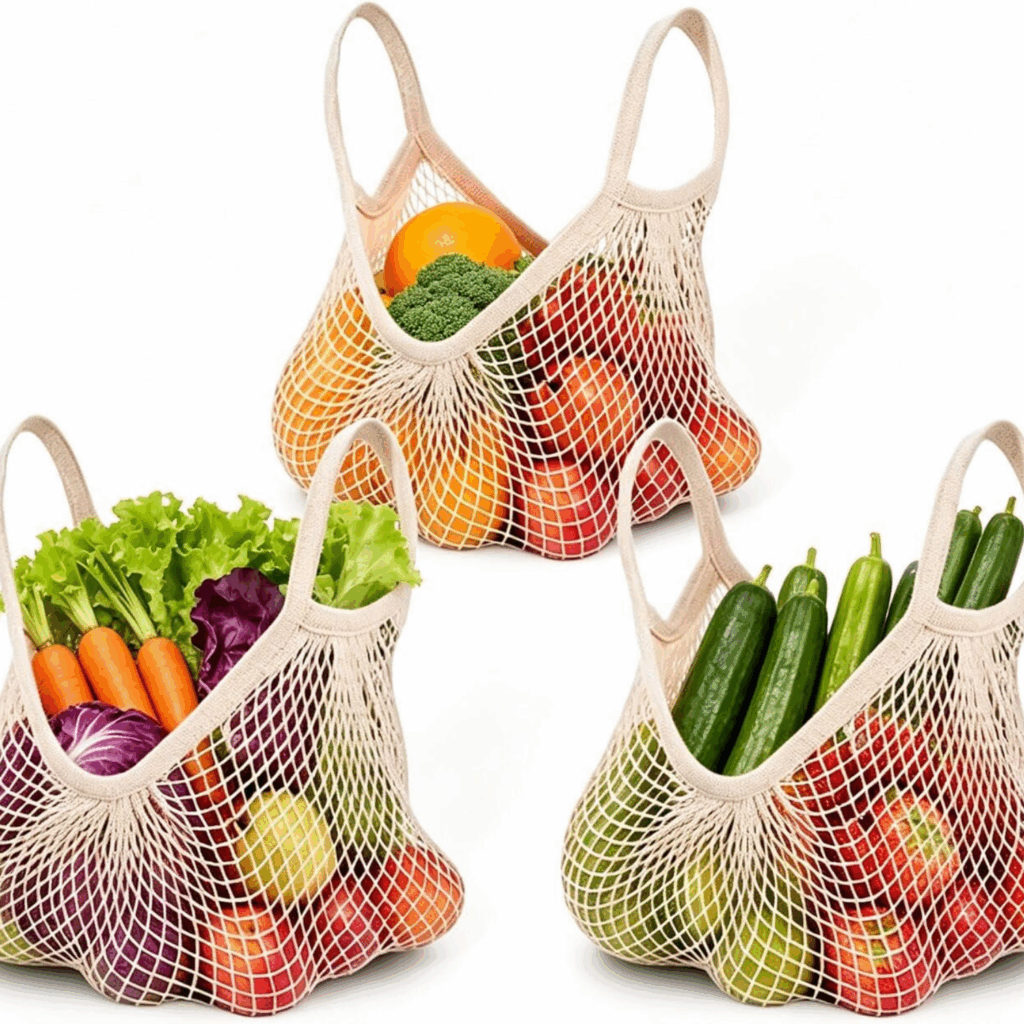
🥕 Mesh or Muslin Produce Bags (Best for Fruit and Veg)
Organic cotton mesh bags weigh almost nothing on a produce scale (most stores will tare them for you), and they wash in the regular laundry. Muslin bags work for bulk grains and dried beans, too.
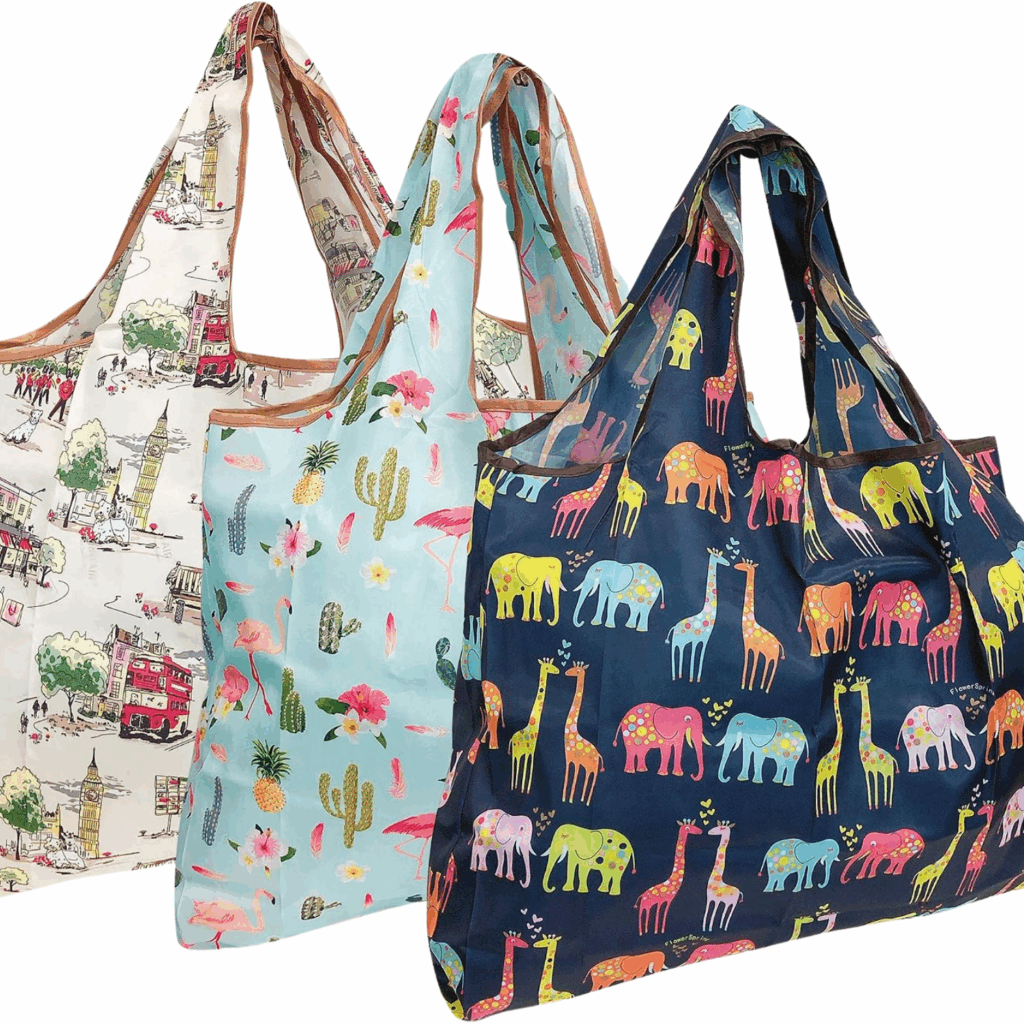
👜 Foldable Pocket Bags (Best for Spontaneous Errands)
These are the bags that ride around in your purse or backpack. The pocket-sized version folds down to about the size of a tea bag and pops open to hold roughly 20 pounds. Look for bags made from recycled cotton or hemp rather than polyester or recycled PET, since synthetic fabrics shed microplastics during washing.
🧺 Wicker, Cane, or Seagrass Baskets (Best for Markets)
A woven natural-fiber market basket is one of the most durable bag options out there. Baskets last for decades with light care and are perfect for farmers’ markets, picnics, and small bulk-store trips.
🫙 Glass Jars and Bulk Containers (Best for Refill Shopping)
If you have a bulk store near you, glass jars or stainless steel containers replace plastic bags entirely for grains, oats, beans, nut butters, oils, and even liquid soaps. The store takes the jar at the counter so you only pay for what’s inside.
Plastic Bag Alternatives
A few reusable bags worth swapping in for plastic.
Are Reusable Bags Always Better? The Honest Trade-Off
Reusable bags are only better than single-use plastic bags if you actually reuse them many times. A cotton tote needs around 130 uses to beat the climate footprint of a single plastic bag, but the math improves with each additional use.
This is the part most awareness-day content skips, and it’s worth being upfront about. Reusable bags aren’t automatically better than single-use plastic on day one. They cost more energy and water to make than a thin polyethylene bag, so the climate math only works out in their favor once you’ve used them a lot.
The 52-to-7,100-Use Break-Even
The 2018 Danish Environmental Protection Agency analysis is the most-cited number. It found that a conventional cotton tote needs to be reused about 52 times to break even on climate impact, and around 7,100 times to break even on all environmental impacts combined (including water use and ozone depletion). Organic cotton totes need even more uses on the water front because organic cotton tends to be lower-yielding per acre.
The Real Takeaway: Use What You Already Own
The takeaway isn’t that totes are a trick. It’s that the bag you already own is almost always the most sustainable bag. The worst outcome is buying a brand-new branded tote every time you go to an event and ending up with a closet of unused ones. Use the bags you have, mend them, and only replace when they wear out.
How Plastic Bag Free Day Connects to the Bigger Plastic Crisis
International Plastic Bag Free Day is one small piece of a much bigger plastic problem, since plastic bags make up only a fraction of the roughly 460 million tons of plastic the world produces each year, yet they’re among the most visible and replaceable.
Plastic bags are about 9% of all plastic waste, according to OECD figures on plastic flows. That’s a meaningful share, but it isn’t the biggest. Packaging accounts for about 40% of global plastic production, and textiles, construction materials, and consumer goods make up the rest.
Why Plastic Bag Free Day Still Matters
What makes plastic bags a useful target for awareness isn’t their share of the total. It’s that they’re one of the easiest categories to replace with something that already exists and works just as well. No breakthrough technology is required to switch from a plastic checkout bag to a cotton tote. Compare that to plastic in medical devices or electronics, where the alternatives don’t always exist yet.
That’s why Plastic Bag Free Day works as a wedge issue. It’s a way to introduce people to the broader plastic problem through the easiest possible swap. Once a person has spent a year not using plastic checkout bags, the leap to refusing plastic produce bags, plastic water bottles, or plastic straws gets smaller. For the full picture of why these swaps matter, see our guide on the hidden costs of plastic and why plastic-free living matters.
FAQs on International Plastic Bag Free Day
International Plastic Bag Free Day falls on Friday, July 3, 2026. The date is fixed each year, so it always falls on July 3, regardless of the day of the week.
The day was launched in 2008 by the Bag Free World coalition, an initiative led by Zero Waste Europe in partnership with the Global Alliance for Incinerator Alternatives (GAIA). It is not run by the United Nations, though several UN agencies have backed similar campaigns over the years.
No, but they overlap. Plastic Free July is a month-long campaign that runs throughout July, started in Australia in 2011. International Plastic Bag Free Day is a single-day awareness event on July 3 focused on single-use plastic bags. The two campaigns are complementary, since Plastic Bag Free Day falls during the first week of Plastic Free July.
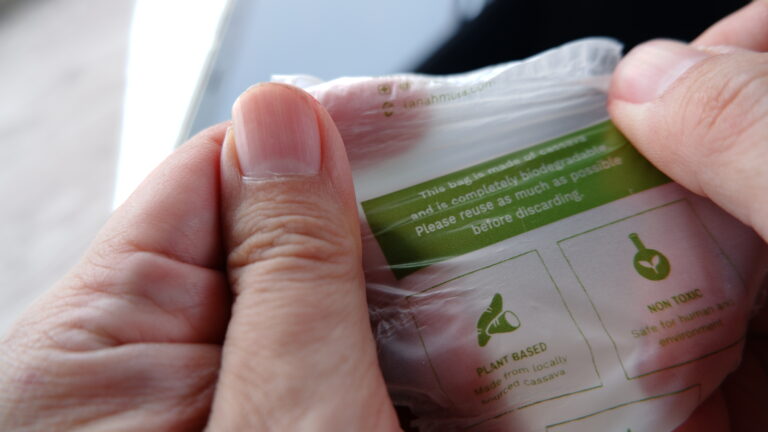
Most “biodegradable” plastic bags only break down in industrial composting facilities, not in backyard compost bins or landfills. If your city doesn’t have an industrial composter, those bags behave almost identically to conventional plastic. Compostable bags certified to ASTM D6400 or EN 13432 standards are the most trustworthy options, but they still aren’t a free pass to use them like single-use bags.
The savings are small per trip but real over time. A 5- to 10-cent charge per bag at large retailers adds up to roughly $20 to $40 per year for a typical household that doesn’t bring its own bag, according to retail data from jurisdictions with bag fees. Bringing your own tote eliminates the charge entirely.
Final Thoughts About International Plastic Bag Free Day
July 3 is a starting line, not a finish line. The plastic bag swap is one of the lowest-friction changes anyone can make, and it’s the kind of habit that quietly compounds. Skip one plastic bag a week, and you’ve kept about 50 bags out of the environment in a year. Skip a few per shopping trip, and the number climbs into the hundreds. Multiply that across a household over a decade, and the impact adds up fast.
So if you take only one thing from this article, make it this: pick the reusable bag you already own (or already love), put it somewhere you can’t forget it, and use it every chance you get. That’s it. International Plastic Bag Free Day exists to nudge that habit into place, not to ask for perfection. Small changes really do add up.
📚 References
- Bag Free World. (n.d.). About International Plastic Bag Free Day. Zero Waste Europe. https://zerowasteeurope.eu/
- Danish Environmental Protection Agency. (2018). Life cycle assessment of grocery carrier bags. Environmental Project No. 1985. https://www2.mst.dk/Udgiv/publications/2018/02/978-87-93614-73-4.pdf
- Geyer, R., Jambeck, J. R., & Law, K. L. (2017). Production, use, and fate of all plastics ever made. Science Advances, 3(7), e1700782. https://www.science.org/doi/10.1126/sciadv.1700782
- Organisation for Economic Co-operation and Development. (2022). Global Plastics Outlook: Economic drivers, environmental impacts and policy options. OECD Publishing. https://www.oecd.org/environment/global-plastics-outlook-de747aef-en.htm
- United Nations Environment Programme. (2018). Single-use plastics: A roadmap for sustainability. UNEP. https://www.unep.org/resources/report/single-use-plastics-roadmap-sustainability
- United Kingdom Department for Environment, Food & Rural Affairs. (2024). Single-use plastic carrier bag charge: data in England. GOV.UK. https://www.gov.uk/government/publications/carrier-bag-charge-summary-of-data-in-england
- United States Environmental Protection Agency. (2024). Plastics: Material-specific data. EPA Facts and Figures About Materials, Waste, and Recycling. https://www.epa.gov/facts-and-figures-about-materials-waste-and-recycling/plastics-material-specific-data
- Wilcox, C., Puckridge, M., Schuyler, Q. A., Townsend, K., & Hardesty, B. D. (2018). A quantitative analysis linking sea turtle mortality and plastic debris ingestion. Scientific Reports, 8, 12536. https://www.nature.com/articles/s41598-018-30038-z
🗨️ Are you skipping plastic bags this July 3? Tell us your favorite reusable bag, and where you got it, in the comments below. Your pick might inspire someone else to make the swap.
More Plastic-Free Living Guides You’ll Want to Read
- Say No to Plastic: Simple Swaps to Protect Your Health & Home
- What Is Plastic Free July® 2026 (And Why It’s Easier Than You Think)
- The Truth About Plastic: Why Plastic-Free Living Matters
- How to Avoid Microplastics: 15 Simple Ways to Reduce Exposure
- What Are Microplastics? The Tiny Pollutants With a Big Impact
- Plastic Free Water Bottles 2026: Best Reusable & Safe Picks
- Plastic-Free Toothbrush Guide: Best Sustainable Picks for 2026
- Zero Waste Lifestyle: Easy Steps to Get Started