
Key Takeaways
- Only 9% of plastic waste worldwide ever gets recycled, per the OECD, so reducing plastic at home does more than anything you sort into a bin.
- You don’t go plastic-free overnight. Swap items as they run out, starting in the kitchen and bathroom where plastic touches food, water, and skin most often.
- Watch for greenwashing: a European Commission screening found 42% of green claims were exaggerated, false, or deceptive, so trust third-party certifications over front-label buzzwords.
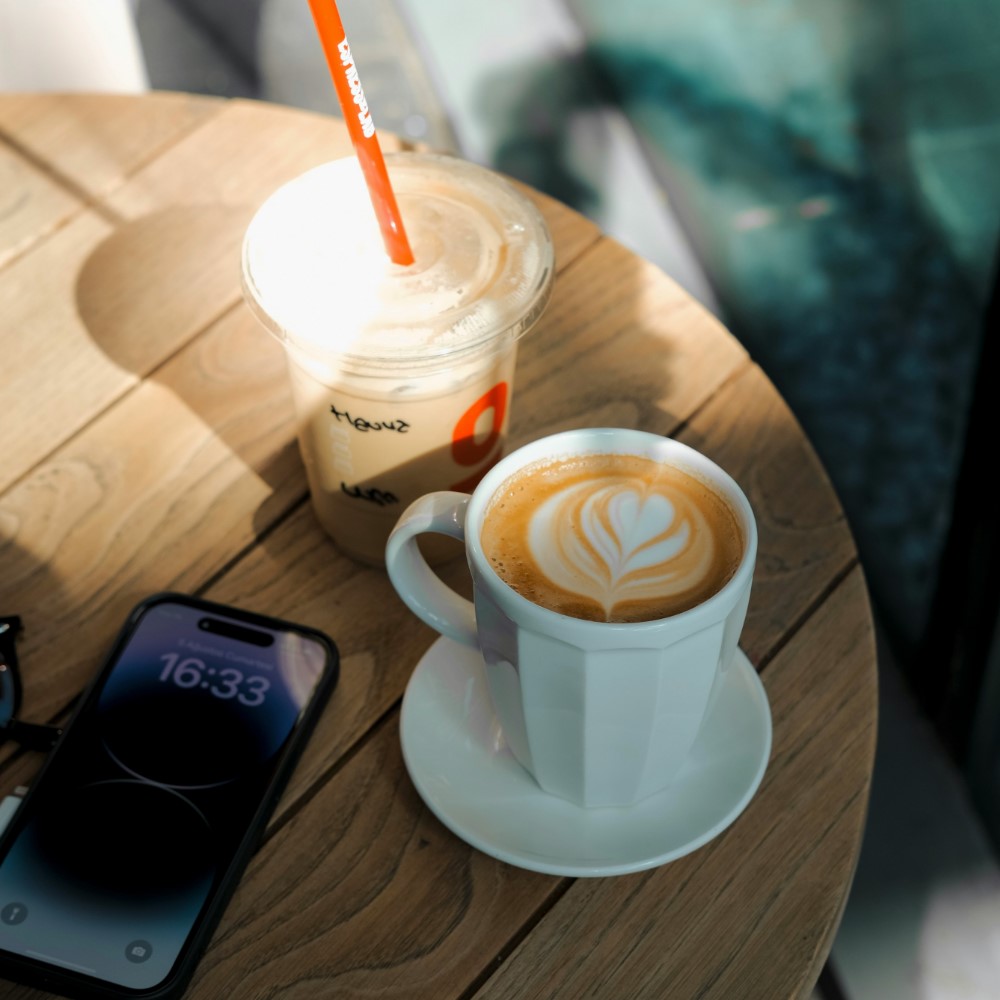
It always amazes me how much effort people put into making their food and drinks healthier, ordering a fat-free, sugar-free, extra-foam, double-shot, with oat milk, no whipped cream, and a sprinkle of cinnamon latte, yet barely pausing to consider the plastic straw they’re using to sip it.
And let’s not forget, most coffee cups are lined with plastic, adding yet another layer to the problem. It’s as if we’re crafting the perfect guilt-free coffee order, but we’re forgetting about the plastic that comes with it.
Plastic can even enter your body directly when you use plastic straws or cups. Studies show that microplastics, tiny plastic particles, can be released from these items, especially when they come into contact with hot or acidic liquids. These particles can be easily ingested, and while a single dose may not seem harmful, long-term exposure raises serious concerns.
Research suggests these tiny fragments can carry harmful chemicals that may disrupt hormones, trigger inflammation, and even increase the risk of certain diseases over time.
I’ll be honest: I don’t live a perfectly plastic-free lifestyle. Each day, I’m learning more about plastic pollution and microplastics, and I’m making small, conscious changes to reduce single-use plastic in my own life. I intend to share what I learn here so that you can take simple steps right alongside me.
Plastic-Free Living Isn’t About Getting to Zero
Plastic-free living means steadily replacing single-use and high-contact plastics with reusable materials like glass, stainless steel, and natural fibers. It is a direction, not a purity test.
The name oversells it, so let’s fix that up front. Nobody living in a modern house has a plastic-free house. Your fridge has plastic parts. So does your car, your phone, and probably your glasses. Plastic-free living isn’t about purging it all. It’s about cutting the plastic you can control: the wrap around your food, the bottle on your nightstand, the scoop in the laundry room.
Plastic earned its place because it’s cheap, light, and durable. That last part is the problem. Plastic doesn’t biodegrade the way a banana peel does. It breaks apart into smaller and smaller fragments called microplastics, which are now turning up in soil, drinking water, and the food chain. Every piece of plastic you skip is a piece that never gets the chance to fragment.
So when I say plastic-free living, I mean a direction: fewer single-use plastics, fewer plastics touching hot food and drinks, and better materials, like glass, stainless steel, wood, and natural fibers, wherever a swap makes sense. Progress counts. Perfection isn’t on the menu, and anyone selling it to you is selling something.
The Real Case for Living With Less Plastic
Plastic-free living matters because microplastics have now been found in human blood, lungs, and brain tissue, while only 9% of plastic waste is ever recycled and global production keeps climbing.
Most of us made peace with plastic a long time ago. It held the leftovers, carried the groceries, and went out with the trash, end of story. The reason so many people are rethinking that deal now comes down to what scientists keep finding, both in the environment and in us.
🧍Microplastics Are in Our Bodies Now
This stopped being an ocean-only story years ago. Researchers have detected microplastics in human blood, lungs, and placentas, and a 2025 study in Nature Medicine found micro- and nanoplastics accumulating in human brain tissue, at concentrations roughly 50% higher in 2024 samples than in samples from just eight years earlier.
Scientists are still working out what this means for long-term health, and the research is early. But “still working it out” is exactly why I’d rather my family’s exposure trend down, not up, while we wait for answers. The encouraging part: the biggest exposure routes, like food packaging, bottled water, and heated plastic, are the easiest ones to swap.
🦌 Wildlife Pays First
Before plastic reached our bloodstreams, it reached everything else’s. Marine animals mistake fragments for food, which can block digestion or introduce chemicals into their bodies, and discarded nets and packaging entangle birds, turtles, and seals. Every wrapper and bottle that never enters your house can’t end up in a waterway. It sounds small. Multiplied across a household’s year, it isn’t.
📈 The Pipeline Keeps Growing
Here’s the part that took me the longest to accept: this problem isn’t going to shrink on its own. Global plastics production reached 413.8 million metric tons in 2023, according to Plastics Europe, and 90% of it was derived from fossil-based sources. Production keeps climbing while waste systems fall further behind. That’s why demand matters. Companies count what we buy, and every plastic-free purchase is a tally mark on the right side of the ledger.
Don’t Miss: How to Tell If Plastic Is BPA-Free BPA-free doesn’t mean plastic-free, and the difference matters for your health. Here’s how to read the codes before your next purchase. Read more →How Do You Start Plastic-Free Living Without Quitting?
The easiest way to start plastic-free living is to use up what you already own, replace items with plastic-free versions as they run out, and finish one room before starting the next.
The fastest way to fail at this is the way most people start: a weekend purge, a cart full of bamboo everything, and a kitchen that looks like a zero-waste store by Sunday night. By March, the enthusiasm is gone, and the spending guilt is not. I’ve watched it happen, and the pattern breaks the same way every time. Slow beats dramatic. Four rules keep it manageable:
- Use up what you have. Tossing working plastic containers to buy glass ones creates waste and costs money. The greenest container is the one already in your cabinet.
- Swap on the run-out. When the shampoo bottle empties, replace it with a bar. When the cling film runs out, try a beeswax wrap. The transition funds itself one purchase at a time.
- One room at a time. Pick the room that bugs you most and finish it before you touch the next one.
- Prioritize contact, not count. A swap that removes plastic from hot food or drinking water matters more than ten swaps in the garage.
✨ Tip
Do the Free Swaps First
Your first week of plastic-free living shouldn’t cost a cent. Say no to straws, carry the tote you already own, repurpose pasta-sauce jars for storage, and brew loose-leaf tea in the strainer at the back of the drawer. Spending money is the last step, not the first.
Plastic-Free Swaps Made Simple
The highest-impact plastic-free swaps happen in the kitchen and bathroom: food storage, water bottles, soap, and shampoo, where plastic touches food, drink, and skin every single day.
Walk through your house with this lens, and you’ll spot plastic in places you’ve stopped seeing it. That’s normal. The point of going room by room isn’t to fix everything; it’s to know exactly what to change next. My full plastic-free swaps list covers more options, but these are the moves that earn their spot in each room.
Plastic-Free Living with Kids and Pets
Plastic-free living with kids starts with what goes in their mouths: bottles, plates, and lunchboxes, then moves to toys, while pet owners can swap bowls, toys, and bulk food packaging.
Kids and plastic seem inseparable, and I won’t pretend a toddler birthday party will ever be a zero-plastic event. It won’t, and chasing that will only frustrate everyone. What works is the same priority filter as the rest of the house: mouths first, hands second, everything else when it’s convenient.
Start With What Touches Their Food
For babies and little kids, that means glass or stainless bottles and sippy cups, stainless or bamboo plates instead of plastic ones (skip “bamboo” dinnerware that’s actually bamboo fiber glued with melamine resin; the label should say solid bamboo or list materials), and a stainless lunchbox that survives being dropped down the stairs, which it will be. Heat matters most here: avoid microwaving food in plastic containers, as heat increases the amount of plastic and additives that can migrate into food.
Toys Are an Easy Secondhand Win
Toys are an easier win than they look, because the secondhand market is full of them. Wooden blocks, books, and hand-me-down everything keep new plastic out of the toy bin and money in your pocket. A local Buy Nothing group can outfit a playroom for free. For warm-weather gear, my plastic-free summer essentials for kids roundup covers the essentials, including sand toys.
Pets Are the Quickest Swaps in the House
Pets are a quick section because the swaps are simple: stainless bowls instead of plastic ones (they’re also more hygienic and chew-proof), natural rubber toys instead of cheap plastic squeakers, buying food in bulk or larger bags to cut packaging, and pine or paper litter instead of clay in plastic jugs. Your dog will not notice the difference. Your trash can will.
Save This for Your Next “Where Do I Even Start” Moment 📌
Can Plastic-Free Living Save You Money?
Going plastic-free saves money over time because reusables replace repeat purchases: a $25 water bottle pays for itself within months compared with buying bottled water.
Somewhere along the way, plastic-free picked up a reputation as a luxury lifestyle, all $40 water bottles and boutique refill shops. The reality runs the other direction. Single-use plastic is a subscription you never agreed to: the same bottles, bags, wraps, and razors purchased over and over, forever. Reusables cancel the subscription.
The Bottled Water Math
Bottled water is the clearest example. Americans drank about 16.2 billion gallons of bottled water in 2024, per the Beverage Marketing Corporation, and it’s been the country’s best-selling packaged drink for years. If you buy a $2 bottle most days, that’s a $500-a-year habit. A $25 stainless bottle covers it in under a month and then pours free for a decade.
Where the Rest of the Savings Add Up
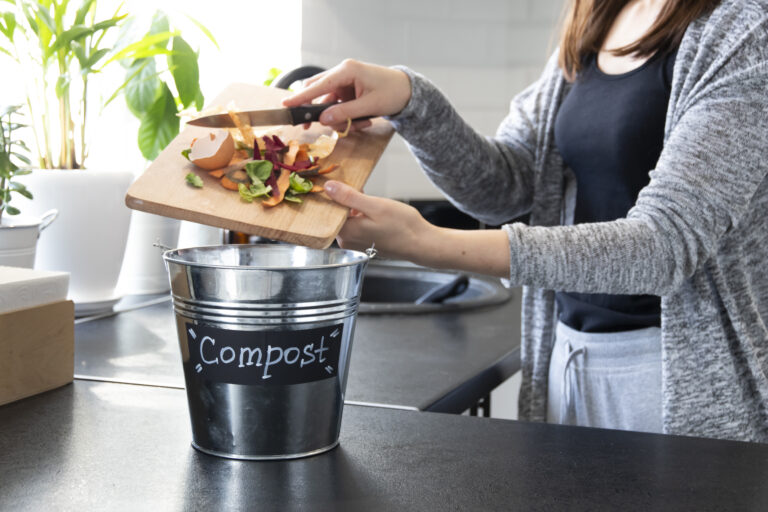
The same math repeats across the house. Cloth towels replace paper towel runs. Safety razor blades cost pennies compared to cartridge refills. Buying staples from bulk bins trims both packaging and price per pound. And the DIY route, vinegar, baking soda, Castile soap- undercuts almost any bottled cleaner. None of these makes you rich. Together, they quietly return a few hundred dollars a year while shrinking your trash.
One honest caveat: some plastic-free versions do cost more upfront, and a few cost more, period. That’s real, and it’s why the next section exists.
When Plastic-Free Living Feels Too Expensive or Too Hard
The biggest barriers to plastic-free living are upfront cost, limited availability, and social friction. Secondhand shopping, using what you already own, and slow swaps solve most of them.
Every plastic-free guide makes it sound breezy, and then you’re standing in a regular grocery store where everything from cucumbers to crackers comes wrapped, on a budget that doesn’t stretch to the fancy refill shop across town. The barriers are real, so let’s treat them that way instead of pretending enthusiasm fixes everything.
The Cost Barrier
Upfront cost is the most common wall, and the workaround is patience plus secondhand. Thrift stores and online resale are full of glass jars, stainless cookware, baskets, and kids’ gear at a fraction of new prices, and secondhand is the lowest-footprint way to buy nearly anything. Pair that with the swap-on-run-out rule, and the project stops requiring a budget line altogether. You’re not buying a lifestyle. You’re redirecting purchases you’d make anyway.
The Availability Barrier
If your area has no bulk aisle and no refill store, you’re not doing it wrong; you just have fewer levers. Pull the ones you have: choose glass, metal, or cardboard packaging over plastic when both are available, buy the bigger size to cut packaging per serving, and lean on swaps that don’t depend on specialty stores, like bar soap, vinegar cleaning, and reusable bags. Litterless keeps a state-by-state list of bulk and zero-waste stores worth checking, and some refill brands ship.
The “Is This Even Worth It” Barrier
Some days the whole project feels like emptying the ocean with a teaspoon, especially when one shopping trip undoes a week of careful choices, or a relative teases you about your jar collection. Two things help me here. First, the math is real: one household’s swaps, held for years, keep thousands of pieces of single-use plastic out of the waste stream. Second, you’re not just subtracting trash. You’re shifting demand, normalizing the behavior for everyone who eats at your table, and voting for shelf space for stores that carry plastic-free products. Quiet influence compounds.
How Do You Avoid Greenwashing When You Shop?
To avoid greenwashing, ignore vague front-label words like eco-friendly and natural, and look for third-party certifications such as Plastic-Free Certification and Zero Plastic Inside.
Walk down any aisle and count the leaves. Green flourishes, earthy fonts, and words like “eco,” “natural,” and “planet-friendly” are everywhere, and most of them are decoration rather than information. The data backs up the gut feeling: a European Commission screening of company websites found that in 42% of cases, green claims were exaggerated, false, or deceptive. When companies make misleading environmental claims to attract conscious shoppers, that’s greenwashing, and it’s the single biggest obstacle between you and truly plastic-free products.
The Certifications Worth Trusting
The way through is third-party certification: independent organizations that verify claims before a brand can print the label. For plastic specifically, these are the ones I check for:
- Plastic-Free Certification verifies that products and packaging are free from fossil-fuel-based plastics.
- Control Union’s Plastic-Free Certification audits products and packaging against plastic-free standards used by brands worldwide.
- Flustix certifies products as plastic-free in materials, packaging, or both, and as microplastic-free in formulas.
- Zero Plastic Inside, from the Plastic Soup Foundation’s Beat the Microbead campaign, flags cosmetics and personal care products with no microplastics in the formula, including liquid polymers. Their free app scans products while you shop.
A certification beats a buzzword every time, but no single label covers everything.
Recycling Won’t Fix the Plastic Problem
Recycling cannot fix plastic pollution: only 9% of plastic waste is recycled globally, and just 5-6% in the United States, because most plastic was never designed to be recycled.
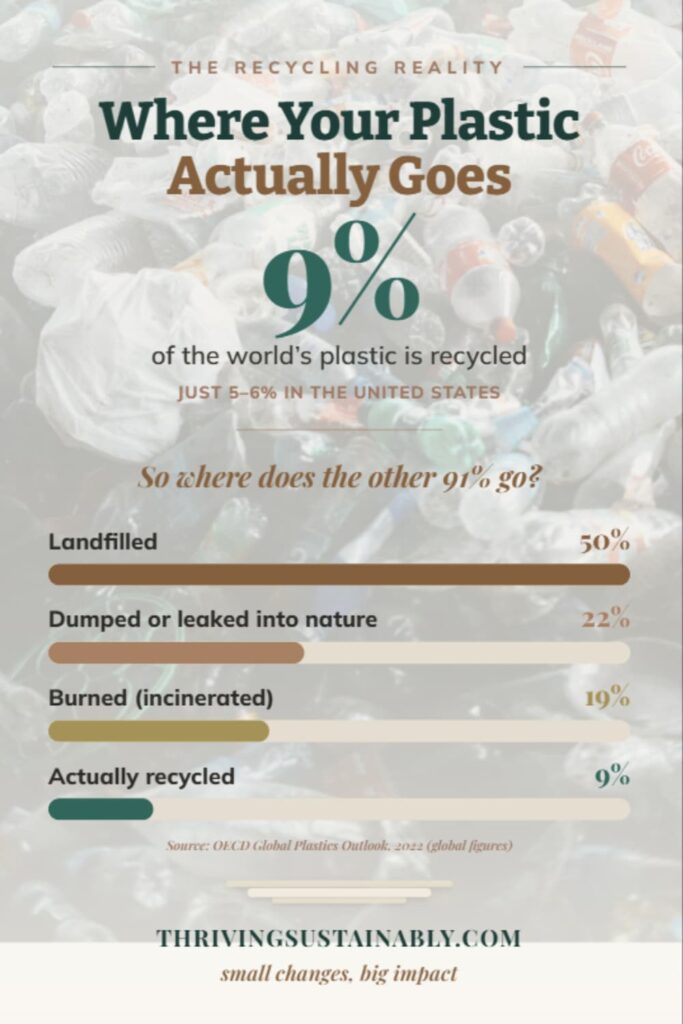
Years ago, I’d stand at the sorting bins outside Whole Foods having a small private crisis, certain everyone behind me was judging my recycling skills. I sorted carefully because I believed sorting was the whole answer. The truth turned out to be harder: according to the OECD’s Global Plastics Outlook, only 9% of plastic waste worldwide is recycled.
In the United States, a Greenpeace survey put the rate at just 5-6%. The rest is landfilled, incinerated, or lost into the environment, and wealthier countries have long exported part of the problem to countries without the infrastructure to manage it.
What the Recycling Triangle Doesn’t Tell You
The number triangle on the bottom of a container doesn’t promise recyclability either. It’s a Resin Identification Code that names the type of plastic, nothing more. Whether your local program accepts it is a separate question, and even recycled plastics degrade after a cycle or two.
Tossing hopeful maybes in the bin, sometimes called wishcycling, actually makes things worse by contaminating loads that were otherwise fine. My guide to recycling correctly covers the codes, the prep, and how to find your local rules.
The Bin Is the Backup Plan, Not the Fix
None of this means skip the bin. Recycle what your program actually accepts, rinsed and dry. It means the bin is the backup plan. The real move is upstream, needing less plastic in the first place, which is the entire case for everything else in this guide.
Pushing for Change Beyond Your Own Home
Individual swaps matter most when paired with collective action: refill stores, local bag policies, and challenges like Plastic Free July multiply the impact of plastic-free living.
A jar collection won’t end plastic pollution, and pretending otherwise sets people up to burn out. The honest frame is that household swaps are the entry point, and the bigger wins happen when enough households make noise together. The encouraging part is how low the bar is for joining in.
Start With Plastic Free July
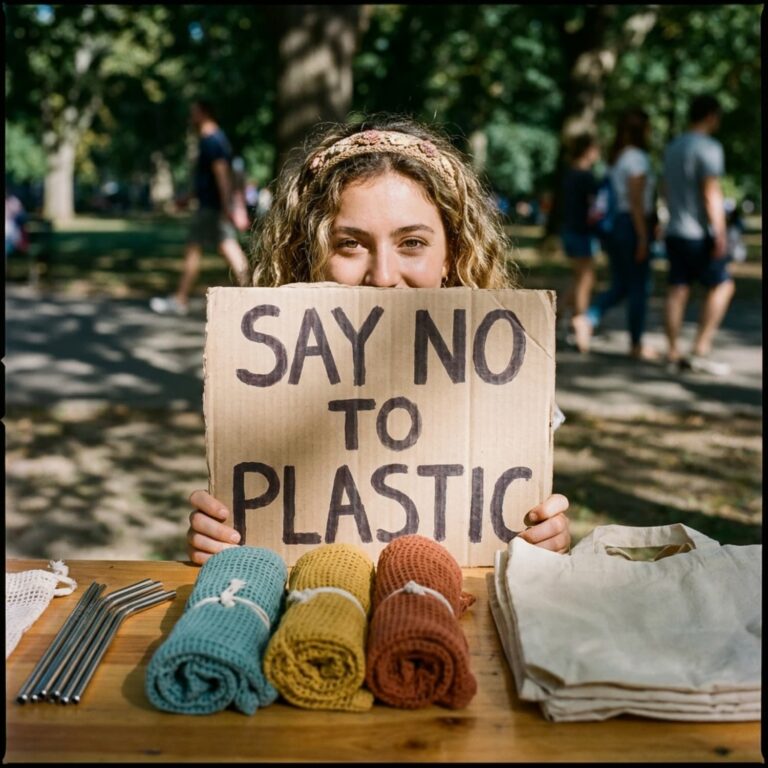
The easiest on-ramp is Plastic Free July, a global challenge in which millions of people cut back on single-use plastic for one month. It works because it’s social: friends compare swaps, workplaces run challenges, and habits formed in July tend to stick around. I’ve shared my own favorite July swaps if you want a starting lineup.
Spend and Speak Where It Counts
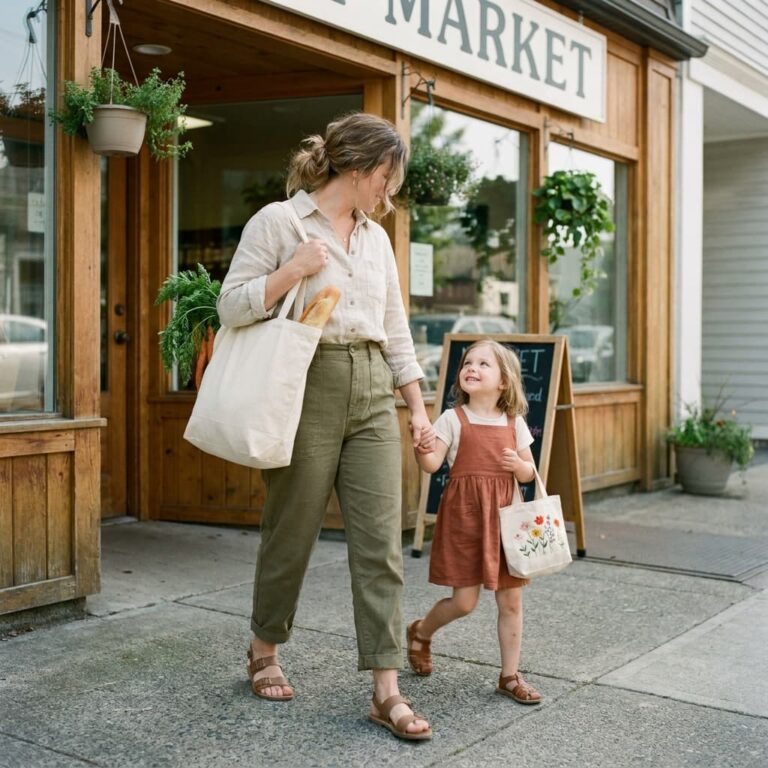
Beyond that, spend where it counts: refill shops, farmers’ markets, and certified plastic-free brands grow when the neighborhood shows up. Speak where it counts, too. Bag fees and single-use bans pass at the city and state levels when residents ask for them, and a short comment at a council meeting carries more weight than most people think. The biggest lever is still being negotiated: a global plastics treaty under the UN Environment Program, with talks set to continue in 2026 after earlier rounds ended without agreement.
FAQ on Plastic-Free Living
Silicone is an elastomer, a rubber-like material built on a silicon-oxygen backbone, while plastics are carbon-based thermoplastics and thermosets. Food-grade silicone is generally a reasonable middle-ground material for things like baking mats and bottle parts. If you’re weighing it for cookware, my guide on whether silicone is safe to cook with goes into more depth.
Sometimes, the label matters. Many “compostable” plastics only break down in industrial composting facilities, not in backyard piles or landfills, and “biodegradable” lacks a consistent standard. If the item ends up in a landfill anyway, the benefit mostly disappears. My breakdown of biodegradable vs compostable explains which labels mean something.
Plastic-free living targets one material: plastic, especially single-use and food-contact plastic. Zero-waste targets all trash, aiming to send as little as possible to the landfill, including paper, glass, metal, and food scraps. They overlap heavily, and most people blend the two. Plastic-free is the easier starting point because the target is so visible.
Estimates range from decades to centuries depending on the plastic and conditions, but the more important point is that plastic doesn’t truly biodegrade. It fragments into microplastics that persist in soil and water rather than returning to nature the way organic material does. That’s why prevention beats cleanup.
No, and this catches many careful shoppers. Most disposable paper cups and many paper plates are lined with a thin layer of polyethylene plastic, and some “bamboo” dinnerware is bamboo fiber bound with melamine resin, a plastic. Check for “uncoated” paper goods and solid bamboo or wood, and treat vague labels as a reason to ask.
Usually not. Most food cans have a thin polymer lining to keep metal from reacting with food, historically made with BPA and now often made with substitutes. Glass jars are the more reliably plastic-free pantry option, though even jar lids typically have a thin liner. It’s a good example of why “less plastic” is a more useful goal than “none.”
Final Thoughts About Plastic-Free Living
Plastic-free living works when it’s small and steady: one room, one swap at a time, with progress, not perfection, as the goal.
If you remember one thing from this guide, make it this: you don’t need a plastic-free house, you need a plastic-free direction. The family that swaps a water bottle, a soap bar, and a handful of grocery habits, and keeps them for a decade, does more than the person who buys everything bamboo in January and quits by spring.
Start tonight if you want, with the free stuff. Move a tote to the car. Promote a pasta jar for food storage. Finish the plastic you own instead of purging it. Then let the run-outs guide the rest: every empty bottle is a small fork in the road, and you only have to choose well at one fork at a time.
And when the project feels slow, look backward instead of forward. Six months of small swaps reads like nothing day to day and like a different household in hindsight. Small changes, big impact. That’s the whole philosophy, and it holds up.
📚 References
- Beverage Marketing Corporation. (2025). Bottled water volume growth quickens in 2024. https://www.beveragemarketing.com/news-detail.asp?id=825
- European Commission. (2021). Screening of websites for ‘greenwashing’. https://ec.europa.eu/commission/presscorner/detail/en/ip_21_269
- Greenpeace USA. (2022). Circular claims fall flat again. https://www.greenpeace.org/usa/circular-claims-fall-flat-again/
- Nihart, A. J., Garcia, M. A., El Hayek, E., Liu, R., Olewine, M., Kingston, J. D., … Campen, M. J. (2025). Bioaccumulation of microplastics in decedent human brains. Nature Medicine, 31, 1114–1119. https://www.nature.com/articles/s41591-024-03453-1
- OECD. (2022). Global plastics outlook. OECD Publishing. https://www.oecd.org/en/publications/2022/02/global-plastics-outlook_a653d1c9.html
- Plastics Europe. (2024). Plastics – the fast facts 2024. https://plasticseurope.org/knowledge-hub/plastics-the-fast-facts-2024/
- United Nations Environment Programme. (2026). Intergovernmental Negotiating Committee on Plastic Pollution. https://www.unep.org/inc-plastic-pollution
🗨️ What was your first plastic-free swap, and did it actually stick? Tell me in the comments. The failed swaps are just as useful to hear about as the wins, and your story might be exactly what gets someone else started.
More Plastic-Free Living Reads
- Third-Party Certifications: The 25 Labels Worth Trusting
- Plastic-Free Gum: 12 Brands With Nothing to Hide
- What Is Tritan Material? Safer Plastic or Hype?
- Does Reverse Osmosis Remove Microplastics?
- Sustainable Food Packaging: Materials, Trends & Benefits
- Plastic-Free Dishwasher Detergents That Actually Clean
- Chlorine-Free Toilet Paper: Why It’s Worth the Switch
We’ve scored every product we recommend on plastic — browse them all in the Plastic Footprint Directory.