
Key Takeaways
- A third-party certification means an independent organization audited the brand and verified the claim. A European Commission screening found 42% of green claims online were exaggerated, false, or deceptive, which is exactly the gap these seals close.
- Not all seals are equally rigorous. Some require on-site audits every year, others screen ingredient lists against a database. Every card below tells you exactly how each one is checked.
- No certification covers everything. Each one verifies a specific slice (ingredients, forests, animal welfare, wages), so the strongest products usually carry two or three complementary seals.
The fastest way to tell a real sustainability claim from marketing is a third-party certification, a seal that means an independent organization audited the brand and verified the claim. Anyone can print “eco-friendly” on a box. Nobody can print a B Corp score or a MADE SAFE seal without earning it.
When the European Commission screened green claims online, it found 42% were exaggerated, false, or deceptive. We checked all 25 certifications below against each certifier’s own published standards, so you know exactly what every seal verifies, how rigorous the audit is, and what it quietly leaves out.
What Is a Third-Party Certification?
A third-party certification is a seal awarded by an independent organization that audited a brand’s product or practices against a published standard, unlike claims a brand makes about itself.
You pick up two shampoo bottles. Both say “clean.” One says it because the marketing team liked the word. The other carries a seal that means an outside organization checked every ingredient against a published standard and put its own reputation behind the result. That difference is the whole reason this page exists.
First-party, second-party, third-party
A first-party assessment is a brand grading its own homework (“we tested it ourselves”). A second-party assessment is a business partner or trade group checking, better, but they still have a stake. A third-party certification comes from an independent organization with no skin in the sale, which is what makes the verification worth trusting.
Self-certified vs third-party certified
This is where greenwashing lives. Made-up leaf logos, “eco” badges a brand designed in-house, and vague “certified natural” stamps with no certifier named are all self-certification. A real seal always names the organization behind it, and you can look the product up in that certifier’s public database. If you can’t find who issued a badge, treat it as decoration.
Certification vs third-party audit
An audit is the inspection. A certification is the result. Auditors visit the factory, screen the ingredients, or review the records; if everything meets the standard, the certification body issues the seal, usually with re-checks on a schedule. One is the exam, the other is the diploma.
How Does a Brand Actually Earn a Seal?
A brand earns a third-party certification by meeting a published standard, passing an audit by an accredited certification body, and staying compliant through scheduled re-checks.
It is harder than slapping a leaf on the label, which is the point. The path looks like this:
Staying certified. Most seals require renewal, annual audits, periodic re-testing, or yearly verification. A certification is a subscription to scrutiny, not a one-time trophy.
The standard. Every legitimate certification publishes exactly what it requires, from chemical limits to wages to forest practices. National and international standards mean a seal earned in Denmark means the same thing in Dallas.
The gap work. The brand compares its product or supply chain against that standard and fixes what falls short. For many brands this step is the real cost, reformulating, switching suppliers, or documenting a supply chain for the first time.
The audit. An accredited certification body inspects, on-site visits, lab tests, ingredient screening, or records review, depending on the seal. Accredited matters: it means someone audits the auditors.
✨ Tip
Look Up the Seal, Not Just the Logo
Every certifier on this page runs a public database of certified products or companies. If a label claim feels off, search the certifier’s site for the brand. Thirty seconds settles it.
Why Do Third-Party Certifications Matter?
Third-party certifications matter because they replace trust in marketing with independent verification, creating transparency and accountability that self-made claims never face.
For shoppers, the math is simple: you cannot personally audit a factory in Vietnam or screen 40 ingredients against a toxicology database, so the certifier does it for you. The seal converts a claim you’d have to take on faith into one somebody already checked.
For brands, certification is an expensive, voluntary invitation to be scrutinized, which is exactly why it signals more than any ad copy. And the marketplace effect compounds: certified brands publish more, disclose more, and pull their whole category toward transparency. The 25 seals below are the ones worth knowing, organized by what they verify.
The 25 Certifications Worth Knowing
The most trustworthy sustainability certifications include FSC, Cradle to Cradle, MADE SAFE, EWG Verified, Leaping Bunny, USDA Organic, Fair Trade Certified, B Corp, GOTS, and OEKO-TEX, each verifying a different slice of how a product is made.
Cradle to Cradle Certified
Circular product design
Verifies: The product was scored on five things at once: safe materials, recyclability, clean energy in production, responsible water use, and fair treatment of workers, then rated Basic through Platinum.
Why it matters: It is the closest thing to a full report card on a product, covering both what it’s made of and how responsibly it was made.
In the aisle: Find the seal on the package back or the online product page, with the level printed beside it. Higher levels (Gold, Platinum) mean tougher marks were hit, so read the level, not just the logo.
The level matters. A Basic-level product and a Platinum one carry the same logo, so check the tier. Covers fashion too.
ENERGY STAR
Energy efficiency
Verifies: The appliance or electronics use 10 to 50% less energy than standard models, confirmed by independent testing against EPA guidelines.
Why it matters: Lower electric bills from the day you plug it in. The program has saved Americans more than $500 billion in energy costs since 1992.
In the aisle: Look for the blue square with the star on the appliance box and the yellow EnergyGuide tag. Phrases like “energy saving” without the blue mark are just adjectives.
It measures energy use only, nothing about materials, chemicals, or durability.

Carbon Trust
Carbon footprint
Verifies: The maker measured the product’s full climate footprint, from manufacturing through disposal, and had the math independently checked against recognized standards.
Why it matters: Brands that actually measure their footprint are usually the ones shrinking it, so the label filters out empty “low carbon” talk.
In the aisle: Find the black footprint logo, then read the words inside it: “Carbon Measured,” “Reducing CO2,” and “Carbon Neutral” are three different promises. You’ll see it most on UK and European products.
Carbon Trust issues several different labels (measured, reducing, neutral), and they make different promises. Read which one is on the box.
GREENGUARD
Indoor air quality
Verifies: The product was sealed in a test chamber to confirm it releases only low levels of chemical fumes (VOCs). GREENGUARD Gold meets stricter limits written for kids, schools, and healthcare settings.
Why it matters: Furniture, mattresses, and paint quietly shape the air in your home, and most of us spend the majority of our time indoors.
In the aisle: Check the box or online listing for the green UL GREENGUARD mark, and reach for “GREENGUARD Gold” for anything going in a nursery or kid’s room. Most common on mattresses, furniture, and paint.
It covers what the product off-gasses, not what it is made of. A GREENGUARD couch can still be polyester.

The Climate Label
Climate funding
Verifies: The company measures its full emissions, charges itself an internal carbon price of at least $15 per ton, and spends that money on verified climate solutions, re-verified every year.
Why it matters: It is a quick filter for brands putting real money behind climate work instead of distant pledges.
In the aisle: Look for the round burst logo reading “The Climate Label Certified.” It is replacing the old “Climate Neutral Certified” wording, so you’ll see both on shelves while brands switch over. Both come from the same certifier.
The standard changed in 2025. It now verifies climate funding and reduction plans, not a “carbon neutral” claim, which is more honest than the old offset math.

1% for the Planet
Environmental giving
Verifies: The company donates at least 1% of total sales, not profits, to vetted environmental nonprofits, with the giving certified yearly. Members have given more than $870 million since 2002.
Why it matters: Roughly a penny of every dollar you spend with these brands funds environmental work, in good years and bad.
In the aisle: Find the blue “1% for the Planet” circle near the barcode or on the brand-story panel. It speaks for the company’s giving, so still read the ingredient panel like normal.
It verifies generosity, not how the product itself is made. Pair it with a product-level seal.

MADE SAFE
Ingredient safety
Verifies: Every single ingredient was screened against a database of more than 6,500 chemicals of concern, including carcinogens, hormone disruptors, and environmental toxins, packaging included.
Why it matters: For lotions, baby products, and anything that sits on skin all day, it is the closest thing to a “nothing sketchy in here” guarantee.
In the aisle: Look for the black-and-white “MADE SAFE” circle on the front or back label of lotions, baby care, and bedding. The words are part of the registered seal, plain text like “made safely” is not the program.
A small certifier doing deep work, so the certified-product list is short. Absence of the seal doesn’t mean a product is unsafe.
EWG Verified
Personal care & cleaning
Verifies: The brand disclosed every ingredient including trace contaminants, and the formula contains nothing from EWG’s list of chemicals of concern.
Why it matters: You skip decoding 40-ingredient labels, the product already passed the strictest screening most shoppers know.
In the aisle: Find the green “EWG VERIFIED” mark on the front label, usually near the bottom. Don’t confuse it with a brand quoting a good EWG score in its marketing, only the mark means the brand applied and passed.
It is screening-based rather than on-site auditing, and it covers health, not animal testing or packaging. Pair with Leaping Bunny if cruelty-free matters to you.
NSF
Food, water & supplements
Verifies: The product actually does what its label claims, a water filter removes the lead it says it removes, a supplement contains what’s listed, tested by an independent nonprofit whose standards regulators adopt.
Why it matters: Performance claims you’d otherwise have no way to test yourself get proven before they reach the shelf.
In the aisle: Look for the blue NSF circle on water filters, supplements, and kitchen gear, with a standard number nearby. On a filter box, find the number: NSF/ANSI 53 covers health contaminants, 42 covers taste and odor.
NSF certifies against dozens of different standards. “NSF certified” on a water filter means check WHICH standard, NSF/ANSI 53 (health contaminants) is not NSF/ANSI 42 (taste).

UL
Product safety
Verifies: The product passed safety testing for fire, electrical, and chemical-exposure risks against nationally recognized standards, by a lab that has done this since 1894.
Why it matters: The appliance or charger in your home was proven not to be a hazard, which is the baseline everything else builds on.
In the aisle: Find the small UL-in-a-circle mark printed or molded near the electrical info on the device itself, not just the box. Check the product, since boxes get reused.
The classic UL mark is about safety, not sustainability. UL’s environmental claims validations are separate programs.
Zero Plastic Inside
Microplastic-free
Verifies: The brand disclosed every ingredient and signed a declaration that its rinse-off products contain no microplastics, including the hidden liquid polymers and synthetic waxes most labels never name.
Why it matters: Scrubs, shampoos, and washes go straight down the drain, and treatment plants can’t fully catch plastic ingredients before they reach waterways.
In the aisle: Look for the blue-and-white “Zero Plastic Inside” stamp on rinse-off products like scrubs, shampoo, and toothpaste. Mostly European brands carry it, so you’ll spot it more in specialty shops and online.
It relies on full disclosure rather than independent lab testing, but it is the only seal targeting microplastics in cosmetics directly.

Leaping Bunny
Cruelty-free
Verifies: No animal testing at any stage, by the brand or any of its ingredient suppliers, backed by legally binding agreements and independent audits.
Why it matters: “not tested on animals” printed on a label is unregulated. This is the cruelty-free claim with supply-chain teeth behind it.
In the aisle: Match the exact leaping rabbit logo, words and design together. A generic bunny drawing or “cruelty-free” text alone is packaging art, and PETA’s bunny logo is a separate program with lighter requirements.
It covers animal testing only. A Leaping Bunny product can still contain ingredients you’d rather avoid, so pair it with a safety seal.
PETA Cruelty-Free
Cruelty-free pledge
Verifies: The brand signed PETA’s statement of assurance that neither it nor its ingredient suppliers test on animals, with a commitment never to start.
Why it matters: This is the bunny you’ll actually see most on US shelves, so knowing what it does (and doesn’t) check saves you from reading every label twice.
In the aisle: Look for the pink-eared bunny logo with “PETA” in the design. “Cruelty-Free and Vegan” is the stricter version, it also means no animal-derived ingredients.
Verification rests on the brand’s signed promise rather than independent audits. Treat it as a good sign, and treat Leaping Bunny as the stronger proof.
Certified Humane
Farm animal welfare
Verifies: Farm animals were raised with space to move, shelter, enrichment, and no routine antibiotics or hormones, against standards written by veterinarians.
Why it matters: “humanely raised” finally has a definition behind it, instead of being whatever the marketing department decides it means.
In the aisle: Look for the blue-and-green “Certified Humane Raised & Handled” rectangle on egg cartons, meat, and dairy labels. Words like “humanely raised” or “farm fresh” without the seal have no definition behind them.
Humane is not organic. The feed can still be conventional unless the product also carries USDA Organic.
Animal Welfare Approved
Pasture-raised welfare
Verifies: Animals live outdoors on pasture for their whole lives, with natural behaviors and no routine mutilations, the highest welfare bar in common use.
Why it matters: Your eggs and meat came from animals that actually lived like animals, and because the program is free for farmers, small family farms can afford it.
In the aisle: Look for the green “Animal Welfare Approved by AGW” circle at co-ops, farmers markets, and natural grocers. “Pasture-raised” text alone is unregulated, the seal is the proof.
Mostly small family farms, so you’ll find it at co-ops and farmers markets more than big-box stores.
USDA Organic
Food & farming
Verifies: At least 95% organic ingredients, no synthetic pesticides from the prohibited list, no GMOs, and no routine antibiotics or hormones, with full traceability required by federal law.
Why it matters: Less pesticide residue on your plate, and it is backed by law rather than marketing, misusing the seal is a federal violation.
In the aisle: Look for the round green-and-white “USDA ORGANIC” seal, it means 95%+ organic. The phrase “made with organic ingredients” without the seal means 70%, and plain “natural” means nothing at all.
The tiers. “Made with organic ingredients” means 70%, and only the round green seal means 95%+.
COSMOS
Organic & natural cosmetics
Verifies: The cosmetic meets one harmonized international standard for organic and natural content, clean processing, and packaging choices.
Why it matters: The word “natural” on a cosmetic is unregulated. COSMOS gives it an actual definition you can check.
In the aisle: Read the words under the certifier’s logo (often ECOCERT): “COSMOS ORGANIC” guarantees organic content, “COSMOS NATURAL” doesn’t. You’ll see it most on European beauty brands.
Two tiers, COSMOS Natural and COSMOS Organic, and only the second one guarantees organic content.
NATRUE
Natural cosmetics
Verifies: The formula contains no synthetic fragrances, colors, silicones, or petroleum-derived ingredients, with three labeled tiers running from natural up to 95% organic.
Why it matters: It is a fast filter for truly natural formulas in a category overflowing with “naturally inspired” lookalikes.
In the aisle: Find the NATRUE logo on the back label of natural beauty products, with the tier wording nearby. Check the tier before assuming organic, the entry tier is natural-only.
The tier system again. The “Natural Cosmetics” tier allows no organic content at all, which is fine, just know what you’re buying.
Fair Trade Certified
Wages & sourcing
Verifies: The farmers and workers behind the product received minimum prices plus community development premiums, safe conditions, and environmental protections.
Why it matters: Your coffee, chocolate, and cotton didn’t shortchange the person who grew it, and the premiums have funded more than 1,400 community projects.
In the aisle: Find the green-and-black seal on the front of coffee, chocolate, and clothing tags. Read the fine print, “Fair Trade Certified Ingredient” covers one ingredient, not the whole product.
An ingredient can be fair trade in a product that isn’t. Check whether the seal applies to the whole product or one ingredient like cocoa.

Rainforest Alliance
Farms & forests
Verifies: The farms behind the product meet standards for forest conservation, worker welfare, and sustainable growing methods, across whole growing regions.
Why it matters: Everyday staples, coffee, tea, bananas, chocolate, grown without clearing rainforest to do it.
In the aisle: Look for the little green frog on coffee bags, tea boxes, bananas, and chocolate. Fine print like “30% Rainforest Alliance Certified cocoa” tells you how much of the product is actually covered.
The little frog can appear on products with a set minimum % of certified content, so check the fine print on mixed products.
B Corp
Whole-company standard
Verifies: The entire company scored at least 80 of 200 points across how it treats workers, community, environment, and customers, and legally committed itself to answer to more than profit. For context, ordinary companies score around 51 on their first try, so 80 is a real bar.
Why it matters: It is a brand-level filter. Before you even compare products, you know the company bound itself to a higher standard on purpose.
In the aisle: Look for the circled “B” with “Certified B Corporation” on the back label or in the brand’s website footer. It travels with the company, not the product, so still check the product itself.
It certifies the company, not the product. A B Corp can still sell you something plastic. Use it as a first filter, then check the product.

SA8000
Worker conditions
Verifies: The factories meet standards on child labor, forced labor, safety, working hours, and workers’ right to organize.
Why it matters: The goods in your cart were made in workplaces audited like workplaces, not sweatshops.
In the aisle: You won’t find this one on packages. Look for it in a brand’s supplier list or transparency report online when you’re vetting where clothes and goods get made.
It certifies facilities, not consumer products, so you’ll rarely see it on a label. Brands list SA8000 factories in their supply chain reports.
GOTS
Organic textiles
Verifies: The fabric is at least 70% organic fiber AND the dyeing met environmental rules AND the people sewing it had basic labor protections, checked from field to finished garment.
Why it matters: It is the only common textile seal covering both what the fabric is and the conditions it was made in, one logo, two promises.
In the aisle: Check the sewn-in tag or hang tag for the green shirt logo plus a certifier name and license number. “Organic cotton” text without the logo means the fiber may be organic but nothing about dyeing or labor was checked.
Two tiers. “Organic” means 95%+ organic fiber; “made with organic” means 70%+.
OEKO-TEX
Textile safety
Verifies: Every component of the textile, fabric, thread, buttons, zippers, was tested against limits for more than 100 harmful substances.
Why it matters: It is the chemical-safety floor for things that live against your skin, sheets, underwear, baby clothes, whatever the fiber.
In the aisle: Look for “STANDARD 100 by OEKO-TEX” on the hang tag with a test number and institute name. That number is real and checkable, type it into oeko-tex.com’s label check to confirm.
Standard 100 is a safety test, not an organic or natural claim. A polyester shirt can be OEKO-TEX certified, it just can’t be full of formaldehyde.
Forest Stewardship Council
Wood, paper & packaging
Verifies: The wood or paper came from forests managed under 10 public rules covering wildlife habitat, water protection, no illegal logging, and workers’ rights. Compliance is checked yearly at every step from forest to finished product.
Why it matters: Your paper towels, furniture, and gift boxes didn’t cost a healthy forest, and the claim is traceable instead of taken on faith.
In the aisle: Look for the tree-and-checkmark logo on the back or bottom of paper goods and boxes, then read the small words under it: “FSC 100%” or “FSC Recycled” beat “FSC Mix.” Don’t confuse it with the SFI label, a separate industry-founded program with looser sourcing rules.
Three label tiers. “FSC 100%” is the strongest, “FSC Recycled” means all reclaimed material, and “FSC Mix” allows blended sources.
Which Certifications Matter Most for Kids, Kitchen, Beauty, and Clothing?
For kids’ products look for MADE SAFE, EWG Verified, and GOTS; for kitchen and food, USDA Organic and NSF; for beauty, EWG Verified, Leaping Bunny, and COSMOS; for clothing, GOTS and OEKO-TEX.
Save This Before Your Next Label-Reading Spiral 📌
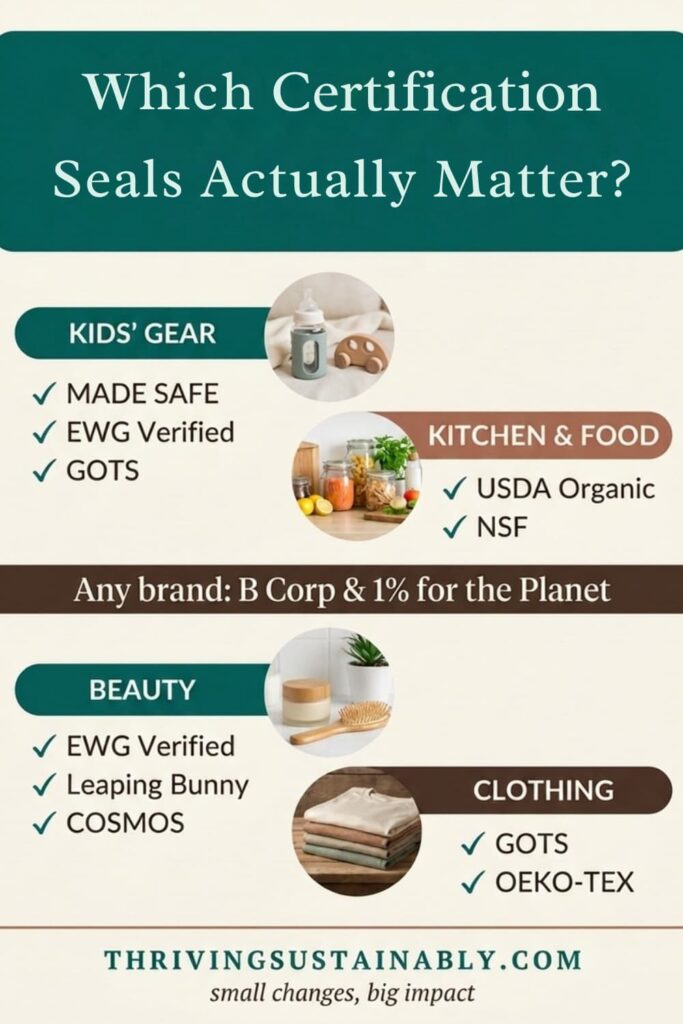
You don’t need all 25. You need the two or three that match what you’re buying:
- Kids’ gear: MADE SAFE, EWG Verified, and GOTS for anything that touches skin or goes in a mouth.
- Kitchen and food: USDA Organic for what you eat, NSF for what filters your water, Zero Plastic Inside for rinse-off products.
- Beauty and personal care: EWG Verified for ingredients, Leaping Bunny for cruelty-free, COSMOS if organic content matters to you.
- Clothing and textiles: GOTS for organic fabric with worker protections, OEKO-TEX as the chemical-safety floor for everything else.
- Any brand, any category: B Corp and 1% for the Planet tell you about the company behind the product.
FAQs on Third-Party Certifications
Yes. Certifications are revoked when audits or re-tests fail, when brands miss renewal requirements, or when violations surface between checks. That enforcement is exactly what separates a certification from a marketing badge, the certifier’s own credibility depends on pulling seals when standards slip.
It ranges from hundreds of dollars for small-brand programs to tens of thousands across multiple certifications, counting application fees, audits, testing, and the operational changes needed to pass. That cost is why a seal signals real commitment, and also why some small ethical brands go without.
Most work on a renewal cycle: annual audits for seals like FSC, GOTS, and USDA Organic, re-verification every three years for B Corp, yearly re-testing for OEKO-TEX. A certification on a product made years ago may no longer be current, which matters most for secondhand or old-stock goods.
Often, but for a specific reason: you’re paying for verified claims rather than hopeful ones. A certified product’s premium covers real costs, cleaner inputs, audited factories, fair wages. Whether that’s worth it depends on the category; we’d prioritize it for things that touch skin, food, and kids.
It means unverified, not necessarily bad. Certification is voluntary and costs money small brands may not have. Check whether the brand publishes full ingredient lists, names suppliers, and answers questions directly. Documented transparency without a seal beats a vague “eco” label every time.
Toward more rigor and more law. The EU is tightening rules on environmental claims, certifiers like The Climate Label are replacing soft “neutral” claims with verified funding requirements, and retailers increasingly require certification for shelf placement. The seals on this page are becoming the entry ticket, not the extra credit.
It is not a certification itself. Amazon adds the badge to products that already hold one of dozens of qualifying third-party certifications, including several from this page like FSC, GOTS, and EWG Verified, plus Amazon’s own packaging standard. Click the badge on a product page to see which actual certification earned it, then judge the product by that seal, not the badge.
Final Thoughts About Third-Party Sustainability Certifications
The smartest way to use sustainability certifications is to learn the two or three seals that match what you buy most, then let the certifier’s database do the verifying for you.
You don’t have to memorize 25 logos. Pick the categories you actually shop, learn the two or three seals that govern them, and let the rest of this page be a reference you come back to. The whole point of third-party certification is that someone else already did the homework.
And when a product carries no seal at all, that isn’t automatically a verdict. Certification costs real money, and some small brands doing everything right haven’t bought the badge yet. That’s when you read the label the way the greenwashing guide teaches, and check whether the brand publishes its suppliers and ingredients anyway. Transparency is the behavior; the seal is just the receipt. Small changes, big impact.
📚 References
- Change Climate Project. (2025). The public launch of The Climate Label and 2025 certification standard. https://www.changeclimate.org/blog/announcing-the-climate-label
- ENERGY STAR. (n.d.). ENERGY STAR impacts. U.S. Environmental Protection Agency. https://www.energystar.gov/about/impacts
- European Commission. (2021). Screening of websites for “greenwashing”: Half of green claims lack evidence [Press release]. https://ec.europa.eu/commission/presscorner/detail/en/ip_21_269
- Fair Trade USA. (n.d.). Why Fair Trade. https://www.fairtradecertified.org
- 1% for the Planet. (n.d.). Accelerating environmental giving. https://www.onepercentfortheplanet.org
All certification marks are the property of their respective owners, shown for identification and education.
🗨️ Which certification do you actually look for when you shop? Tell us in the comments; we’re always curious which seals earn your trust.
More Label-Reading & Plastic-Free Living Reads
- Non-Toxic Living: Where to Actually Start, Room by Room
- Plastic-Free Summer Essentials for Kids
- How to Reduce Plastic Use: 21 Easy Ways That Actually Work
- Is Polyester Plastic? What Your Clothes Are Really Made Of
- What Is Tritan Material? Safer Plastic or Hype?
- The Best Plastic-Free Water Bottles
- 10 Best Non-Toxic Laundry Detergents (Plastic-Free)
We’ve scored every product we recommend on plastic — browse them all in the Plastic Footprint Directory.