
Key Takeaways
- The FDA allows synthetic polymers like polyisobutylene and polyvinyl acetate inside the vague “gum base” ingredient, which is why most conventional gum is essentially flavored plastic.
- Two 2025 studies (UCLA and Queen’s University Belfast) found chewing gum releases hundreds to hundreds of thousands of microplastic particles per piece, and the UCLA team found natural gum shed similar amounts as synthetic, likely from environmental contamination rather than the chicle itself.
- The plastic-free gum brands worth buying name every ingredient (chicle, mastic, spruce resin, candelilla wax), skip “gum base” entirely, and package in cardboard or glass instead of plastic blister packs.
Plastic-free gum sounds like a search that should take five seconds. It does not. Most gum hides its plastic under the vague ingredient “gum base,” and the FDA allows more than 40 different materials under that single term, including the same polymers used in glue and tire inner tubes. A 2025 study from Queen’s University Belfast found that a single stick can release more than 250,000 microplastic particles into your saliva after one hour of chewing.
Let’s be honest, that number sticks with you. The good news: truly plastic-free gum exists, and brands like Simply Gum, Chewsy, and Chicza swap synthetic gum base for chicle, a biodegradable tree sap, and name every ingredient on the label. We dug into the actual ingredient lists for the most-shopped “natural” brands, called out the ones still hiding behind “gum base,” and built a short list of 12 that pass the test. The other surprise from the 2025 research is that even truly natural gum still appears to shed particles, and we cover what scientists think is happening there, too. Some brands on this list we’ve chewed firsthand. The rest are vetted on ingredient transparency, certifications, and brand response to the new research.
Why Plastic Is in Most Gum
Plastic-free gum exists because the FDA’s “gum base” loophole allows manufacturers to blend synthetic polymers like polyisobutylene and polyvinyl acetate into conventional chewing gum without listing them on the label.
Pop a stick of Trident or Extra in your mouth, and you’ve already chewed plastic; you just can’t tell from the box. The ingredient list says “gum base.” That single phrase carries a lot of weight because, under 21 CFR § 172.615, the FDA allows manufacturers to put more than 40 different materials into it, including a long list of synthetic plastic polymers, and they don’t have to tell you which ones are in your gum.
The “gum base” loophole, in plain language
“Gum base” is the chewy part of gum. In old-school gum, that chewy part was tree sap. Today, it’s almost always synthetic. Two of the most common ingredients hiding in “gum base” are polyisobutylene, the same plastic used in car tire inner tubes, and polyvinyl acetate, the polymer used in wood glue and detergent pods. The FDA approves them at specific molecular weights for food contact, but that doesn’t change the fact that they are plastic.
You won’t see “polyisobutylene” on your gum label. You’ll see “gum base.” A 2022 paper in Food Additives & Contaminants described “gum base” as a “compositional black box,” which is the polite scientific way of saying the system is built to obscure.
Why brands don’t just tell you
Two reasons. First, the recipe is treated as a trade secret. Each manufacturer has a proprietary blend, and disclosing it would reveal how competitors could copy it. Second, the regulation lets them get away with it. As long as the polymers used are on the approved list and meet the molecular weight rules, the brand isn’t doing anything illegal by hiding behind “gum base.”
The result is that a regular chewer can pop a piece of Wrigley’s, Trident, Mentos, or Extra and have no realistic way to know what they’re chewing on. The vague label is doing the work the brand wants it to do.
What this means for the “natural” gum aisle
The same loophole applies to gum marketed as “natural.” Brands like PUR, Spry, and Falim use marketing copy that leans hard on words like “natural” or “sugar-free,” then still list “gum base” without further detail. There’s no FDA rule on the word “natural” for chewing gum, so a brand can use it freely, even if the gum has a synthetic base. The only way to know a gum is truly plastic-free is to read the ingredients past the buzzword on the front.
Learn More: What Are Microplastics? Learn what microplastics really are, where they come from, and how they end up in products like chewing gum and the environment around us. Read more →How Much Microplastic Is in One Piece of Gum
Chewing gum can release between several hundred and 250,000 microplastic particles per piece into your saliva, with most particles shed in the first 8 minutes of chewing, according to two 2025 studies from UCLA and Queen’s University Belfast.
Both of the new gum studies came out within weeks of each other in early 2025, and they used different methods to ask the same question: how much plastic is your gum putting in your mouth?
The UCLA pilot study
UCLA engineers Lisa Lowe, Jacob Leonard, and Sanjay Mohanty tested 10 commercial gum brands, 5 synthetic and 5 natural, by having a subject chew each one and collecting saliva samples every 30 seconds for 4 minutes (and again over a longer 20-minute window). Their paper, published in the Journal of Hazardous Materials Letters, found gum released an average of 100 microplastic particles per gram, with some brands releasing up to 600 per gram. A standard piece of gum weighs 2 to 6 grams, so a single chew session can put up to 3,000 plastic particles in your saliva. The UCLA team estimated that the average regular chewer (160 to 180 pieces a year) could swallow about 30,000 microplastics annually just from gum.
The biggest takeaway from their work: 94% of those particles came loose in the first 8 minutes of chewing.
The Queen’s University Belfast study
Around the same time, a first-of-its-kind study led by Dr. Cuong Cao and Udit Pant at Queen’s University Belfast, published in the Journal of Hazardous Materials, used a more sensitive detection method, automated Raman spectroscopy. Their headline number was much higher: over 250,000 microplastic and nanoplastic particles detected in saliva after one hour of chewing a single piece of gum.
The two numbers look different but tell the same story. Belfast caught smaller fragments and chewed for longer. UCLA caught a narrower particle size range and stopped earlier. Both pulled thousands of plastic bits out of one piece of gum.
The polymers showing up in saliva
The UCLA team identified the specific plastics in the saliva samples. Polyolefins (the family that includes polyethylene and polypropylene) were the most abundant. Polyethylene terephthalate (PET), polyacrylamides, and polystyrenes also appeared. Those are the same polymer families that show up in plastic bags, food packaging, and bottle caps, which gives a pretty clear picture of what’s coming off the gum.
Health context, without overstating it
The honest answer is that the long-term health effects of swallowing microplastics from gum specifically haven’t been studied in humans. What scientists have found is microplastics in human blood, lungs, placenta, breast milk, and brain tissue, and recent research has linked higher exposure to inflammation, hormone disruption, and a more than fourfold higher risk of heart attack, stroke, or death for people with microplastics detected in their carotid artery plaque. Reducing gum exposure is one of the easier swaps you can make, because the alternative (natural gum or no gum) is available and not radically more expensive.
Don’t Miss: The Truth About Plastic — Why Plastic-Free Living Matters Learn why reducing plastic use goes far beyond recycling and how small swaps like plastic-free gum can protect your health and the planet. Read more →The Surprising 2025 Finding About Natural Gum
Both natural and synthetic gum released similar levels of microplastics in the 2025 UCLA study, and researchers suspect environmental contamination of the raw ingredients (rather than the chicle itself) is the most likely cause.
Here’s the part that confused everyone. When UCLA tested 5 synthetic and 5 natural gums, they expected the natural gum to shed much less plastic. It did not. Lisa Lowe, one of the lead researchers, said the team was surprised that both types released similar levels.
So how does a natural gum (just chicle, mastic gum, gum arabic, and xylitol) end up releasing polyolefins and PET into saliva?
The leading theories
There are three reasonable explanations, and none of them means the chicle itself is secretly plastic.
- Environmental contamination of the raw ingredients. Microplastics are now in soil, water, and air, and research has shown plants can take them up through both their roots and their leaves. Chicle, mastic, mint, and gum arabic are all plant materials, and they may already carry a microplastic load before they ever reach the factory.
- Manufacturing line contamination. Factory conveyor belts, plastic gloves, plastic packaging, and plastic mixing equipment are everywhere in food production. Each surface can shed particles that end up in the finished product.
- Detection limits. The natural rubbers in chicle and mastic are polymers, just naturally occurring ones. Simply Gum has publicly said that some detection methods can confuse natural rubber with synthetic plastic because both are polymers, and the equipment isn’t always built to tell them apart. The full peer-reviewed methodology has now been published, but the question of whether some natural polymer signals were counted as plastic remains under debate.
What the gum brands are saying
Underbrush has made a related point in its own messaging: even if some contamination shows up at the start, synthetic gum continues to degrade into more microplastics over time, whereas natural gum doesn’t. A natural gum base of chicle and mastic that ends up in a landfill will completely break down. A synthetic base will fragment into smaller and smaller microplastics for decades.
In a comment posted in May 2026, David Acar, who runs a natural gum base manufacturing operation, made a similar point. His company holds a Carbon-14 test report (the standard test for biobased content) and a biodegradability test report for its product, confirming that the gum base contains no plastic or petroleum-derived materials. Contamination during testing is a real possibility, he wrote, and one study with that many open questions shouldn’t be enough to write off the entire natural gum category.
What we take from this
The natural gum category is not blameless, and a “plastic-free” label isn’t a guarantee of zero microplastic exposure. It is still a significant reduction over conventional gum, especially when you factor in the post-chew degradation of synthetic gum bases into the environment. Switching from Trident to Chewsy or Simply Gum cuts the petroleum-based polymer load. It doesn’t get exposure to zero. Reducing total chewing time is the other half of the equation.
How to Read a Gum Label (and Spot Hidden Plastic)
A plastic-free gum will name its actual base ingredient (chicle, mastic, spruce resin, candelilla wax) instead of using the umbrella phrase “gum base,” and will list every other ingredient in clear language.
Five seconds in the gum aisle is all you need. Three signals tell you everything.
The base is named explicitly. Real plastic-free brands list “chicle,” “mastic gum,” or “chicle base (chicle, candelilla wax, citric acid).” If the box just says “gum base” with no further detail, you don’t actually know what you’re chewing. That’s the single most important rule.
The ingredient list is short. Plastic-free gum is usually made from 5 to 10 ingredients. Synthetic gum is often 15–25. If you count more than a dozen items and several of them you can’t pronounce, that’s a tell.
The packaging skips plastic. Real plastic-free brands package in cardboard boxes (Simply Gum, Chewsy, Milliways, Underbrush, Refresh) or metal tins (Greco Gum, Van Man’s). Plastic blister packs and resealable plastic pouches are conventional gum’s hallmark, and they undercut the “plastic-free” claim even when the gum base is clean.
❌ Ingredients to avoid
Skip the gum if you see any of these:
- Gum base (with no further description)
- Polyvinyl acetate (PVA) or polyvinyl alcohol
- Polyethylene or polypropylene
- Polyisobutylene or butyl rubber
- Styrene-butadiene rubber
- Microcrystalline wax or paraffin (petroleum-derived)
- Aspartame or acesulfame K (not plastic, but a different chemical concern)
- BHA or BHT (synthetic preservatives)
✅ Ingredients to look for
These are the building blocks of a real plastic-free gum:
- Essential oils (peppermint, spearmint, cinnamon, citrus)
- Chicle or sapodilla tree sap (the classic chewy base)
- Mastic gum (Pistacia lentiscus resin, usually from Chios, Greece)
- Spruce resin (used by Underbrush and Indigenous communities for centuries)
- Gum arabic (acacia tree sap, used as a binder)
- Candelilla wax (plant-based wax used in Simply Gum and Enamio)
- Carnauba wax (palm-based natural wax)
- Xylitol (a plant-based sugar alcohol that actually supports oral health)
- Stevia or monk fruit (natural sweeteners)
✨ Tip
Natural vs. Gum Base
If a brand uses the word “natural” on the front of the box but lists “gum base” on the back, that’s your answer. Brands like PUR and Spry are textbook examples of this. The marketing word doesn’t override the ingredient line.
Save Your Gum Swap, Pin It for Later 📌
12 Plastic-Free Gum Brands We Trust in 2026
The plastic-free gum brands worth buying in 2026 name their actual base (chicle, mastic, candelilla wax), skip the “gum base” loophole entirely, and package in cardboard or glass rather than plastic blister packs.
These are the gum brands that hold up when you read past the front of the box. Two of them (Chewsy and Simply Gum) we’ve chewed ourselves. The rest are vetted on ingredient transparency, certifications, packaging, and each brand’s public response to the 2025 microplastics research.
Simply Gum
The OG plastic-free gum, with post-chew wraps included
$5 starting price
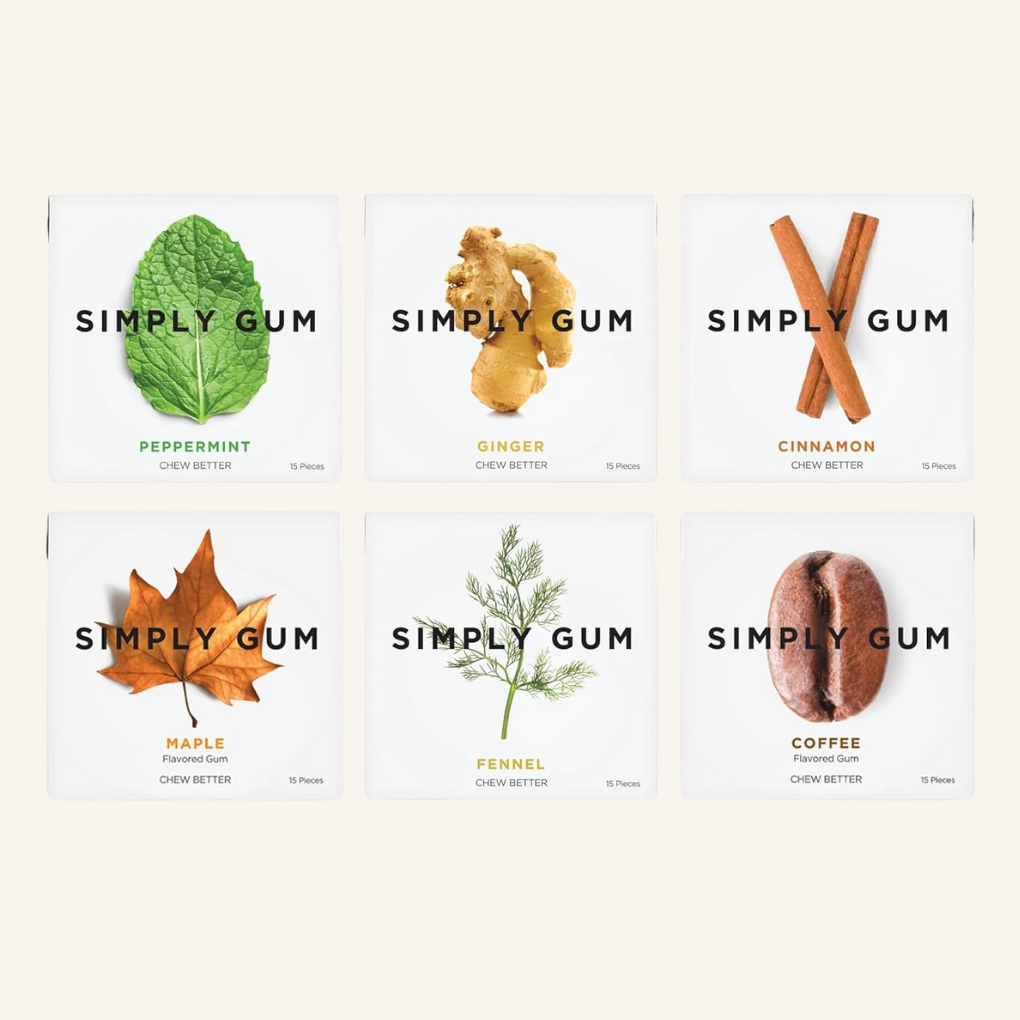
Simply Gum proved the plastic-free gum category could exist. The chicle base is named explicitly on the box: chicle tree sap, candelilla wax, and citric acid. The peppermint, cinnamon, ginger, and fennel flavors skip “natural flavors” entirely and use real plant extracts. Certified Vegan, Non-GMO Project Verified, and Kosher.
When the 2025 UCLA microplastics study put a question mark over natural gum, Simply Gum responded with their own Carbon-14 test results confirming the formula is 100% biobased. The cardboard box flips open to reveal a small stack of paper post-chew wraps, so you have something to dispose of the gum in once the flavor fades.
I tried the spearmint gum and really liked the clean, refreshing taste, even though the flavor faded faster than conventional gum. The texture was firmer than I expected while chewing. The post‑chew wraps are a small touch that makes tossing less messy.
Gum Base
Chicle + Candelilla Wax
✓ Plastic FreeSweetener
Organic Cane Sugar
✓ Plant-BasedBox
Cardboard
✓ RecyclableFormat
Square Pieces
✓ VeganPros
- Carbon-14 verified, 100% biobased formula
- Certified Vegan, Non-GMO Project Verified, Kosher
- Includes paper post-chew wraps for clean disposal
- Made in the USA, woman-founded brand
Cons
- Flavor fades faster than conventional gum
- Texture gets stringy between molars as it warms
- Coffee and Maple flavors do list “natural flavor”
If you want the cleanest, most transparent plastic-free gum on the US market with packaging that thinks through every step including disposal, this is the place to start. The cleanest plastic-free gum you can buy in the US.
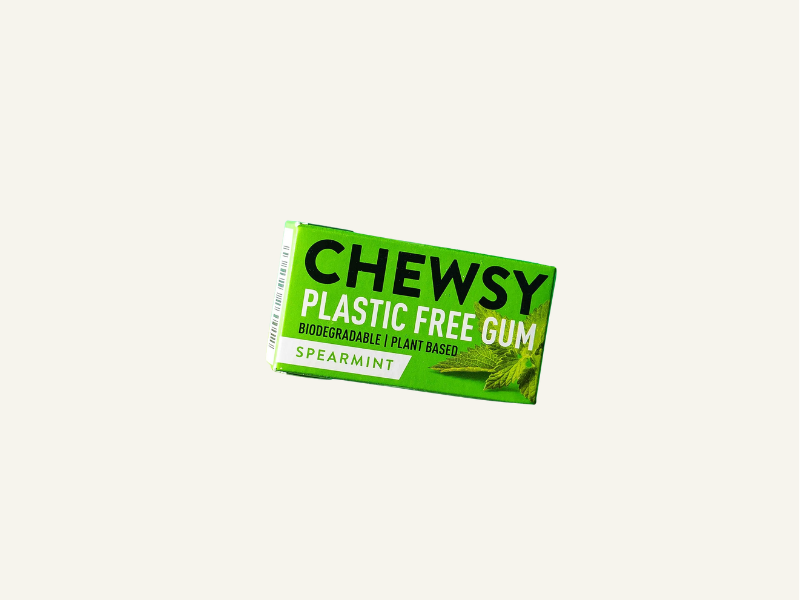
Chewsy
The easiest swap from conventional gum
$20 starting price
Chewsy is the UK-born plastic-free gum that feels closest to conventional gum without actually being it. The ingredient list is spare: xylitol, chicle, gum arabic, natural flavour, sunflower lecithin, and carnauba wax. The base is named explicitly, with the one transparency note being the unspecified “natural flavour” line.
Vegan, sugar-free, aspartame-free, biodegradable, and home compostable. Cardboard box that folds closed for portability. Originally a London brand.
I tried both the Chewsy peppermint and spearmint flavors. The hard outer shell quickly softens into a pleasant, chewy texture, and the peppermint has a satisfying, lasting flavor. It’s the gum I’d recommend to someone switching from Extra or Orbit for the first time. It’s also the sweetest of the natural brands I’ve tried, which I enjoy.
Gum Base
Chicle + Gum Arabic
✓ Plastic FreeSweetener
Xylitol
✓ Plant-BasedBox
Cardboard
✓ RecyclableFormat
Coated Pellets
✓ Sugar-FreePros
- Closest texture and flavor to conventional gum
- Vegan, sugar-free, aspartame-free
- Home compostable, biodegradable
- Four flavors including cinnamon and lemon
Cons
- Lists “natural flavour” without further breakdown
- Sweeter than some chewers may prefer
- Higher starting price than most chicle gums on this list
If you’re switching from Trident or Orbit and want a gum that feels familiar, this is the easiest entry point into plastic-free chewing. The closest taste and texture to conventional gum.
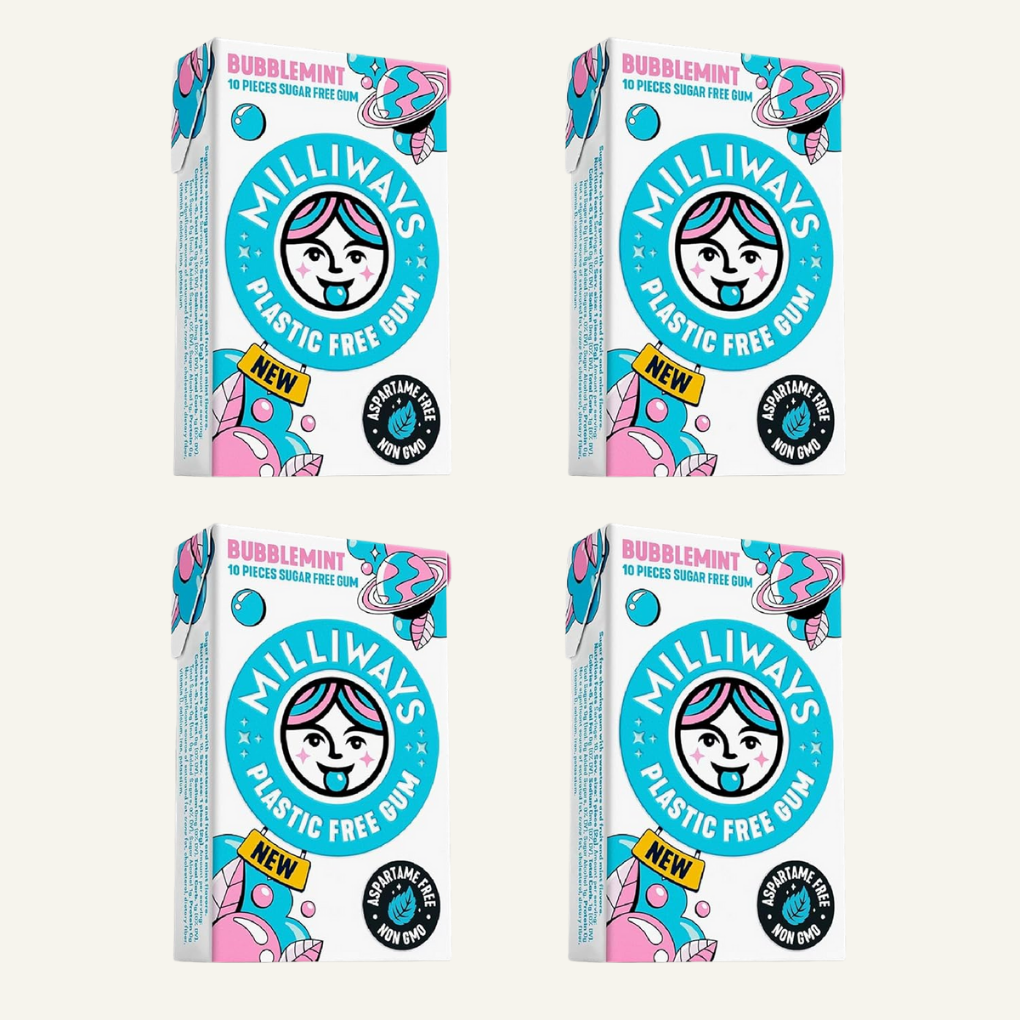
Milliways
Best flavor variety in the category
$10 starting price
Milliways uses 8 plant-based ingredients: xylitol, stevia, chicle from Mexican sapodilla trees, vegetable glycerin, natural flavors, gum arabic, magnesium stearate, and carnauba wax. The box says “natural gum base” but the brand’s FAQ discloses the actual chicle source and full composition.
100% plant-based, vegan, plastic-free, biodegradable. Cardboard box that folds shut. The brand name and FAQ page are a Hitchhiker’s Guide to the Galaxy reference, so points for personality.
Gum Base
Chicle + Carnauba Wax
✓ Plastic FreeSweetener
Xylitol + Stevia
✓ Plant-BasedBox
Cardboard
✓ RecyclableFormat
Coated Pellets
✓ Sugar-FreePros
- 8 plant-based ingredients, all named on the FAQ
- Vegan, 100% plant-based, and biodegradable
- Six flavors including bubblemint and watermelon
- Smaller box format is pocket-portable
Cons
- Front-of-pack uses umbrella “natural gum base”
- Contains “natural flavors” without further breakdown
- Smaller per-box piece count
The plastic-free gum to grab if flavor variety matters or you want something kid-friendly with watermelon and bubblemint options. Best flavor variety in the category.
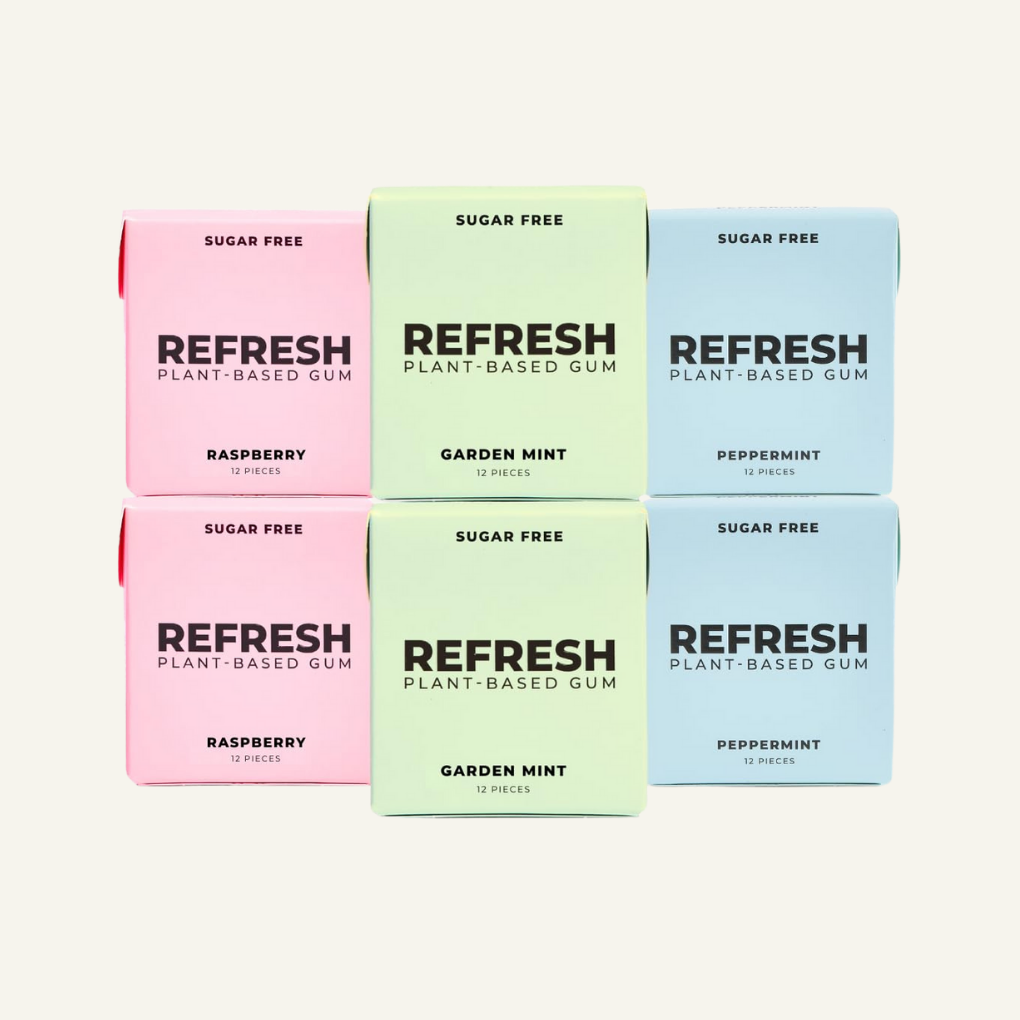
Refresh
The strongest mint flavor on the list
$9 starting price
Refresh Gum is the breath-freshener pick. Real chicle base, sweetened with xylitol and calcium carbonate (which adds a small enamel benefit). Certified Vegan, Non-GMO Project Verified, and palm-oil-free. Hard outer shell softens into a chewy interior.
Two transparency notes: every flavor uses unspecified “natural flavors,” and the fruit varieties color with “fruit and vegetable juice” without naming the source. Neither is a plastic concern, just label honesty. Cardboard box. Made in Germany, based in NY.
Gum Base
Chicle + Calcium Carbonate
✓ Plastic FreeSweetener
Xylitol
✓ Plant-BasedBox
Cardboard
✓ RecyclableFormat
Coated Pellets
✓ Sugar-FreePros
- Certified Vegan, Non-GMO Project Verified
- Palm-oil-free, no artificial sweeteners
- Strongest mint of all plastic-free brands tested
- Calcium carbonate adds light enamel support
Cons
- All flavors list “natural flavors” without naming oils
- Fruit flavors use unspecific “fruit and vegetable juice”
- Hard outer shell can be jarring at first
Reach for this when you need fresh breath fast and the other natural brands feel too mellow. Strongest mint kick on the list.
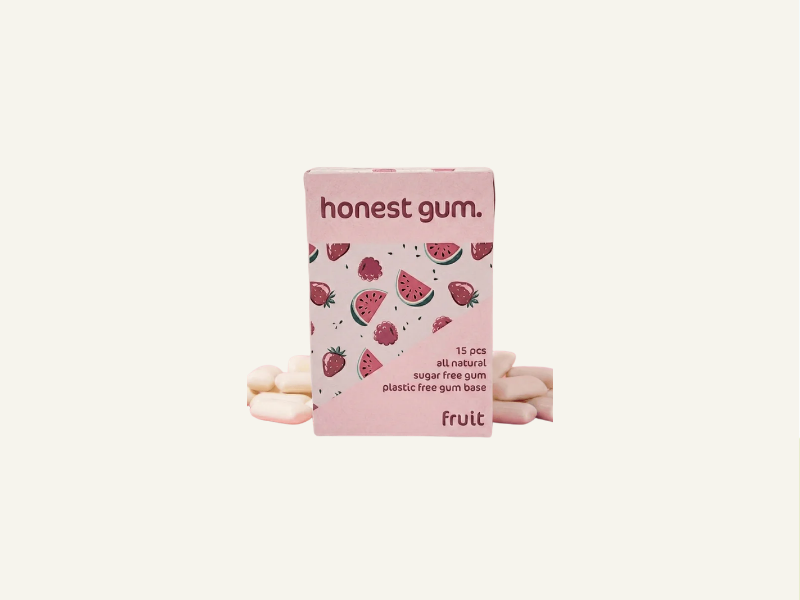
Honest Gum
100% home compostable, breaks down in 12 to 15 months
$33 starting price
Honest Gum launched in 2014 as Australia’s first natural plastic-free gum. Ingredients: xylitol, chicle (Mexican sapodilla), natural flavours, glycerol, arabic gum, magnesium stearate, and carnauba wax. Vegan, gluten-free, sugar-free.
The brand specifically notes the gum and its packaging are 100% home compostable, breaking down in 12 to 15 months. Cardboard box, paper inner wrap, no plastic anywhere.
Gum Base
Mexican Chicle
✓ Plastic FreeSweetener
Xylitol
✓ Plant-BasedBox
Cardboard
✓ CompostableFormat
Square Pieces
✓ Sugar-FreePros
- 100% home compostable in 12 to 15 months
- Australia’s first plastic-free chewing gum brand
- Vegan, gluten-free, sugar-free
- Real plant-based essential oils for flavor
Cons
- “Natural flavours” line is unspecific
- Higher per-box price than most chicle gums on this list
- Flavor fades faster than conventional gum
The most decisively compostable option on this list, with the most rigorous decomposition timeline disclosure. Most decisively compostable pick.
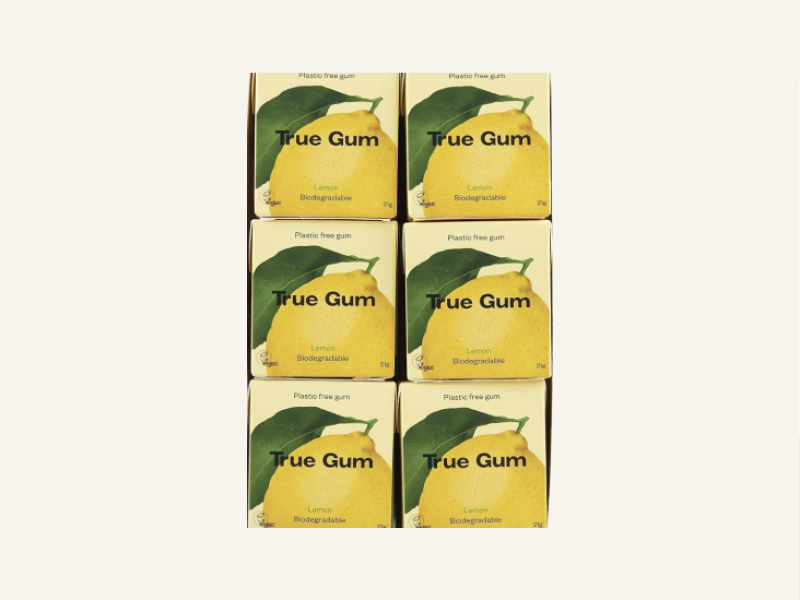
True Gum
Made at the smallest artisan gum factory in the world
$45 starting price
True Gum is the Scandinavian pick, made in Copenhagen at a small artisan factory. Base is chicle from Central American sapodilla trees. Full ingredient list: xylitol, stevia, chicle gum base, natural plant flavours, glycerol, gum arabic, spirulina or carthamus extract for color, and carnauba wax.
100% plant-based, vegan, palm-oil-free, and free of artificial colors and additives. Biodegradable cardboard box with no foil wrappers or plastic strips inside. Compost the gum and the box together.
Gum Base
Chicle + Gum Arabic
✓ Plastic FreeSweetener
Xylitol + Stevia
✓ Plant-BasedBox
Cardboard
✓ BiodegradableFormat
Coated Pieces
✓ Sugar-FreePros
- 7 flavors including liquorice, fennel, ginger turmeric
- No foil wrappers or plastic strips inside the box
- Palm-oil-free, no artificial colors or additives
- Made by hand at a small Danish factory
Cons
- Highest starting price in the lineup
- Flavor fades faster than conventional gum
- Some flavors won’t appeal to mint-only chewers
If you want the most adventurous flavor lineup and a brand that pays attention to every layer of its packaging, this is your gum. Best for flavor explorers.
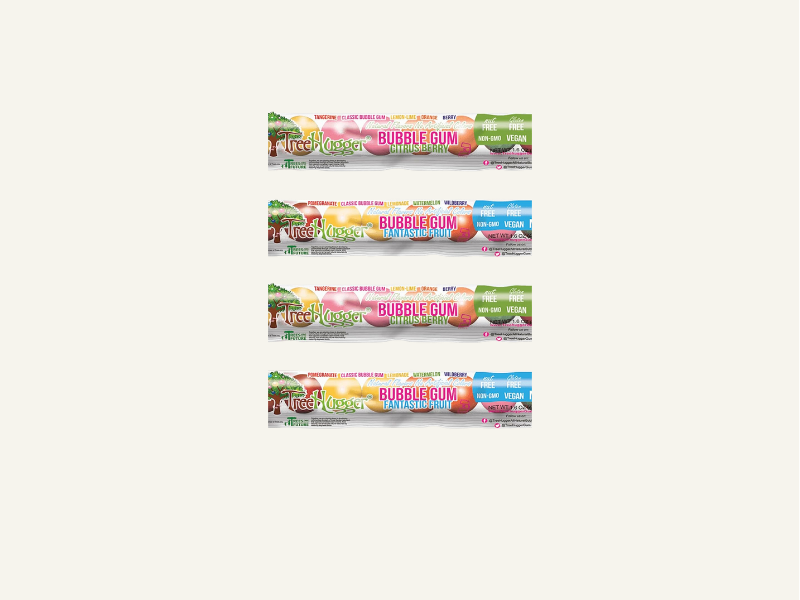
Tree Hugger
The only plastic-free option that actually blows bubbles
$13 starting price
Tree Hugger Gum is the standout pick for real bubble gum. Base is Mayan Rainforest chicle, and the brand partners with Trees for the Future for reforestation. The sugar-free mini sticks use just 5 ingredients: xylitol, 100% real chicle, calcium carbonate, natural flavor, and sunflower lecithin.
Two formats. The mini sticks are sugar-free and xylitol-sweetened, closest to a Trident-style chew. The classic bubble gum uses cane sugar and is the better pick for kids or anyone wanting a real bubble-blower. Non-GMO and vegan. Based in Chevy Chase, Maryland.
I tried the Tree Hugger gum and it instantly reminded me of the sugary, colorful round gum I chewed as a kid. It has the best texture of any plastic‑free gum I’ve tried, and the taste is good. The flavor doesn’t last very long, but the bubbles you can make are surprisingly good.
Gum Base
Mayan Chicle
✓ Plastic FreeSweetener
Xylitol or Cane Sugar
✓ Plant-BasedBox
Cardboard
✓ RecyclableFormat
Sticks + Bubble Gum
✓ VeganPros
- Real bubble gum that holds bubble pressure
- Only 5 ingredients in the sugar-free mini sticks
- Supports Trees for the Future reforestation
- Non-GMO Project Verified and vegan
Cons
- Classic bubble gum uses cane sugar (not tooth-friendly)
- Mini sticks list “natural flavor” without breakdown
- Fruit flavors use unspecific “natural colors”
The only brand on this list that gives you a real bubble gum experience without the synthetic base. Kid-friendly and dentist-friendly in the right format. Best for kids and bubble-blowers.
Nuud
A short, clean ingredient list from a UK brand
$20 starting price
Nuud is the UK-based plastic-free pick built around one of the shortest ingredient lists in the category. The chicle base is sustainably harvested from Mexican sapodilla trees, and the rest is spare: xylitol, chicle, natural flavouring, glycerol, gum arabic, stevia, and carnauba wax.
The one transparency note is the “natural flavouring” line, which isn’t broken down further on the box. Everything else is named explicitly. Plant-based, biodegradable, no aspartame, no artificial sweeteners. Sold in cardboard packaging.
Gum Base
Mexican Chicle
✓ Plastic FreeSweetener
Xylitol + Stevia
✓ Plant-BasedBox
Cardboard
✓ RecyclableFormat
Coated Pellets
✓ Sugar-FreePros
- Short, clean ingredient list
- Plant-based and fully biodegradable
- No aspartame, no artificial sweeteners
- Sustainably harvested chicle
Cons
- Lists “natural flavouring” without breakdown
- Higher starting price than most chicle gums on this list
- Flavor fades faster than conventional gum
One of the shortest, cleanest ingredient lists in the category, with no plastic anywhere in the box. Best short-ingredient-list pick.
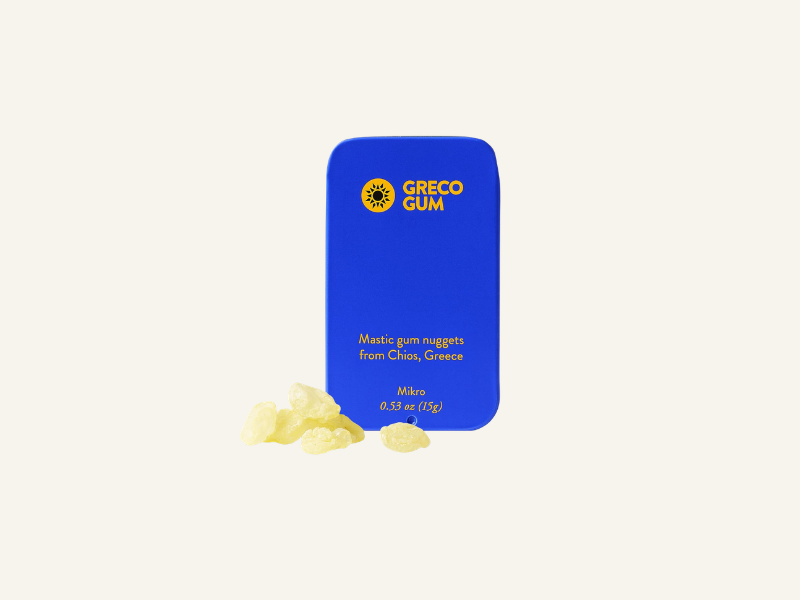
Pure Chios mastic, the jaw-workout pick
$26 starting price
Greco Gum has a one-line ingredient list: whole crystallized resin from the mastic tree, with nothing added. The resin is harvested and sorted by hand on Chios, the Greek island where mastic trees grow, and comes through the island’s official growers’ association.
This is not gum the way Trident is gum. Each piece starts hard and breaks apart for the first minute or two, then binds into a firm, rubbery chew with a piney, unsweetened taste. The Starter Pack holds one tin of softer nuggets and one tin of harder droplets, so you can find the texture you like.
Gum Base
Pure Mastic Resin
✓ Plastic FreeSweetener
None
✓ UnsweetenedBox
Metal Tin
✓ Plastic FreeFormat
Nuggets + Droplets
✓ Sugar-FreePros
- One ingredient: crystallized Chios mastic, nothing added
- Sourced through the official Chios growers’ association
- Metal tins, no plastic blister packs
- Lab results published for every harvest
Cons
- Piney and unsweetened, an acquired taste
- Hard enough to damage fillings, crowns, or braces
- Not a breath-freshener gum
The pick when you want chewing to do more than freshen your breath, made from a single tree resin and nothing else. Best for jaw work and an after-meal chew.
Enamio
Most conventional-feeling texture in the remineralizing category
$25 starting price
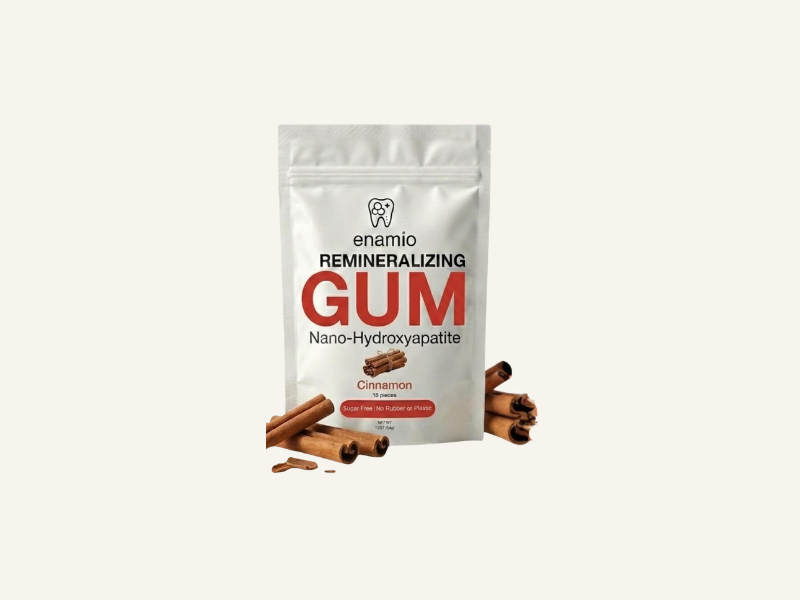
Enamio publishes its full formula on the brand blog: chicle base (chicle + candelilla wax + citric acid), xylitol, monk fruit, carbonate nano-hydroxyapatite (20nm, rod-shaped), calcium glycerophosphate, magnesium citrate, L-arginine bicarbonate, bamboo silica, zinc gluconate, matcha extract, and natural mint oil.
The texture is closer to conventional gum than most natural brands, which Enamio attributes to the candelilla wax and bamboo silica. Strong mint flavor that lasts longer than most natural gums. Made in the USA. One downside: ships in a plastic resealable bag, which downgrades the band to Mostly Plastic Free even though the gum itself is fully plastic-free.
Gum Base
Chicle + Candelilla Wax
✓ Plastic FreeSweetener
Xylitol + Monk Fruit
✓ Plant-BasedBox
Resealable Bag
⚠ Plastic PouchFormat
Square Pieces
✓ Sugar-FreePros
- Most conventional-feeling texture for a remineralizing gum
- Rod-shaped 20nm nano-hydroxyapatite from a documented source
- Strong mint flavor lasts longer than most natural gums
- Full formula published, made in the USA
Cons
- Ships in a plastic resealable bag (downgrades band)
- nHAp source is not the EU-approved manufacturer
- Pricier per piece than non-remineralizing options
The remineralizing gum to pick if texture and flavor matter most, though the plastic packaging holds it back from a fully plastic-free claim. Best remineralizer for texture purists.
Van Man’s
Traditional cattle-bone hydroxyapatite, tin packaging
$12 starting price
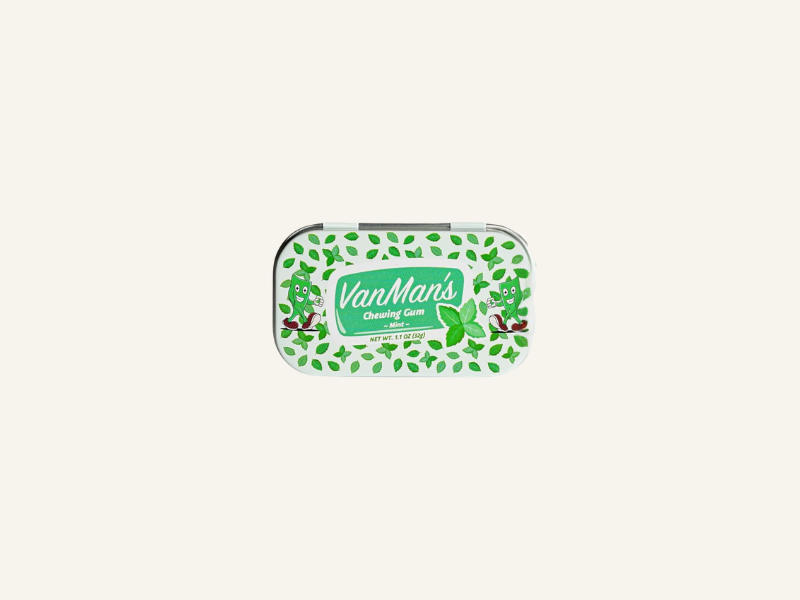
Van Man’s Remineralizing Gum is the only gum on this list that uses animal-derived hydroxyapatite. Six ingredients, all named: chicle gum, mastic gum, organic xylitol, grass-fed cattle bone hydroxyapatite, organic peppermint extract, and organic peppermint oil.
The cattle-bone hydroxyapatite is positioned as a more bioavailable, traditional source than the nano-synthetic versions used in Underbrush and Enamio. Not vegan as a result. The blend of chicle and mastic gives a firmer chew than pure-chicle gums but softer than pure mastic. Ships in a tin.
Gum Base
Chicle + Mastic
✓ Plastic FreeSweetener
Organic Xylitol
✓ Plant-BasedBox
Tin
✓ RecyclableFormat
Soft Pieces
✓ Sugar-FreePros
- Only 6 ingredients, all named explicitly
- Organic peppermint instead of “natural flavors”
- Tin packaging, fully plastic-free
- Most affordable remineralizing option on this list
Cons
- Not vegan (cattle bone hydroxyapatite)
- Single peppermint flavor only
- Firmer texture from chicle + mastic blend
The most affordable, transparent remineralizing gum, with traditional cattle-bone hydroxyapatite for the bioavailability-minded. Most affordable remineralizing option.
Underbrush
The most thorough remineralizing gum, four tree saps
$30 starting price
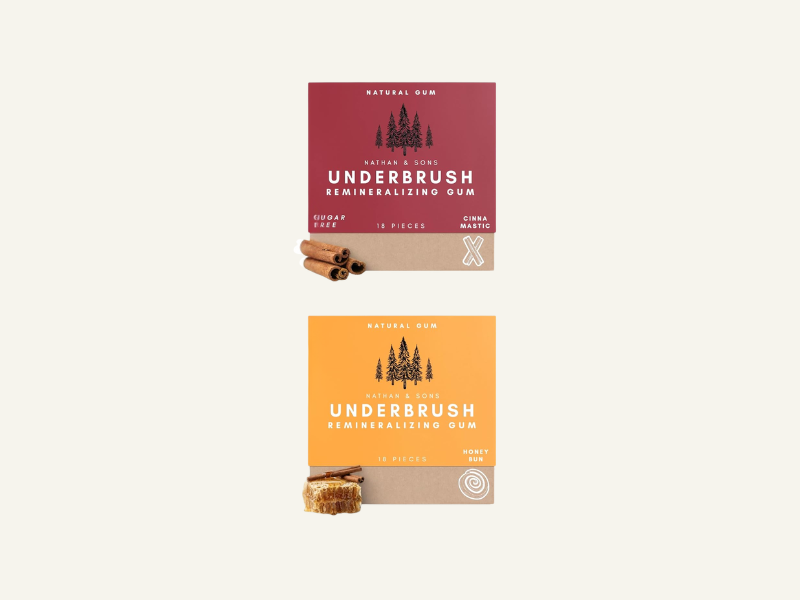
Underbrush by Nathan & Sons is the most thorough natural gum on the market. The base is a blend of chicle, mastic, spruce, myrrh, and arabic gum, four different tree saps doing the job one synthetic polymer does in conventional gum. The full ingredient list on the website goes further than the box, including scientific citations for each ingredient.
Includes EU-approved rod-shaped nano-hydroxyapatite, plus xylitol, erythritol, bentonite clay, calcium carbonate, magnesium carbonate, zinc gluconate, and a natural terpene blend. Diabetic and keto-friendly. Cardboard box with a flip-over lid. One thing to know: not vegan (contains egg shell powder as part of the remineralizing mineral blend). Made by hand in California.
Gum Base
4 Tree Saps
✓ Plastic FreeSweetener
Xylitol + Erythritol
✓ Plant-BasedBox
Cardboard
✓ RecyclableFormat
Square Pieces
✓ Sugar-FreePros
- Four tree saps: chicle, mastic, spruce, myrrh
- EU-approved rod-shaped nano-hydroxyapatite
- Most thorough ingredient transparency in the category
- Made by hand in California, diabetic and keto-friendly
Cons
- Not vegan (contains egg shell powder)
- Pricier than the other remineralizing options
- Cinna-Mastic flavor may be too mild for cinnamon-gum fans
The most transparent and most complete remineralizing gum, blending four different tree saps with EU-approved nano-hydroxyapatite. The premium pick in the category. Most thorough ingredient transparency.
A note on Cerez Pazari, Mystic Gum, Chicza, and Georganics
A few more brands worth knowing about. Chicza is a real Mexican chicle gum cooperative (truly just chicle), but it’s not currently sold in the US. Georganics is a UK oral-care brand with a chicle gum that ships within the UK but not consistently to the US.
Two mastic-only options sit in the same category as Greco Gum: Cerez Pazari (Turkey, ships to the US) and Mystic Gum (US, mastic from Greece). Both are single-ingredient natural mastic resin, similar in flavor and chew to Greco Gum. The texture on these two is firmer than Greco’s hand-sorted nuggets, and the resin is less curated, so they’re better as a backup if Greco is sold out than as a first pick.
Brands to skip, even when the box says “natural”
Three “natural” gum lines that aren’t actually plastic-free, despite marketing copy that suggests otherwise. PUR Gum lists “gum base” with no further details. Spry (“Natural Xylitol Chewing Gum”) also lists “gum base” as a generic term. Project 7 lists “gum base” plus aspartame, acesulfame-K, titanium dioxide, and artificial flavors. Falim (the Turkish brand popular for jaw-exercise content on TikTok) lists “gum base” alongside BHA and BHT preservatives. The “natural” label on the front of these boxes isn’t supported by the ingredient panel.
Where Mastic Gum Fits (and Why It’s Different)
Mastic gum is a single-ingredient natural resin from the Pistacia lentiscus tree on Chios, Greece, and serves a different purpose than chicle-based plastic-free gum, working as a jaw exerciser and traditional digestive aid rather than a breath-freshener.
If your dentist or PT has ever told you to chew gum to strengthen your jaw, mastic is usually what they’re pointing at, even if they don’t say it by name. It’s the gum people reach for when chewing has a job to do beyond freshening breath.
Mastic is a tree resin, not a chicle-style sap. It crystallizes into hard, translucent yellow droplets that have been chewed in Greece for at least 2,500 years. The traditional uses are jaw exercise, breath freshening, and (this is the part with actual modern clinical interest) digestive support. A 2010 randomized trial in the Journal of Ethnopharmacology by Dabos and colleagues showed that mastic improved symptoms of functional dyspepsia in patients who chewed 350 mg three times a day, with 77% of the mastic group reporting improvement, compared with 40% on placebo. Newer studies on H. pylori bacteria show mixed but generally favorable results.
Mastic is different from chicle in three ways:
- Texture. Mastic is much harder than chicle when you start chewing. You usually soften it for a minute before it becomes chewable. Greco Gum recommends chilling it in the refrigerator first, which sounds backward but actually makes the first piece easier (cold resin shatters into chewable bits faster than warm resin softens).
- Flavor. Pure mastic tastes piney, slightly cedar, and earthy. There is no sweetness and no mint. People either love it or hate it. There’s not much in between.
- Purpose. Most people don’t reach for mastic to freshen their breath after a meeting. They reach for it for jaw work, for stomach support, or because they want a gum experience that’s closer to chewing on a tree.
If you’ve tried Greco, Cerez Pazari, or Mystic Gum and didn’t love the texture, that’s fair. It’s not what conventional gum chewers expect. Underbrush includes mastic in its blend without making the whole gum taste like resin, which is a reasonable middle-ground entry point.
What Plastic-Free Gum Can’t Do
Plastic-free gum won’t taste exactly like conventional gum; the flavor fades faster, the texture is firmer, and even the cleanest natural gums still shed some microplastic particles during chewing, per the 2025 research.
Switching to plastic-free gum is mostly a win. It also comes with five trade-offs worth knowing about before you make the swap.
🍃 Flavor doesn’t last as long
Conventional gum is engineered to deliver flavor for an hour or more. That’s mostly because of the plasticizers in the synthetic base, which slowly release flavor compounds. Plastic-free gum uses real essential oils and plant extracts, which dissipate faster. Expect 20 to 40 minutes of real flavor on most natural brands.
👅 Texture takes adjustment
Chicle-based gum starts firmer than synthetic gum and softens as it warms in your mouth. Mastic stays firm. If you grew up on Bubblicious or Hubba Bubba, the first few pieces of a chicle gum can feel like chewing a small rock. Give it about 30 seconds.
⏳ Shelf life is shorter
No preservatives means the gum can dry out within a few months of opening. Store the box in a cool, dry place. A drier piece is just less flexible, not unsafe, but it’s not pleasant. Buy smaller quantities and use them up.
⏱️ Price is higher
Plastic-free gum runs about $3 to $6 for a 12 to 15-piece box, or roughly $0.20 to $0.50 per piece. Conventional gum is closer to $0.05 per piece. The math on switching depends on how often you chew. For an occasional chewer, the annual cost difference is small. For a regular chewer, it adds up.
⚠️ Microplastic exposure isn’t zero
The 2025 UCLA study found that natural gum still contains microplastic particles not from the chicle itself, but from environmental contamination during harvesting and processing. That makes natural gum a reduction strategy, not a zero‑exposure solution. The cleanest swap is simply to chew less and chew one piece longer.
Don’t Miss: Microplastics — Health Risks, Sources, and How to Reduce Exposure Learn more about why we should be concerned about microplastics and how they affect our health, environment, and the food we eat. Read more →How to Cut Microplastic Exposure If You Still Chew Gum
The most effective ways to reduce microplastic exposure from gum are to chew one piece longer (94% of microplastic particles are released in the first 8 minutes), skip gum for young children, and pick brands that name every base ingredient instead of hiding behind “gum base.”
You don’t have to give up gum to lower your exposure. The 2025 research actually gives a clear set of behavior changes that move the needle.
Chew longer, not more
The single biggest lever. The UCLA team found 94% of microplastic particles were released in the first 8 minutes of chewing. After that, the gum has already let go of most of what it’s going to let go of. Chewing one piece for 20 minutes shifts way less plastic into your body than chewing four pieces for 5 minutes each. Don’t reach for a second piece while the first one still has flavor.
Pick a brand that names the base
Stick with the brands above that list “chicle,” “mastic,” or “spruce resin” by name. Skip anything that lists “gum base” without further detail, including brands that call themselves “natural” or “xylitol” gum on the front of the box.
Don’t give it to young kids
Kids absorb chemicals at a higher rate per body weight than adults do, and gum-chewing isn’t necessary for them. Most pediatricians warn against gum entirely for kids under 5 because of the risk of choking, and even older kids don’t gain anything meaningful from regular gum chewing. If the goal is dental support, a xylitol mint or lozenge does the same job without the microplastic question.
Pair gum with other low-plastic swaps
Gum is one small daily exposure source. The bigger sources are bottled water, plastic food storage, and synthetic clothing. If you’re focused on gum specifically, also look at how to avoid microplastics in your kitchen, and use our plastic-free swap finder for the rest of the house.
Use post-chew wraps or compost it
Plastic-based gum stuck to a sidewalk takes 25 years to break down and never fully degrades, contributing to urban litter. Natural chicle gum will biodegrade in soil and is generally compostable in a home compost pile within a year. Wrap the chewed piece in a small square of paper and toss it in your compost or trash.
FAQs on Plastic-Free Gum
Don’t throw any gum on the ground, plastic-free or not. Plastic-free chicle gum will biodegrade in compost or soil within about 12 months in the right conditions (moisture, temperature, microbial activity). Synthetic gum will fragment into microplastics for 25+ years. The right disposal for both is in a wrapper, in the trash, or in a home compost pile for natural gum.
This is a good and underrated question. Chicle is a naturally occurring polymer (like rubber, amber, and tree latex), and synthetic gum bases like polyisobutylene and polyvinyl acetate are man-made polymers derived from petroleum. The difference matters in three ways: chicle is a renewable resource harvested by tapping sapodilla trees, it biodegrades in soil, and it doesn’t carry the petroleum-refining footprint synthetic polymers do. The molecular structure also differs in ways that affect how a finished gum breaks down in landfills.
Yes, Simply Gum’s Bubble Gum and original flavors use organic cane sugar. Most other plastic-free brands use xylitol because it’s tooth-supportive and has a lower glycemic index, but cane sugar versions are available for kids who can’t tolerate xylitol or for adults who prefer it. Just be aware that xylitol is toxic to dogs, and so is any gum containing it. Keep all gum out of pets’ reach, regardless of the sweetener.
Some clinical evidence supports the use of nano-hydroxyapatite (the active ingredient in Underbrush, Enamio, and Van Man’s) for surface enamel repair. The mineral is the same one teeth are made of, and small studies have shown improvements in early-stage enamel demineralization. It’s not a substitute for brushing or for seeing a dentist, but adding it through gum is low-risk if you’re already a regular chewer. The xylitol in those gums also helps reduce the bacteria that cause cavities.
Whole Foods carries Simply Gum and sometimes Chewsy. Target carries Refresh, Simply Gum, and selected plastic-free brands seasonally. Sainsbury’s in the UK now carries Milliways. Most independent natural-foods stores (Earth Fare, Sprouts, MOM’s Organic Market, Erewhon) stock at least one plastic-free option. Amazon stocks most US-shipped brands. For smaller or international brands (Honest Gum, Chicza, Nuud), you’re mostly ordering directly from their websites.
📚 References
- American Chemical Society. (2025, March 27). Chewing gum can shed microplastics into saliva, pilot study finds [Press release]. American Chemical Society. https://www.acs.org/pressroom/presspacs/2025/march/chewing-gum-can-shed-microplastics-into-saliva-pilot-study-finds.html
- Jones, D. (2025, March 17). Chewing gum is plastic pollution, not a litter problem. Phys.org. https://phys.org/news/2025-03-gum-plastic-pollution-litter-problem.html
- Queen’s University Belfast. (2025, March 26). Stop chewing: New research reveals the shocking number of microplastics in a single piece of gum. Queen’s University Belfast. https://www.qub.ac.uk/News/Allnews/2025/StopchewingNewresearchrevealstheshockingnumberofmicroplasticsinasinglepieceofgum.html
- U.S. Food and Drug Administration. (n.d.). 21 CFR § 172.615 — Chewing gum base. Electronic Code of Federal Regulations. https://www.ecfr.gov/current/title-21/chapter-I/subchapter-B/part-172/subpart-G/section-172.615
More Microplastics & Plastic-Free Living Reads
- Plastic Free Tea Bags: 9 Brands That Pass the Test (Most Don’t)
- Microplastics in Food: Sources, Health Risks & How to Avoid
- How to Avoid Microplastics: 15 Easy Swaps
- How to Remove Microplastics: Simple Ways to Reduce Exposure
- What Are Microplastics? A Simple, Useful Definition
- How to Spot Greenwashing: 7 Sneaky Tricks Hidden on “Eco” Labels
- Best Plastic-Free Toothbrush Brands We Trust
- The Truth About Plastic: Why Plastic-Free Living Matters
We’ve scored every food and drink swap on plastic — see them in the Food & Drink directory.