
This content is for informational purposes only and is not a substitute for medical advice.
Key Takeaways
- Microplastics get into food through six main routes: seafood, salt and sugar, bottled water, produce, plastic packaging and cookware, and household dust.
- A 2024 New England Journal of Medicine study linked microplastics in artery plaque to a 4x higher risk of heart attack, stroke, or death.
- The biggest cuts happen in your kitchen: filter your water, keep plastic out of the microwave, and swap plastic cutting boards and containers for wood and glass.
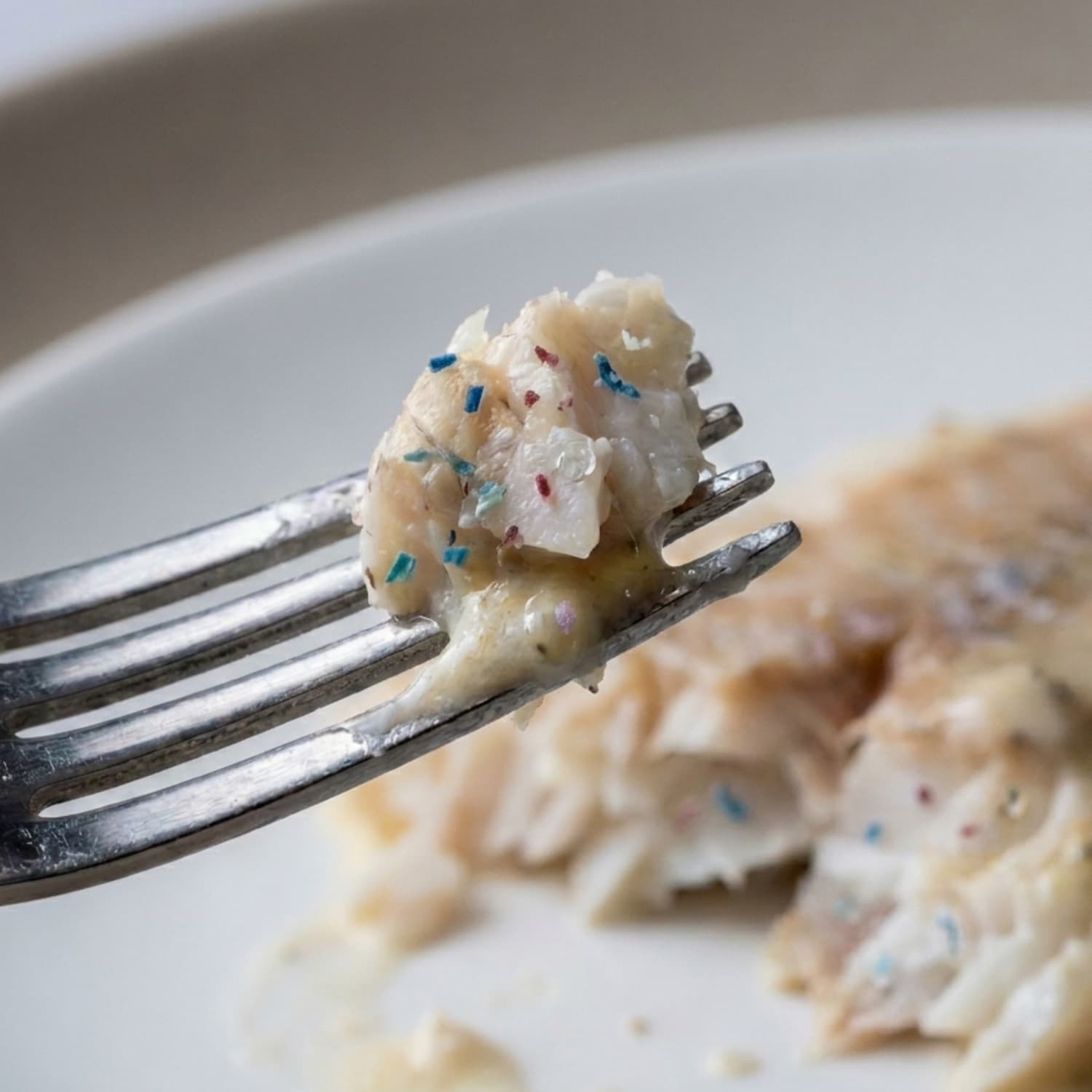
There’s plastic in your groceries. Not just the wrapper, the food itself. Microplastics in food show up in seafood, salt, bottled water, and even fresh produce, and one widely cited estimate puts the average American’s intake at 39,000 to 52,000 particles a year.
So should you panic? No. Should you care? I think so, and a 2024 study that found plastic inside people’s artery plaque is a big part of why. Below, I’ll walk you through where the particles get in, what the science really says about your health, and the seven kitchen swaps that make the biggest dent.
What Are Microplastics in Food?
Microplastics in food are plastic fragments smaller than 5 millimeters that enter meals through water, soil, packaging, and air. Nanoplastics are much smaller particles that can enter the bloodstream.
Flip over almost any plastic container in your kitchen, and you’ll find scratches, scuffs, and worn edges. That waste has to go somewhere, and a lot of it ends up as microplastics, plastic fragments smaller than 5 millimeters. For scale, that’s about the size of a sesame seed, and many pieces are far too small to see.
Nanoplastics are the even smaller cousins, under 1 micrometer, roughly 50 times thinner than a human hair. They form as microplastics continue to break down, and it’s their size that worries researchers. Particles that small can slip through filters, cell barriers, and possibly into the bloodstream.
Both types come from two sources: larger plastics breaking down (bottles, bags, packaging) and direct shedding from items like synthetic fabrics, tires, scrubbed cookware, and worn containers. Once loose, they travel through water, soil, and air, which is how they end up in what we eat.
If This Surprised You, Save It for Your Next Grocery Run 📌
How Do Microplastics Get Into Food?
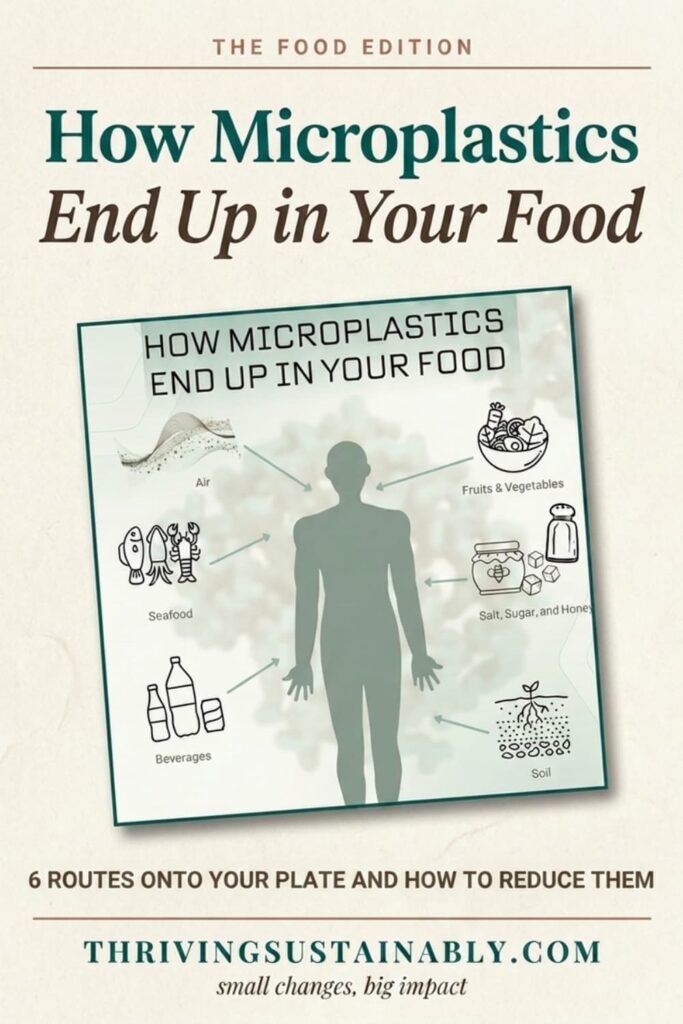
Microplastics get into food in six main ways: contaminated seafood, sea salt and sugar, bottled water, produce grown in polluted soil, plastic packaging and cookware, and airborne fibers that settle on meals.
There’s no single leak to plug. Plastic particles slip into the food chain at the ocean, the farm, the factory, and your own counter. By the time dinner hits the table, it may carry plastic from several of these routes at once.
1. Seafood and Shellfish
Fish ingest fragments floating in oceans, rivers, and lakes. Filter feeders like mussels, oysters, and clams concentrate them as they strain water for food, and since we eat those animals whole, gut and all, we take in whatever they collected. The European Food Safety Authority flagged shellfish as a key exposure route back in 2016, and it still tops the list. Our microplastics in fish guide breaks down which seafood tests highest and lowest.
2. Salt and Sugar
That sea salt grinder traces back to evaporated seawater, plastic and all. A 2018 Environmental Science & Technology analysis of salt brands from around the world found microplastics in more than 90% of them, with sea salt from polluted waters testing highest. Processed sugar and honey have tested positive too, likely picking up particles during refining and storage. Salt mined from old underground deposits tends to carry less.
3. Bottled Water
The bottle itself is the source of contamination here. A 2024 Columbia University analysis found an average of about 240,000 plastic fragments per liter of bottled water, with roughly 90% being nanoplastics. Tap water carries plastic too, just far less of it, which makes a filtered tap your better option.
Don’t Miss: Nanoplastics in Bottled Water A single bottle can release particles small enough to slip past your body’s filters. See what the newest research found and which bottles tested worst. Read more →4. Fruits, Vegetables, and Honey
Crops drink what’s in the soil, and increasingly that includes plastic. Particles in irrigation water and in contaminated soil can be taken up through roots, so washing and peeling only remove what’s on the surface. Honey picks up particles from the environment and processing equipment, so local honey in glass jars is the safer pick. If you grow your own food, our microplastics in soil guide covers compost and mulch choices that keep plastic out of your beds.
5. Food Packaging and Cooking Tools
This is the route you control most. Plastic cutting boards shed shavings with every slice. Plastic-lined cans, takeout boxes, and “paper” cups shed into hot food. And heat makes everything worse: a 2023 Environmental Science & Technology study found that microwaving some plastic baby food containers released millions of microplastics and billions of nanoplastics per square centimeter of container. Refrigerated and room-temperature storage released far fewer.
6. Airborne Dust on Meals
Even a plastic-free meal can pick up plastic while it sits on the table. Fibers shed from synthetic clothing, carpet, and furniture drift in household air and settle on plates. Covering food and airing out rooms reduces what lands on your dinner.
The Foods With the Most Microplastics
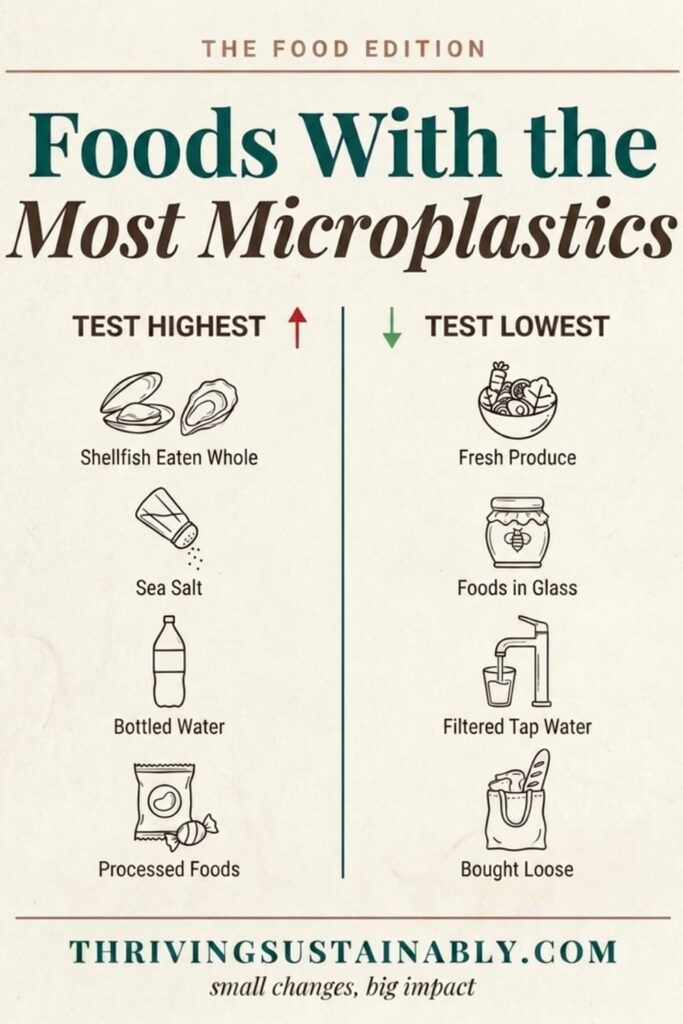
Shellfish eaten whole, sea salt, bottled water, and highly processed foods consistently test highest for microplastics, while fresh whole foods and filtered tap water tend to test lowest.
Walk through the grocery store with this lens, and a pattern quickly emerges: the more processing and packaging there is between the farm and your cart, the more plastic tends to come along. Testing has found microplastics in rice, tea, beer, milk, and packaged proteins, but a handful of categories stand out.
Mussels, oysters, and clams top the list, since we eat them whole, stomach and all. Sea salt, bottled water, and heavily processed foods round out the worst offenders. On the brighter side? Fresh produce, anything bought loose or in glass, and filtered tap water all test low. You don’t need to memorize a contamination chart. Just pick whole foods with less plastic packaging, and you’ve covered most of it without trying.
Microplastics in Food and Your Health
Early research links microplastics in food to inflammation, hormone disruption, and a higher rate of cardiovascular events, but scientists have not yet proven harm at the levels typically found in food.
This is the question every researcher gets asked first, and the answer right now is an unsatisfying “we’re finding out.” What’s changed in the last two years is that the evidence moved from “plastic is present in the body” to “plastic in the body tracks with worse outcomes.”
The Strongest Evidence So Far
A 2024 study in the New England Journal of Medicine followed 257 patients who had plaque removed from their carotid arteries. Patients whose plaque contained microplastics or nanoplastics had over 4x the risk of heart attack, stroke, or death over roughly the next 3 years compared to patients whose plaque was plastic-free. It’s an association, not proof that plastic caused the events, but it’s the most serious human health signal yet.
Chemicals That Hitch a Ride
The particle is only half the problem. Plastics carry additives like BPA and phthalates, chemicals that can interfere with hormones, and the particles also act like sponges, soaking up pesticides and heavy metals from the environment before entering the body.
Your Gut Gets the First Hit
The digestive system meets these particles first. Early studies suggest microplastics may irritate the gut and disrupt the microbiome, the bacterial community tied to digestion, immunity, and even mood. Chronic low-grade gut inflammation is linked to a long list of downstream issues.
What the FDA and WHO Actually Say
Here’s the balanced part most articles skip. The FDA states that current evidence does not demonstrate that microplastic levels in food pose a risk to human health. The World Health Organization reached a similar “more research needed” conclusion for drinking water. That’s not an all-clear. It means the science is young, the detection methods are still maturing, and regulators won’t act ahead of the data. Reducing exposure now is a reasonable hedge, not a panic response.
How Scientists Detect Microplastics in Food
Scientists detect microplastics in food using laser-based imaging and microscopy that identify each particle’s plastic type, though most nanoplastics still slip past standard detection methods.
Finding a particle thinner than a hair inside a mussel takes some clever lab work. Researchers shine lasers at food and water samples and read how the light bounces back, which reveals not just that a particle is plastic but which plastic it is, polyester fiber versus bottle fragment versus packaging film. That’s how the Columbia team counted individual nanoplastics in bottled water for the first time.
The catch is that nanoplastics still evade most standard methods, so nearly every contamination number you read is an undercount. As detection improves, expect the measured numbers to go up, not because food got dirtier, but because we finally have the right magnifying glass.
There’s an even bigger problem than tiny particles: no two labs measure them the same way. The FDA notes there are still no standardized analytical methods for sampling, sample preparation, detection, characterization, or quantification, so different testing methodologies produce different counts from the same food.
FDA scientists published a 2024 paper outlining how measurement methods should be developed and validated before the agency can use study results for regulatory decision-making. Closing that research gap is the first step toward a formal risk assessment, and it’s the main reason regulators keep saying “more data needed” instead of setting limits.
How to Avoid Microplastics in Food: 7 Swaps That Matter Most
To avoid microplastics in food, filter your tap water, never heat food in plastic, and replace plastic cutting boards, scratched containers, and conventional gum with wood, glass, and plant-based options.
You can’t filter the ocean, but you can change the five square feet of kitchen where most of your personal exposure happens. These seven swaps target the biggest sources first. For the whole-home version, our Plastic-Free Swaps page walks you through it room by room.
💧 Filter Your Water
Water is the most consumed substance, making it the highest-impact fix. A quality filter cuts microplastics from tap water, and refilling glass or stainless steel beats bottled water by a wide margin. I use the AquaTru Carafe and notice the difference in taste alone. Our guide to reverse osmosis systems covers which filtration types actually capture plastic.
✨ Tip
The Free Backup Plan
No filter yet? A 2024 study reported by the American Chemical Society found that boiling hard tap water and pouring it through a coffee filter removed up to about 90% of microplastics. The minerals in hard water trap particles as they crystallize.
🔥 Keep Plastic Out of the Microwave
Heat is the single biggest accelerant for particle release. Microwave in glass or ceramic only, and transfer takeout into real dishes before reheating. Our glass food storage roundup has picks that go from freezer to microwave without shedding anything.
♻️ Retire Scratched Plastic Containers
Reusing containers is the right instinct, but scratched and cloudy plastic sheds the most. When a plastic container looks worn, move it to non-food duty and replace it with glass or stainless steel, which never wear out.
🔪 Swap the Plastic Cutting Board
Every knife stroke on a plastic board carves out shavings that go straight into your food. A 2023 estimate reported by the American Chemical Society put it at tens of millions of microparticles a year from chopping. Wood and bamboo boards don’t shed plastic and are naturally antimicrobial.
🥤 Rethink Takeout Containers and “Paper” Cups
Most paper cups and takeout boxes are lined with plastic, and hot liquids pull that lining loose. Bring a real mug or transfer hot food to a mug at home. Your coffee habit alone is worth the swap.
🍬 Check Your Gum
Most gum base is synthetic rubber, a form of plastic. A 2025 UCLA pilot study presented at the American Chemical Society meeting found that gum released an average of about 100 microplastics per gram into saliva, whether the gum was synthetic or “natural.” Plant-based chicle gums avoid the issue. We named names in our plastic-free gum roundup.
🫙 Buy Staples in Glass
Salt, honey, oil, and condiments all show lower contamination when minimally processed and packaged in glass. Rock salt from underground deposits sidesteps the sea salt problem entirely.
Foods That Help Your Body Handle Microplastics
No food removes microplastics from your body, but fiber-rich, colorful diets may help counter the inflammation and oxidative stress that plastic exposure appears to cause.
A quick reality check before the produce aisle pep talk: nothing on your plate “detoxes” plastic. What a good diet can do is support the three systems plastic seems to stress most: your gut, your inflammation response, and your body’s cleanup crew for oxidative damage. Here’s what that looks like on an actual plate.
Fiber Does the Heavy Lifting
Most particles you swallow pass through the body and out, and fiber is what keeps that traffic moving. It also feeds the gut bacteria that early research suggests plastic may disrupt. Oats, beans, lentils, apples, and whole grains are the workhorses here. If you only change one thing about your diet, make it more fiber.
Eat the Rainbow, Literally
Colorful produce like berries, red cabbage, and purple sweet potatoes gets its color from anthocyanins, plant pigments that act as antioxidants. Researchers studying microplastics keep coming back to oxidative stress as one of the main ways particles seem to cause trouble, and antioxidant-rich foods are your built-in counterweight. Deep greens like spinach and kale pull similar weight with different compounds, so variety beats any single superfood.
Feed Your Gut Some Backup
Yogurt, kefir, sauerkraut, and kimchi deliver live bacteria that help keep the microbiome balanced. Since the gut is where microplastics make first contact, a resilient bacterial community is a sensible line of defense. Bonus: sauerkraut in a glass jar checks the low-plastic-packaging box, too.
Pick Anti-Inflammatory Proteins
If early research is correct that microplastics nudge the body toward chronic inflammation, foods rich in omega-3s, like flaxseed, walnuts, and small fish fillets, may help calm it. Small fish like sardines also sit lower on the contamination ladder than shellfish eaten whole, so you get the benefit without the worst exposure route.
✨ Tip
One-Plate Version
Half your plate colorful produce, a quarter beans or whole grains, a quarter protein, something fermented on the side, and filtered water to drink. That covers every point above without a supplement in sight.
So eat the rainbow, not as a cure, but as backup for your body’s own defenses while you cut exposure at the source.
Where Regulators Stand on Microplastics in Food
Regulation is moving slowly. The UN plastics treaty remained unfinished after the February 2026 Geneva session, while the EU has restricted intentionally added microplastics in consumer products.
If you’re waiting for a law to fix this, pack a lunch. But the regulatory picture is busier than the headlines suggest. Here’s what the rules cover today and who’s working on the rest.
What US Law Already Covers
A point most articles get wrong: microplastics aren’t an approved ingredient that slipped past anyone. No FDA regulation authorizes plastic particles as something added to food, they’re treated as environmental contaminants. What the law does cover tightly is food contact materials. Under the Federal Food, Drug, and Cosmetic Act, any plastic used in packaging, processing equipment, food prep surfaces, or cookware must be authorized by the FDA before it’s sold, and that review weighs migration testing (how much of a substance transfers into food) against toxicological data.
Bottled water has its own FDA rules, and the EPA sets tap water contaminant limits, though neither agency has set a specific microplastic limit yet. If the evidence ever shows microplastic levels make a food unsafe, the FDA can take regulatory action, from working with the manufacturer to pulling the product off the market. The FDA tracks microplastics under its broader food chemical safety program, the same umbrella that covers other environmental contaminants in food like lead and PFAS.
Who’s Working Toward New Rules
More agencies than you’d guess. The FDA participates in the U.S. Government Nanoplastics Community of Interest and the White House Interagency Policy Committee on Plastic Pollution and the Circular Economy, and the CDC‘s toxic substances registry is studying the short- and long-term health effects. On the world stage, the United Nations Environment Assembly is the body that called for a legally binding treaty on plastics.
The U.S. State Department leads the interagency efforts on the American side, while the FDA’s Office of Global Policy and Strategy represents the agency at the multilateral intergovernmental negotiating committee meetings. The talks have stalled repeatedly over whether to limit plastic production or just manage waste. At the most recent session in Geneva in February 2026, per the International Institute for Sustainable Development, countries elected a new chair, Chile’s Julio Cordano, and substantive negotiations are expected to resume later this year.
There is real movement elsewhere. The European Chemicals Agency restriction on intentionally added microplastics is phasing plastic out of products like cosmetics and detergents. Scientists are comparing notes across borders too, through National Academies of Sciences, Engineering, and Medicine workshops and a European Commission Joint Research Centre report on nanoplastics, all aimed at building the standardized risk assessment regulators need. Until policy catches up, the fastest progress is the kind you make in your own kitchen, and the brands you support with your grocery money are the votes companies actually count.
📚Learn more
Industry and Policy Solutions for Plastic Pollution
Want to learn more about how companies and governments are tackling the plastic problem and how you can help push for change? Check out these trusted resources:
- Plastic Pollution Coalition – Global network advocating for a plastic-free world through corporate accountability and policy change.
- Break Free from Plastic Movement – International movement pushing for system-wide solutions and brand responsibility.
- Beyond Plastics – Focused on transforming the plastics economy through legislation, education, and advocacy.
- Oceana – Plastics Campaign – Campaigns for protecting oceans and banning harmful single-use plastics.
- Ellen MacArthur Foundation – Plastics Initiative – Driving innovation toward a circular economy where plastics never become waste.
Small choices at home can make a significant difference, but advocating for larger changes helps reshape the system for the better.
FAQs on Microplastics in Food
Generally, yes, but organic certification covers pesticides and farming practices, not plastic. Organic crops grown in contaminated soil or irrigated with contaminated water can still contain microplastics, so “organic” lowers the odds without guaranteeing anything.
They can be. Most cans are lined with a thin plastic coating to prevent corrosion, and that lining can shed particles and chemicals into food, especially acidic foods like tomatoes. Glass jars are a lower-plastic alternative for pantry staples.
No. Plastic particles survive cooking, freezing, and digestion. Worse, heating food in plastic increases the number of particles released, so cooking methods affect how much plastic gets into the food, not whether it breaks down.
Almost never. The largest microplastics approach sesame-seed size, but the vast majority are microscopic, and nanoplastics are thousands of times smaller. Clean-looking food and clear water can still carry particles, which is why lab detection matters.
Generally yes. Each processing and packaging step provides an opportunity for contact with plastic equipment, films, and liners. Studies consistently find more particles in heavily processed, heavily packaged foods than in fresh whole foods.
There’s no proven method. Your body naturally clears many particles through digestion, though some accumulate in tissues. The practical move is to cut new intake, and our guide on removing microplastics from your home covers where to start.
Final Thoughts About Microplastics in Food
Microplastics in food are unavoidable in 2026, but filtering water, keeping plastic away from heat, and choosing whole foods in glass can cut your intake dramatically while research catches up.
Plastic in food sounds like a problem too big for one kitchen, and at the global scale, it is. But your personal exposure is surprisingly local. Most of it runs through your water, your containers, and your packaging choices, and all three are yours to change this week.
Start with the water filter, since nothing else comes into contact with as much of what you consume. Then let plastic age out of your kitchen naturally: when a container scratches or a cutting board grooves, replace it with glass or wood and don’t look back.
The science will keep developing, and we’ll keep updating this guide as it does. In the meantime, small changes really do add up to a big impact, one meal at a time.
📚 References
- American Chemical Society. (2023, June). Cutting boards can produce microparticles when chopping veggies. American Chemical Society. https://www.acs.org/pressroom/presspacs/2023/june/cutting-boards-can-produce-microparticles-when-chopping-veggies.html
- American Chemical Society. (2024, February 28). Want fewer microplastics in your tap water? Try boiling it first. American Chemical Society. https://www.acs.org/pressroom/presspacs/2024/february/want-fewer-microplastics-in-your-tap-water.html
- American Chemical Society. (2025, March 25). Chewing gum can shed microplastics into saliva, pilot study finds. American Chemical Society. https://www.acs.org/pressroom/presspacs/2025/march/chewing-gum-can-shed-microplastics-into-saliva-pilot-study-finds.html
- Columbia University Mailman School of Public Health. (2024, January 8). Bottled water can contain hundreds of thousands of nanoplastics. https://www.publichealth.columbia.edu/news/bottled-water-can-contain-hundreds-thousands-nanoplastics
- Cox, K. D., Covernton, G. A., Davies, H. L., Dower, J. F., Juanes, F., & Dudas, S. E. (2019). Human consumption of microplastics. Environmental Science & Technology, 53(12), 7068–7074. https://doi.org/10.1021/acs.est.9b01517
- European Chemicals Agency. (2023). Restriction on intentionally added microplastics. https://echa.europa.eu/hot-topics/microplastics
- European Food Safety Authority. (2016). Presence of microplastics and nanoplastics in food, with particular focus on seafood. EFSA Journal, 14(6), 4501. https://doi.org/10.2903/j.efsa.2016.4501
- Hussain, K. A., et al. (2023). Assessing the release of microplastics and nanoplastics from plastic containers and reusable food pouches: Implications for human health. Environmental Science & Technology, 57(26). https://pubs.acs.org/doi/10.1021/acs.est.3c01942
- International Institute for Sustainable Development. (2026). INC-5.3: Where the global plastics treaty talks stand, and why this meeting matters. https://www.iisd.org/articles/explainer/inc5.3-global-plastics-treaty-talks-why-meeting-matters
- Kim, J. S., Lee, H. J., Kim, S. K., & Kim, H. J. (2018). Global pattern of microplastics (MPs) in commercial food-grade salts: Sea salt as an indicator of seawater MP pollution. Environmental Science & Technology, 52(21), 12819–12828. https://doi.org/10.1021/acs.est.8b04180
- Liebezeit, G., & Liebezeit, E. (2013). Non-pollen particulates in honey and sugar. Food Additives & Contaminants: Part A, 30(12), 2136–2140. https://www.tandfonline.com/doi/abs/10.1080/19440049.2013.843025
- Marfella, R., Prattichizzo, F., Sardu, C., et al. (2024). Microplastics and nanoplastics in atheromas and cardiovascular events. New England Journal of Medicine, 390(10), 900–910. https://doi.org/10.1056/NEJMoa2309822
- Pletz, M. (2022). Ingested microplastics: Do humans eat one credit card per week? Journal of Hazardous Materials Letters, 3, 100071. https://www.sciencedirect.com/science/article/pii/S2666911022000247
- U.S. Food and Drug Administration. (n.d.). Microplastics and nanoplastics in foods. https://www.fda.gov/food/environmental-contaminants-food/microplastics-and-nanoplastics-foods
- World Health Organization. (2019). Microplastics in drinking-water. World Health Organization. https://www.who.int/publications/i/item/9789241516198