
Key Takeaways
- A reverse osmosis system blocks PFAS and microplastics at the membrane, but only systems with NSF/ANSI 53 or 58 certification carrying a specific PFOA/PFOS claim are independently verified to do it. Lab-tested by SGS is the next tier down, still credible but not the same as certified.
- AquaTru is the only brand in this guide with a certified PFOA and PFOS reduction claim, which is why its Carafe, Classic, and Under-Sink systems take three of the eight spots.
- Match the system to your situation: AquaTru Carafe for one or two people who want glass, AquaTru Classic for small families, AquaTru Under-Sink for a hidden install, Waterdrop G3P800 for high-volume households, Waterdrop X16 for maximum flow, Frizzlife PD600-N for tankless on a tighter budget, iSpring RCC7AK-UV for well water, and Bluevua RO100ROPOT for the lowest entry price.
Plastic particles turn up in about 94% of US tap water samples, according to Orb Media’s tap water investigation. A reverse osmosis system blocks them at the membrane at around 99.9%, according to a 2023 review of point-of-use filtration devices.
If you’ve been filtering through a fridge or pitcher and wondering whether it’s actually catching the stuff that matters, the short answer is: probably not. Fridge filters mostly handle chlorine and off-flavors. The rest slips right through, including PFAS forever chemicals, lead, pharmaceutical residues, and the microplastics that everyday filtration just can’t catch. RO is the home filter most people can actually buy that physically blocks them, because the membrane’s pores are about 1,000 to 10,000 times smaller than the smallest microplastic particle.
There are brands actually committed to proving their RO systems do the job. We considered NSF, IAPMO, and WQA certifications, third-party SGS lab testing for PFAS, real-world filter costs, and how systems hold up after a year or two of use, when narrowing the field to 8 picks across countertop, under-sink, and tankless formats. I also have the AquaTru Carafe in my own kitchen, so that pick comes with a personal review block.
Why PFAS and Microplastics Belong at the Top of Your Water List
Reverse osmosis is the only common home filtration method that physically blocks both PFAS, or forever chemicals, and microplastics at the same time, since RO membranes have pores roughly 1,000 to 10,000 times smaller than the smallest microplastic particles.
Your tap water can pass every current safety test and still contain contaminants the test wasn’t looking for. That’s where PFAS and microplastics live. They’re in nearly everyone’s water, they’re showing up in our blood and our kids’ lunches, and your local treatment plant wasn’t built to catch them.
PFAS, the Forever Chemicals
You’ve probably come into contact with PFAS this week without knowing it. They’re the slick stuff on non-stick pans, the water-repellent layer on raincoats, the grease shield on fast food wrappers. Manufacturers love them because they don’t break down. Your body has the opposite reaction, because they don’t break down inside you either. The most-studied ones (PFOA and PFOS) are linked to hormone disruption, weaker immune response, and a handful of cancers.
In April 2024, the EPA finally drew a line. It set the first enforceable nationwide limits on PFAS in drinking water, including just 4 parts per trillion for PFOA and PFOS. About 6% to 10% of public water systems will need to make changes to hit the new limits, and they have until 2029 to do it. Five years is a long wait for the water you drink every day. That’s where a good RO system comes in.
Microplastics, the Invisible Sip
Microplastics are tiny plastic bits smaller than 5 millimeters across, and nanoplastics are even smaller, way too small to see without a high-powered microscope. Here’s the kicker: they’re in almost everybody’s tap water. An Orb Media investigation tested 159 tap water samples from 14 countries and found plastic particles in 83% of them. In US samples, the hit rate jumped to 94%.
Bottled water doesn’t fix it either. A 2024 Columbia University study counted roughly 240,000 plastic particles in a single liter of popular bottled water brands. About 90% were nanoplastics small enough to slip into your cells. Here’s the part to hold onto, though: RO is the home filter most people can actually buy that physically blocks them. The membrane’s pores are about 0.0001 microns wide, which is 1,000 to 10,000 times smaller than the smallest microplastic. Pitcher filters can’t touch that.
Learn More: Does Reverse Osmosis Remove Microplastics? See how RO filtration compares to other water purification methods and which one removes the most contaminants. Read more →How Reverse Osmosis Actually Works
A reverse osmosis system uses water pressure to push tap water through a semi-permeable membrane that allows water molecules to pass while blocking dissolved contaminants, including PFAS, microplastics, lead, arsenic, and pharmaceutical residues.
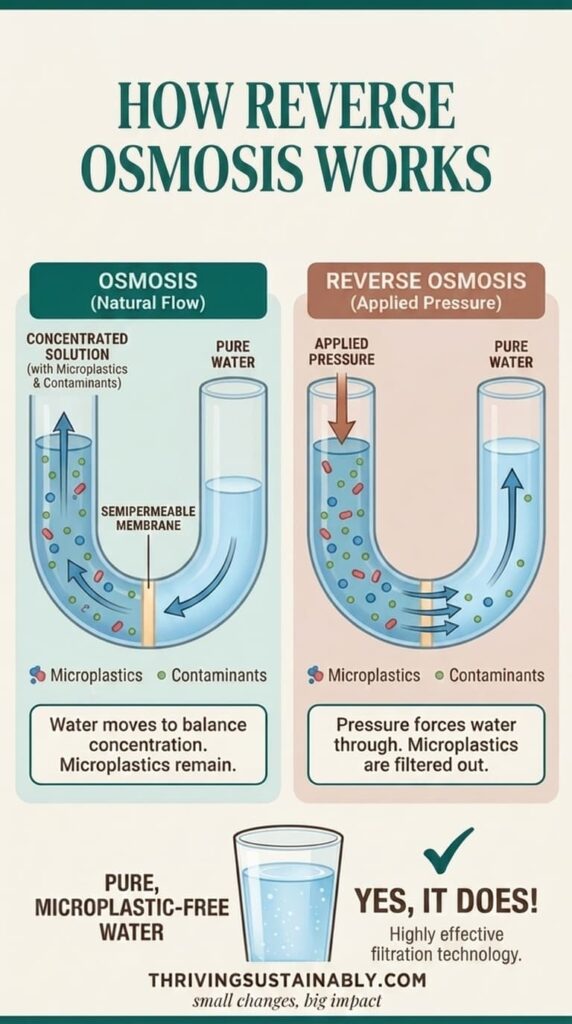
Think of an RO system like a really thorough bouncer at the door of your glass. Water gets in, almost nothing else does. It’s the same technology that makes ocean water drinkable and bottles the spring water you see at the store, just shrunk down to fit under your sink or on your counter.
The heart of the whole system is one part: the membrane. Picture a sheet so fine its openings are about a hundred-thousandth of a millimeter wide. Water molecules slip right through. PFAS, lead, microplastics, and dissolved solids stay behind and get flushed out of the drain line.
Before water even reaches the membrane, it passes through a couple of warm-up stages. A sediment filter catches sand and rust (yes, your pipes shed both). One or two carbon filters strip out the chlorine taste and the funky smells. After the membrane, a final carbon polish makes the water taste like nothing at all, which is exactly what you want.
Some systems add a UV stage that zaps bacteria and viruses (great for well water), and some include a remineralization cartridge that adds a pinch of calcium and magnesium back in for taste.
How We Chose These Reverse Osmosis Systems
The systems featured here were filtered against four evidence criteria: independent NSF or IAPMO certification, verified or SGS-tested PFAS reduction, real-world ownership feedback over multiple years, and total cost of ownership across a five-year window.
There are easily over a hundred reverse osmosis systems on Amazon, and almost every single one claims to remove PFAS. So how do you actually pick? Here are the four things I checked before any system was added to the list.
1. Real certification, not just marketing words. Every pick in this guide has been independently certified by NSF, IAPMO, or the Water Quality Association for at least the core RO standards (NSF/ANSI 58 or 372). These three organizations actually test water filters in a lab and hold the brand to specific standards. (More on what those numbers mean in a section below.)
2. PFAS evidence, certified or lab-tested. This was the big one. The three AquaTru systems carry a certified PFOA and PFOS reduction claim under NSF 53 or 58. Bluevua, both Waterdrop systems, and Frizzlife back their PFAS claims with third-party SGS lab testing, and iSpring publishes its own testing. That is a step below “certified for PFAS” but well above “we promise.” The status pill at the top of each card tells you which level you’re getting.
3. Microplastics, too, not just PFAS. Every RO membrane in this guide has pores small enough to physically block microplastics and even nanoplastics. AquaTru made waves in December 2024 by becoming the first consumer brand to actually get certified for microplastic reduction. The others all block them in practice, just without the specific cert on paper yet.
4. Filter cost, install hassle, and how long it lasts. A perfect membrane is useless if the filter swaps cost a small fortune or the plastic housing cracks in year two. So I looked at the five-year total cost (system plus filters), how hard the install actually is, and what people who’ve owned these for 2 or 3 years are saying.
Learn More: Microplastics — Health Risks, Sources, and How to Reduce Exposure Discover where microplastics come from, how they get into our homes, and what you can do to lower your exposure. Read more →Quick Comparison of the 8 Picks
The eight best reverse osmosis systems for 2026 differ most in PFAS evidence tier, format, and household size match. AquaTru leads in certification depth, Waterdrop in capacity, Frizzlife in tankless value, iSpring in well water, and Bluevua in entry price.
A quick side-by-side before the full reviews. Use this to spot the right format and capacity for your household, then jump to the matching card below for the full story.
8 Best Reverse Osmosis Systems for PFAS & Microplastics in 2026
The best reverse osmosis systems for PFAS and microplastics in 2026 are the AquaTru Carafe, AquaTru Classic, AquaTru Under-Sink, Bluevua RO100ROPOT, Waterdrop G3P800, Waterdrop X16, Frizzlife PD600-N, and iSpring RCC7AK-UV, ranked by certification strength and use case rather than price alone.
Each pick below earns its spot on the list for a specific reason: AquaTru leads in certification depth, Waterdrop in capacity, Frizzlife in tankless value, iSpring in well water and UV, and Bluevua in entry price. Three of the eight are countertop systems for renters and small kitchens, and five are under-sink systems for homeowners who want filtered water on a permanent tap.
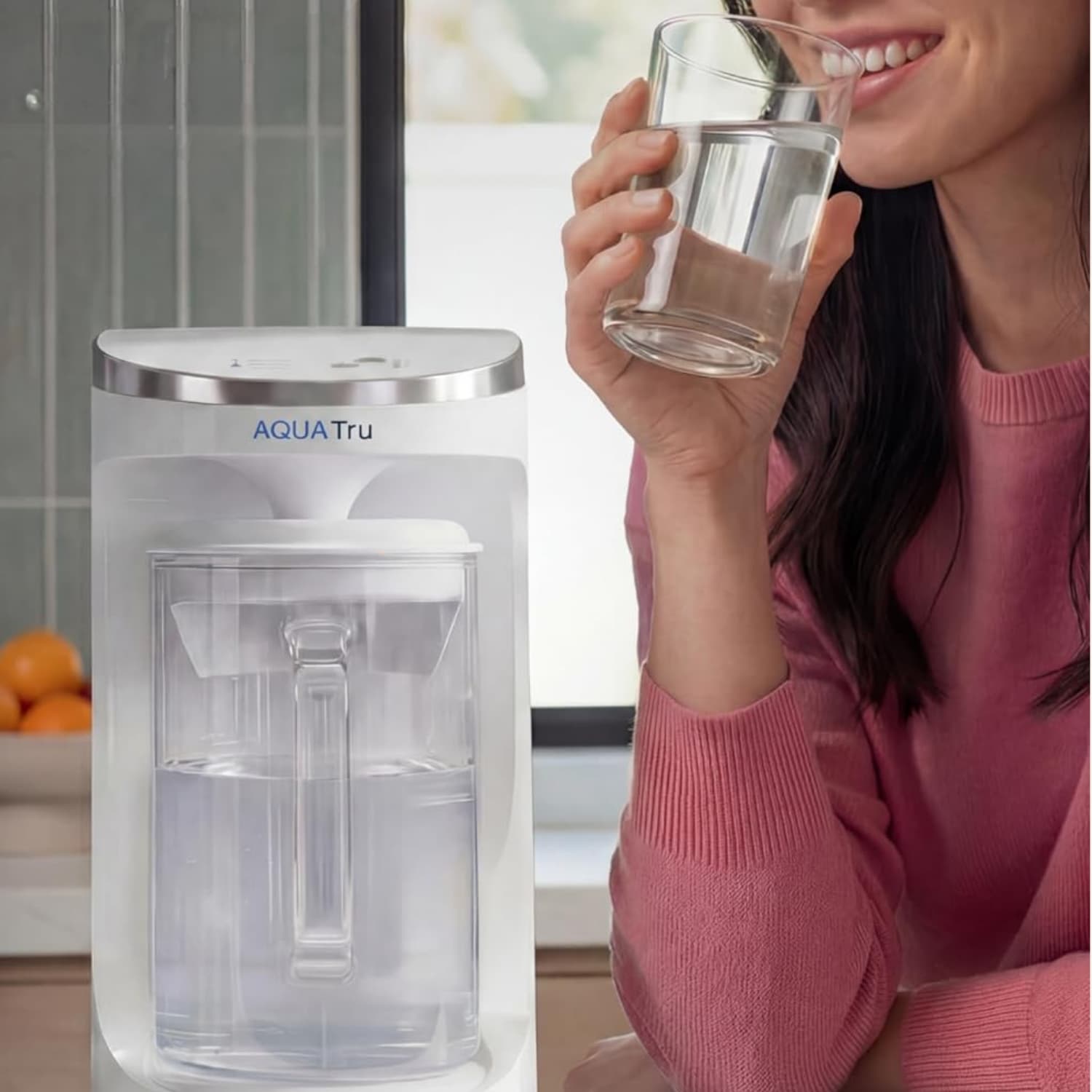
Best overall countertop, the one in my own kitchen
$375 list price
The AquaTru Carafe is the smaller, sleeker sibling of the AquaTru Classic, built around a 64-ounce glass carafe instead of a plastic tank. It carries IAPMO certification to NSF Standards 42, 53, 58, and 372, with verified PFOA and PFOS reduction and certified microplastics removal added across the AquaTru line in December 2024.
The glass carafe is the standout for anyone who doesn’t want filtered water sitting in a plastic reservoir. It fits in a fridge door, which means cold water is always ready. The smaller capacity means more frequent filtering cycles compared to the Classic, the right trade for one or two people but tight for a busy family.
Certification
NSF 42, 53, 58, 372
✓ IAPMO CertifiedPFAS
PFOA & PFOS Reduction
✓ Certified ClaimCarafe
Glass, Not Plastic
✓ Plastic FreeCapacity
64 oz Carafe
◎ Small HouseholdPros
- Glass carafe, no plastic in contact with filtered water
- Same PFAS certification as the Classic
- Fits in a standard fridge door
- Smallest footprint in the AquaTru lineup
Cons
- 64 oz fills up fast in a multi-person household
- Filtration cycle has a noticeable pump hum
- Glass means more careful handling than a plastic tank
My Experience
The AquaTru Carafe lives on our kitchen counter and gets used multiple times a day. The water tastes clean in a way fridge-filtered water never did, and the glass carafe was the deciding factor for me. I didn’t want a plastic reservoir holding water that’s supposed to be cleaner.
The trade-off for our household: between my son and me, we go through filtered water faster than the carafe refills. If I were buying again knowing how much we drink, I’d go with the Classic for the larger tank, or the Under-Sink for unlimited flow. The Carafe is still the right pick for one or two people, especially in an apartment.
Same certification as the Classic in a smaller, glass-forward form, perfect for one or two people in a smaller kitchen.Best for: Apartments, small kitchens, anyone who wants filtered water out of glass instead of plastic
Best PFAS-certified countertop, certified end to end
$475 list price
The AquaTru Classic is the strongest PFAS-certified pick on the market, and it’s the system most “best of” lists default to for a reason. It’s IAPMO-certified to NSF Standards 42, 53, 58, 401, and the legacy P473 framework, covering 84 contaminants including PFOA, PFOS, lead, fluoride, chromium-6, and pharmaceutical residues. In December 2024, AquaTru added certified microplastics reduction across the lineup.
It’s plug-and-play, no plumbing required, and the digital filter-life tracker takes the guesswork out of replacement timing. The 3-gallon tank holds enough for a small family’s daily drinking and cooking. The trade-off is the waste ratio at around 4:1, higher than tankless under-sink models. For households of one to three drinking the most filtered water, the certification depth makes up for it.
Certification
NSF 42, 53, 58, 401
✓ IAPMO CertifiedPFAS
PFOA & PFOS Reduction
✓ Certified ClaimMicroplastics
Certified Reduction
✓ Dec 2024Waste Ratio
~4:1 Pure to Drain
◎ AveragePros
- The deepest PFAS certification on the market
- No plumbing or installation needed, 10-minute setup
- Certified microplastics reduction across the line
- Digital filter-life tracker
Cons
- Higher waste ratio (~4:1) than tankless systems
- Takes counter space, similar footprint to a coffee maker
- Filtration cycle has a noticeable pump hum
If you want the strongest verified PFAS protection with zero installation, this is the pick.Best for: Renters, small families, anyone who wants certified PFAS removal without touching plumbing
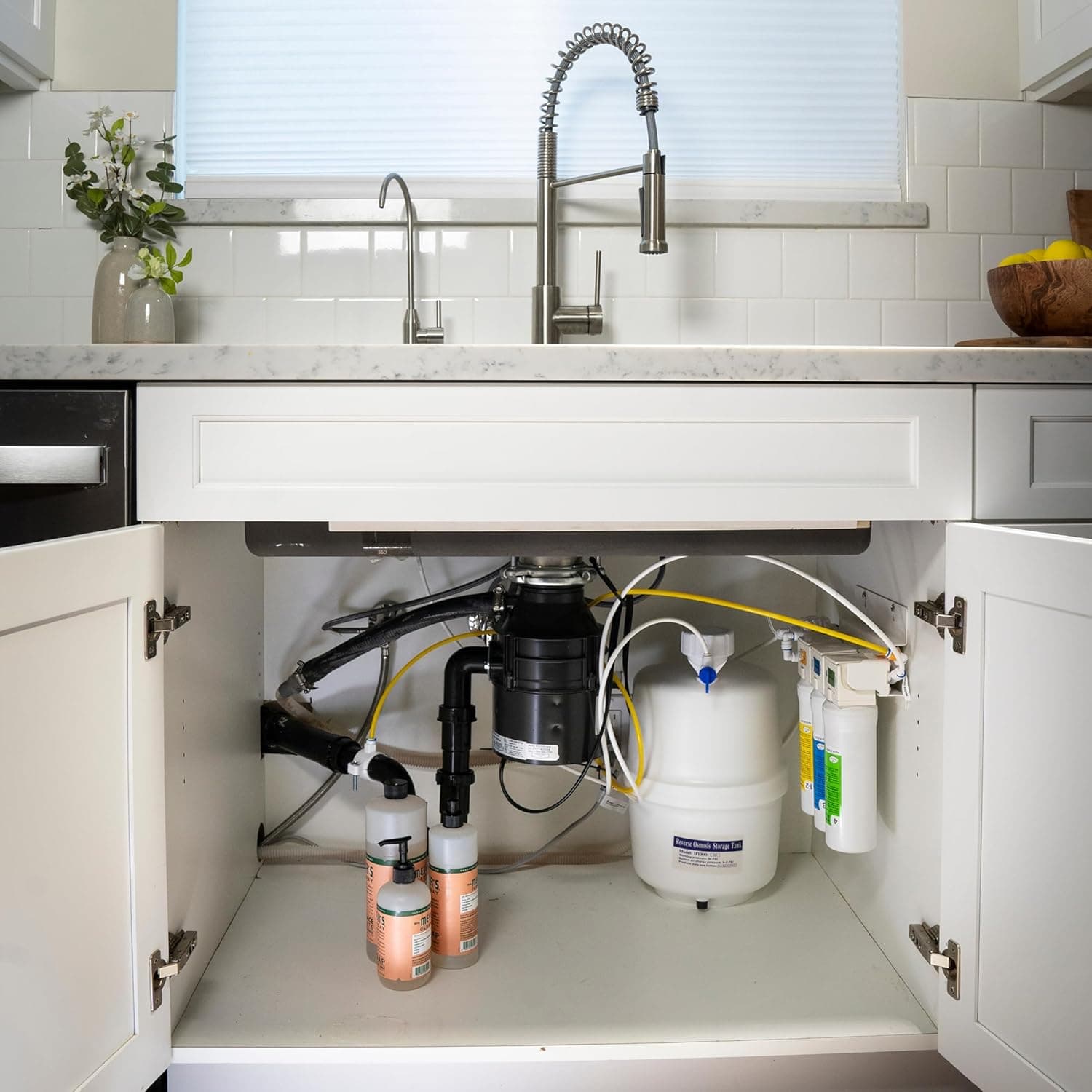
Best hidden install, frees up counter space
$375 list price
The AquaTru Under-Sink is the answer for anyone who wants AquaTru’s certification depth without sacrificing counter space. It carries the same IAPMO certification to NSF Standards 42, 53, 58, 401, and the legacy P473 framework, covering PFOA, PFOS, lead, fluoride, and 80-plus other contaminants.
The filters last longer than the countertop versions (360 to 1,200 gallons depending on the cartridge). Installation runs one to two hours for someone comfortable with basic plumbing. A dedicated filtered-water faucet drops next to your main one, and the system itself tucks under the cabinet.
Certification
NSF 42, 53, 58, 401
✓ IAPMO CertifiedPFAS
PFOA & PFOS Reduction
✓ Certified ClaimFilter Life
360-1,200 Gallons
✓ Long CycleInstall
DIY, 1-2 Hours
◎ Basic PlumbingPros
- Frees up counter space entirely
- Same certification depth as the Classic
- Longer filter life than countertop versions
- Dedicated faucet, no need to swap pitchers
Cons
- Requires plumbing comfort or a plumber
- Needs cabinet space and a drilled hole for the faucet
- Renters with limited cabinet access may need landlord sign-off
The AquaTru certification depth without the counter footprint, ideal for families who want unlimited filtered water on tap.Best for: Homeowners, larger households, anyone who’d rather skip the countertop setup
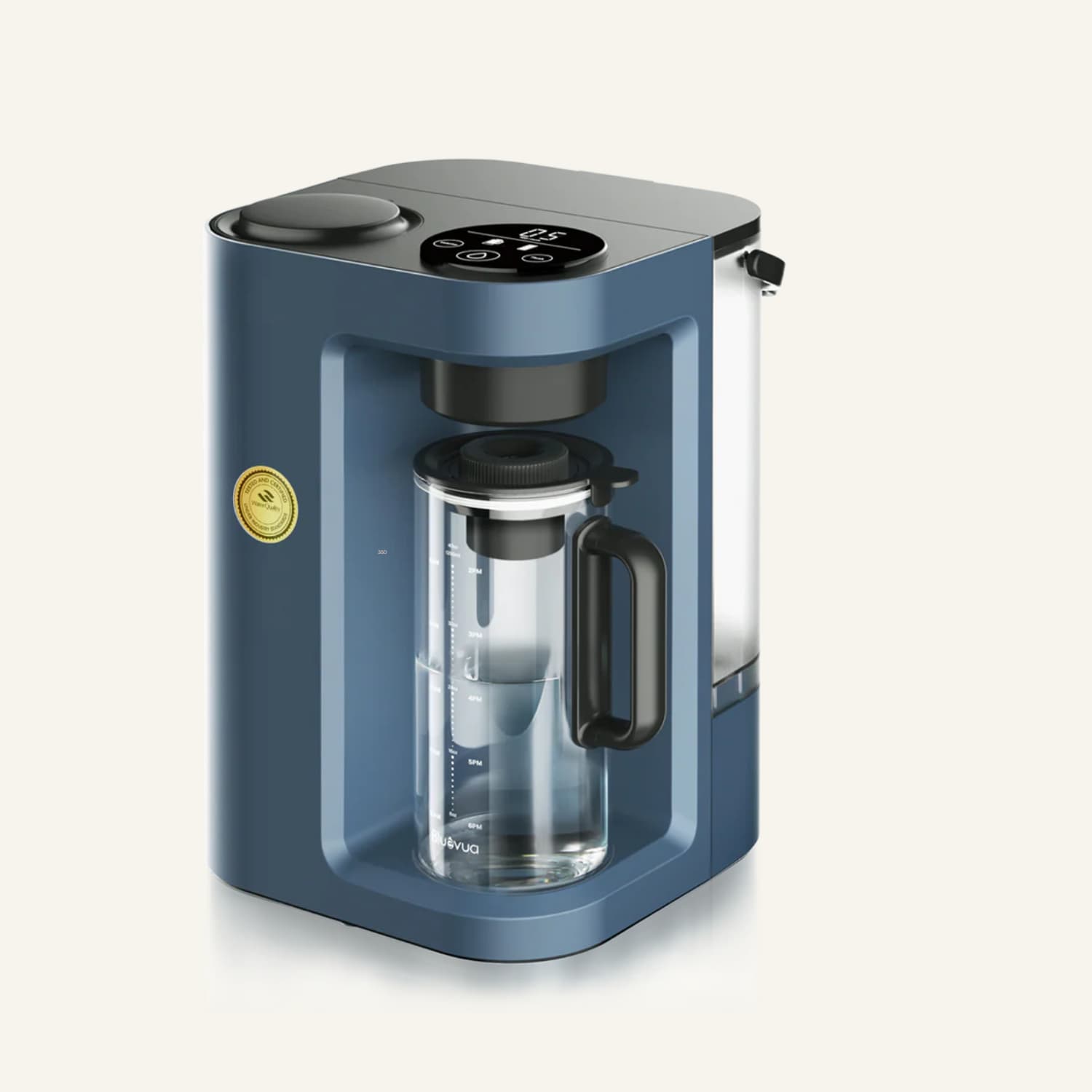
Best budget countertop, the lowest entry into certified RO
$299 Lite model
The Bluevua RO100ROPOT is the cheapest credible way into countertop RO. It’s WQA-certified to NSF/ANSI Standards 58 and 372, so the structural integrity, TDS reduction, and lead-free materials are independently verified. PFAS performance is third-party SGS tested, with manufacturer-claimed reductions in the 95-99% range.
It’s a four-stage system with a 4:1 waste ratio (or 3:1 on the newer Lite model), and the build quality is noticeably less premium than AquaTru. The trade-off is the price, roughly $75 less than the AquaTru Carafe for similar countertop functionality.
Certification
NSF 58, 372 (WQA)
✓ CertifiedPFAS
SGS Third-Party Test
◎ Lab-TestedPrice
From $299 (Lite)
✓ BudgetWaste Ratio
3:1 to 4:1
◎ AveragePros
- Lowest entry price with real NSF certification
- Plug-and-play, no plumbing needed
- 4-stage filtration with PFAS lab testing
- Compact footprint for small kitchens
Cons
- PFAS reduction not NSF-certified, only SGS-tested
- Build quality not as solid as AquaTru
- Filter availability less consistent than bigger brands
The right pick when budget is the constraint and you still want certified RO performance.Best for: First-time RO buyers, small apartments, anyone wanting to upgrade from a pitcher filter without spending $400+
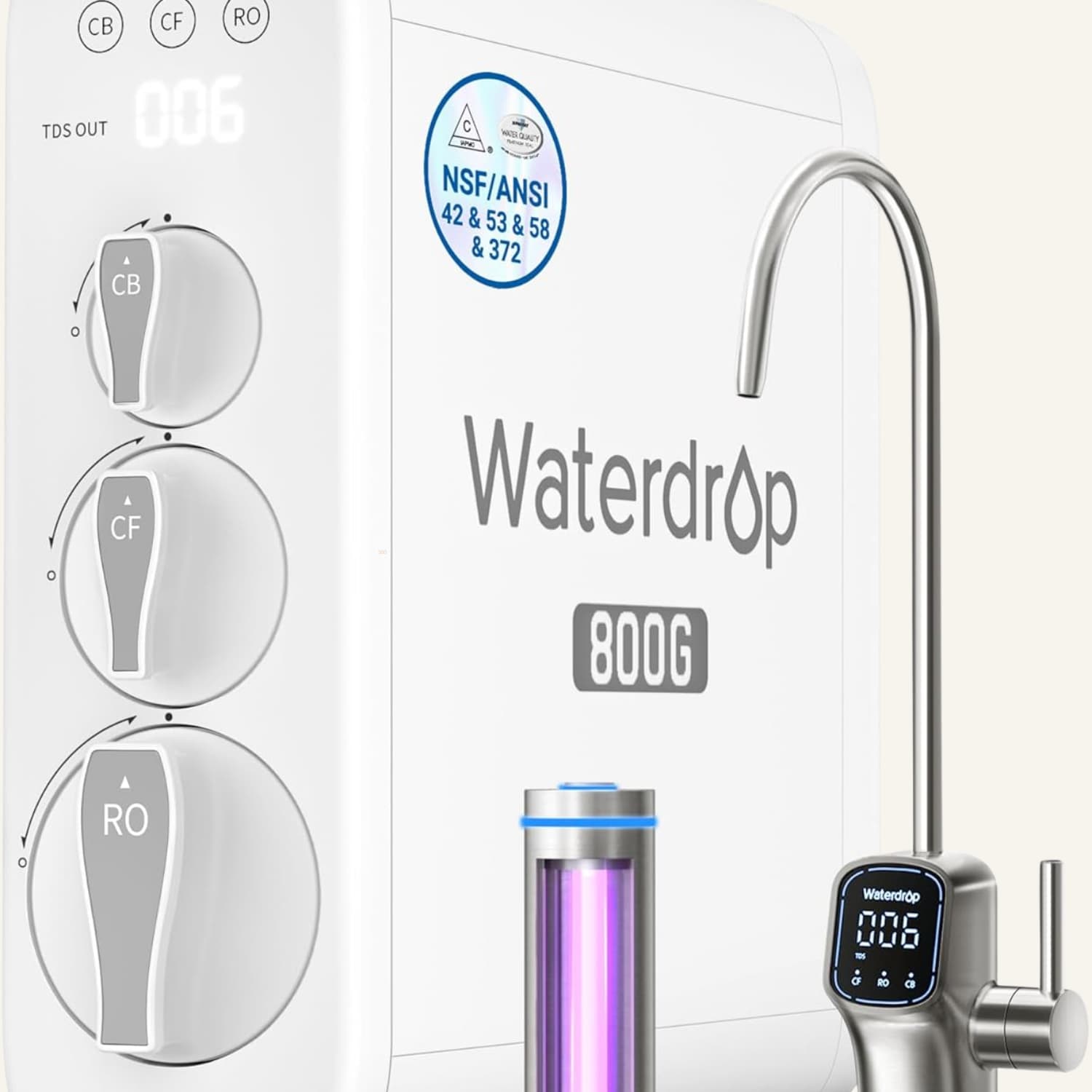
Best high-capacity tankless for large families
$999 list price
The Waterdrop G3P800 is the high-capacity pick when AquaTru’s countertop pace can’t keep up. It’s tankless, which means no bacterial growth concerns from sitting water, and it produces up to 800 gallons per day. Cup fills happen in about three seconds.
It’s IAPMO-certified to NSF Standards 42, 53, 58, and 372, covering taste, lead, TDS reduction, and lead-free materials. PFAS reduction is backed by third-party SGS testing rather than a certified NSF claim, still independently verified. The 3:1 efficiency ratio is a real advantage for high-volume households.
Certification
NSF 42, 53, 58, 372
✓ IAPMO CertifiedPFAS
SGS Third-Party Test
◎ Lab-TestedCapacity
800 GPD Tankless
✓ High VolumeWaste Ratio
3:1 Pure to Drain
✓ EfficientPros
- 800 GPD throughput for busy households
- 3:1 waste ratio beats most countertops
- Tankless, no stored water sitting around
- Smart faucet shows filter status at a glance
Cons
- PFAS reduction is SGS-tested, not NSF-certified
- Higher upfront cost than most picks
- Requires an electrical outlet under the sink
The right call when capacity matters more than maximum certification depth.Best for: Families of four or more, anyone filling kettles, water bottles, and pots all day long
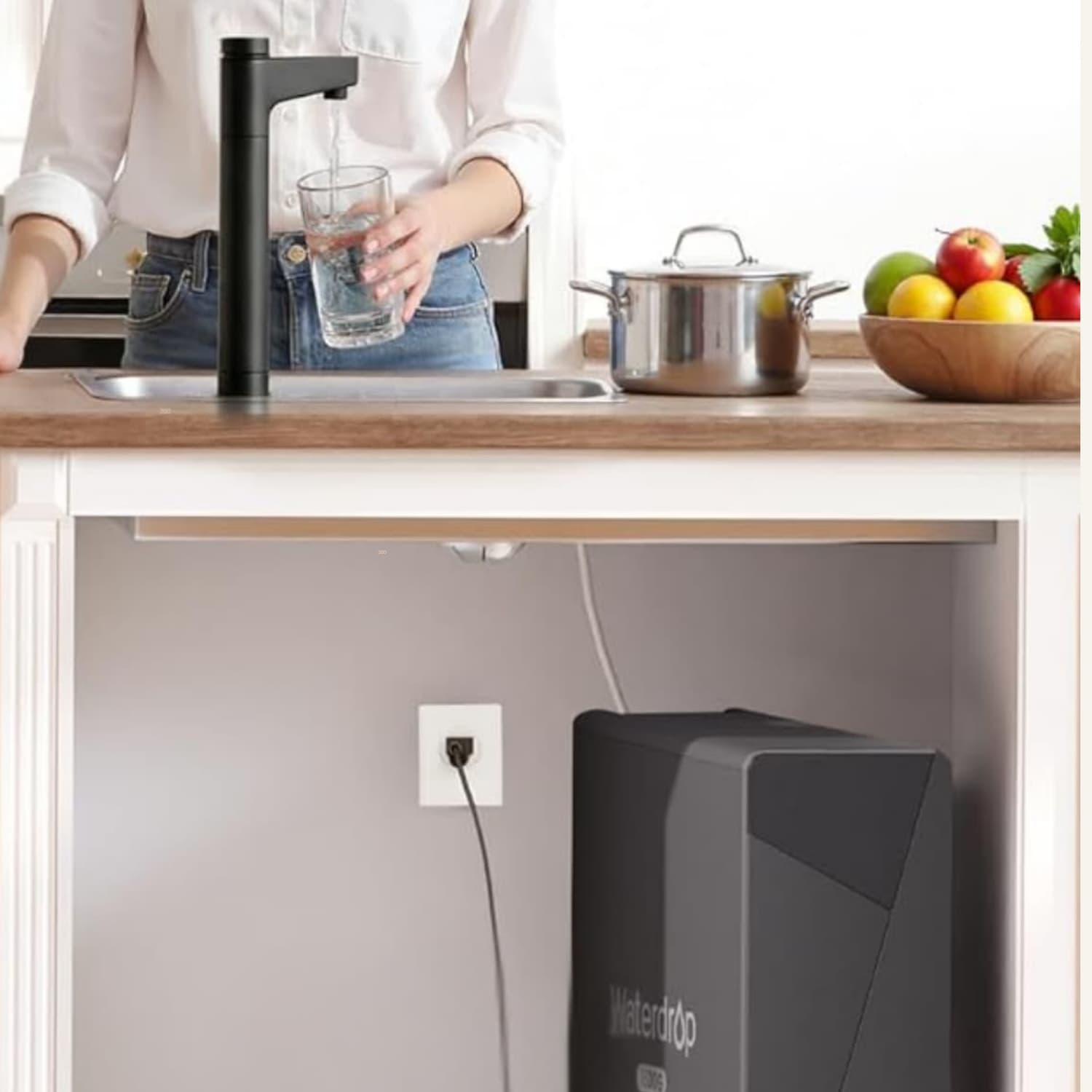
Best premium tankless, maximum throughput at 1,600 GPD
$1,999 list price
The Waterdrop X16 is the top-shelf pick when 800 GPD isn’t enough. It’s a tankless under-sink system rated for 1,600 gallons per day, double the G3P800, filling a 6-ounce cup in about 2 seconds. The 11-stage filtration includes a reinforced 0.0001-micron RO membrane and a built-in alkaline mineralization stage that brings pH back to around 7.5 for taste.
It’s IAPMO-certified to NSF/ANSI Standards 42, 58, and 372, with SGS lab testing for PFOA, PFOS, chlorine, fluoride, arsenic, and lead reduction. The smart digital faucet shows real-time TDS, filter life, and lets you dispense precise volumes. The RO filter lasts up to 24 months.
Certification
NSF 42, 58, 372
✓ IAPMO CertifiedPFAS
SGS Third-Party Test
◎ Lab-TestedCapacity
1,600 GPD Tankless
✓ Max ThroughputMembrane Life
24-Month RO Filter
✓ PremiumPros
- 1,600 GPD throughput, highest in this guide
- IAPMO NSF 42/58/372 certified
- Alkaline mineralization built in for taste
- Smart digital faucet with real-time TDS readout
Cons
- Premium price point, the highest in this guide
- PFAS reduction is SGS-tested, not NSF-certified
- Smart features add more failure points
The premium pick when throughput, smart features, and maximum spec ceiling matter more than price.Best for: Multi-generational households, large entertaining setups, anyone who wants the top of the tankless line
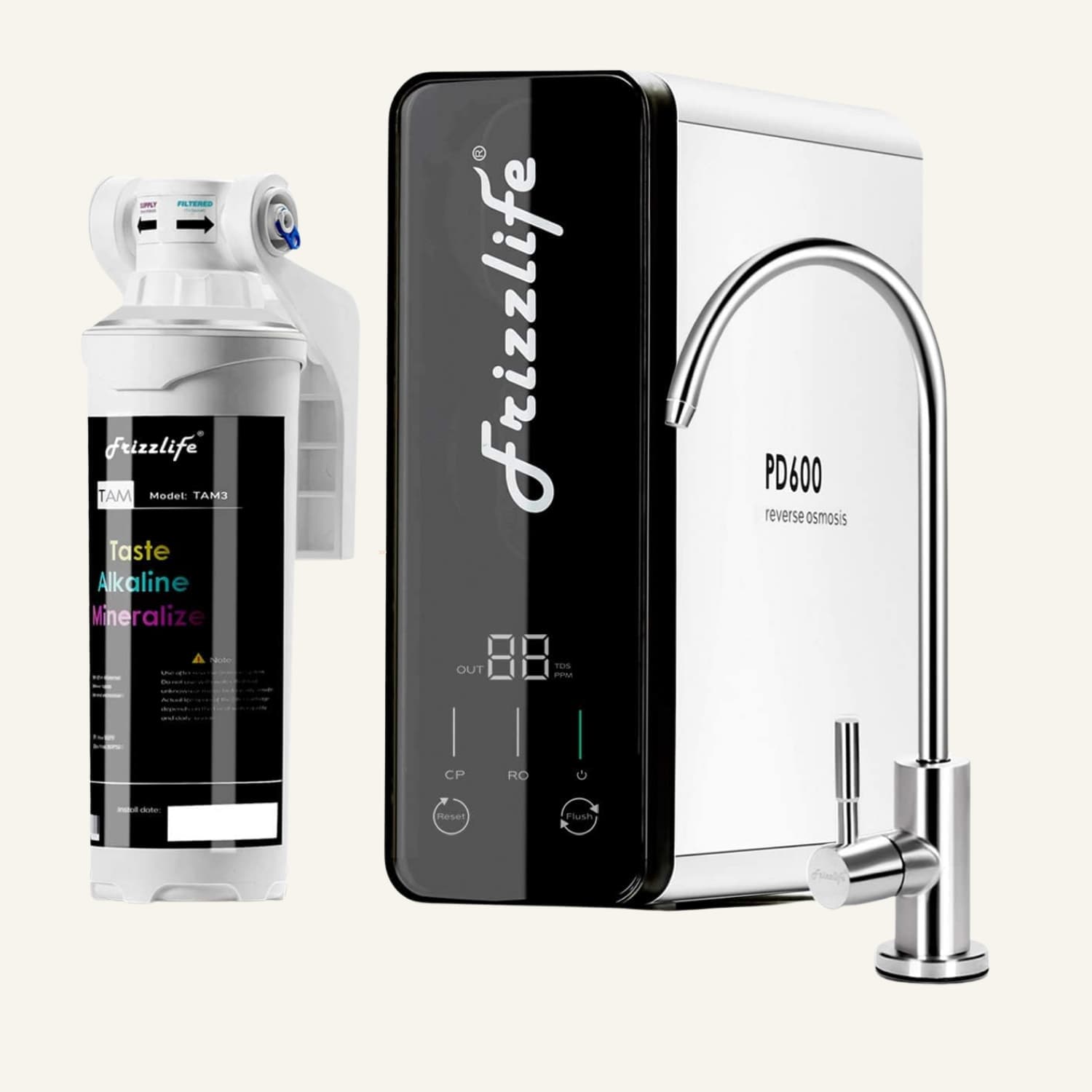
Best mid-range tankless, premium specs without the premium price
$470 list price
The Frizzlife PD600-N hits the spot between Waterdrop’s premium tankless and Bluevua’s budget countertop. It’s NSF/ANSI 372 certified for lead-free materials, with third-party SGS lab testing to NSF/ANSI 58, 53, and 42 standards. Manufacturer claims include 99% reduction for PFAS (PFOA/PFOS), lead, fluoride, chlorine, and TDS through the 8-stage filtration.
The 2:1 pure-to-drain ratio is a meaningful efficiency win over countertop systems. The alkaline remineralization stage raises pH above 7.5 and adds back calcium and magnesium for taste. At 600 GPD with a smart LED faucet showing filter life, it fits a 2-4 person household.
Certification
NSF/ANSI 372
✓ Lead-Free CertPFAS
SGS Third-Party Test
◎ Lab-TestedCapacity
600 GPD Tankless
✓ Family SizeWaste Ratio
2:1 Pure to Drain
✓ Most EfficientPros
- 2:1 waste ratio, tied for most efficient in this guide
- 600 GPD tankless flow, no stored water
- Alkaline remineralization built in
- Smart LED faucet shows filter status
Cons
- Only NSF 372 is formally certified, NSF 58/53/42 are SGS-tested
- Pre-filter swaps every 6-12 months
- Smaller dealer network than AquaTru or Waterdrop
The tankless under-sink pick that lets you skip the premium without skipping the lab evidence.Best for: 2-4 person homes that want tankless flow without spending $700+
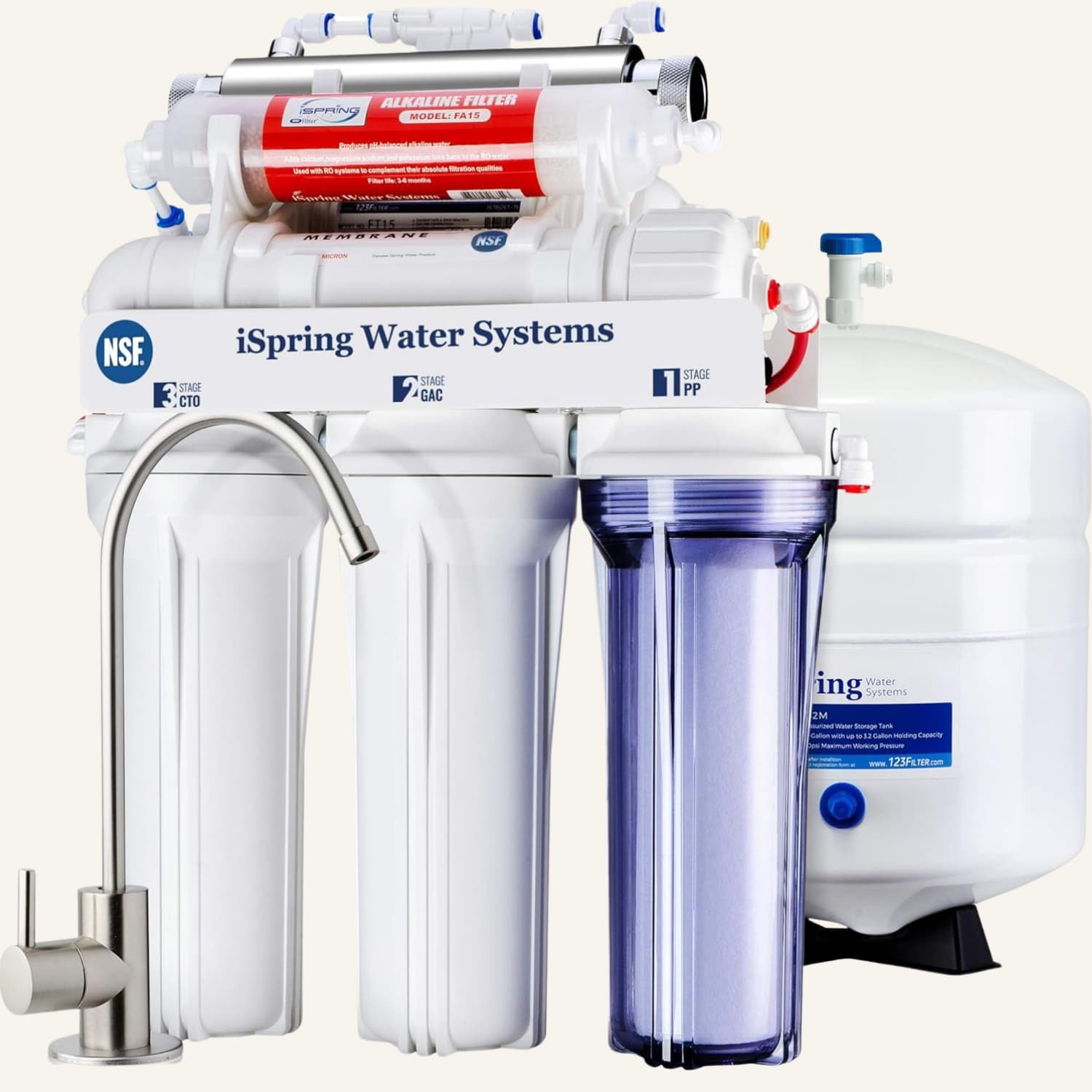
Best for well water, with built-in UV and remineralization
$370 list price
The iSpring RCC7AK-UV is built specifically for the situations that trip up most other RO systems: well water, untreated source water, or any home where bacteria and viruses are a concern. It pairs a standard 5-stage RO setup with a dedicated UV sterilizer on a sensor, and a final alkaline remineralization cartridge.
It’s NSF/ANSI 58 certified, with iSpring publishing verified reduction figures for asbestos (99.7%), lead (98.9%), fluoride (97.4%), and TDS (97.9%). The brand also publishes 96-99% PFAS reduction from internal testing. Well-water households are the clearest fit, but anyone in a high-arsenic or aging-pipe area gets value too.
Certification
NSF/ANSI 58
✓ CertifiedPFAS
96-99% Reduction
◎ Brand-TestedUV Stage
11W Smart UV
✓ Bacteria/VirusCapacity
75 GPD + Tank
✓ Family SizePros
- UV stage tackles bacteria and viruses (ideal for wells)
- Alkaline remineralization restores taste-friendly minerals
- NSF 58 certified with published reduction figures
- Best value among full 7-stage systems
Cons
- PFAS reduction is brand-tested, not NSF-certified
- Tank-based, takes more cabinet space than tankless
- UV lamp needs annual replacement
The only pick in the guide built for water sources where bacteria, viruses, and high TDS are real risks.Best for: Well water households, anyone in an area with bacterial advisories or aging pipes
How to Choose the Right Reverse Osmosis System for Your Home
Choosing the right reverse osmosis system comes down to three questions: what’s actually in your water, how much filtered water your household uses each day, and whether you’d rather sit a system on the counter or hide it under the sink.
The eight picks above cover the most common situations. The next step is matching your situation to the right one. Run through these four checks before clicking buy.
🧪 Test Your Water First
Before you spend $300 to $2,000 on any system, you should know what’s actually in your tap water. The system you need depends on it.
Free option: Every public water utility publishes an annual Consumer Confidence Report. Search “[your city] water quality report” or check the EPA’s Consumer Confidence Reports portal for a direct link. These cover what leaves the treatment plant, not what your pipes might add along the way.
Paid testing: For $75 to $300, a mail-in test from SimpleLab’s Tap Score or Cyclopure gives you a full readout, including PFAS-specific panels and microplastic markers. Tap Score’s Essential City Water test runs about $115 and includes PFOA, PFOS, and 100-plus other contaminants. For well water, the price is closer to $300, but the data is more critical because public-system standards don’t apply.
👨👩👧 Match Capacity to Household Size
The most common mistake is buying a system that’s too small (or too slow) for actual daily use. Run the rough math:
- One or two people: 1 to 2 gallons per day, including coffee and cooking. Any pick in this guide handles it.
- Three to four people: 3 to 5 gallons per day. AquaTru Carafe is a tight fit here; the AquaTru Classic, Frizzlife PD600-N, or iSpring RCC7AK-UV is a better fit.
- Five or more people, or heavy water bottle use: 5+ gallons daily. Waterdrop G3P800 is the right size, and the X16 covers the heaviest use.
🏡 City Water vs. Well Water Changes the Math
Municipal water is treated for bacteria and viruses, regulated for most heavy metals, and tested regularly. PFAS and microplastics are the gaps that AquaTru, Waterdrop, Frizzlife, and Bluevua fill.
Well water is unregulated, untreated, and often unpredictable. Bacteria, viruses, nitrates, and high TDS are all in play. The iSpring RCC7AK-UV is the only pick in this guide with a built-in UV stage for that exact scenario, and the alkaline cartridge helps balance pH if your well water runs slightly acidic.
🚰 Countertop, Under-Sink, or Tankless
The format choice is mostly about space and lifestyle, not water quality.
Under-Sink with Tank (AquaTru Under-Sink, iSpring): dedicated faucet, hidden setup, longer filter life, requires basic plumbing.
Countertop (AquaTru Carafe, AquaTru Classic, Bluevua): no installation, perfect for renters, slower flow rates. Best when you don’t want to touch plumbing.
Tankless Under-Sink (Waterdrop G3P800, Waterdrop X16, Frizzlife PD600-N): highest flow rate, no stored water, takes the least cabinet space, but pricier upfront and requires an electrical outlet.
Pin It for Later, Know What to Look For📌
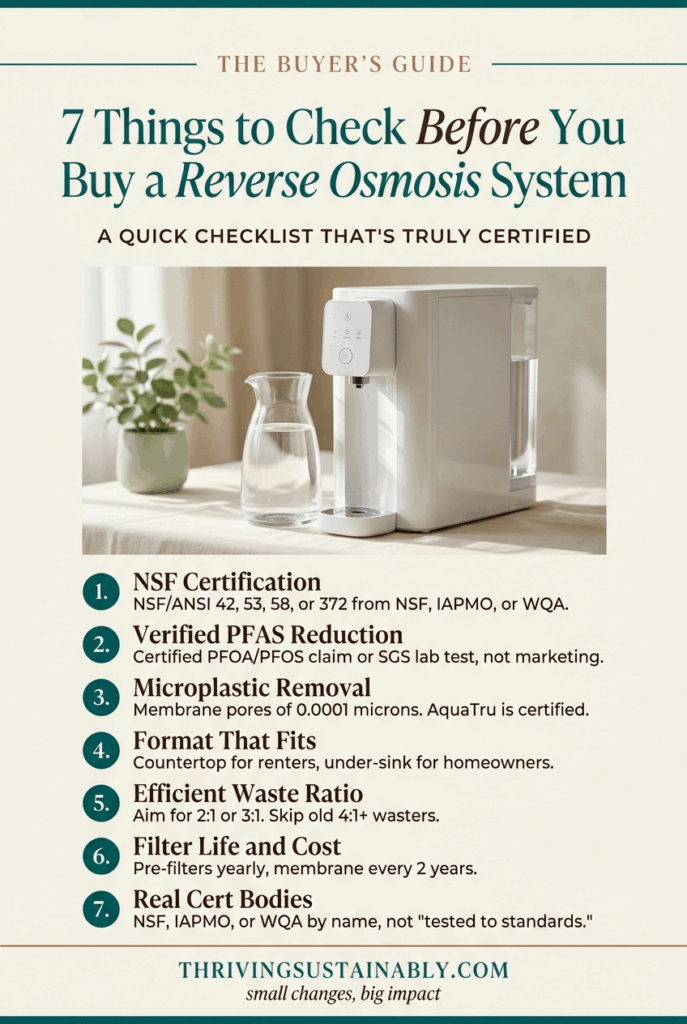
What to Look for on the Certification Label
Look for NSF/ANSI Standards 42 (taste and odor), 53 (health contaminants including PFOA and PFOS), 58 (RO performance), and 372 (lead-free materials), certified by NSF, IAPMO, or the Water Quality Association. Anything else is marketing.
Walk through any RO product page, and you’ll see a parade of NSF numbers. Most “best of” lists won’t tell you what they actually mean. Here’s the friend-explaining-it-over-coffee version, so you can read a label in 30 seconds.
Maintenance, Filter Replacement, and 5-Year Cost
A reverse osmosis system costs roughly $1,000 to $1,800 over five years of ownership, including the initial purchase and filter replacements, which still works out to less than half the cost of bottled water for a family of four.
The upfront cost is the easy part. The number that actually matters is what you’ll spend over five years of ownership, since filters need to be swapped and membranes eventually wear out.
Filter Replacement Schedules
Most RO systems run on a three-filter setup with different lifespans:
- Pre-filters (sediment and carbon): 6 to 12 months. These are the cheapest and most frequent swaps, usually $30 to $50 each.
- RO membrane: 24 months on average, longer for under-sink systems with bigger membranes. Typically $50 to $100.
- Post-filter polish or remineralization cartridge: 12 months. $30 to $40.
Annual filter costs range from $100 to $250 across the picks above, with countertop systems on the lower end and high-capacity tankless systems on the higher end. The Waterdrop G3P800 runs about $200 to $250 a year, and the Bluevua RO100ROPOT sits closer to $100.
What to Expect Year One
New systems sometimes ship with their filters dry, and the first water cycle may produce small bubbles or appear slightly cloudy. Run two or three full cycles before drinking, as all manufacturer manuals confirm. After that, the flow stabilizes, and the water clears.
Check the connection points monthly for any drips or seeps, especially during the first few weeks. Most leaks come from a fitting that wasn’t fully tightened during installation, not from a manufacturing defect.
When to Replace vs. Repair
A well-maintained RO system lasts 10 to 15 years. The plumbing, faucet, and housings generally outlast the membrane by a wide margin. If your TDS readings start creeping up despite recent filter changes, the membrane is the likely culprit, and it’s almost always a swap (not a system replacement).
FAQs About Best Reverse Osmosis System
Older systems wasted 4 to 6 cups for every 1 cup filtered. Modern systems are dramatically better. The Frizzlife PD600-N runs at 2:1 (pure to drain), the Waterdrop G3P800 and X16, and iSpring at roughly 3:1. Countertop batch systems like the AquaTru Carafe, AquaTru Classic, and Bluevua run closer to 4:1. If wastewater matters to you, the drain water is clean for plants and household cleaning, so you can collect it in a pitcher for reuse
Probably not for health reasons, but possibly for taste. RO removes about 90-97% of calcium and magnesium along with contaminants, but most of your daily mineral intake comes from food, not water. The USDA’s FoodData Central lists tap water as providing roughly 6% of daily calcium needs. Some people find RO water tastes flat, and that’s where remineralization cartridges (like the alkaline stage on the iSpring and Frizzlife) or mineral drops come in
Yes, for countertop systems and most under-sink units. Countertop systems take 10 minutes and require no tools beyond what’s in the box. Under-sink installation takes 1 to 3 hours and requires basic plumbing skills: shutting off the cold water valve, drilling one small hole for the dedicated faucet, and connecting the supply line. Tankless systems also need access to an electrical outlet. Whole-house systems are the only ones that really need a professional.
All three are accredited third-party certification bodies that test water treatment products against the same NSF/ANSI standards. The standards (42, 53, 58, 401, 372) are written by NSF International but enforced by whichever body runs the audit. A WQA-certified product is held to the same testing thresholds as an NSF-certified product, just verified by a different organization. None of them is meaningfully better than the others. What you want to avoid is “tested to NSF standards” without any of the three bodies’ names attached, which usually means the brand commissioned its own testing (sometimes through a credible independent lab like SGS) rather than going through an accredited certification program.
The EPA finalized the first enforceable federal limits in April 2024, setting Maximum Contaminant Levels of 4 parts per trillion for PFOA and PFOS, 10 ppt for PFHxS, PFNA, and HFPO-DA (GenX), and a combined hazard index for PFBS in mixtures. Public water systems have until 2029 to comply. Any RO system with a verified NSF/ANSI 53 or 58 PFOA/PFOS reduction claim will get you well below those limits, since certification testing reduces influent of 1.5 parts per billion to under 20 parts per trillion.
The system itself lasts 10 to 15 years with regular maintenance, sometimes longer. The filter set wears out, not the housings. Pre-filters get swapped every 6 to 12 months, the RO membrane every two years, and the post-filter annually. As long as you’re on top of the schedule, the faucet, tank, and main unit can outlast the membrane by a wide margin
Final Thoughts On Best Reverse Osmosis Systems
After months of drinking reverse osmosis water, I’m convinced it’s one of the best investments you can make for your family’s health. Yes, there’s an upfront cost and ongoing filter replacements. Still, when I think about the PFAS, microplastics, and pharmaceuticals I was potentially consuming before, the peace of mind is worth it.
Get your water tested first; you might be surprised what’s actually in there. Once you see what’s coming out of your tap, choosing the right RO system becomes an easy decision. The taste difference alone will convince you it was the right choice.
📚 References
- U.S. Environmental Protection Agency. (2024, April 26). PFAS National Primary Drinking Water Regulation (Federal Register 89 FR 32532). EPA. https://www.federalregister.gov/documents/2024/04/26/2024-07773/pfas-national-primary-drinking-water-regulation
- Ideal Living. (2024, December 3). Ideal Living announces all AquaTru water purifiers now certified to remove microplastics [Press release]. BusinessWire. https://www.businesswire.com/news/home/20241203117669/en/Ideal-Living-Announces-All-AquaTru-Water-Purifiers-Now-Certified-to-Remove-Microplastics
- NSF International. (n.d.). Forever chemicals: Advancement of filtration standards. NSF. https://www.nsf.org/knowledge-library/forever-chemicals-advancement-filtration-standards
- NSF International. (n.d.). NSF/ANSI 58: Reverse osmosis drinking water treatment systems. NSF. https://www.nsf.org/knowledge-library/nsf-ansi-58-reverse-osmosis-drinking-water-treatment-systems
- Orb Media. (2017). Invisibles: The plastic inside us. Orb Media. https://orbmedia.org/invisibles-final-report
- Qian, N., Gao, X., Lang, X., Deng, H., Bratu, T. M., Chen, Q., Stapleton, P., Yan, B., & Min, W. (2024). Rapid single-particle chemical imaging of nanoplastics by SRS microscopy. Proceedings of the National Academy of Sciences, 121(3), Article e2300582121. https://doi.org/10.1073/pnas.2300582121
- Yang, Z., Liu, C., Wang, L., Cui, P., Yang, Y., & Sun, Y. (2023). Microplastic removal from drinking water using point-of-use devices. Polymers, 15(6), 1331. https://doi.org/10.3390/polym15061331
More Microplastics Guides You’ll Want to Read
We’ve scored every kitchen product on plastic — see them in the Kitchen directory.