

Key Takeaways
- Polyester is a type of plastic called polyethylene terephthalate (PET), the same material used in water bottles, and it makes up about 59 percent of all fiber produced worldwide.
- A single load of polyester laundry can shed close to 500,000 plastic microfibers into wastewater, and recycled polyester sheds even more than virgin polyester.
- Switching to natural fibers like organic cotton, linen, hemp, wool, or Tencel cuts both your microplastic exposure and the load on rivers and oceans.
Is polyester plastic? Yes, and there’s a good chance more than half of what’s hanging in your closet right now is exactly that. Polyester is the most common fabric in the world and appears in fast-fashion tops, athletic wear, fleece jackets, kids’ uniforms, and even bedsheets.
The most common form of polyester is polyethylene terephthalate (PET), the same material used to make single-use water bottles. The Textile Exchange’s 2025 Materials Market Report shows that polyester now accounts for about 59% of global fiber production, with 88% of it derived from fossil fuels. That’s a lot of plastic against your skin, swirling in your washing machine, and eventually piling up in landfills and oceans.
This guide breaks down exactly what polyester is, how it’s made, the real environmental and health concerns, and what to wear instead. No fear-mongering, just facts and practical swaps.
What Is Polyester?
Polyester is a synthetic fabric made from petroleum-based plastic, most commonly polyethylene terephthalate (PET), and it is the most widely produced fiber in the world.
Polyester is a man-made fiber created from chemicals derived from crude oil. British chemists invented it in the 1940s, and DuPont began commercial production in the United States in 1953 under the brand name Dacron. Within a couple of decades, it had taken over the textile industry.
Today, it shows up in just about every closet. The Textile Exchange’s 2025 Materials Market Report estimates that around 78 million tonnes of polyester were produced in 2024, up from 71 million tonnes the year before. That makes polyester the dominant fiber on the planet, far ahead of cotton, wool, or any other material.
What separates polyester from cotton or linen is that polyester isn’t grown. It’s manufactured. The fibers start out as small plastic chips, melted and stretched into long threads, then woven or knitted into fabric. So while a cotton t-shirt comes from a plant, a polyester t-shirt comes from a refinery.
Is Polyester Plastic? The Direct Answer
Yes, polyester is plastic. It is made from polyethylene terephthalate (PET), the exact same plastic used in disposable water bottles and many food containers.
The short answer is yes. Polyester is a type of plastic.
Plastic is a broad term for any synthetic material made from long chains of repeating molecules called polymers. Polyester, as the name hints (poly + ester), is a polymer. The version used in clothing is polyethylene terephthalate, abbreviated PET. If you check the bottom of a clear water bottle, you’ll often see a “1” inside the recycling triangle with “PET” or “PETE” underneath. That’s the same plastic that makes up your fleece jacket, your yoga pants, or your kid’s school uniform.
When you wear polyester, you’re wearing plastic. When you wash it, you’re washing plastic. And when it ends up in a landfill or floating in the ocean, it stays plastic for a very long time.
How Is Polyester Made?
Polyester is made by reacting petroleum-derived chemicals to form long polymer chains, which are then spun into fibers, woven into fabric, and used in clothing, packaging, and household goods.
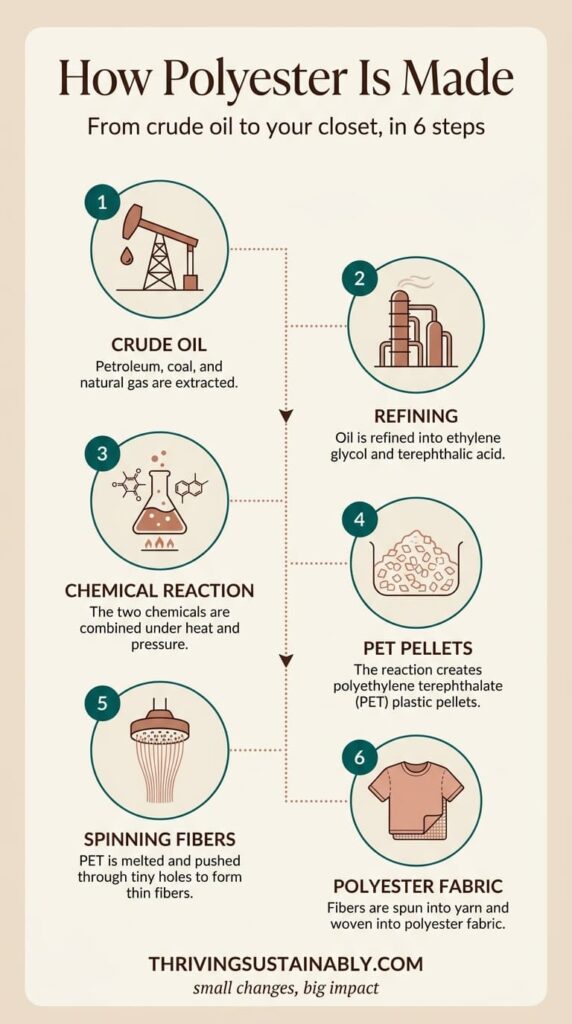
Polyester production starts with fossil fuels, mainly crude oil, with smaller shares of coal and natural gas. Petroleum is refined into smaller molecules, and two of them, ethylene glycol and terephthalic acid, are combined under heat and pressure. This chemical reaction creates a thick, syrupy liquid that hardens into small plastic chips called PET pellets.
From there, the pellets are melted again and forced through tiny holes, kind of like a high-tech pasta machine. The thin filaments cool, solidify, and get spun into yarn. The yarn is then woven or knitted into fabric.
Recycled polyester (rPET) follows a slightly different path. Used water bottles or polyester garments get cleaned, shredded, melted, and re-spun into new fibers. This sounds great in theory, but as you’ll see below, it carries some hidden trade-offs. The Textile Exchange reports that recycled polyester accounted for about 12% of all polyester production in 2024, a slight drop from 12.5% the year before, as virgin polyester is growing faster.
Where You’ll Find Polyester
Polyester is in roughly 60% of the clothing sold today and also appears in upholstery, carpets, bedding, packaging, and food containers.
Most of the polyester produced each year goes into clothing and textiles. The rest goes into bottles, food packaging, and industrial uses.
In your home, you’ll find polyester in:
- Athletic wear, leggings, base layers, and swimsuits
- Fast fashion tops, dresses, and jeans (often blended with cotton)
- Fleece jackets, hoodies, and sweatshirts
- Kids’ uniforms, pajamas, and outerwear
- Bedsheets, pillowcases, and microfiber towels
- Curtains, upholstery, and most carpets
- Stuffed animals, plush throws, and decorative pillows
- Water bottles, soda bottles, and food trays
Even garments labeled as cotton are often a poly-cotton blend. Always check the tag; the percentages tell the truth.
The Environmental Impact of Polyester
Polyester pollution shows up at every stage, from fossil fuel extraction and greenhouse gas emissions during polyester production, to microplastic fibers in marine life, to garments piling up in landfills with near-zero biodegradability.
This is where polyester’s plastic identity really shows up.
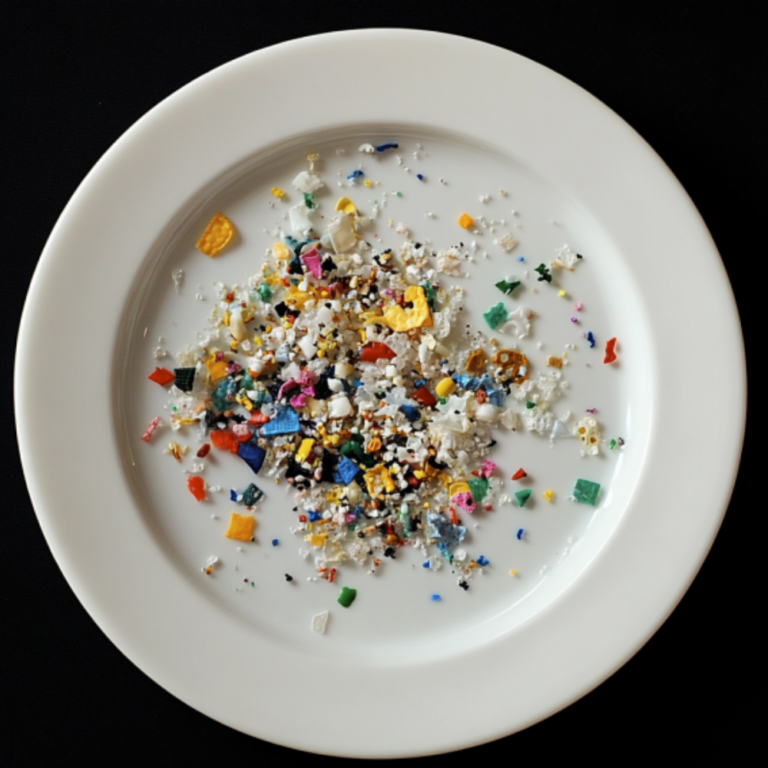
Microfiber shedding and marine life. A 2024 study published in Environmental Pollution found that a single 6-kilogram load of polyester clothing can release nearly 500,000 plastic microfibers into wastewater. Most washing machines aren’t built to filter particles that small, so the fibers flow into rivers, lakes, and oceans, where they enter the food chain through plankton, fish, shellfish, and seabirds. Microplastics from synthetic textiles are now considered one of the largest sources of plastic pollution in marine life. They have also been detected in human blood, lungs, and breast milk.
Biodegradability and landfills. Polyester has almost zero biodegradability. A polyester garment can sit in a landfill for decades to centuries, slowly breaking into smaller and smaller microplastic fragments rather than ever fully decomposing. The vast majority of discarded textiles globally end up in landfills or incinerators, and polyester is the fiber that stays put the longest.
Fossil fuels and carbon footprint. Around 88% of polyester is made from fresh fossil fuels (mostly petroleum, with smaller contributions from coal and natural gas), according to the Textile Exchange. Polyester production also releases significantly more greenhouse gases per kilogram of fabric than cotton or other natural fibers. Multiply that by 78 million tonnes a year, and you get one of the biggest carbon footprints in the entire fashion supply chain.
For more on reducing microplastic exposure throughout your home, see our guide on how to avoid microplastics.
Polyester and Your Health
Polyester does not breathe well, can trap odor and bacteria, and may contribute to skin irritation, while microfiber shedding from polyester clothes adds to your daily plastic exposure.
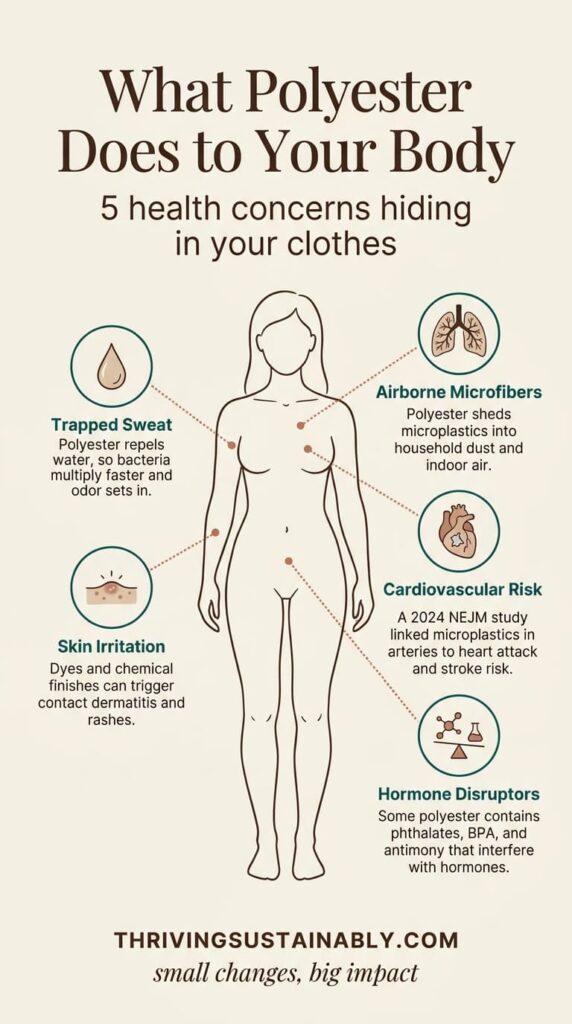
Polyester is hydrophobic, which means it repels water. That sounds useful for athletic wear, but it also means sweat sits on the surface instead of being absorbed, which leads to faster bacterial growth and that classic polyester gym-bag smell.
Other concerns to keep in mind:
- Skin irritation and rashes. The dyes and finishing chemicals used on polyester can trigger contact dermatitis in people with sensitive skin or eczema.
- Heat retention. Polyester traps heat against the body, which is why it feels sticky on warm days, while natural fibers tend to be more comfortable.
- Hormone disruptors. Some polyester clothing has been found to contain phthalates, BPA, and antimony, chemicals known to interfere with hormones, especially in cheap fast-fashion items.
- Microplastic exposure. The same fibers that shed in your washer can also shed during normal wear, releasing into household dust and indoor air. A 2024 New England Journal of Medicine study found that people with detectable microplastics in their carotid artery plaque had more than four times the risk of heart attack, stroke, or death within three years compared to people without those particles.
The science on long-term health effects is still developing, but reducing exposure where you can reasonably do so is a sensible call.
Is Recycled Polyester Better?
Recycled polyester (rPET) reduces virgin oil use, but it sheds more microplastics per wash than virgin polyester, and most of those microplastics come from water bottles, not old clothing.
Recycled polyester sounds like a clean solution, and on the carbon side, it is an improvement. Making rPET uses less energy and fewer fresh fossil inputs than producing virgin polyester from scratch.
But there are caveats. A 2024 study found that recycled polyester releases about 12,000 microfibers per gram on average, roughly 55% more than virgin polyester. Recycling weakens the polymer chains, which makes the fibers more brittle and more likely to break apart in the wash.
There’s also a sourcing problem. Most “recycled polyester” comes from PET water bottles, not from old clothes. Once a bottle gets turned into a t-shirt, it can’t easily be recycled again, so the closed-loop people imagine is more of a one-way trip from bottle to landfill.
Recycled polyester is a step up from virgin polyester, but it still sheds plastic, still doesn’t biodegrade, and still relies on the petroleum supply chain. Treat it as a less-bad option, not a green one.
Don’t Miss: How to Catch Microplastics Before They Leave Your Washer Simple laundry tweaks (filters, bags, wash settings) can stop most polyester microfibers from reaching your local waterway. Read more →Sustainable Alternatives to Polyester
Sustainable alternatives like organic cotton, linen, hemp fabric, wool, and Tencel are biodegradable, breathable, and shed no microplastics, making them better choices for both your skin and the planet than virgin or recycled polyester.
Polyester’s claim to fame is its resistance to environmental degradation. It does not rot, fade, or fall apart easily, which is why fast fashion brands love it. But that same toughness is exactly what makes it so persistent in landfills and waterways. A natural fiber breaks down in months. A polyester shirt can outlast everyone reading this article.
If you want to dial down the plastic in your closet, here are the natural and synthetic alternatives worth seeking out.
✅ Fibers Worth Choosing
- Organic cotton. Soft, breathable, and biodegradable. Look for GOTS certification to avoid pesticide residues.
- Linen. Made from flax, durable, gets softer with every wash, and uses far less water than conventional cotton.
- Hemp fabric. Incredibly strong, naturally antimicrobial, and grown with very few pesticides. One of the most underrated sustainable alternatives.
- Wool. Biodegradable, temperature-regulating, naturally odor-resistant, and great for outerwear and base layers.
- Tencel (lyocell). Made from sustainably harvested wood pulp using a closed-loop process that reuses 99 percent of solvents.
- Recycled cotton or wool. Gives existing fibers a second life without the microplastic issue associated with recycled polyester.
❌ Fibers to Skip When You Can
- Virgin polyester
- Acrylic
- Nylon
- Conventional fleece
- Most “performance” or “moisture-wicking” synthetics
You don’t have to throw out everything synthetic; the most sustainable garment is the one already in your closet. But for your next purchase, lean toward fibers that don’t come from a refinery.
✨ Tip
Flip the Tag
When you’re shopping for a new piece, flip the tag before the price. If the fabric content reads polyester, acrylic, or nylon, weigh whether you’d buy it again at the price of a real cotton or linen version. That one habit slowly rewires the whole closet.
Found this Helpful? Pin It! 📌
FAQs on Is Polyester Plastic
Yes, you can run a simple burn test on a small clipping. Polyester melts into a hard plastic bead and gives off a sweet chemical smell, while natural fibers like cotton and linen burn to a soft gray ash that crumbles between your fingers. Wool smells like burning hair and self-extinguishes. Always do this outdoors in a heat-safe dish.
Both have downsides, but they cause different problems. Polyester relies on fossil fuels and sheds microplastics for hundreds of years. Conventional cotton uses heavy water and pesticide inputs but breaks down naturally and sheds no plastic. Organic cotton, hemp, and linen come out ahead of polyester on almost every measure.
Pediatric experts generally recommend natural fibers for babies, especially for sleepwear and items worn close to the skin for long stretches. Polyester traps heat, can irritate sensitive skin, and may contain chemical finishes used to meet flame-retardancy rules. Organic cotton or wool sleepers are a safer default.
Polyester shrinks less than cotton, which is part of the appeal of fast fashion. High dryer heat can cause minor shrinkage and weaken fibers over time, which can lead to more microfiber shedding. Air drying or using low heat extends the life of polyester garments
No. Polyester is plastic, and it will not break down in a backyard compost bin or commercial composter. Even after years of weathering, polyester only fragments into smaller microplastic pieces. Landfill, textile recycling, or repurposing as rags is more responsible than tossing it in the green bin.
Static cling occurs because polyester is hydrophobic and doesn’t hold moisture, allowing electric charges to build up on the fabric’s surface during friction. Adding wool dryer balls, drying with a damp cotton cloth, or a quick spritz of water inside a garment knocks the static down without dryer sheets.
Final Thoughts About: Is Polyester Plastic
So, is polyester plastic? Yes, every yard of it. Polyester is PET, the same material as a clear water bottle, and it now accounts for close to 60% of all fiber produced on Earth. That’s a lot of plastic getting worn, washed, and eventually shed into the air, water, and our own bodies.
Don’t worry, you don’t have to fix it overnight. Wear out what you already own. Wash synthetics on cold with a microfiber-catching bag, and air dry when the weather lets you. And the next time you go shopping, the choice between a polyester top and a linen one matters more than the price tag suggests. A closet built mostly from natural fibers cuts microplastic shedding to near zero, lasts longer, and feels better against your skin.
Small changes, big impact. That part hasn’t changed.
🗨️ Your Turn
Have you started swapping polyester for natural fibers in your closet? Tell us which switch made the biggest difference. The comments are open below.
📚 References
- Carbonfact. (n.d.). The carbon footprint of polyester. Carbonfact. https://www.carbonfact.com/blog/knowledge/polyester-carbon-footprint
- Changing Markets Foundation. (2024). Spinning greenwash: How the fashion industry’s shift to recycled polyester is worsening microplastic pollution. Changing Markets Foundation. https://changingmarkets.org/report/spinning-greenwash/
- Greenpeace International. (2014). A little story about the monsters in your closet. Greenpeace e.V. https://www.greenpeace.org/static/planet4-thailand-stateless-release/2019/09/192afd2f-a-little-story-about-the-monsters-in-your-closet-technical-report.pdf
- Jenner, L. C., Rotchell, J. M., Bennett, R. T., Cowen, M., Tentzeris, V., & Sadofsky, L. R. (2022). Detection of microplastics in human lung tissue using μFTIR spectroscopy. Science of the Total Environment, 831, 154907. https://www.sciencedirect.com/science/article/pii/S0048969722020009
- Lenzing AG. (n.d.). TENCEL™ Lyocell fibers: Closed loop production. Lenzing Group. https://www.lenzing.com/products/textile-fibers/tenceltm-lyocell/
- Leslie, H. A., van Velzen, M. J. M., Brandsma, S. H., Vethaak, A. D., Garcia-Vallejo, J. J., & Lamoree, M. H. (2022). Discovery and quantification of plastic particle pollution in human blood. Environment International, 163, 107199. https://www.sciencedirect.com/science/article/pii/S0160412022001258
- Marfella, R., Prattichizzo, F., Sardu, C., Fulgenzi, G., Graciotti, L., Spadoni, T., D’Onofrio, N., Scisciola, L., La Grotta, R., Frigé, C., Pellegrini, V., Municinò, M., Siniscalchi, M., Spinetti, F., Vigliotti, G., Vecchione, C., Carrizzo, A., Accarino, G., Squillante, A., … Paolisso, G. (2024). Microplastics and nanoplastics in atheromas and cardiovascular events. New England Journal of Medicine, 390(10), 900–910. https://www.nejm.org/doi/full/10.1056/NEJMoa2309822
- Ragusa, A., Notarstefano, V., Svelato, A., Belloni, A., Gioacchini, G., Blondeel, C., Zucchelli, E., De Luca, C., D’Avino, S., Gulotta, A., Carnevali, O., & Giorgini, E. (2022). Raman microspectroscopy detection and characterisation of microplastics in human breastmilk. Polymers, 14(13), 2700. https://www.mdpi.com/2073-4360/14/13/2700
- Textile Exchange. (2025). Materials market report 2025. Textile Exchange. https://textileexchange.org/knowledge-center/reports/materials-market-report-2025/
- Volgare, M., Santonicola, S., Cocca, M., Avolio, R., Castaldo, R., Errico, M. E., Gentile, G., Raimo, G., Gasperi, M., & Mercogliano, R. (2024). Release of microplastic fibers from synthetic textiles during household washing. Environmental Pollution, 357, 124455. https://www.sciencedirect.com/science/article/pii/S0269749124011692
We’ve scored every clothing and textile pick on plastic — see them in the Fashion & Textiles directory.