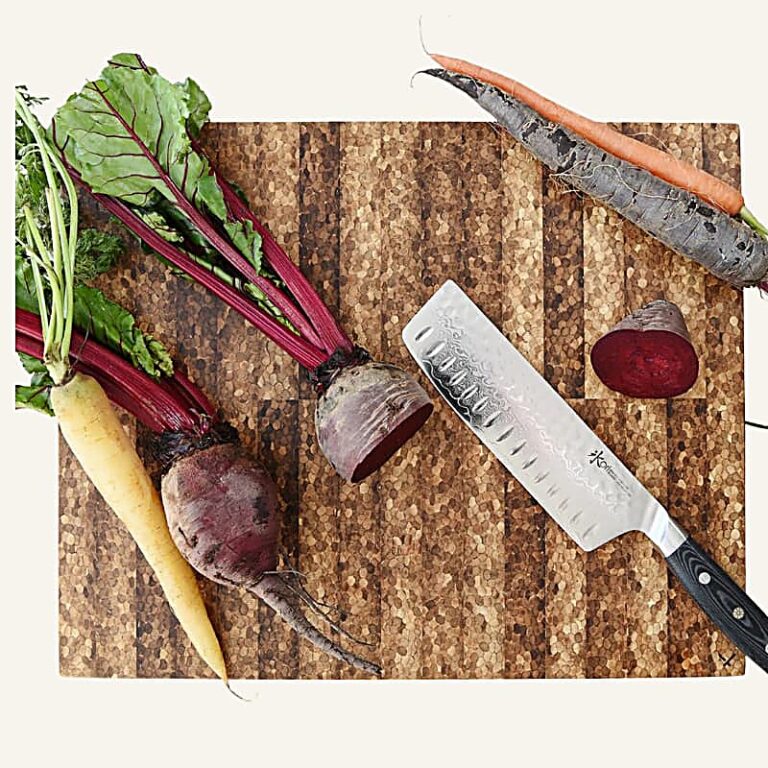
ChopValue Cutting Board (Recycled Chopsticks)
ChopValue
Cutting / Serving Board (Recycled Chopsticks)
A genuinely clever recycled-chopstick board, but the binder is a water-based acrylic resin, a synthetic polymer, so it is not plastic-free and its surface can shed composite particles as you cut. We score it for awareness and point you to a solid-wood board.
A clever circular-economy board made from recycled chopsticks, but the binder is a water-based acrylic resin, a synthetic polymer, so it is not plastic-free and can shed composite particles as you cut.
How this score breaks down
Strengths
- Made from recycled bamboo chopsticks, a real circular-economy story
- Binder is stated to be free of formaldehyde and urea, and the process VOC-free
- Certified B Corporation with published carbon-negative material figures
Trade-offs
- The binder is a water-based acrylic resin, a synthetic polymer, so the board is not plastic-free
- Cutting into a resin-bonded surface can shed fine composite particles
- The chopstick-to-resin ratio and any food-contact migration testing are not published
Scored on our durable-goods method (durables-v1, 2026-08-19). How we rank →
What's inside
This board is a composite: recycled bamboo chopsticks compressed with a water-based acrylic resin binder. The resin is a synthetic polymer, which is why this is not a plastic-free board. To its credit the resin is stated to be free of formaldehyde and urea and the process is VOC-free, and the recycled content is high, but a knife cutting into a resin-bonded surface can shed fine composite particles, including the synthetic binder.
| Part | Material |
|---|---|
| Board | Recycled bamboo chopsticks compressed with resin |
| Binder | Water-based acrylic resin (synthetic polymer), formaldehyde and urea free |
| Finish | None; condition with food-safe mineral oil |
- Packaging
- Not stated
- Microplastics
- Possible. The cutting surface is a resin-bonded composite, so cutting can shed fine particles that include the acrylic binder
Attributes
What this product is, at a glance.
Certifications
Independent, third-party certifications only. Tap any badge to see what it verifies.
About ChopValue
ChopValue is a Certified B Corporation, founded in 2016 and headquartered in Vancouver, that recycles used bamboo chopsticks into a dense composite material and presses it into boards, tiles, and furniture through a network of microfactories.
The circular story is genuinely impressive, and the company publishes carbon-negative figures for its material. The catch, for a plastic-footprint directory, is the binder: ChopValue states its material is bound with a water-based acrylic resin, and acrylic is a synthetic polymer.
The resin is stated to be free of formaldehyde and urea and the process VOC-free, which is better than many composites, but the board is still a resin-and-fiber composite rather than solid wood, so it cannot be called plastic-free, and a knife cutting into it can release fine composite particles. We score it for awareness rather than recommending it as a low-plastic cutting surface, and point you to a solid-wood board instead.
Categories: