


Turn a bottle of blue window cleaner around and read the label. You probably will not see 2-butoxyethanol listed anywhere, but there is a solid chance it is in the bottle. The EPA puts that solvent at 1% to 30% by volume in commercial products, and glass cleaners are one of the places it turns up most.
You do not need any of it to get clear glass. The best homemade window cleaner is equal parts distilled white vinegar and distilled water, with an optional splash of rubbing alcohol for faster drying. That one blend cuts grease, fingerprints, and hard-water film without ammonia or hidden solvents. Below you get five tested recipes, plus a car-window variant nobody else covers and the technique that actually stops streaks.
💫 now you know
What 2-Butoxyethanol Is
What “2-butoxyethanol” actually means. It’s a solvent, which is just a liquid that dissolves other stuff. Cleaning companies reach for it because it cuts the greasy film on glass and evaporates slowly enough to have time to work. You might also see it written as ethylene glycol monobutyl ether, EGBE, or butyl cellosolve, though most of the time you will not see it at all, since it is not required on the label.
Your body converts it into butoxyacetic acid, and that is the part worth knowing about, because in high enough doses it damages red blood cells. The EPA puts it anywhere from 1% to 30% by volume in commercial products. Vinegar and alcohol do the same grease-cutting job without any of it.
Why make your own window cleaner?
Homemade window cleaner works because the acetic acid in vinegar dissolves the greasy film and mineral spots that make glass look cloudy, and it does it without ammonia or 2-butoxyethanol. You control every ingredient, and a batch costs a small fraction of a bottle of name-brand glass cleaner.
There are three good reasons to mix your own.
1. What you breathe while you clean
The U.S. EPA notes that glycol ethers like 2-butoxyethanol are used in commercial cleaning compounds, and that breathing in high levels can cause pulmonary edema and liver and kidney damage, while long-term exposure has been tied to anemia and other blood effects. Glass cleaners are built to flash-dry fast, so that chemical load goes straight into the air you breathe while you clean.
2. What happens when cleaners mix
Ammonia is a common glass-cleaner ingredient, and if it ever meets chlorine bleach it produces toxic chloramine gas. Vinegar has the same problem with bleach. When you mix your own, you know exactly what is in the bottle and what it should never touch.
3. What it costs to make your own
Vinegar, water, and a little alcohol cost pennies compared to a branded spray. You also get to tweak the recipe for the job in front of you instead of buying a separate bottle for every surface.
✅ The 4 ingredients that actually clean glass
Only a handful of kitchen items do the real work on glass. Here is what each one does, so you can mix with confidence rather than follow a recipe blind.
- Distilled water. The base of almost every recipe. Distilled water has no minerals, so it will not leave the chalky spots that tap water does as it dries.
- Distilled white vinegar. The everyday hero. Most white vinegar on US shelves is labeled 5% acetic acid, and that mild acid dissolves greasy film, fingerprints, and light mineral haze. Check the label, though, because the FDA has no standard of identity for vinegar and its labeling guidance puts the floor at 4%, so some bottles are weaker than you expect. Cleaning vinegar is typically 6% strength if you want extra muscle, but it is not food-safe.
- Isopropyl (rubbing) alcohol. The streak-stopper. Alcohol evaporates fast, so it lifts oily smudges and dries before it can leave residue. A 91% bottle dries quicker and leaves fewer streaks than 70%, which holds more water.
- Dish soap. The grease-cutter for grimy outdoor glass. A drop or two of plain liquid dish soap acts as a surfactant that lifts caked-on dirt the acid alone cannot.
❌ What should you never use on windows?
Never use tap water, ammonia, or bleach in a homemade window cleaner. Tap water leaves mineral streaks, ammonia can damage tinted film and window seals, and bleach makes toxic gas the moment it meets ammonia, vinegar, or rubbing alcohol.
💧 Tap water leaves mineral spots
Tap water carries dissolved minerals. The water evaporates, the minerals stay, and you get the chalky haze you were trying to remove. Hard water areas have it worst. Distilled water is inexpensive and it is the easiest upgrade you can make to any recipe here.
🧪 Ammonia damages film and seals
Ammonia cuts grease, which is why it has been in blue glass cleaner for generations. The trouble is what it does over months to window tint and the seals around the glass. Both Pella and Andersen tell their own customers to keep it off their windows. It is also half of the most dangerous mistake on this list.
☠️ Bleach belongs nowhere near this
Never put bleach in a homemade cleaner, and never use one right after the other. Bleach plus ammonia makes chloramine gas. Swap in an acid like vinegar and you get chlorine gas instead. Rubbing alcohol turns it into chloroform. The CDC warns that these gases can cause severe lung damage. Washington State’s health department points out that ammonia hides in ordinary glass cleaners, so cleaning a mirror and then a toilet without rinsing in between is a genuine risk. One product at a time, rinse
🌸 Essential oils leave their own film
A few drops make the bottle smell nicer, but oil does not rinse away with water, so it leaves a faint film behind. On tinted or coated glass, that film is harder to remove than the grime you started with.
🪟 Harsh cleaners ruin coated glass
You do not have to guess here, because the companies that made your windows already wrote the answer down. Pella and Andersen are the two biggest window brands in the country, the ones you have walked past at Lowe’s and Home Depot for years, and both publish care instructions for their own glass. Pella says do not use ammonia and do not use alcohol, and points owners to 1 part white vinegar to 10 parts water. Andersen says mild soapy water or a vinegar solution, and nothing abrasive near its Low-E coating.
The best homemade window cleaner recipe (our pick)
The best homemade window cleaner combines 1 cup distilled water, 1 cup distilled white vinegar, 1 tablespoon isopropyl alcohol, and 1 drop of dish soap in a spray bottle. That mix cleans grease and mineral film while the alcohol dries fast enough to leave glass streak-free.
Recipe 1: The everyday streak-free blend (my pick)
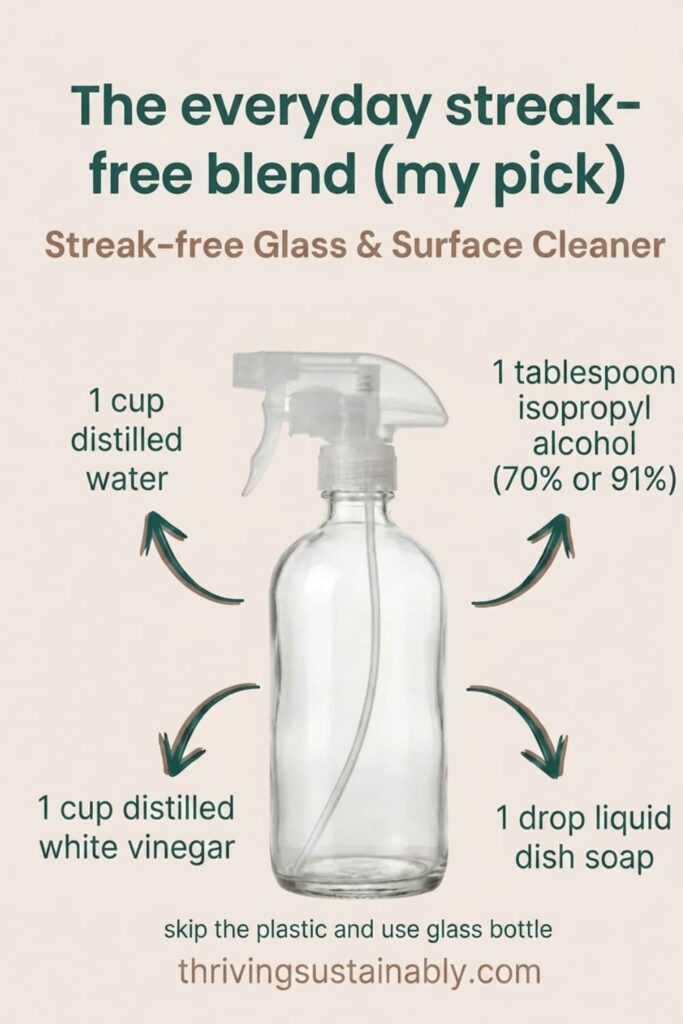
This is the one to make first and keep on the shelf. It handles indoor windows, mirrors, and glass tables with no fuss.
- 1 cup distilled water
- 1 cup distilled white vinegar
- 1 tablespoon isopropyl alcohol (70% or 91%)
- 1 drop liquid dish soap
Pour everything into a clean spray bottle, cap it, and swirl gently to combine. Spray onto the glass or onto your cloth, then wipe and buff dry. The vinegar and alcohol both fight streaks, and the single drop of soap helps the cleaner sheet off cleanly.
✨ Tip
Too Stinky?
A faint vinegar smell fades within a minute of drying. If it bothers you, add a small strip of citrus peel to the bottle rather than essential oils, which can streak coated glass.
4 more homemade window cleaner recipes
Recipe 2: Vinegar-only window cleaner
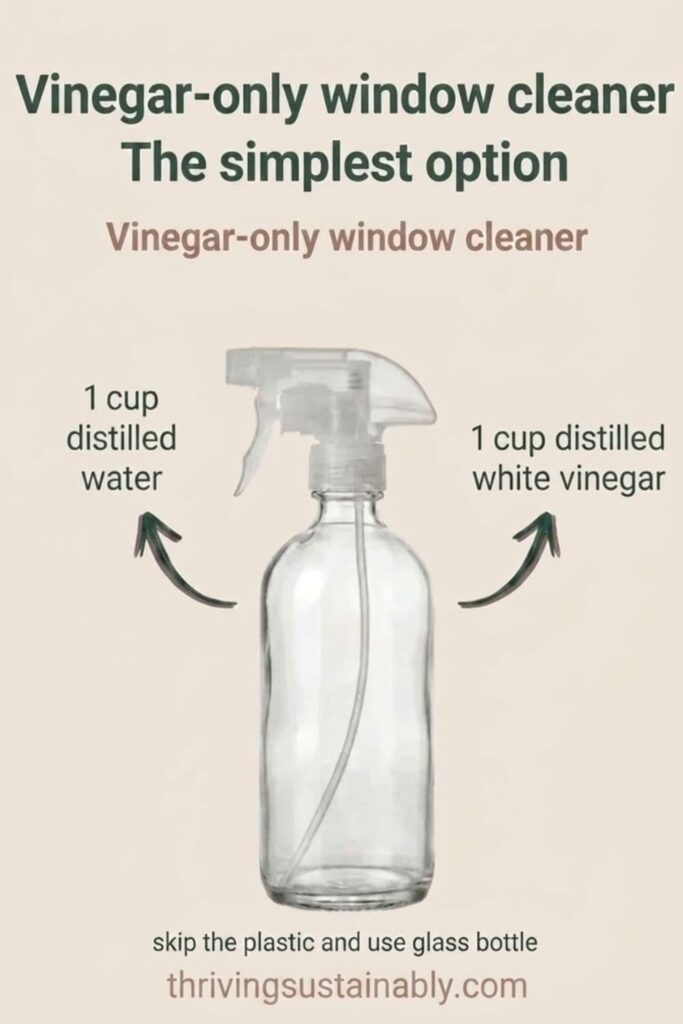
The simplest option, and a great choice for coated or tinted glass where you want to skip alcohol.
- 1 cup distilled white vinegar
- 1 cup distilled water
Combine in a spray bottle and shake. For delicate Low-E or tinted windows, dilute further to the 1 part vinegar to 10 parts water ratio the window makers recommend. Wipe with a linen or cotton flour sack towel and buff dry.
Recipe 3: Rubbing alcohol window cleaner

The fastest-drying blend, ideal for steamy bathroom mirrors and humid days when regular cleaners dry too slowly.
- 1 cup distilled water
- 1/4 cup distilled white vinegar
- 1/4 cup isopropyl alcohol (91% works best)
Mix in a spray bottle. The higher alcohol share flashes off quickly, which is exactly what you want on a mirror that fogs. Keep this one away from coated or tinted glass.
Recipe 4: Dish soap and water for grimy exterior windows
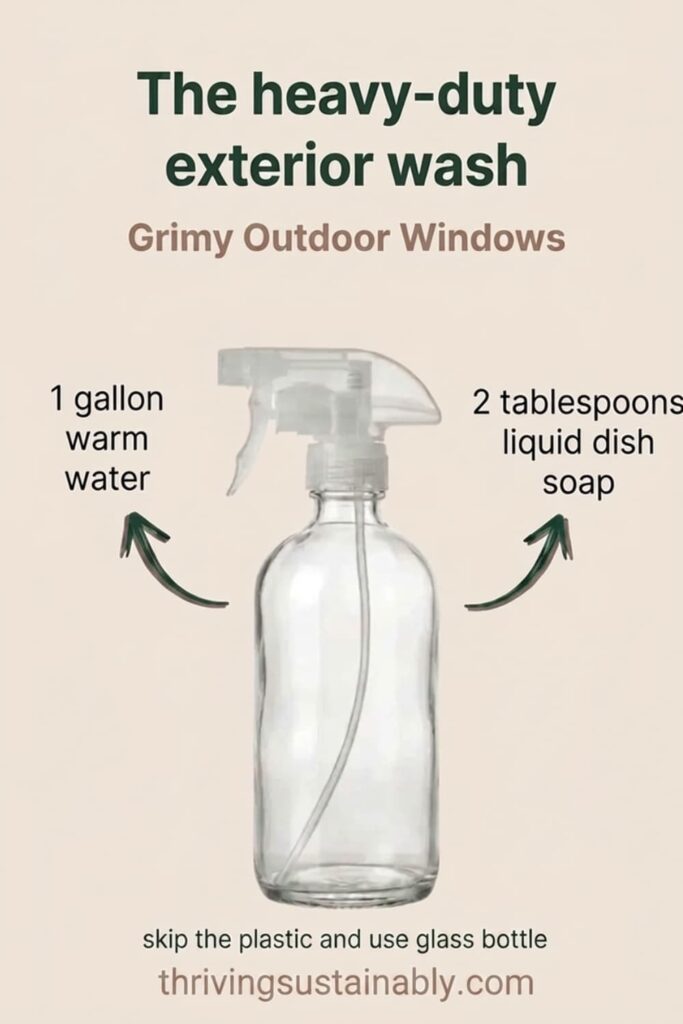
Outdoor glass covered in pollen, dust, and bird mess needs a surfactant, not just acid. This is a bucket recipe, not a spray.
- 1 gallon warm water
- 1 teaspoon liquid dish soap
Wash the glass with a soft sponge or cloth, then rinse with clean water and pull it dry with a squeegee. For a spotless finish, follow up with Recipe 1 or 2 once the heavy dirt is gone.
Recipe 5: Cornstarch window cleaner
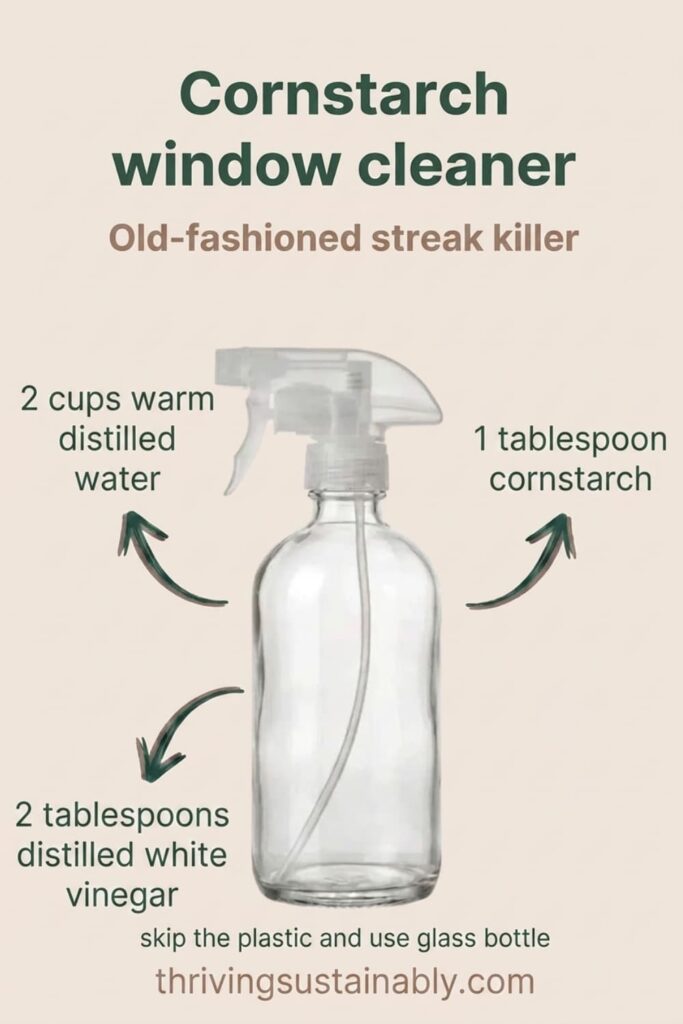
The old-fashioned streak killer that still works. Cornstarch acts as a mild polish and breaks the surface tension that causes film.
- 2 cups warm distilled water
- 2 tablespoons distilled white vinegar
- 1 tablespoon cornstarch
Shake well before every use, because cornstarch settles fast. Spray lightly, wipe, and buff with a dry cloth. Do not over-apply, since too much cornstarch can leave a haze of its own.
💫 NOW YOU KNOW
What Microfiber Actually Is
It feels like cloth, but it is plastic, usually polyester and polyamide spun into strands about 1/100 the width of a human hair. Those split fibers are exactly why it grabs dust so well, and they are also the problem, because they break off in the wash and while you wipe. Synthetic textiles like this are estimated to account for as much as 35% of the microplastics reaching the ocean.
Linen and cotton shed fibers too, at roughly comparable weights in the laundry, but flax fibers break down, and polyester ones do not. If you already own microfiber cloths, do not throw them out, since tossing working cloths just creates waste. Use them up, rinse them between jobs instead of washing after every use, and move to linen when they wear out.
Best homemade cleaner for car windows
The best homemade car window cleaner is an alcohol-heavier mix of 1 cup distilled water, 1 cup isopropyl alcohol, and 1 tablespoon distilled white vinegar. The extra alcohol cuts the oily film that dashboards leave on the inside of the glass, and it dries fast enough to leave no streaks.
Car glass picks up an oily film from the dashboard that regular cleaners smear around. The alcohol in this version dissolves that haze and evaporates before it can streak, which matters for visibility on a sunny drive. One caution: if your car has aftermarket window tint, treat it like coated house glass. Skip ammonia entirely and go easy on the alcohol, using the plain vinegar-and-water blend to protect the film.
How to apply for a streak-free finish
The trick to streak-free windows is to clean out of direct sunlight, use less cleaner rather than more, and buff the glass dry with a linen cloth. Sunlight dries the solution before you can wipe it off, which bakes streaks into the glass.
Andersen makes the same point in its own care guide: never clean glass in direct sunlight. Pick a cloudy day or work in the shade so you control the drying. Then dial in your tools and motion:
- Linen over paper towels. Linen is what professional window cleaners have used for a century. It is lint-free, it buffs glass dry without streaking, and it is flax rather than plastic. A cotton flour-sack towel is an easy stand-in.
- Wipe in one direction. Go top to bottom in an S-pattern, or use a squeegee pulled in overlapping strokes and wiped dry between passes.
- Buff with a second dry cloth. A quick pass with a clean, dry linen towel removes any last film and brings up the shine.
- Use less product. A light mist beats a soaking every time. Extra liquid is the number one cause of streaks.
Troubleshooting streaks and film
Homemade window cleaner streaks for four main reasons: using too much product, leftover residue from an old commercial cleaner, tap water minerals in the mix, or cleaning in direct sun. Switch to distilled water, use a light mist, and buff dry to fix it.
If you just switched from a store-bought spray, your first homemade pass may look worse before it looks better. That is the waxy residue from the old cleaner lifting off, and it clears after a wipe or two. After that, the usual culprit is either too much liquid or hard tap water. Distilled water and a dry buffing cloth solve almost every streak problem.
Storage, shelf life & labeling
Store homemade window cleaner in a labeled spray bottle in a cool, dark spot, away from children and pets. Vinegar and alcohol blends stay good for months, while dish-soap and cornstarch mixes are best made in small batches and used within a couple of weeks.
Always label the bottle with what is inside and the date you mixed it. That keeps a curious kid from mistaking it for something else and reminds you which recipe is which. Cornstarch blends separate over time, so give them a shake before every use.
Don’t Miss: Plastic-Free Living: Where to Actually Start, Room by Room Swapping microfiber for linen is one small win. Here is where the rest of the plastic hides. Read more →FAQs on Homemade Window Cleaner
Both work, and the best cleaners use them together. Vinegar dissolves grease and mineral film, while alcohol evaporates fast to prevent streaks. Alcohol is the better pick for mirrors and humid rooms, but vinegar alone is safer for tinted or Low-E coated glass.
It is better to use distilled water. Tap water carries minerals that dry into chalky spots and streaks, especially in hard-water areas. Distilled water leaves nothing behind, which is why it is the base for every recipe here.
A gentle vinegar-and-water blend is generally safe, but skip anything with ammonia or heavy alcohol. Those can degrade tint film and adhesives over time. For tinted or coated glass, dilute to about 1 part vinegar to 10 parts water and test a small corner first.
Vinegar and alcohol blends keep for months. Recipes with dish soap or cornstarch are best used within a couple of weeks and made in smaller batches, since they can separate or grow cloudy.
Diluted vinegar is fine on most glass and vinyl frames, but avoid letting it pool on rubber seals, natural stone sills, or unsealed wood. Wipe up drips and keep the spray on the glass, not the gaskets.
Final Thoughts on Homemade Window Cleaner
You do not need a shelf of chemical sprays to get clear glass. Five simple recipes and one good habit, cleaning out of the sun and buffing dry with a linen cloth, will handle every window in your home.
Start with the everyday blend, keep the vinegar-only mix on hand for coated glass, and pull out the alcohol or dish-soap versions when a job needs more. Once you see how well a pennies-per-bottle cleaner works, the store-bought stuff is hard to justify.
📚 References
- Andersen Windows. (n.d.). Glass cleaning. https://parts.andersenwindows.com/detail_CleanGlass__Care_GlassClean.html
- Centers for Disease Control and Prevention. (2020). Knowledge and practices regarding safe household cleaning and disinfection for COVID-19 prevention, United States, May 2020. Morbidity and Mortality Weekly Report, 69(23), 705-709. https://www.cdc.gov/mmwr/volumes/69/wr/mm6923e2.htm
- Pella Corporation. (n.d.). Cleaning glass. https://pella.custhelp.com/app/answers/detail/a_id/18/
- U.S. Environmental Protection Agency. (2000). Glycol ethers (2-methoxyethanol, 2-ethoxyethanol, and 2-butoxyethanol): Hazard summary. https://www.epa.gov/sites/default/files/2016-09/documents/glycol-ethers.pdf
- U.S. Environmental Protection Agency. (2010). Toxicological review of ethylene glycol monobutyl ether (EGBE) (CASRN 111-76-2). Integrated Risk Information System. https://iris.epa.gov/static/pdfs/0500tr.pdf
- U.S. Food and Drug Administration. (1995). CPG Sec. 525.825 Vinegar, definitions: Adulteration with vinegar eels. https://www.fda.gov/regulatory-information/search-fda-guidance-documents/cpg-sec-525825-vinegar-definitions-adulteration-vinegar-eels
- University of California Agriculture and Natural Resources. (2025, June 12). About that vinegar, read the label! UC Master Food Preservers of Central Sierra. https://ucanr.edu/site/uc-master-food-preservers-central-sierra/article/central-sierra-about-vinegar-read-label-edc
- Village of Skokie. (n.d.). Dangers of mixing household chemical cleaners. https://www.skokie.org/1023/Dangers-of-Mixing-Household-Chemical-Cle
- Washington State Department of Health. (n.d.). Dangers of mixing bleach with cleaners. https://doh.wa.gov/community-and-environment/contaminants/bleach-mixing-dangers