

Key Takeaways
- After 16 months of daily use, my Caraway pans still release food well, and the mineral ceramic coating has held up better than I expected for a coated pan.
- Caraway reviews come down to one honest trade: the coating is genuinely PFAS-free, but it is still a coating over aluminum, so it will wear out in a way bare cast iron or steel never will.
- My one complaint is cosmetic. On a couple of the colored pans, the exterior finish has chipped, which is a good reminder that the outside color is a coating too.
Caraway is one of the most talked-about non-toxic cookware brands, and most Caraway reviews you will find read like a sales page. This one does not. I bought the full Caraway set with my own money, added two of their baking pans, and I have cooked with them nearly every day for the past 16 months. This is a long-term, everyday-kitchen take, wear and all. The short version: Caraway is a good PFAS-free ceramic set that lives up to its core safety claims, it releases food nicely, and it is worth the price for the right cook, as long as you understand you are buying a coated pan that will not last forever.
The Verdict
- Rating: 4.2 out of 5
- Best for: Home cooks who want easy nonstick release without Teflon chemistry, in a coordinated set that stores neatly.
- Skip if: You want cookware that lasts decades, cook on high heat often, or reach for metal utensils by habit.
- Price: Sold as a 12-piece set, a smaller Duo, or individual pans. The full set is the best value if you are replacing several pieces at once.
How I Tested Caraway Over 16 Months
I cook with the full Caraway set plus two of their baking pans, on a daily basis, for 16 months. This review is based on everyday cooking, not a spec sheet or a two-week trial.
Caraway reviews are only useful if the person writing them actually lived with the pans, so here is exactly what mine covers. I use these for the ordinary rotation most kitchens run: eggs and pancakes in the morning, sauteed vegetables and seared proteins for dinner, sauces and grains in the pots, and roasting and baking in the two Caraway baking pans I added later. That means the coating gets a genuine workout, not a gentle one. My cooking runs low to medium heat most of the time, I use wooden and silicone tools, and I hand wash. Those habits matter, and I will come back to why.
What I Bought and What It Cost
I started with the 12-piece Caraway cookware set, which covers a fry pan, sauce pan, saute pan, and Dutch oven, along with their lids, plus the magnetic pan rack and canvas lid holder for storage. Later I added two Caraway baking pans because I wanted the same coating for roasting. Caraway prices its sets in tiers, and the brand runs frequent sales, so the number you pay depends heavily on timing. If you are replacing several worn pieces at once, the full set is the better value than buying pans one at a time.
✨ tip
Buy the set on sale, not the pieces
Caraway discounts its full sets far more often and more deeply than its single pans. If you only need one pan today but expect to replace more later, waiting for a set sale usually costs less per piece than buying individually now.
What Caraway Cookware Is Made Of
Caraway cookware is an aluminum body with a mineral-based ceramic nonstick coating and stainless steel handles. Caraway states its coating is made without PTFE, PFOA, PFAS, lead, or cadmium, and that it is third-party tested for more than 600 forever chemicals.
The construction is simple to picture. Underneath is a cast aluminum body that heats quickly and evenly. Over it sits Caraway’s ceramic coating, which is a sol-gel mineral coating, meaning it starts as a liquid mineral mixture and cures into a hard, glassy nonstick surface. The handles are stainless steel. Caraway’s own materials page lists the coating as free of PTFE, PFOA, other PFAS, lead, and cadmium, and the brand publishes third-party test results to back the PFAS claim. That is the heart of why people choose it: you get easy release without the fluorinated chemistry that gives Teflon its reputation.
Why does that matter? PFAS are a large family of synthetic chemicals used to make surfaces slick and stain resistant, and they are persistent enough to earn the nickname “forever chemicals.” According to the Agency for Toxic Substances and Disease Registry, most people in the U.S. have been exposed to PFAS and carry it in their blood. Cookware is only one route of exposure, but it is one you can control at the point of purchase, which is exactly what a PFAS-free coating lets you do.
💫 now you know
What is a mineral ceramic coating?
It is a nonstick surface made from a mineral, sand-derived mixture that cures into a hard, glass-like layer, rather than from the fluorinated plastics used in Teflon. It gives you slick release without PFAS, but it is thinner and less heat-tolerant than fluorinated nonstick, which is why gentle heat and soft utensils extend its life.
Cooking Performance in Everyday Use
Caraway performs best on low to medium heat, where its nonstick release is genuinely good. It heats fast thanks to the aluminum core, but it is less forgiving of high heat and preheating than stainless or cast iron.
Day to day, this is where Caraway earns its keep. Eggs slide, pancakes flip clean, and cleanup is quick when I cook the way the coating wants me to. The aluminum body means the pans come up to temperature fast, so I keep the burner lower than I would for stainless. That is the single biggest adjustment for anyone coming from stainless or cast iron: you do not need the heat you are used to, and cranking it is the fastest way to shorten the coating’s life.
Nonstick Release Over Time
The honest headline after 16 months is that the interior still releases food the way it should. I have not hit the point where eggs start to grab, which is the failure mode people worry about most with ceramic coatings. I credit that entirely to how I treat the pans: low to medium heat, a little fat, no metal, and hand washing. Ceramic coatings are known to lose their slickness faster than fluorinated nonstick if you abuse them, so the flip side of my good result is a warning. If you routinely sear on high, use metal utensils, or run these through the dishwasher, expect the release to fade well before mine did.
Heat Distribution and Responsiveness
The aluminum core spreads heat evenly and responds quickly when you adjust the burner, which is a big advantage over thick cast iron that takes ages to change temperature. Where Caraway falls short of clad stainless is in high-heat searing. A hard sear is not what these pans are built for, and pushing them there is exactly what damages the coating, so I reach for a different pan when I want a deep crust.
Induction and Gas Compatibility
Caraway is designed to work on induction as well as gas and electric, so it fits most kitchens without a second thought. On gas, the responsiveness of the aluminum body is easy to feel. On induction, the pans heat evenly and quietly. Either way, the same rule holds: keep the setting lower than you think you need.
Durability: The Part No One Shows You
After 16 months, my Caraway cooking surfaces are intact and still nonstick, but the colored exterior finish has chipped on a couple of pans. Caraway is a coated pan, which means it is a consumable that will eventually need replacing, unlike bare metal cookware.
This is the section the glowing Caraway reviews skip, so here is my honest wear report. The cooking surfaces have held up. What has not stayed perfect is the outside. On a couple of my colored pans, the exterior finish has chipped. It does not touch the cooking surface and it does not affect how the pan cooks, but it is a reminder that the pretty exterior color is a coating too, and coatings chip. If a flawless look matters to you long term, factor that in.
The bigger-picture durability point is structural, not cosmetic. Every ceramic-coated pan is a consumable. The coating is doing the work, and coatings wear. That is not a Caraway flaw, it is the nature of the category, and it is the single reason I score Caraway a 2 rather than a 1 in our directory. Bare cast iron, carbon steel, stainless, and pure ceramic have nothing to wear off, so they can last decades. A coated pan cannot make that promise, no matter how well you treat it. Buy Caraway knowing you will replace it someday.
Cleaning and Maintenance
Caraway is easiest to maintain with gentle hand washing, a soft sponge, and no aerosol cooking sprays. Dishwashers, metal scrubbers, and spray oils all shorten the coating’s life.
Cleaning is genuinely easy when the pan is treated right. Most days a soft sponge and warm water is all it takes, because food releases so well in the first place. When something does stick, a little warm soapy water and a short soak lifts it without scrubbing.
Two habits protect the coating more than anything else: skip aerosol cooking sprays, which leave a residue that builds up and dulls nonstick performance over time, and skip the dishwasher, whose heat and harsh detergent age the coating faster. If your release ever starts to fade, a gentle deep clean to remove built-up oil residue often brings some of it back.
Design and Kitchen Storage
Caraway’s magnetic pan rack and canvas lid holder keep the set organized and save cabinet space, and in my experience they hold up well as everyday storage.
The storage system is more than it sounds. The pans nest on a magnetic rack and the lids sit in a wall-mounted or in-cabinet canvas holder, so the set stays tidy instead of clattering in a pile. For a small kitchen, that alone is a selling point, and it has worked reliably for me over the full 16 months. The coordinated look is part of the appeal too, though it is worth remembering that the colored exteriors are the part most prone to cosmetic chipping.
Oven and Broiler Use
Caraway pans are rated oven-safe up to 550°F. Overheating an empty pan, using aerosol sprays, and high-heat abuse are the fastest ways to damage the ceramic coating.
Caraway lists its cookware as oven-safe to 550°F, which covers most roasting and finishing tasks, and the stainless handles take oven heat without trouble. The thing to respect is that heat is the coating’s enemy over the long run. An empty pan left to overheat on a burner, or repeated high-heat cooking, wears ceramic faster than gentle use ever will. Treat the 550°F rating as a ceiling for occasional oven use, not a license to run these hot every day.
Caraway Pros and Cons
Caraway’s biggest strengths are genuine PFAS-free nonstick release, fast even heating, and smart storage. Its main drawbacks are a coating that wears out, cosmetic exterior chipping, and a price that is high for a consumable pan.
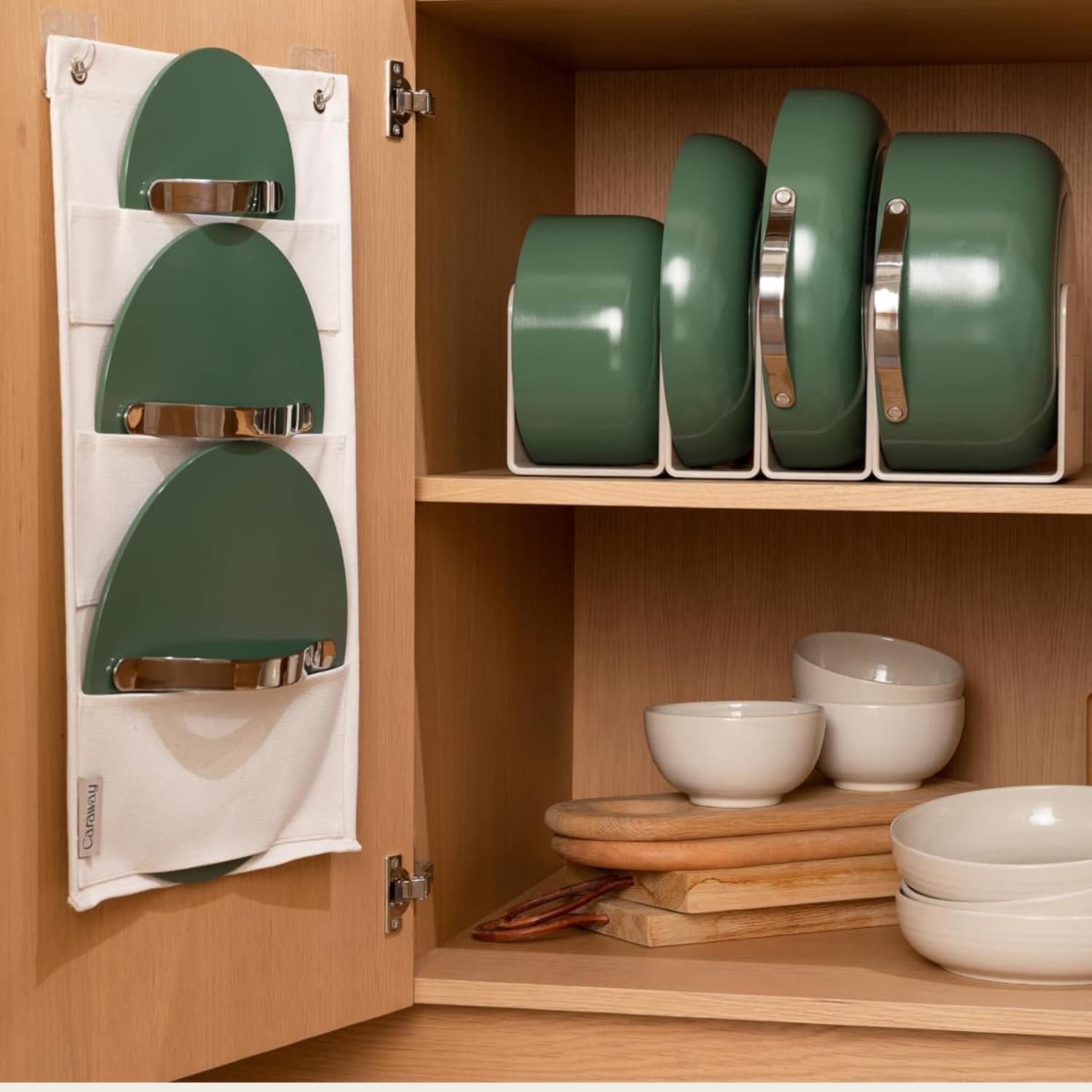
The set I have cooked on for 16 months
$$$
The Caraway Cookware Set is the pick for anyone who wants easy nonstick release without Teflon chemistry, in a coordinated set that stores neatly. The brand states its mineral coating is made without PTFE, PFOA, or PFAS, and that it is third-party tested for more than 600 forever chemicals.
Underneath the coating is an aluminum body with stainless steel handles, and it ships plastic-free in recycled cardboard. It scores a 2 rather than a 1 for one honest reason: it is still a coating over metal, and every coating wears eventually.
I have cooked with the full Caraway set plus two of their baking pans nearly every day for 16 months. The interior still releases food the way it should. My one genuine gripe is cosmetic: on a couple of the colored pans, the exterior finish has chipped. It does not touch the cooking surface, but it is a good reminder that the outside color is a coating too.
Body
Aluminum
✓ Plastic FreeCoating
Mineral Ceramic
⚠ Wears Over TimeHandles
Stainless Steel
✓ Plastic FreePackaging
Recycled Cardboard
✓ No FoamPros
- Genuine nonstick release without PTFE or PFAS
- Aluminum core heats fast and evenly
- Magnetic rack and lid holder save space
- Third-party tested, ships plastic-free
Cons
- Coating is a consumable that will wear out
- Exterior color can chip cosmetically
- Not built for high-heat searing
A good PFAS-free set that earns its price if you cook gently. Worth it, as long as you treat it as the consumable it is.
The Full Caraway Lineup, Piece by Piece
Beyond the cookware set, Caraway sells individual pans, a bakeware set, glass food storage, wooden kitchen tools, and storage accessories. The plastic-free pieces, the birch utensils and the glass food storage, are the best swaps; every coated piece shares the same wear tradeoff as the set.
If the full 12-piece set is more than you need, here is every Caraway line I would consider, ordered with the fully plastic-free pieces first. Only the cookware has a scored Plastic Footprint Directory entry so far; the others are scored here by material and flagged for directory entries.
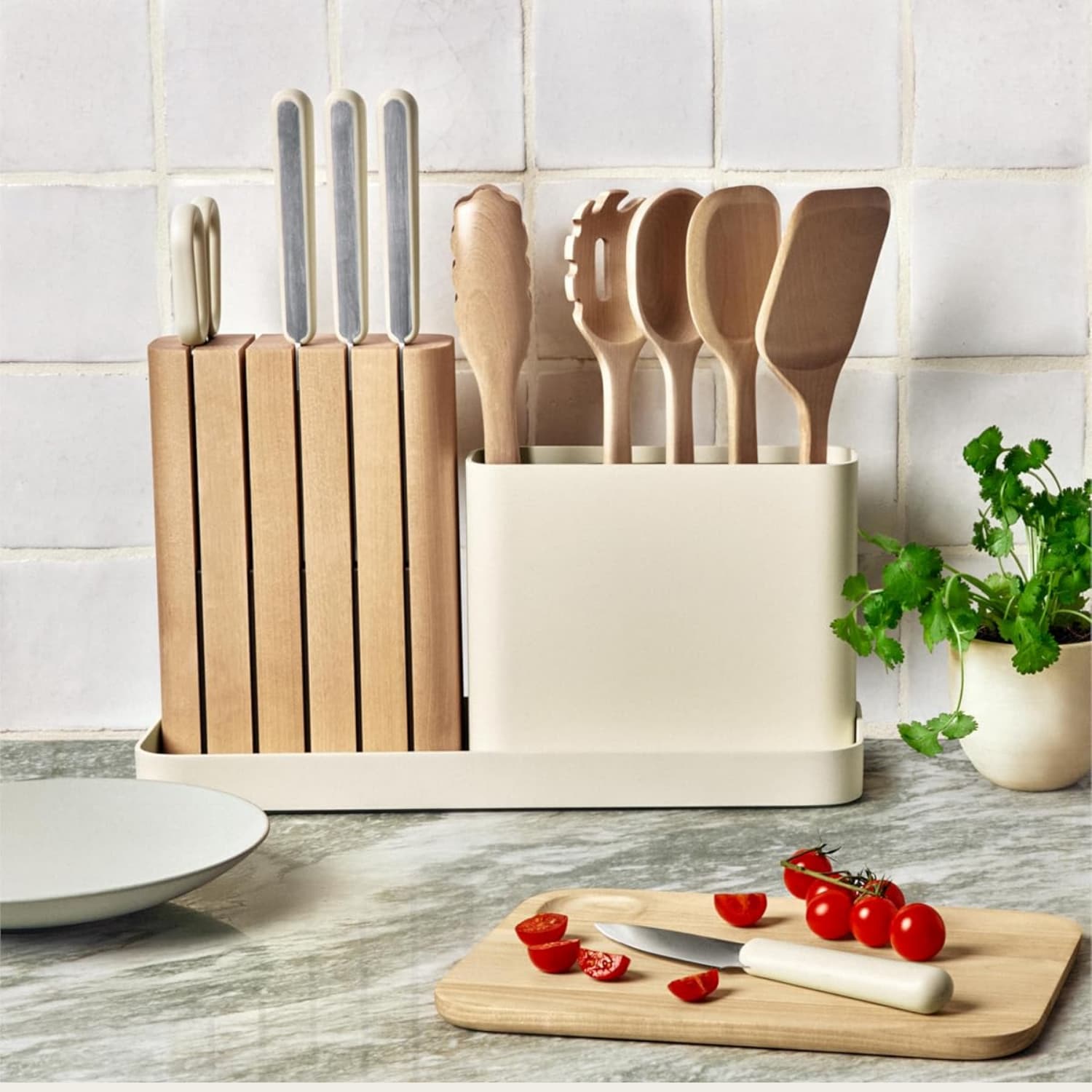
Birch utensils that will not scratch the coating
$$
Caraway’s Kitchen Tools are FSC-certified birch wood with a food-safe varnish, and the brand states they are made without plastic, BPA, BPS, phthalates, or melamine.
Wood is the right tool for a ceramic coating, since it cannot scratch the surface the way metal does. No coating, nothing to wear off, which is why this is the lowest-plastic item in the lineup.
Body
FSC Birch Wood
✓ FSC WoodFinish
Food-Safe Varnish
✓ Plastic FreeHandles
Solid Wood
✓ Plastic FreePackaging
Recycled Cardboard
✓ No FoamPros
- Zero plastic, nothing to wear off
- Safe on ceramic and every other surface
- FSC-certified wood, third-party tested
Cons
- Hand wash only, never soak
- Wood needs occasional oiling
The first thing to buy alongside any coated pan. A plastic-free swap that protects the pans you already own.
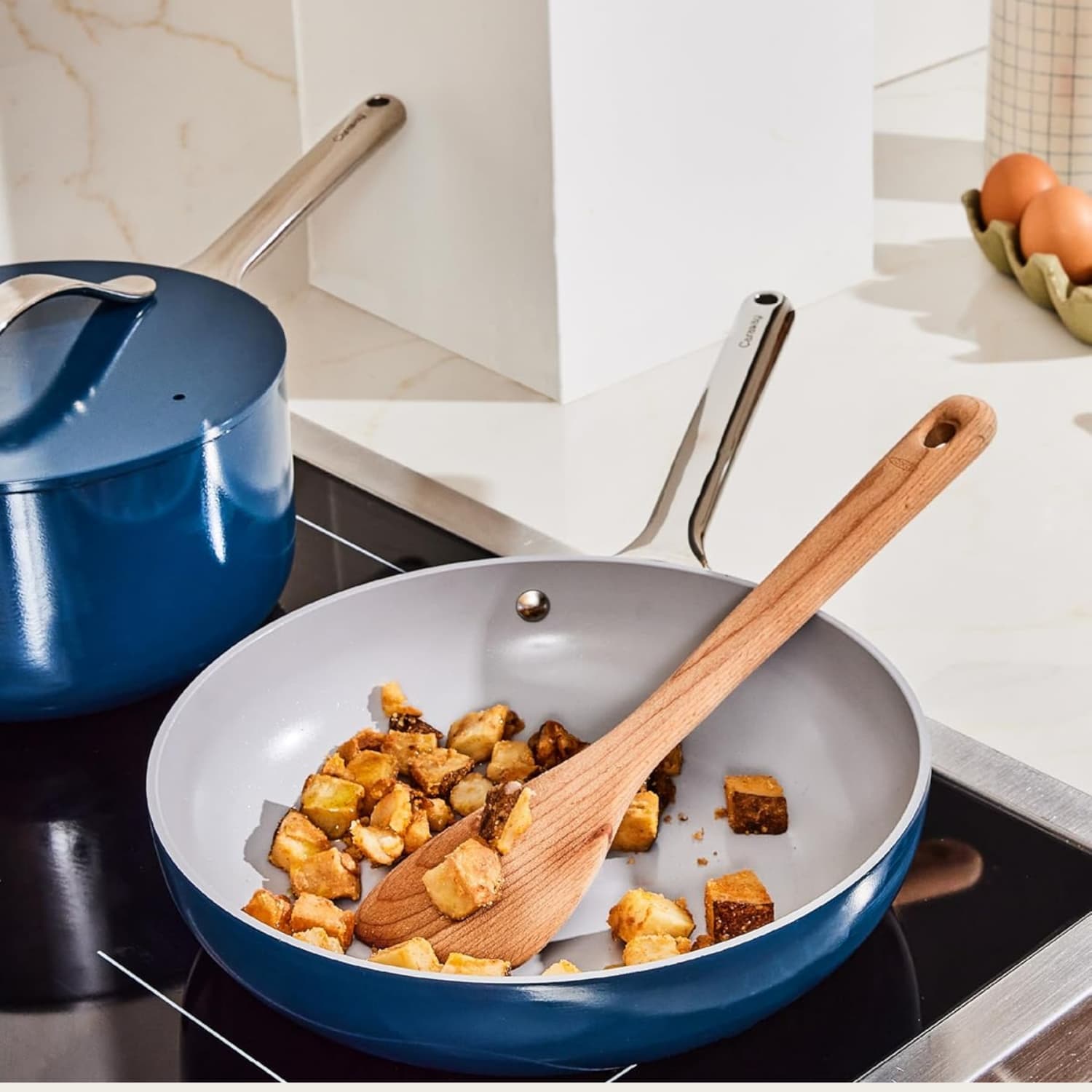
The everyday pan, eggs to stir fry
$$
The Caraway Fry Pan is the piece that gets the most use in my kitchen. Aluminum body, mineral ceramic interior, stainless handle, oven-safe to 550°F, and compatible with gas, electric, and induction.
If you only want to try one Caraway piece before committing to the set, this is the one. Same coating, same care rules: low to medium heat, soft tools, hand wash.
This is the pan I reach for most mornings. After 16 months of near-daily eggs it still releases cleanly, which is the test that matters for a ceramic coating.
Body
Aluminum
✓ Plastic FreeCoating
Mineral Ceramic
⚠ Wears Over TimeHandles
Stainless Steel
✓ Plastic FreePackaging
Recycled Cardboard
✓ No FoamPros
- Best single piece to start with
- Fast, even heating on any stovetop
- Releases eggs and pancakes cleanly
Cons
- Coating wears with high heat or metal tools
- Hand wash only
The one Caraway pan to buy if you only buy one. Start here before committing to the full set.
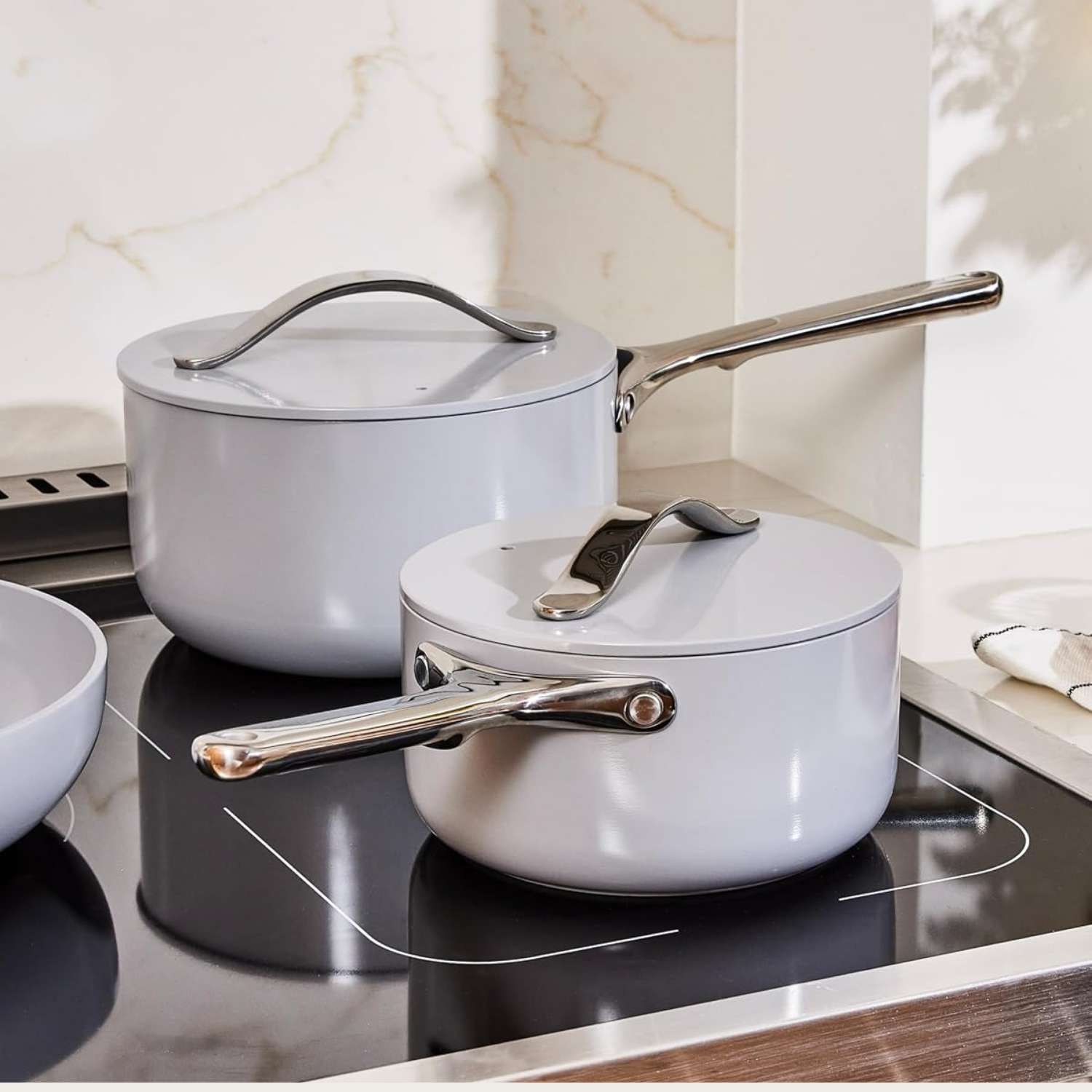
Grains, sauces, and reheating
$$
The Caraway Sauce Pan handles rice, oatmeal, sauces, and reheating leftovers, all the sticky jobs where a nonstick interior saves a lot of scrubbing time.
Same aluminum body and ceramic coating as the fry pan, with a fitted lid. Because it sees liquids more than high direct heat, the coating tends to hold up well here.
Body
Aluminum
✓ Plastic FreeCoating
Mineral Ceramic
⚠ Wears Over TimeHandles
Stainless Steel
✓ Plastic FreePackaging
Recycled Cardboard
✓ No FoamPros
- Nonstick interior makes oatmeal and rice cleanup easy
- Lid included
- Even heating for sauces
Cons
- Coating still a consumable
- Hand wash only
The workhorse for everything that sticks to a regular pot. The piece that earns its keep at breakfast.
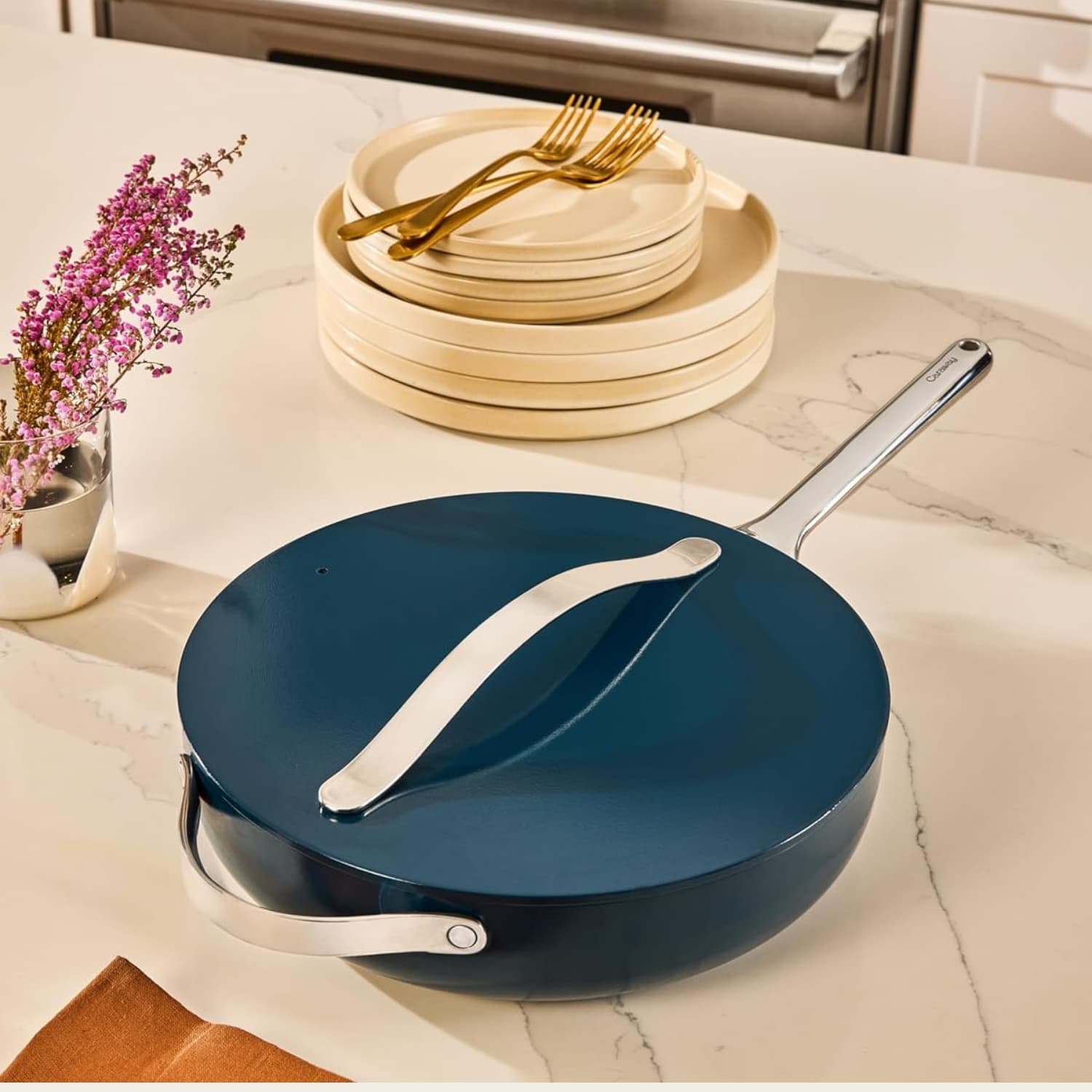
One-pan dinners and shallow braises
$$$
The Caraway Sauté Pan is the deep, straight-sided pan for one-pan meals, shallow braises, and anything that needs room to stir without spilling.
It is the piece that replaces a skillet for family-size cooking. Keep it on medium and it does the job; push it to a hard sear and you shorten the coating’s life.
Body
Aluminum
✓ Plastic FreeCoating
Mineral Ceramic
⚠ Wears Over TimeHandles
Stainless Steel
✓ Plastic FreePackaging
Recycled Cardboard
✓ No FoamPros
- Big capacity for one-pan dinners
- Straight sides keep food in the pan
- Lid included
Cons
- Not for high-heat searing
- Heavy when full, hand wash only
The family-dinner pan in the lineup. Best for volume cooking at medium heat.
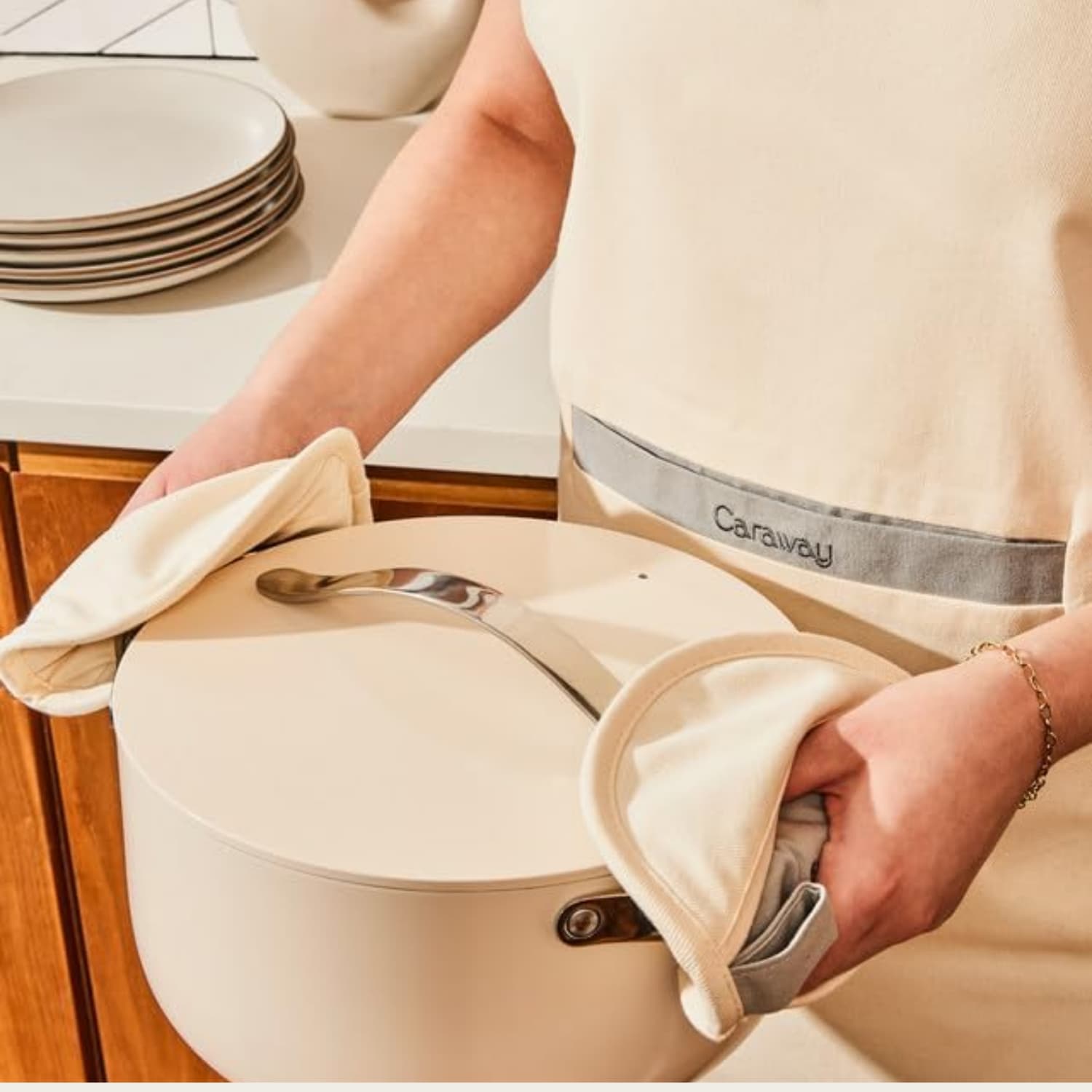
Soups, stews, and oven braises
$$$
The Caraway Dutch Oven covers soups, stews, pasta, and oven braises, and it is far lighter than enameled cast iron because the body is aluminum.
The honest comparison: a Le Creuset Dutch oven is inert and lasts decades, while this one is a coated pan that will eventually need replacing. The trade is weight and easy release against longevity.
Body
Aluminum
✓ Plastic FreeCoating
Mineral Ceramic
⚠ Wears Over TimeHandles
Stainless Steel
✓ Plastic FreePackaging
Recycled Cardboard
✓ No FoamPros
- Much lighter than cast iron
- Nonstick interior, easy cleanup
- Oven-safe to 550°F
Cons
- Coating wears, unlike enameled cast iron
- Not a lifetime piece
Choose it for weight and easy cleanup, not for heirloom life. If you want a Dutch oven for life, look at Le Creuset instead.
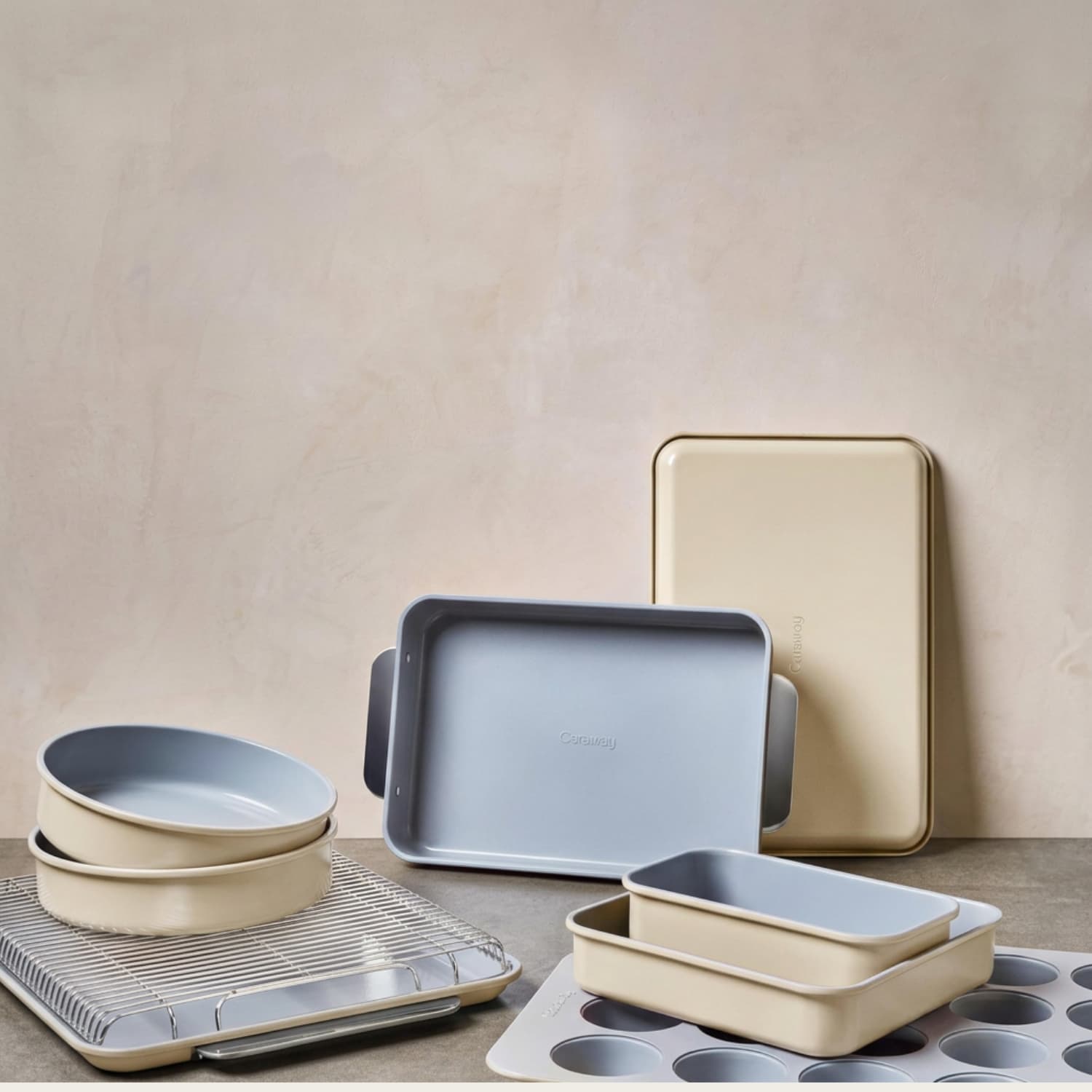
Sheet pans, loaf, muffin, and more
$$$
The Caraway Bakeware Set uses an aluminized steel body with the same mineral ceramic coating and stainless handles, oven-safe to 550°F, and the brand states it is third-party tested without PFAS, PTFE, PFOA, lead, or cadmium.
This is where my two extra Caraway pieces came from. Roasting vegetables and baking without parchment is the biggest payoff, and the storage organizer keeps the set from becoming a cabinet avalanche.
I added two Caraway baking pans after living with the cookware. Roasted vegetables release without parchment, which is the whole reason I bought them.
Body
Aluminized Steel
✓ Plastic FreeCoating
Mineral Ceramic
⚠ Wears Over TimeHandles
Stainless Steel
✓ Plastic FreePackaging
Recycled Cardboard
✓ No FoamPros
- Roast and bake without parchment or spray
- Steel core heats evenly
- Organizer included
Cons
- Coating wears like the cookware
- Hand wash only, no dishwasher
The upgrade I bought after the cookware won me over. Worth it if you roast more than you fry.
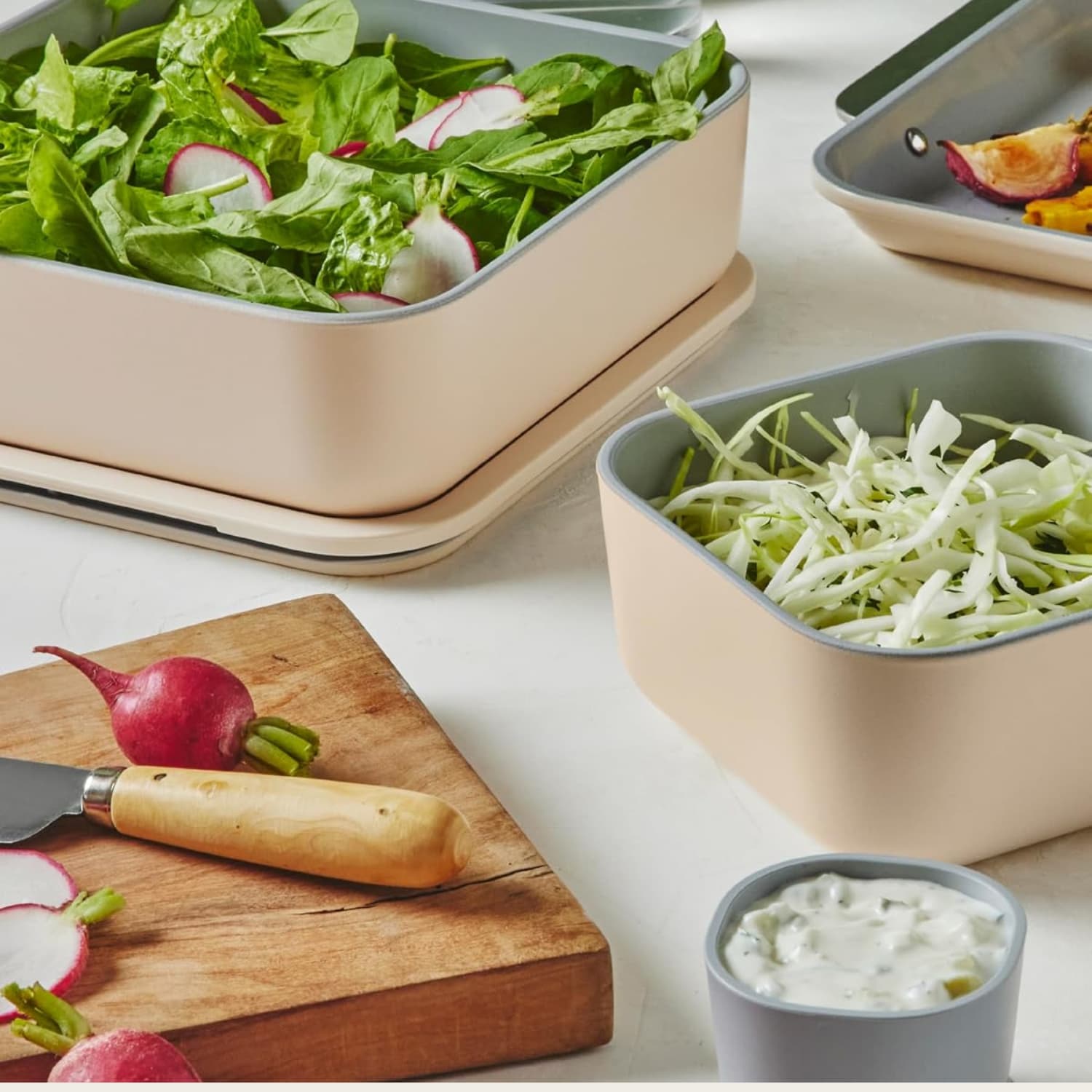
Leftovers without plastic containers
$$$
The Caraway Food Storage Set is borosilicate glass with a ceramic nonstick coating, oven-safe to 450°F, and dishwasher, microwave, fridge, and freezer safe. The brand states it is third-party tested and built to cut microplastics from leftovers.
This is the swap for anyone still storing food in plastic tubs. Glass body, nothing leaching into your food, and the coating means tomato sauce does not stain it.
Body
Borosilicate Glass
✓ Plastic FreeCoating
Mineral Ceramic
⚠ Wears Over TimeLid
Glass
✓ Plastic FreeSeal
Food-Safe Silicone
◎ Food-Safe SiliconePros
- Glass body, no plastic touching food
- Dishwasher and freezer safe
- Organizers included
Cons
- Heavier than plastic containers
- Coating can wear over years
The easiest plastic-free swap in the whole lineup. Replace your plastic tubs with these first.
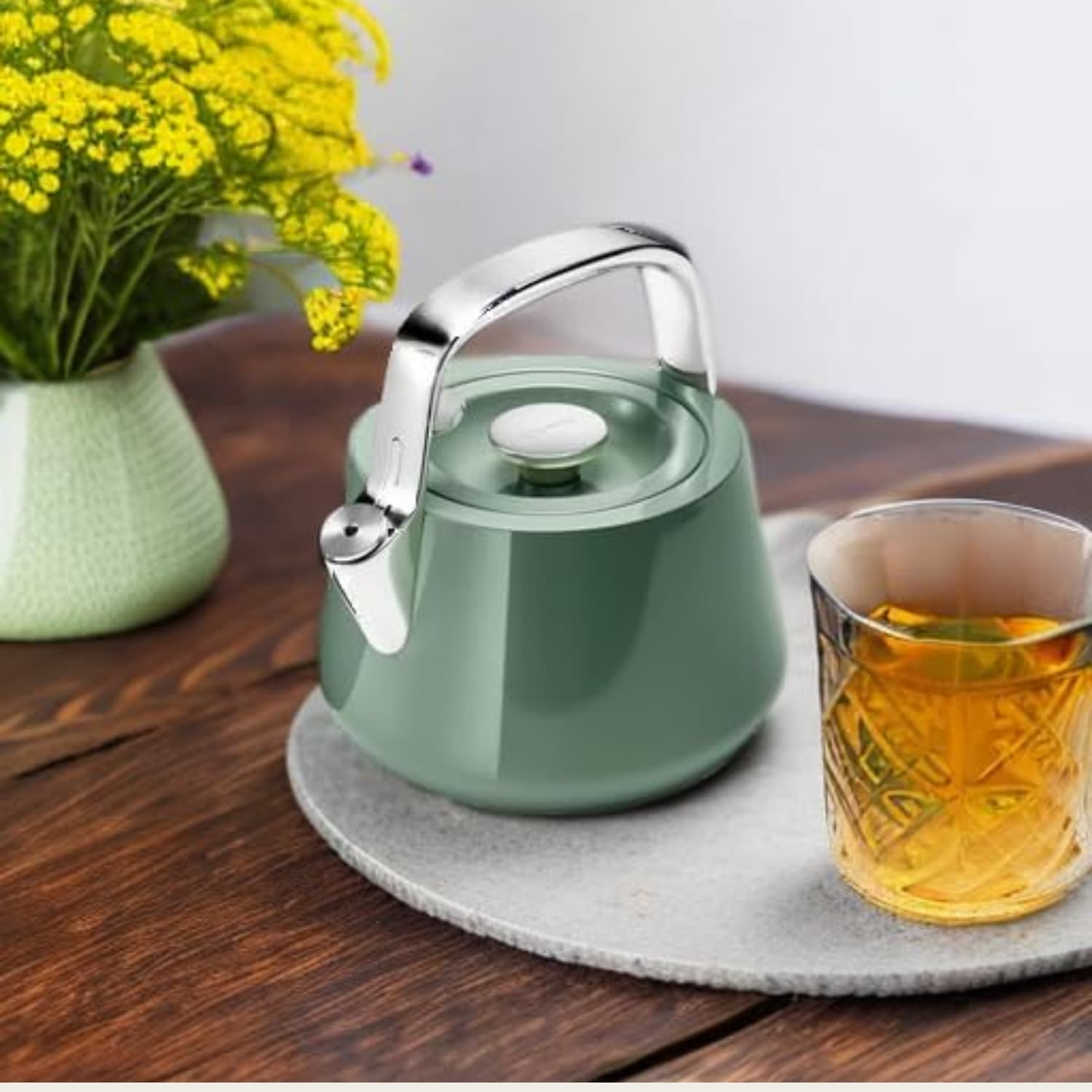
Racks and organizers that keep the set tidy
$$
Caraway’s Kitchen Accessories are the organizers that make the set work in a crowded cabinet: the magnetic pan rack, the lid holder, and the organizers that stop lids from rattling loose.
They are not cookware, so there is no coating to worry about. They are the reason my Caraway pieces stay tidy instead of stacked, and after 16 months they have held up as everyday storage.
Rack
Steel, Magnetic
✓ Plastic FreeLid Holder
Canvas
✓ Plastic FreeHardware
Steel
✓ Plastic FreePackaging
Recycled Cardboard
✓ No FoamPros
- Keeps pans and lids organized
- No coating, nothing to wear
- Fits every Caraway piece
Cons
- Only useful if you own Caraway
- Adds cost on top of the set
Not essential, but the reason the set stays neat. Buy it if cabinet space is tight.
Caraway vs. the Alternatives
Against Our Place, GreenPan, and HexClad, Caraway stands out for publishing third-party PFAS test results, but all coated pans share the same wear limit. For cookware that never needs replacing, an inert material like enameled cast iron is the honest alternative.
If you are cross-shopping, here is the quick read. The Our Place Always Pan is the closest match, a PFAS-free ceramic coating over aluminum built around one-pan cooking, and it discloses its coating makeup openly, though it does not publish the same third-party testing Caraway does. GreenPan is another ceramic-coated option in the same family, with the same coating-wear reality. HexClad is different in a way worth knowing: despite its stainless look, it sets a PTFE nonstick into the etched steel, so it still relies on a PFAS coating, which is exactly what a Caraway buyer is usually trying to avoid. And if the coating-wears-out problem is a dealbreaker, the better alternative is not another coated pan at all, it is an inert surface like Le Creuset enameled cast iron that has nothing to wear off.
| Cookware | Coating Type | PFAS-Free | Wears Out |
|---|---|---|---|
| Caraway | Mineral ceramic | Yes, third-party tested | Yes |
| Our Place Always Pan | Mineral ceramic | Yes, brand-stated | Yes |
| HexClad | PTFE in etched steel | No | Yes |
| Le Creuset enameled cast iron | Porcelain enamel (inert) | Yes | No |
Save This Caraway Review for Later 📌

Pricing, Discounts, and Warranty
Caraway sells sets and individual pans, discounts sets frequently, and offers a limited warranty that covers manufacturing defects rather than everyday coating wear. Coating that fades from normal use is not a warranty claim.
Caraway is priced as a premium set, and the number you pay swings a lot with promotions, so it pays to buy during a sale rather than at full price. On the warranty, read the fine print before you assume you are covered for life. Caraway’s warranty is aimed at manufacturing defects, not the gradual loss of nonstick that any coated pan eventually shows. In plain terms, if a handle fails or a pan arrives flawed, that is a warranty matter, but a coating that dulls after years of cooking is expected wear, not a defect. That is one more reason to treat these pans as a consumable you will replace, and to protect the coating with gentle use so that day comes as late as possible.
Who Should Buy Caraway and Who Shouldn’t
Buy Caraway if you want easy PFAS-free nonstick, cook on low to medium heat, and like a coordinated set that stores well. Skip it if you want cookware for life, sear on high often, or will not baby a coating.
Caraway is a strong fit for the cook who wants nonstick without Teflon chemistry and is realistic about what a coating is. If your kitchen runs gentle heat, you already reach for wooden or silicone tools, and you value a set that looks tidy on the wall, you will likely be happy the way I have been for 16 months. It is a poor fit if your goal is one-and-done cookware that outlives you, if you sear steaks on max heat, or if you know yourself well enough to admit you will grab a metal spatula and toss pans in the dishwasher. For that cook, an inert pan will frustrate you less and last far longer.
Don’t Miss: Safest Cookware in 2026 If a coating that wears out is a dealbreaker, see how every cookware material compares, from ceramic coatings to stainless steel and cast iron. Read more →Final Rating: 4.2 out of 5
Caraway earns 4.2 out of 5: excellent PFAS-free nonstick and smart design, held back only by the coating wear and cosmetic chipping that come with any ceramic-coated pan.
Sixteen months in, I stand behind the score. Caraway does the main job well, the safety claims check out against the brand’s own testing, and the set has made my kitchen easier to cook in and easier to keep tidy. The points it loses are the honest ones every buyer deserves to know up front: the coating is a consumable, the exterior color can chip, and the price is steep for something you will eventually replace. Go in with clear eyes and Caraway is worth it. Expect a pan for life and you will be disappointed, not because Caraway is bad, but because no coated pan can be that.
FAQs About Caraway Cookware
Caraway’s ceramic coating is made without PTFE, PFOA, other PFAS, lead, and cadmium, and the brand publishes third-party test results for more than 600 forever chemicals. Under the coating is an aluminum body, and the handles are stainless steel.
Hand washing is the better choice for Caraway. The heat and harsh detergent in a dishwasher age the ceramic coating faster, while a soft sponge and warm soapy water keep the nonstick working much longer.
Yes, Caraway is designed to work on induction as well as gas and electric stoves. On induction, the pans heat evenly and quietly.
Metal utensils wear down the ceramic coating, so the nonstick release fades much sooner. Wooden or silicone utensils are the safer pick and help the pans last.
Final Thoughts About Caraway Reviews
Most Caraway reviews stop at “it’s non-toxic and pretty.” After 16 months of daily use, the fuller truth is that Caraway is a good PFAS-free set worth buying, as long as you understand you are buying a consumable, not an heirloom.
If you take one thing from my time with these pans, let it be this: the safety claim holds up and the release is genuinely good, so the decision comes down to whether you accept the trade every coating asks. Treat Caraway gently, keep the heat down, skip the metal and the dishwasher, and it will serve you well for years. Just remember the pan you buy today will need replacing someday, which is exactly why an inert material earns a better score in our directory even as Caraway earns a spot in my kitchen.
📚 References
View all sources
- Agency for Toxic Substances and Disease Registry. (2024). Fast facts: PFAS in the U.S. population. U.S. Centers for Disease Control and Prevention. https://www.atsdr.cdc.gov/pfas/data-research/facts-stats/index.html
- Caraway Home. (n.d.). Our materials. https://www.carawayhome.com/our-materials
- Caraway Home. (n.d.). Third-party test results. https://www.carawayhome.com/pages/third-party-test-results