
Key Takeaways
- A 2018 peer-reviewed study found 81% of tap water samples worldwide held plastic particles, and US samples were the most contaminated of any country tested.
- The best water filter pitcher for microplastics uses a physical membrane, not carbon alone, because research shows carbon-only cartridges do not reliably sieve out plastic particles.
- Only one pitcher we reviewed, the Brita Elite, is third-party certified for microplastics, PFAS, and lead together, while glass-bodied picks cut down on the plastic your water sits in.
If you want the short answer, the best water filter pitcher for most homes is the LifeStraw Home in glass, because it is the only pitcher in this guide that pulls water through a physical membrane fine enough to catch microplastics while holding your water in glass instead of plastic. That said, the right pitcher for you depends on what is actually in your water, and the label claims can be slippery. We researched the performance data sheets, third-party certifications, and published science behind a dozen popular pitchers so you can skip the marketing and buy the one that fits your tap.
Why a Better-Tasting Filter Is Not Enough
However, here is the part most roundups leave out. A filter that removes chlorine so your water tastes better is not the same as a filter that removes lead, PFAS, or plastic particles. In other words, those are different jobs, proven by different tests, and a pitcher can be excellent at one and useless at another. Below, every pick is sorted by what it is certified or lab tested to do, with the plastic content of the pitcher itself laid out plainly, since a plastic jug is a strange place to store water you are trying to keep plastic out of.
The Experts Behind the Research
- Mary Kosuth and Dr. Sherri Mason, researchers whose 2018 PLOS ONE study tested tap water from 14 countries and gave us the widely cited figure for plastic particles in drinking water.
- Cherian and colleagues, whose 2023 study in Polymers tested point-of-use filters and found that membrane devices removed plastic fragments while a carbon-and-resin-only device did not.
- Dr. Zhanjun Li and Dr. Eddy Zeng, whose 2024 study in Environmental Science & Technology Letters showed that boiling hard water can trap most of its nano and microplastics in limescale.
Our Top Picks at a Glance
For microplastics and PFAS in a lower-plastic build, the LifeStraw Home in glass leads. If you want certified proof on paper at the lowest cost per gallon, the Brita Elite wins. For the widest contaminant range including fluoride, the Clearly Filtered pitcher does the most.
The table below is sorted the way we recommend shopping: lower-plastic picks first, then the strongest plastic-bodied filters. Tap any product name to jump to its full review. The certification column lists only genuine third-party certifications, so a pitcher that is only lab tested to a standard, rather than certified to it, is noted as such in its review.
| Pitcher | Best For | Body | 3rd Party Certs | Filter Life | Price |
|---|---|---|---|---|---|
| LifeStraw Home Glass | Microplastics and PFAS | Borosilicate glass | None At This Time | Up to 264 gal membrane | $$ |
| Aarke Purifier | Lowest-plastic build | Glass and stainless steel | None At This Time | About 32 gal per refill | $$$ |
| Brita Elite | Certified value | BPA-free plastic | NSF 42, 53, 401 | 120 gal / 6 months | $ |
| Clearly Filtered | Widest range, plus fluoride | Tritan plastic | NSF 42, 372 | 100 gal | $$ |
| Epic Pure | Fluoride reduction | Tritan plastic | NSF 42, 372 | 100 gal | $$ |
| ZeroWater | TDS and chromium-6 | BPA-free plastic | NSF 42, 53 | About 15 gal | $ |
| Waterdrop | Budget pick | BPA-free plastic | NSF 42, 372 | 200 gal | $ |
How We Researched These Pitchers
We did not run our own lab. We compared each pitcher against its manufacturer performance data sheet, its third-party certification listing, and independent published research, then ranked them on what the evidence actually supports rather than what the box says.
Honesty matters more than a dramatic before-and-after photo, so here is our method in plain terms. For every pitcher, we pulled the official performance data sheet where one exists, then checked the certification registries at NSF, the Water Quality Association, and IAPMO to confirm which claims are certified and which are only tested. In short, a certified claim means an accredited body verified it. A tested claim means a lab measured it using the standard test method, which is useful, but not the same thing.
We also weighed the pitcher material itself. Because our focus is a lower-plastic home, a glass or stainless build earns credit, and a plastic body is flagged even when it is labeled BPA-free. Finally, we scored value on cost per gallon rather than sticker price, since a cheap pitcher with a thirsty filter can cost more over a year than a pricier one that sips.
Contaminants We Focused On
Not every contaminant matters in every home, so we tracked the ones that show up most in US tap water and carry real health weight. Microplastics and PFAS lead the list, since those are the reasons most people start filtering in the first place. We also tracked lead, which has no safe level, along with chlorine and chloramine, chromium-6, and fluoride for readers who want to reduce them.
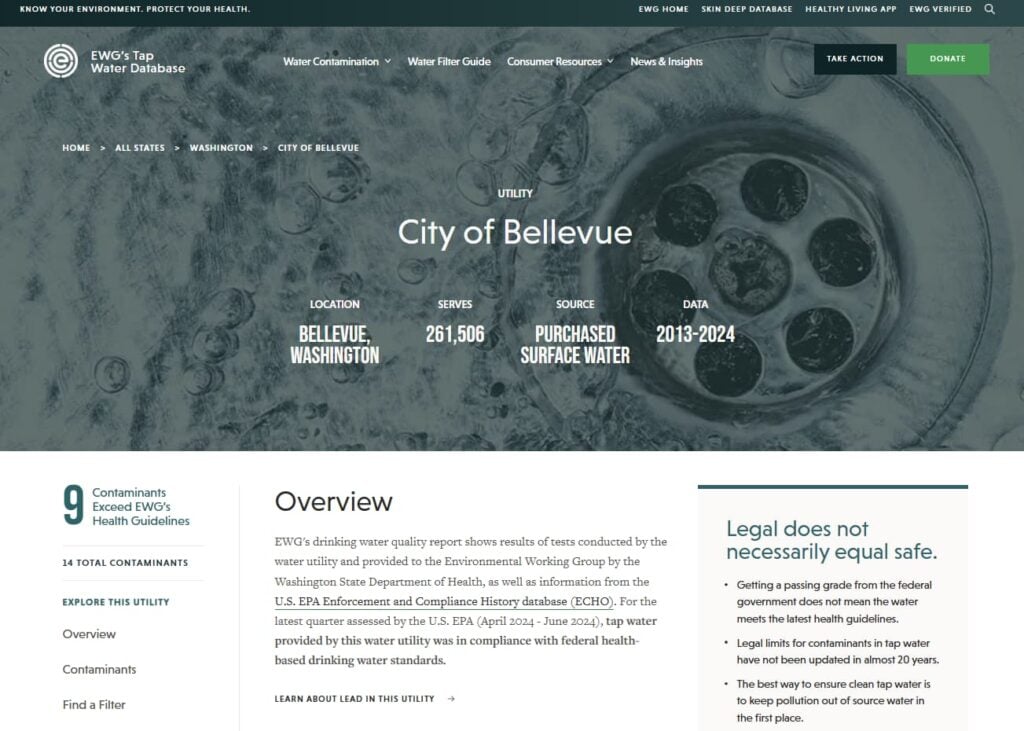
Also, you can look up what is in your own water for free. For example, the Environmental Working Group keeps a Tap Water Database searchable by zip code, and your water utility publishes an annual Consumer Confidence Report you can find on its website, through the EPA’s CCR finder, or by calling to ask for it. Then, knowing your two or three real problems turns this from a guessing game into a quick match.
✨ tip
Match the Filter to Your Water, Not the Hype
Pull your zip code report first. If your only issue is chlorine taste, almost any pitcher works and you can save money. If lead, PFAS, or microplastics show up, you need a pitcher proven against those specific contaminants, and most basic filters are not.
Where a Pitcher Is the Wrong Tool
This guide covers municipal tap water, which US utilities already disinfect, so bacteria and viruses are outside what an everyday pitcher is built to handle. Two picks here do add a microbiological membrane, noted in their reviews, but if you are on questionable well water or under a boil-water notice, a pitcher is the wrong tool and a certified system is the right one.
What Is Actually in US Tap Water
US tap water carries more plastic than most people expect. A 2018 study found 81% of tap water samples worldwide contained plastic particles, with US samples the most contaminated of any country tested, and a 2023 USGS study estimated at least 45% of US tap water contains PFAS.
Above all, knowing what is in your glass makes the rest of this decision easier. Specifically, four contaminants come up again and again in US water, and each calls for a different kind of filter.
Microplastics
First, microplastics are the reason many people start filtering. For instance, the 2018 study by Mary Kosuth and colleagues, published in PLOS ONE, tested tap water from 14 countries and found plastic particles in 81% of samples, most of them tiny fibers, with US water averaging the highest count of any country in the study. Researchers are still learning what that means for health, and a 2019 World Health Organization review judged the current risk to be low based on limited data, while calling for more research.
PFAS, the Forever Chemicals
PFAS, often called forever chemicals, are the second big worry. A 2023 US Geological Survey study estimated that at least 45% of US tap water contains one or more of these compounds, and in 2024 the EPA set its first national limits, capping PFOA and PFOS at 4 parts per trillion. Those two limits still stand, so a filter proven against PFAS is a smart buy in much of the country.
Lead and Chlorine
Finally, lead rounds out the short list, alongside the chlorine most utilities add to disinfect. Indeed, lead has no safe level, and the EPA is lowering its action level from 15 to 10 parts per billion, which matters most in older homes with lead service lines or plumbing. Chlorine isn’t a major health concern at tap levels, but it is the taste and smell that send most people looking for a pitcher in the first place.
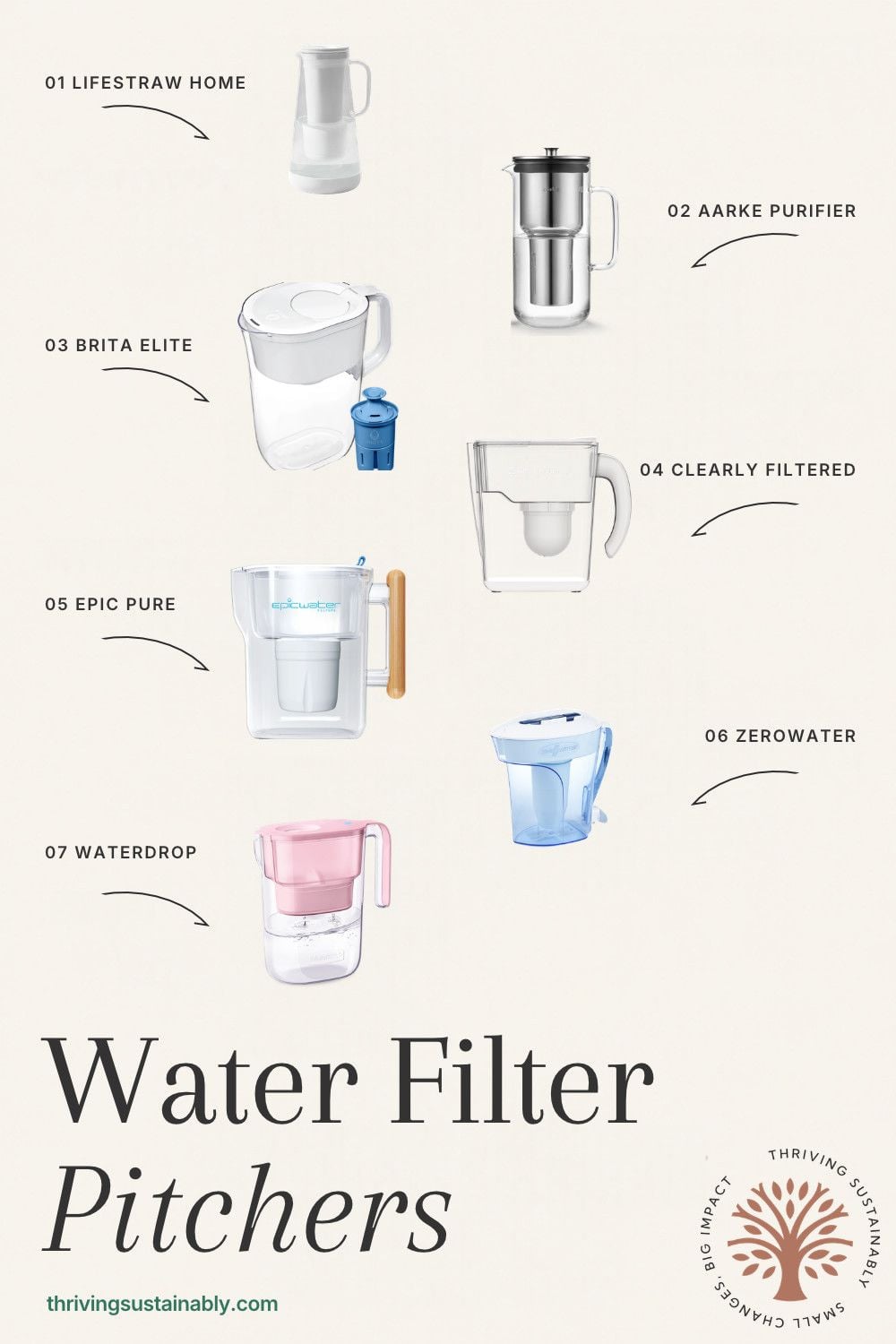
The 7 Best Water Filter Pitchers
Overall, these seven pitchers earned their spots by matching a proven filtration job to a clear buyer. Lower-plastic glass and steel builds come first, followed by the plastic-bodied pitchers with the strongest filtration on paper.
These are the seven pitchers worth your money, ordered by how little plastic each adds to your water. As a result, glass and stainless builds lead, followed by plastic-bodied filters strong enough to earn a spot, starting with the LifeStraw Home in glass.
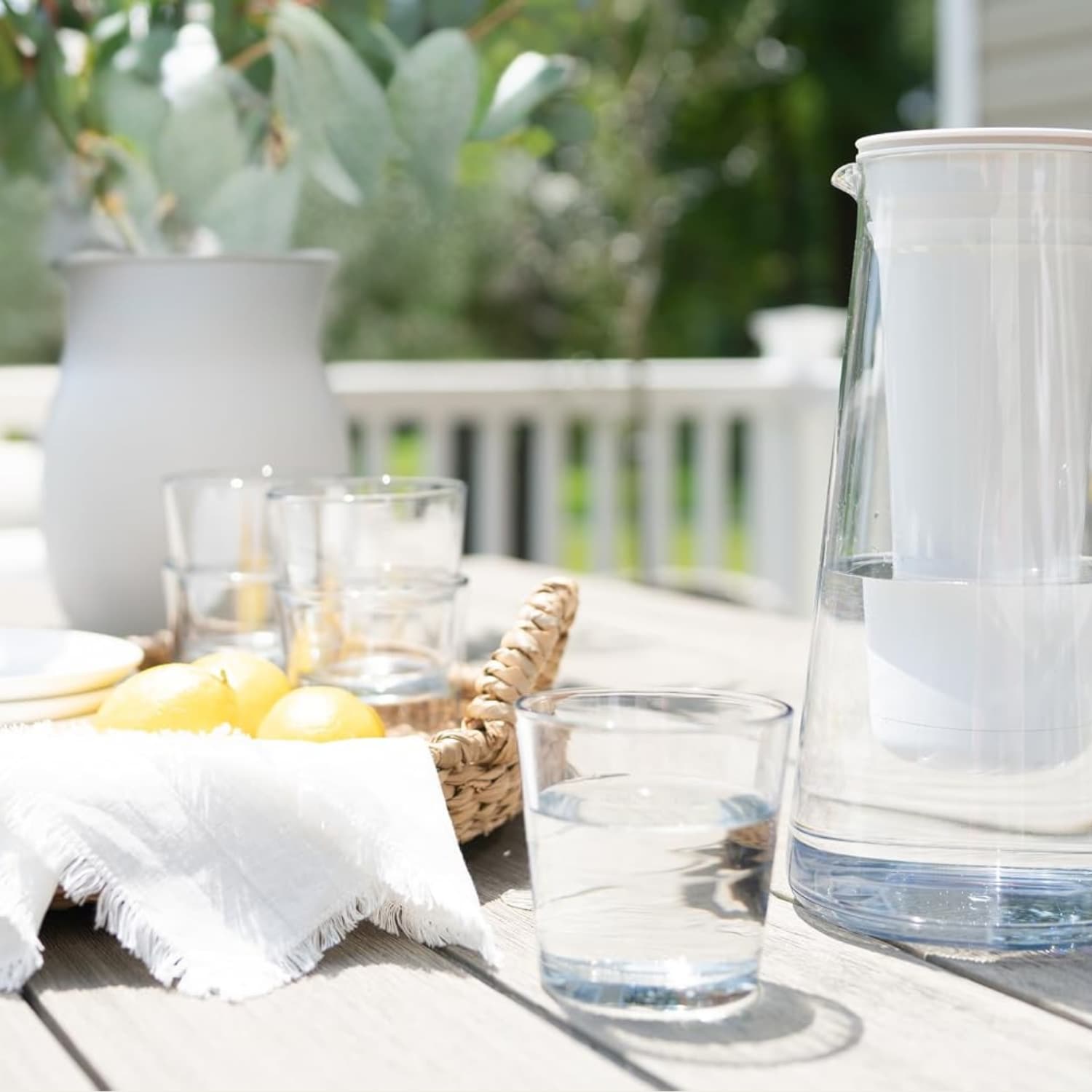
LifeStraw Home (Glass)
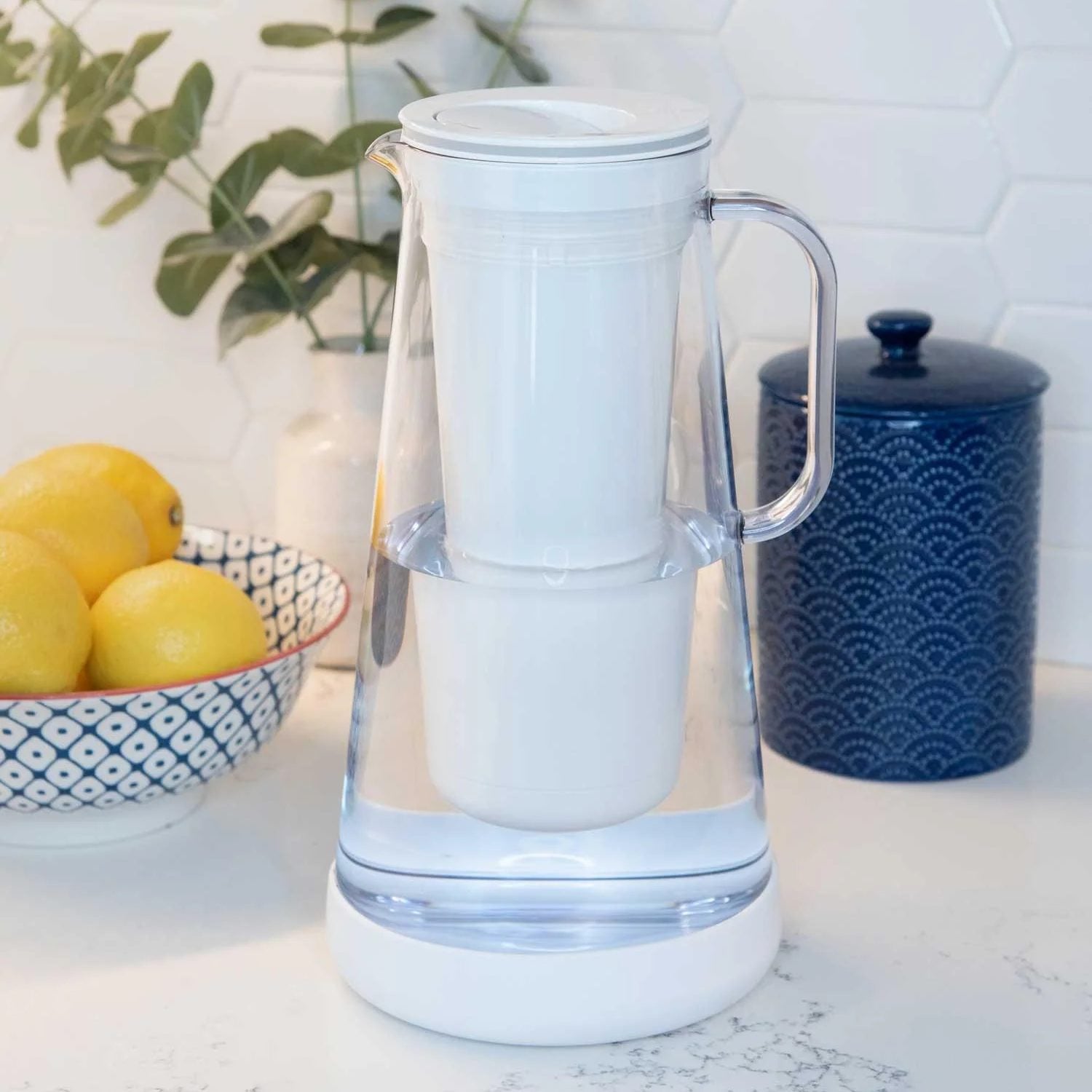
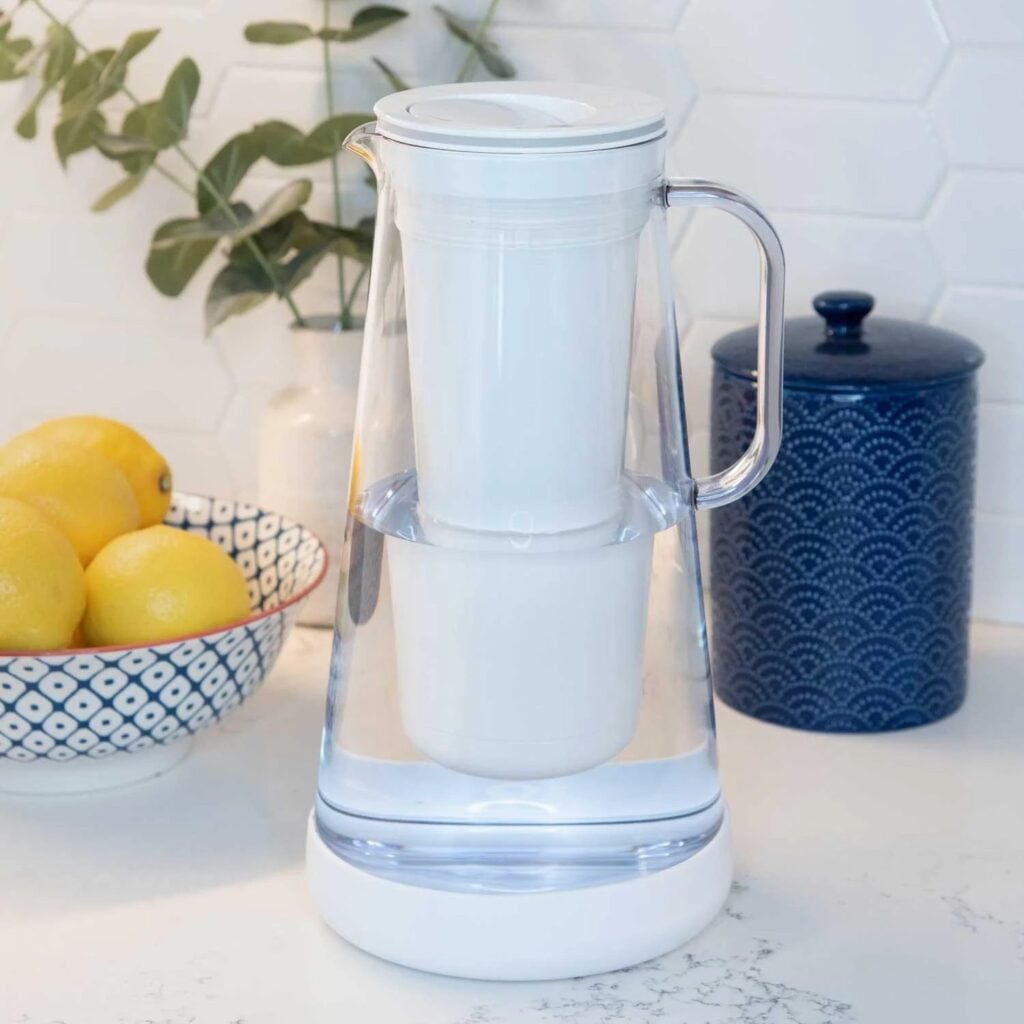
The LifeStraw Home is the only pitcher in this guide that pulls water through a 0.2 micron hollow-fiber membrane, so it physically sieves out particles instead of relying on carbon alone. That design is why its microplastics reduction reaches 99.999% and its PFAS reduction tops 99% on the NSF test methods.
The reservoir is borosilicate glass, so your water sits in glass rather than plastic, though the lid and filter housing are still BPA-free plastic. It reduces lead, mercury, chlorine, and waterborne bacteria and parasites, but it does not reduce fluoride.
Buy this if microplastics and PFAS are your worry and you want your water in glass. In short, the membrane is what makes the microplastic claim real.
- Contains plasticLid: BPA-Free Plastic. Filter Housing: BPA-Free Plastic.
- GlassGlass parts, per the brand.
At a glance
- Reservoir
- Borosilicate Glass
- Lid
- BPA-Free Plastic
- Filter Housing
- BPA-Free Plastic
- Filter Media
- Membrane + Carbon
Keep in mind
- Tested to NSF methods, not NSF certified
- Does not reduce fluoride
- Carbon stage needs changing about every 2 months
- Glass is heavier and can break
This is the pitcher for the reader who started filtering because of microplastics headlines. The membrane is the difference maker, since it strains particles by size the way a fine net would, rather than hoping carbon grabs them. In addition, pairing that with a glass reservoir answers the obvious question about storing water in plastic.
- Best for households focused on microplastics, PFAS, and a lower-plastic build.
- Skip it if you specifically want fluoride reduced, since it leaves fluoride in.
- Also, plan on two filter parts, a long-life membrane and a shorter-life carbon stage.
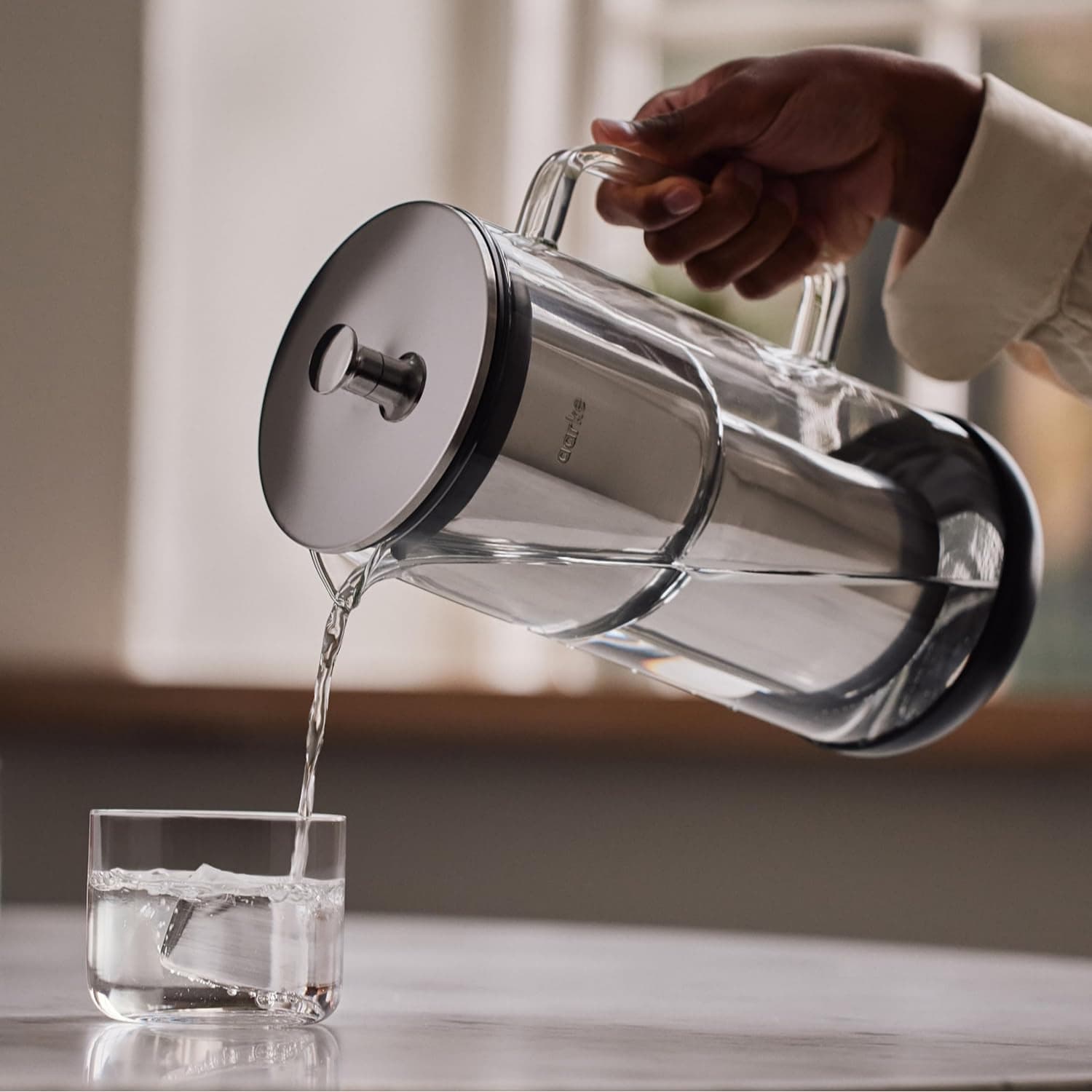
Aarke Purifier
The Aarke Purifier is the lowest-plastic pitcher here. The carafe is glass and the cartridge is a refillable steel canister you top up with mineral granules, so you are not throwing away a plastic cartridge every month. Aarke does use some BPA-free plastic and silicone in the lid and hopper parts, which is why it still carries a contains-plastic tag.
Its main limit is scope. It reduces limescale, chlorine, copper, and lead, and it is tested to the European EN 17093 standard rather than NSF. It does not target PFAS or microplastics, so treat it as a taste and metals pitcher, not a microplastics one.
The pick when your first priority is the least plastic and better taste on city water. Look elsewhere if PFAS or microplastics are the goal.
- Contains plasticLid: Plastic.
- GlassGlass parts, per the brand.
- Stainless steelStainless steel parts, per the brand.
- RefillableRefillable, per the brand.
At a glance
- Body
- Glass + Stainless
- Cartridge
- Refillable Steel
- Media
- Mineral Granules
- Lid & hopper
- Steel + some plastic
Keep in mind
- No PFAS or microplastics reduction
- Tested to a European standard, not NSF
- Short granule life, about 32 gallons
- Highest price in this guide
Ultimately, Aarke rewards a specific buyer: someone on treated city water who wants the most attractive, least-plastic vessel and mainly cares about taste, limescale, and basic metals. On the other hand, anyone chasing PFAS or plastic particles will be happier with the LifeStraw. Value here is about the object as much as the filtration, so go in knowing that.
- Best for taste, limescale, and a plastic-minimal kitchen on municipal water.
- Skip it if your report shows PFAS, microplastics, or fluoride as concerns.
- Admittedly, refilling granules takes a minute more than dropping in a cartridge.
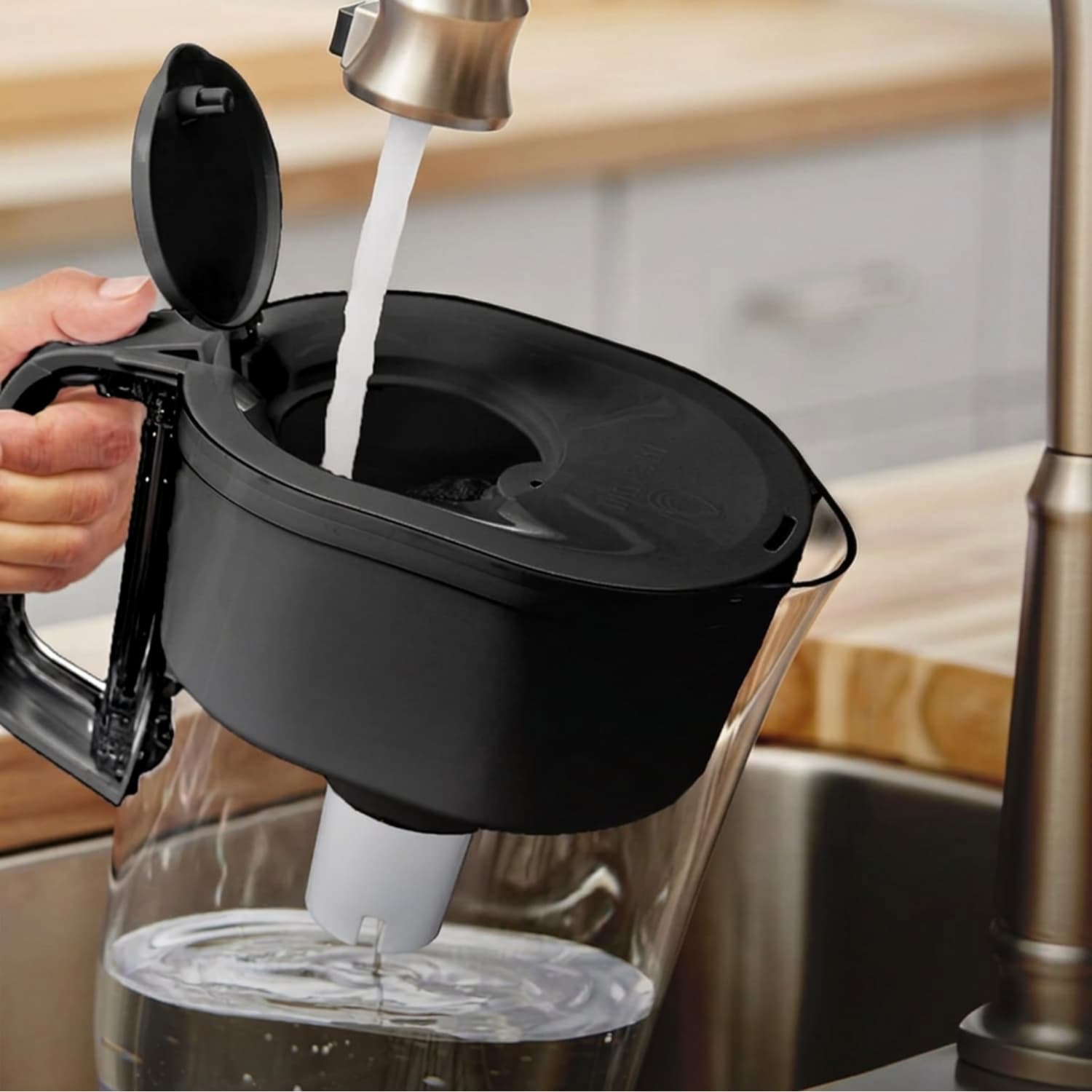
Brita Elite
The Brita Elite filter is the only one here third-party certified to NSF 42, 53, and 401 together. That covers lead at 99.5%, microplastics at 99.6%, and combined PFOA and PFOS at 98.1%, with the PFAS claim certified by IAPMO.
A 120-gallon filter that lasts about 6 months gives it the lowest cost per gallon in this group. However, the body is BPA-free plastic, and the filter does not reduce fluoride or chromium-6.
The value winner when you want proof on paper without overpaying. Most importantly, make sure you buy the Elite filter, not the basic one.
- Contains plasticReservoir: BPA-Free Plastic. Lid: BPA-Free Plastic. Filter Housing: BPA-Free Plastic.
At a glance
- Reservoir
- BPA-Free Plastic
- Lid
- BPA-Free Plastic
- Filter Housing
- BPA-Free Plastic
- Filter Media
- Carbon + Ion Exchange
Keep in mind
- Plastic body
- No fluoride or chromium-6 reduction
- By contrast, the basic Brita filter does none of this, easy to grab by mistake
For most families, this is the sensible middle. Specifically, you get certified reduction of the three contaminants people worry about most, at the lowest running cost in the guide, from filters sold in every grocery store. The one catch is the name game, since the standard blue-and-white Brita filter shares shelf space and does far less.
- Best for buyers who want certified results and the lowest cost per gallon.
- Skip it if a plastic body is a dealbreaker or you need fluoride reduced.
- Look for the gray Elite filter, model OB06, not the white Standard.
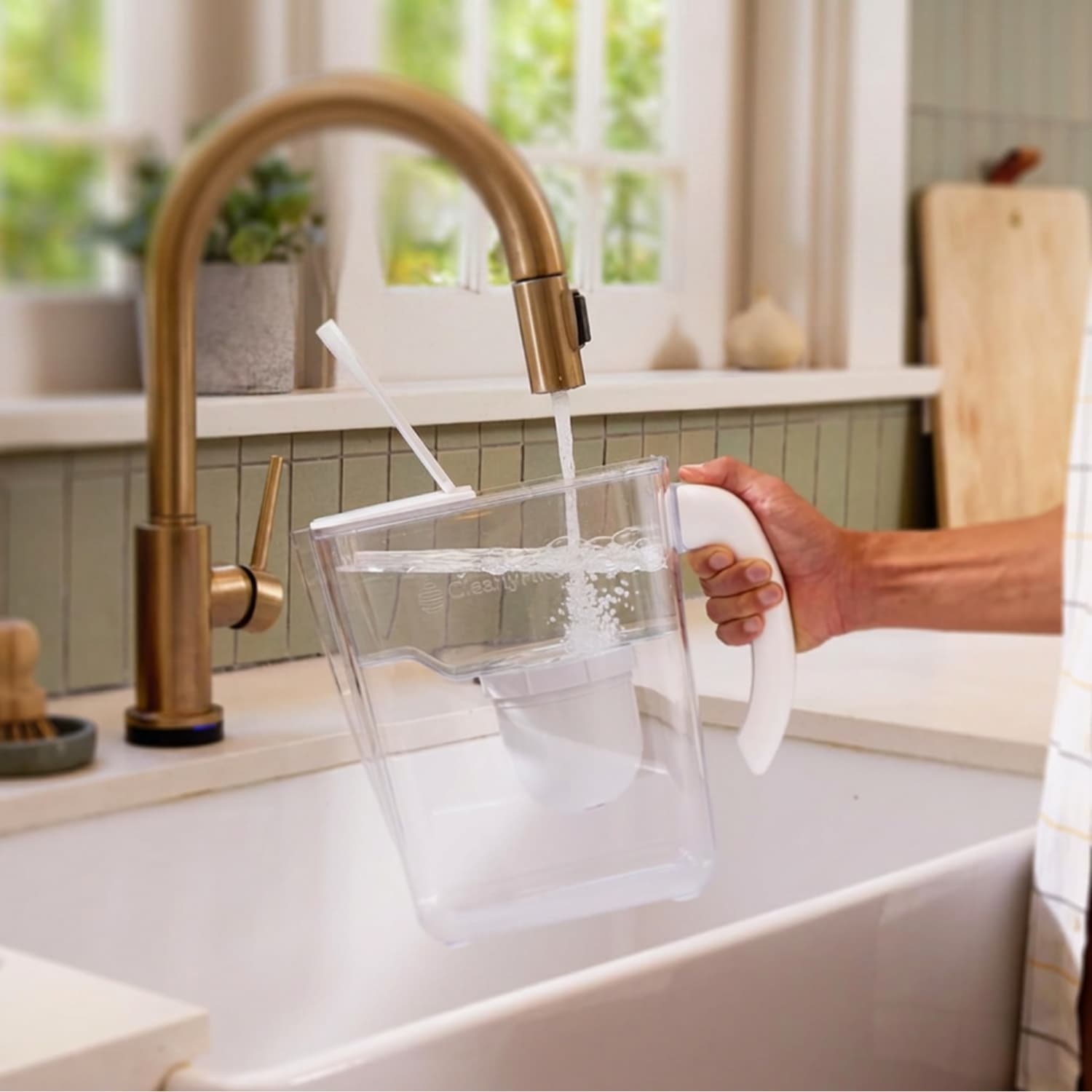
Clearly Filtered
The Clearly Filtered pitcher is NSF certified for chlorine and lead-free materials, and independently lab tested to reduce fluoride at 99.5%, microplastics above 99.99%, PFOA above 99%, and lead at 99.3%. That is the broadest tested list here.
However, the body is Tritan, a BPA and BPS free plastic. Also, the three-stage filter lasts about 100 gallons, shorter than the Brita, and the pitcher costs more up front.
It is the most thorough pitcher on paper, and the one to pick if fluoride reduction matters. That said, the broad claims are lab tested, not NSF certified.
- Contains plasticReservoir: Tritan Plastic. Lid: Plastic. Filter Housing: Plastic.
At a glance
- Reservoir
- Tritan Plastic
- Lid
- Plastic
- Filter Housing
- Plastic
- Filter Media
- 3-Stage Affinity
Keep in mind
- Only NSF certified for chlorine and materials, the rest is tested
- Plastic body
- Higher price and shorter 100-gallon filter
Reach for Clearly Filtered when your water throws a lot at you at once, or when fluoride reduction is on your list. Notably, few pitchers tackle fluoride, and this one pairs it with strong microplastics and PFAS lab data. The honest caveat is that most of that range is verified by an independent lab rather than an NSF certification, which is common for smaller brands but worth knowing.
- Best for complex water or anyone who wants fluoride reduced.
- Skip it if you prefer full NSF certification over independent lab testing.
- In addition, budget for more frequent filter changes at 100 gallons.
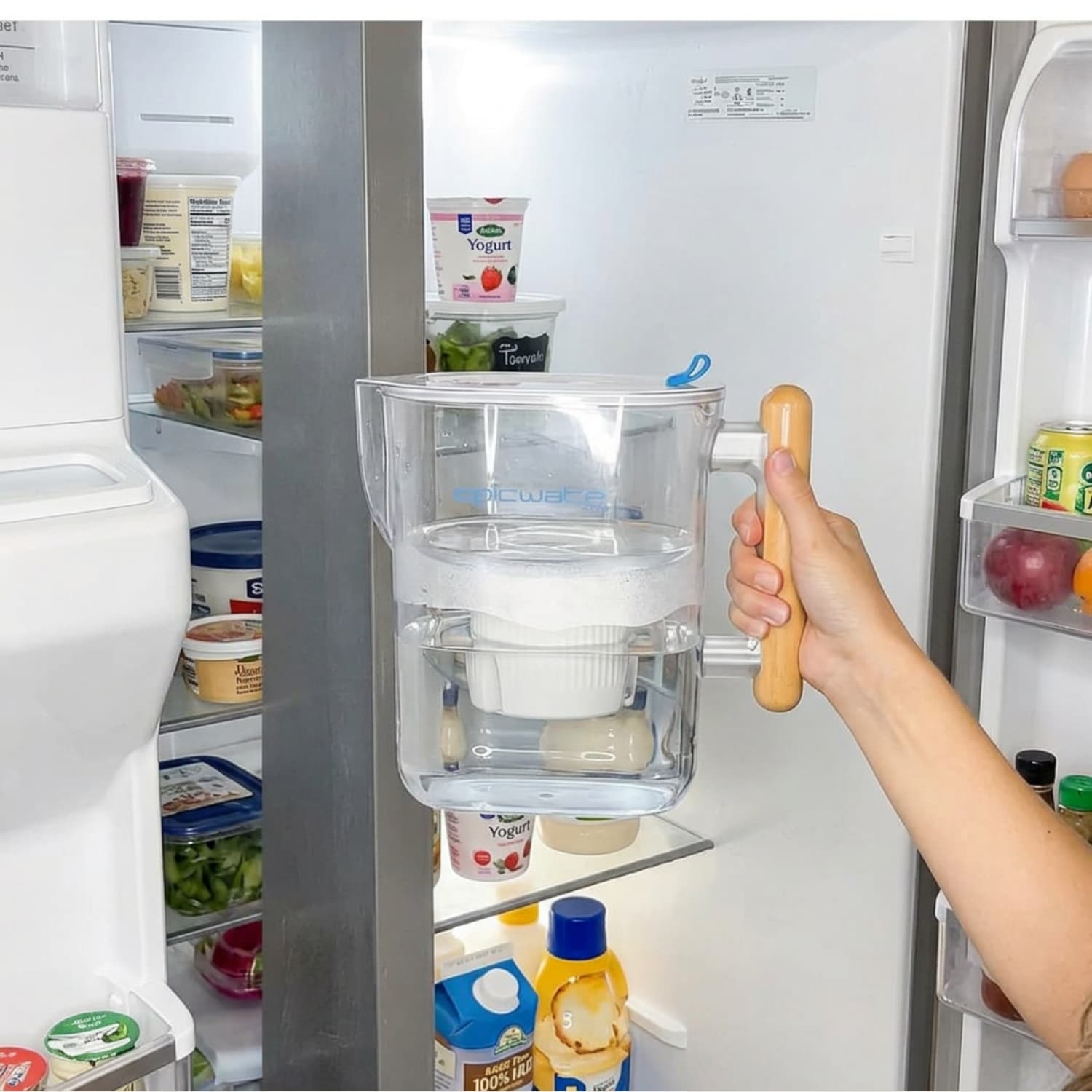
Epic Pure
The Epic Pure is a close cousin to Clearly Filtered, usually for a bit less. Similarly, it is NSF certified for chlorine and materials, and independently tested to reduce fluoride at 99.2%, PFAS at 99.9%, microplastics at 99.9%, and lead at 99.9%.
Likewise, the build is BPA and BPS free food-grade plastic with Tritan parts, and the solid carbon block filter lasts about 100 gallons. Epic also runs a filter recycling program, a small plus for a plastic product.
A strong fluoride-reducing option at a friendlier price than Clearly Filtered. Same tested-not-certified caveat applies.
- Contains plasticReservoir: BPA-Free Plastic. Lid: Plastic. Filter Housing: Tritan Plastic.
At a glance
- Reservoir
- BPA-Free Plastic
- Lid
- Plastic
- Filter Housing
- Tritan Plastic
- Filter Media
- Solid Carbon Block
Keep in mind
- Certified only for chlorine and materials
- Plastic body
- Average 100-gallon filter life
Epic Pure is the value alternative when fluoride is the reason you are shopping. In fact, it covers nearly the same ground as Clearly Filtered, often for less, with a recyclable filter as a bonus. Pick between the two on price and on which brand you trust, since their tested claims land in the same range.
- Best for fluoride reduction on a slightly smaller budget.
- Skip it if you want NSF certification for the health claims.
- Note there is also an Epic Nano model built to filter microbes, useful on well water.
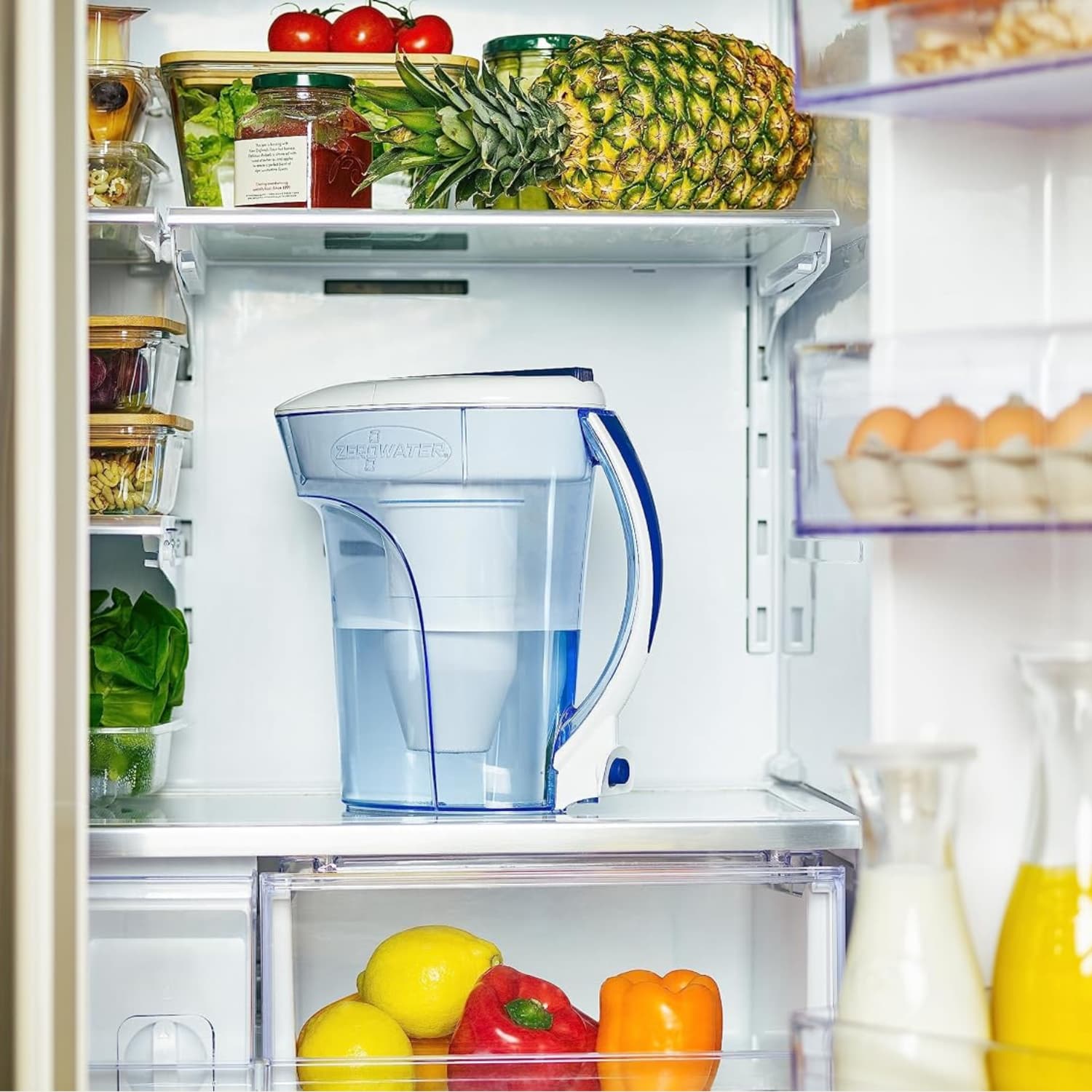
ZeroWater
The ZeroWater five-stage filter is certified to reduce lead at 95%, chromium-6 at 99%, and combined PFOA and PFOS at 99%, and it removes more total dissolved solids than any other pitcher here. A TDS meter comes in the box so you can watch the reading drop toward zero.
The body is BPA-free plastic. However, the real catch is filter life, around 15 gallons in average water, the shortest here, which makes running cost the highest. It carries no microplastics claim.
The pick for high-TDS or chromium-6 water when you want to see the numbers drop. Budget for frequent filter changes.
- Contains plasticReservoir: BPA-Free Plastic. Lid: Plastic. Filter Housing: Plastic.
At a glance
- Reservoir
- BPA-Free Plastic
- Lid
- Plastic
- Filter Housing
- Plastic
- Filter Media
- 5-Stage Ion Exchange
Keep in mind
- Very short 15-gallon filter, highest running cost
- No microplastics reduction claim
- Water can taste flat or slightly tart
ZeroWater is a specialist. If your water is high in dissolved solids, or your report flags chromium-6, nothing else on this list strips those as aggressively, and the included meter lets you prove it. The price of that performance is a filter that tires quickly, so factor in the cost of replacements before you commit.
- Best for high-TDS water, chromium-6, and readers who want a visible number.
- Skip it if microplastics are your main concern or you hate changing filters.
- Change the filter when the meter reads 006, not on a fixed schedule.
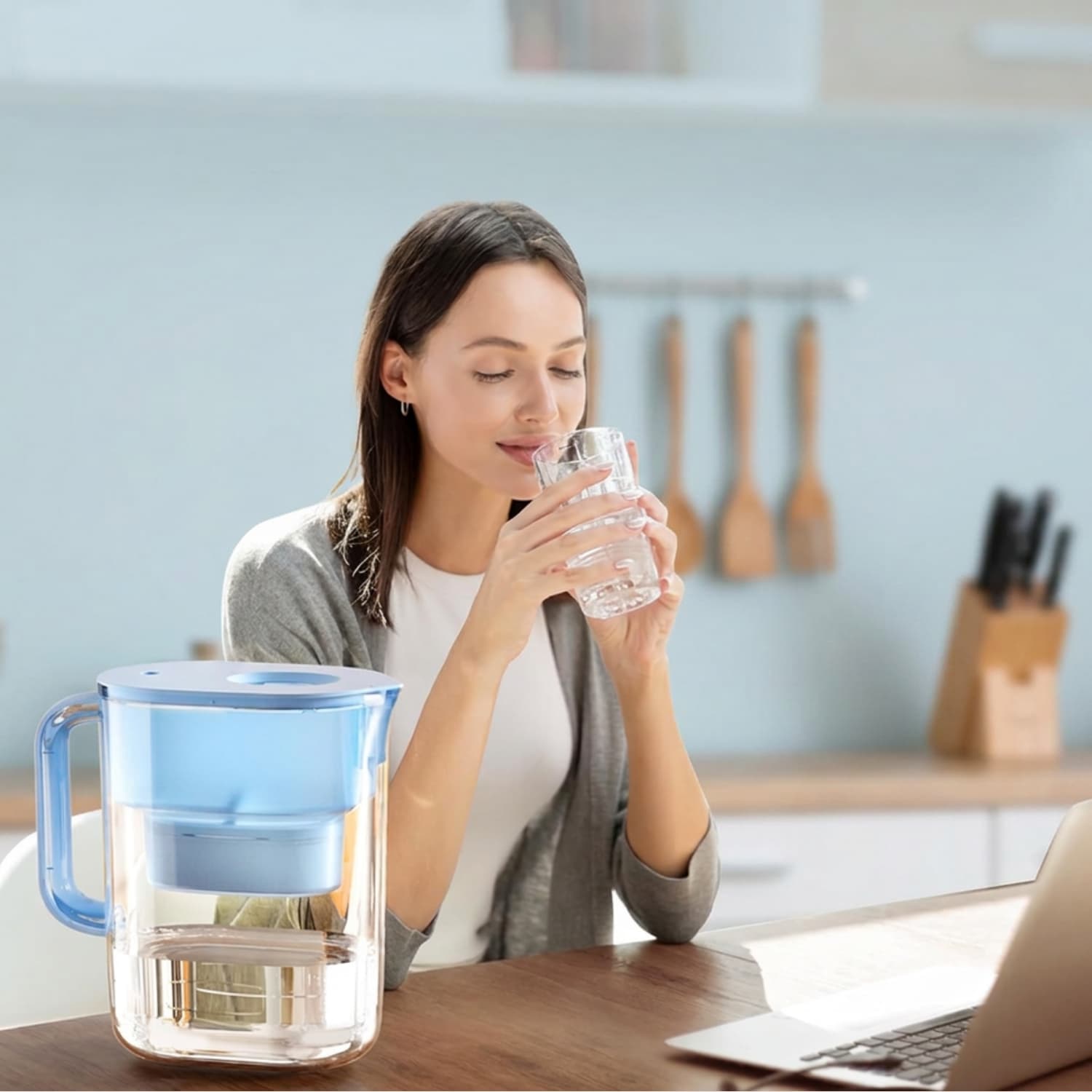
Waterdrop
The Waterdrop pitcher is the lowest-priced pick here. That said, its base filter is NSF certified for chlorine and lead-free materials and lasts a long 200 gallons, about 3 months, which keeps running cost low.
If you need more, Waterdrop sells an upgraded filter certified to NSF 53 that adds PFAS and lead reduction. The body is BPA-free plastic. On the standard filter, treat it as a taste-and-basics pitcher rather than a heavy-metal specialist.
The best low-cost way to fix chlorine taste, with room to grow. Add the upgraded filter later if your needs change.
- Contains plasticReservoir: BPA-Free Plastic. Lid: Plastic. Filter Housing: Plastic.
At a glance
- Reservoir
- BPA-Free Plastic
- Lid
- Plastic
- Filter Housing
- Plastic
- Filter Media
- Coconut Carbon
Keep in mind
- Base filter only certified for chlorine and materials
- Plastic body
- Therefore, you must buy the upgraded filter for PFAS
Waterdrop is the easy yes for a first pitcher or a second one for the office. It fixes the chlorine taste that sends most people shopping, costs the least, and gives you an upgrade path if a future water report turns up something more serious. Just match the filter to the job, since the base cartridge is a taste filter, not a metals filter.
- Best for a low-cost start or a spare pitcher where taste is the goal.
- Skip the base filter if you need certified lead or PFAS reduction now.
- Buy the upgraded NSF 53 filter to add PFAS and lead later.
Head-to-Head Comparison
Side by side, the pattern is clear. Certified microplastics reduction only shows up on the Brita Elite, membrane microplastic removal on the LifeStraw, and fluoride reduction on Clearly Filtered and Epic Pure. No single pitcher wins every column, so match the table to your water report.
| Pitcher | Body | Microplastics | PFAS | Lead | Fluoride | 3rd Party Certs | Filter Life |
|---|---|---|---|---|---|---|---|
| LifeStraw Home Glass | Glass | Yes, lab tested 99.999% | Yes, lab tested over 99% | Yes | No | None At This Time | Up to 264 gal |
| Aarke Purifier | Glass and steel | No | No | Yes | No | None At This Time | About 32 gal |
| Brita Elite | BPA-free plastic | Yes, certified 99.6% | Yes, certified 98.1% | Yes, certified 99.5% | No | NSF 42, 53, 401 | 120 gal |
| Clearly Filtered | Tritan plastic | Yes, lab tested over 99.99% | Yes, lab tested 99.6% | Yes, lab tested 99.3% | Yes, lab tested 99.5% | NSF 42, 372 | 100 gal |
| Epic Pure | BPA-free plastic | Yes, lab tested 99.9% | Yes, lab tested 99.9% | Yes, lab tested 99.9% | Yes, lab tested 99.2% | NSF 42, 372 | 100 gal |
| ZeroWater | BPA-free plastic | No claim | Yes, certified 99% | Yes, certified 95% | Reduced, lab tested | NSF 42, 53 | About 15 gal |
| Waterdrop | BPA-free plastic | No | Upgraded filter only | Upgraded filter only | No | NSF 42, 372 | 200 gal |
A note on the columns. “Certified” means an accredited body verified the claim, and “lab tested” means the maker’s published laboratory data to the NSF method. We did not test any pitcher ourselves, so every figure here comes from third-party certifications, manufacturer performance data, or published research.
Water Filter Pitcher Buying Guide
In the end, a good pitcher purchase comes down to four things: what your water actually contains, whether the filter is certified for those contaminants, the true cost per gallon over a year, and how much plastic the pitcher itself adds back.
Once you know your two or three real problems, the rest of the decision gets simple. Next, the sections below explain the details that separate a pitcher that just improves taste from one that removes what you care about.
Filter Media Types Explained
Most pitchers use one of three media, or a mix. First, activated carbon, whether loose granules or a solid block, grabs chlorine, many organic chemicals, and some metals through adsorption. In comparison, a solid carbon block is denser and generally captures more than loose granules. Meanwhile, ion exchange resin swaps unwanted ions like lead for harmless ones, which is how the strongest lead and TDS pitchers work.
Lastly, the third type is a physical membrane, a barrier with pores small enough to strain out particles. This matters for microplastics, because that job is about sieving by size, not adsorption. For example, the LifeStraw membrane, rated at 0.2 microns, is why it removes plastic particles that carbon-only pitchers let through.
💫 Now You Know
What is a Micron?
A micron is one millionth of a meter. For comparison, a human hair is about 70 microns wide, and the smallest microplastics of concern run below 10 microns. A filter’s micron rating tells you the size of particle it can physically block, so a lower number means a finer net.
NSF Certifications That Matter
Certification numbers look like alphabet soup, but three cover almost everything a pitcher claims. NSF/ANSI 42 covers aesthetic effects like chlorine, taste, and odor. Next, NSF/ANSI 53 covers health-related contaminants such as lead, certain chemicals, and chromium, and it now includes the PFOA and PFOS test method that used to live under the retired P473 standard. Finally, NSF/ANSI 401 covers emerging contaminants like pharmaceutical traces.
Read the wording carefully. Meanwhile, a brand can say its filter is “tested to” a standard, meaning an independent lab ran the method, without being “certified to” it, which means an accredited body such as NSF, the Water Quality Association, or IAPMO verified and listed the product. Both can be trustworthy, but certification is the higher bar, and it is worth knowing which one you are getting.
Flow Rate and Contaminant Removal
Of course, there is a trade-off baked into every pitcher. Filters that remove the most tend to run the slowest, because water has to move through denser media or a fine membrane. For example, a ZeroWater or a Clearly Filtered drips more slowly than a basic Brita, and that is the price of tighter filtration. If a slow pour drives you crazy, buy a larger-capacity pitcher so you are refilling less often, rather than a weaker filter.
✨ TIP
When a Pitcher Is Not Enough
If your water has heavy lead, high PFAS, or you drink gallons a day, an under-sink reverse osmosis system filters more, faster, and cheaper per gallon than any pitcher. For example, brands like APEC and Express Water are the usual step up. Our guide to the best reverse osmosis systems compares them.
Cost Per Gallon, the Real Math
However, sticker price hides the real cost, which is filters over time. Instead, divide the filter price by its rated gallons to compare fairly. For example, the Brita Elite lasts about 120 gallons per filter, which gives it the lowest cost per gallon here by a wide margin. A ZeroWater filter costs about the same but lasts only around 15 gallons, so its cost per gallon runs several times higher. Over a year that gap can outweigh the difference in sticker price, so a cheap pitcher with a thirsty filter is often the expensive choice.
Pitcher Materials, BPA, and Microplastic Shedding
Still, here is the tension at the heart of a plastic water filter pitcher. In fact, research shows that plastic containers can shed microplastics into the water they hold, and heat makes it worse. For instance, a 2020 study in Nature Food found polypropylene infant bottles released up to 16.2 million plastic particles per liter, with sterilizing and hot water driving the numbers up. Those were bottles, not pitchers, but the principle carries: storing water in plastic is not a plastic-free act.
Two practical takeaways follow. First, never pour hot water into a plastic pitcher, and keep it out of the dishwasher’s hot cycle unless the brand says it is safe. Second, if avoiding plastic is a real priority, a glass reservoir like the LifeStraw Home Glass, or a glass and steel build like the Aarke, keeps your filtered water out of plastic between the tap and your glass. Also, you can read more about that in our guide on nanoplastics in bottled water.
Save This Guide for Later 📌
The Pitchers That Remove the Most Contaminants
On the widest lab-tested range, Clearly Filtered and Epic Pure lead, because they add fluoride to the usual microplastics, PFAS, and lead. For certified proof across microplastics, PFAS, and lead together, the Brita Elite is the strongest, and the LifeStraw membrane is the surest bet for particle removal.
Breadth is not the same as certainty. Clearly Filtered and Epic Pure reduce the longest list of contaminants on lab data, which is the right call when your water has many issues or when fluoride is on your list. If you would rather have fewer claims but each one independently certified, the Brita Elite is the pick, since its microplastics, PFAS, and lead numbers are all verified by accredited bodies. For microplastics specifically, the LifeStraw membrane is the most reliable design, because it strains particles by size instead of relying on adsorption.
Whichever you choose, you can see how each of these picks is scored in our Plastic Footprint Directory, where water filtration products are rated by how much plastic they add to your home.
Getting Even Fewer Microplastics Beyond the Pitcher
A pitcher is the biggest single step, but a few simple habits cut microplastics further. One 2024 study showed that boiling hard water can trap up to 90% of its nano and microplastics in the limescale, which you then filter or scrub away.
Filtering handles the water in your pitcher, yet plastic reaches you in other ways too. A study published in 2024 in Environmental Science & Technology Letters found that boiling hard water and then straining it removed up to 90% of the plastic particles, because the minerals that form limescale trap the particles as they precipitate. The effect is much smaller in soft water, closer to 25%, so it helps most where scale builds up on your kettle.
Storage matters as much as filtration. Keep filtered water in glass or stainless rather than a plastic bottle, skip single-use plastic water bottles where you can, and never microwave or pour boiling water into plastic. Finally, for the full set of habits, our guide on how to avoid microplastics walks through the everyday swaps that add up.
✨ TIP
Boil, Then Filter, in Hard-Water Homes
If your kettle scales up quickly, you have hard water, which is where boiling helps most. Bring it to a boil, let it cool so the scale settles, then run it through your pitcher to catch the trapped particles along with the minerals.
Pitchers We Do Not Recommend
Three popular pitchers did not make the list. The basic Brita Standard only improves taste, the PUR Plus markets PFAS and microplastics claims its own performance data sheet does not support, and the Soma offers a narrow feature set with thin public data.
Skipping a pitcher is as useful as picking one, so here is why these three fall short. None of them is unsafe, but each is easy to buy expecting more than it delivers.
❌ Brita Standard
- What it does: reduces chlorine taste and odor, plus mercury, copper, and cadmium.
- What it does not: it does not reduce lead, PFAS, or microplastics, and it leaves fluoride in.
- Better swap: the Brita Elite filter fits the same pitcher and adds certified lead, PFAS, and microplastics reduction.
❌ PUR Plus
- What it does: its performance data sheet certifies reduction of lead, mercury, and chlorine, which is genuinely useful.
- What to watch: PUR markets the filter as reducing PFAS and microplastics, but those claims do not appear in the filter’s own published performance data, so we do not count them.
- Better swap: for certified PFAS and microplastics, choose the Brita Elite instead.
❌ Soma
- What it does: reduces chlorine, mercury, copper, and cadmium with a partly plant-based filter and an attractive design.
- What to watch: it makes no PFAS, microplastics, or fluoride claim, and public performance data is limited.
- Better swap: for a design-forward, lower-plastic build, the Aarke Purifier is the stronger choice.
FAQs About Water Filter Pitchers
Only some do, and it depends on the media. However, carbon-only pitchers are not designed to sieve particles, and one 2023 study in Polymers found a carbon-and-resin device actually released more particles than it caught. Pitchers with a physical membrane, like the LifeStraw Home, or those certified for microplastics, like the Brita Elite, are the reliable choices.
Several do. The Brita Elite is certified to reduce combined PFOA and PFOS by 98.1%, ZeroWater is certified for PFOA and PFOS, and LifeStraw, Clearly Filtered, and Epic Pure show over 99% PFAS reduction on lab testing. Basic taste filters, including the Brita Standard, do not.
Yes, within their rating. The basic Brita Standard reduces chlorine taste, mercury, copper, and cadmium, but not lead or PFAS. By contrast, the Brita Elite goes much further, with certified reduction of lead, microplastics, and combined PFOA and PFOS. The two look similar, so check which filter you are buying.
Follow the rated gallons, not just the calendar. A Brita Elite lasts about 120 gallons or 6 months, a basic filter about 40 gallons or 2 months, and a ZeroWater around 15 gallons. ZeroWater includes a meter, so change its filter when the reading hits 006.
A pitcher is worth it for renters, small households, and anyone whose water needs only a few contaminants reduced. If you have serious lead, PFAS, or high-volume needs, an under-sink or reverse osmosis system filters more water faster and costs less per gallon over time.
It depends on your water. ZeroWater removes far more total dissolved solids and is certified for chromium-6, but its filter tires quickly and it makes no microplastics claim. The Brita Elite is certified for microplastics, PFAS, and lead, lasts much longer, and costs less per gallon.
Only with caution. Most pitchers are made for treated city water, not untested wells. If you are on a well, test your water first, and choose a system rated for microbes, or a model with a microbiological membrane, rather than a standard taste pitcher.
It is possible, especially with heat and wear, since research shows plastic containers can release microplastics into the water they hold. Keep hot water out of a plastic pitcher, and if this worries you, choose a glass or stainless build so your filtered water is not stored in plastic.
Final Thoughts About the Best Water Filter Pitcher
The best water filter pitcher is the one matched to your water report and your plastic goals. For microplastics and PFAS in a glass body, choose the LifeStraw Home Glass; for certified proof at the lowest cost per gallon, choose the Brita Elite.
Filtering your water is one of the simplest ways to cut daily exposure to plastic and other contaminants, and it does not take a whole-house overhaul to start. Look up your zip code report, pick the two or three problems that actually apply to you, then choose the pitcher proven against those. Storing the result in glass rather than plastic is the finishing touch that keeps the whole effort honest.
📚 References
View sources
- Cherian, A. G., Liu, Z., McKie, M. J., Almuhtaram, H., & Andrews, R. C. (2023). Microplastic removal from drinking water using point-of-use devices. Polymers, 15(6), 1331. https://www.mdpi.com/2073-4360/15/6/1331
- Environmental Working Group. (n.d.). Tap Water Database. https://www.ewg.org/tapwater/
- Kosuth, M., Mason, S. A., & Wattenberg, E. V. (2018). Anthropogenic contamination of tap water, beer, and sea salt. PLOS ONE, 13(4), e0194970. https://journals.plos.org/plosone/article?id=10.1371/journal.pone.0194970
- Li, Y., Wang, Z., & Zeng, E. Y. (2024). Drinking boiled tap water reduces human intake of nanoplastics and microplastics. Environmental Science & Technology Letters, 11(3), 273 to 279. https://pubs.acs.org/doi/abs/10.1021/acs.estlett.4c00081
- Li, D., Shi, Y., Yang, L., Xiao, L., Kehoe, D. K., Gun’ko, Y. K., Boland, J. J., & Wang, J. J. (2020). Microplastic release from the degradation of polypropylene feeding bottles during infant formula preparation. Nature Food, 1, 746 to 754. https://www.nature.com/articles/s43016-020-00171-y
- NSF. (n.d.). NSF/ANSI 42, 53, and 401: Filtration systems standards. https://www.nsf.org/knowledge-library/nsf-ansi-42-53-and-401-filtration-systems-standards
- Smalling, K. L., Romanok, K. M., Bradley, P. M., et al. (2023). Per- and polyfluoroalkyl substances (PFAS) in United States tapwater. Environment International, 178, 108033. https://www.sciencedirect.com/science/article/pii/S0160412023003173
- US Environmental Protection Agency. (2024). Per- and polyfluoroalkyl substances (PFAS) final PFAS National Primary Drinking Water Regulation. https://www.epa.gov/sdwa/and-polyfluoroalkyl-substances-pfas
- US Environmental Protection Agency. (n.d.). Lead and Copper Rule. https://www.epa.gov/dwreginfo/lead-and-copper-rule
- World Health Organization. (2019). Microplastics in drinking-water. https://www.who.int/news/item/20-08-2019-microplastics-in-drinking-water