
Key Takeaways
- Yes, toothpaste expires, usually about two years after the date it was made, because the fluoride that fights cavities slowly loses strength.
- Using expired toothpaste is not dangerous, but it gives you weaker cavity protection and can taste or feel off.
- Natural and fluoride-free formulas without synthetic preservatives can have shorter shelf lives, so check the tube and toss it at the first sign of separation or odor.
Most of us check the date on the milk, the eggs, even a bottle of vitamins. The tube of toothpaste we reach for twice a day? That one tends to get a free pass for years. Yet it does have an expiration date, usually stamped right into the crimp at the bottom of the tube, and there is a real reason it is there.
So does toothpaste expire? Yes. Most tubes stay at their best for about two years after they are made, and after that the fluoride that protects your teeth slowly loses strength. Here is how long each type of toothpaste actually lasts, how to tell when a tube has gone bad, and why the clean, natural formulas so many of us have switched to can expire sooner than the drugstore kind.
Toothpaste Expires About Two Years After It Is Made
Toothpaste expires about 2 years after its manufacturing date. That timeline keeps the fluoride strong enough to protect your enamel, though some formulas, like whitening pastes, run shorter at around 18 months.
Oral health professionals and the major manufacturers land on the same number: about two years from the manufacturing date. Colgate states plainly that its products “typically have a two-year expiration date to ensure that the fluoride is at an optimal level of stability.” Some formulas run shorter. Certain whitening pastes, for example, list around 18 months because their active ingredients are less stable over time.
One point most articles get wrong is worth clearing up. The US Food and Drug Administration regulates fluoride toothpaste as an over-the-counter drug, but federal rules do not force a printed expiration date onto every tube. Under 21 CFR 211.137, over-the-counter products whose labels carry no dosage limits are exempt from expiration dating if stability data shows they hold up for at least three years. Colgate confirms the practical result: the FDA “doesn’t regulate over-the-counter toothpaste expiration dates,” yet the packaging lists them anyway.
So why print a date at all? The clearest answer sits in the American Dental Association’s acceptance requirements for fluoride toothpaste. To earn the ADA Seal, a paste has to be tested fresh and aged, and at least 90% of the labeled fluoride must still be available in aged samples, meaning product held to the end of its expiration period. That single number explains the whole system. Your date stamp is the manufacturer’s promise that the fluoride inside is still doing its job.
Where to Find the Expiration Date on Your Toothpaste Tube
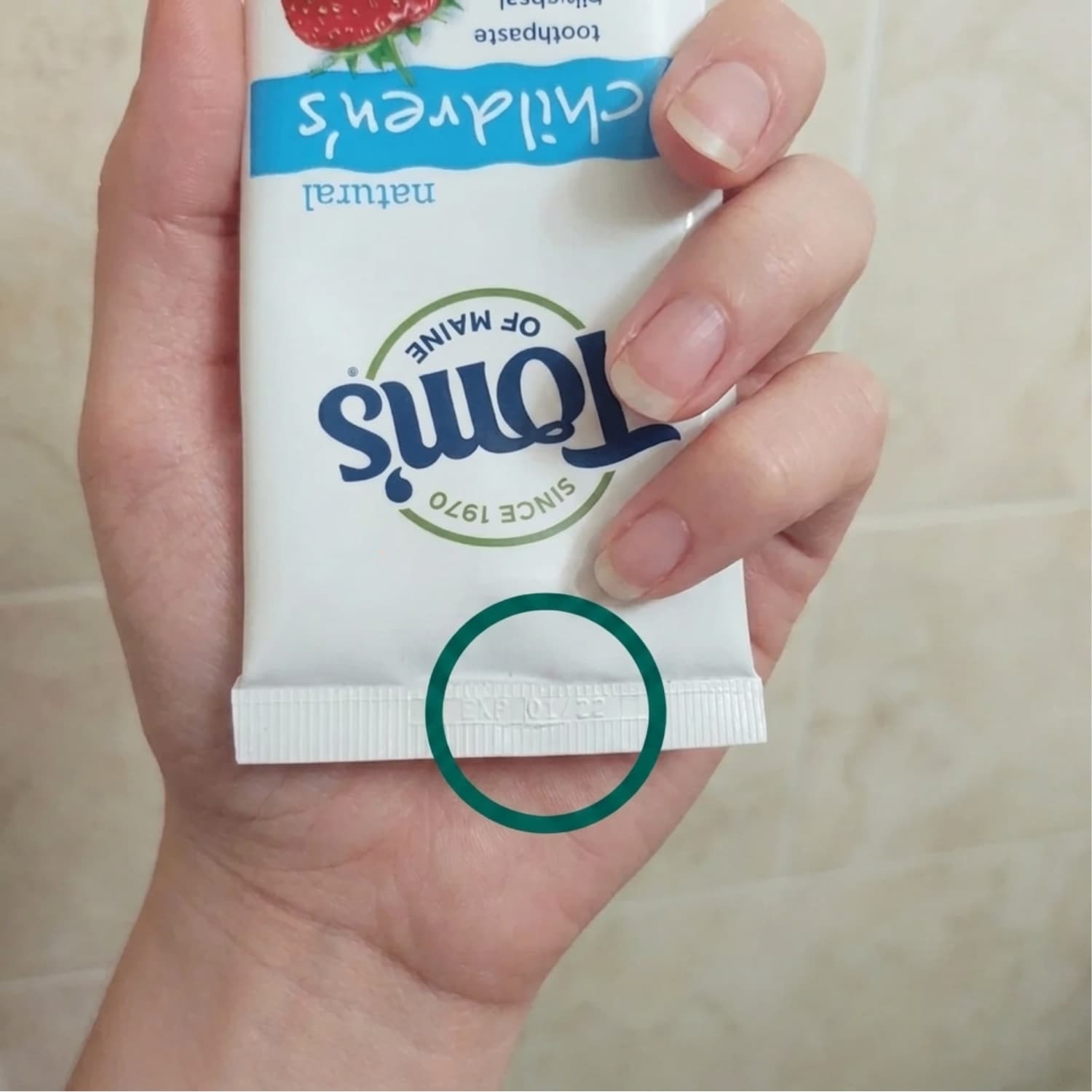
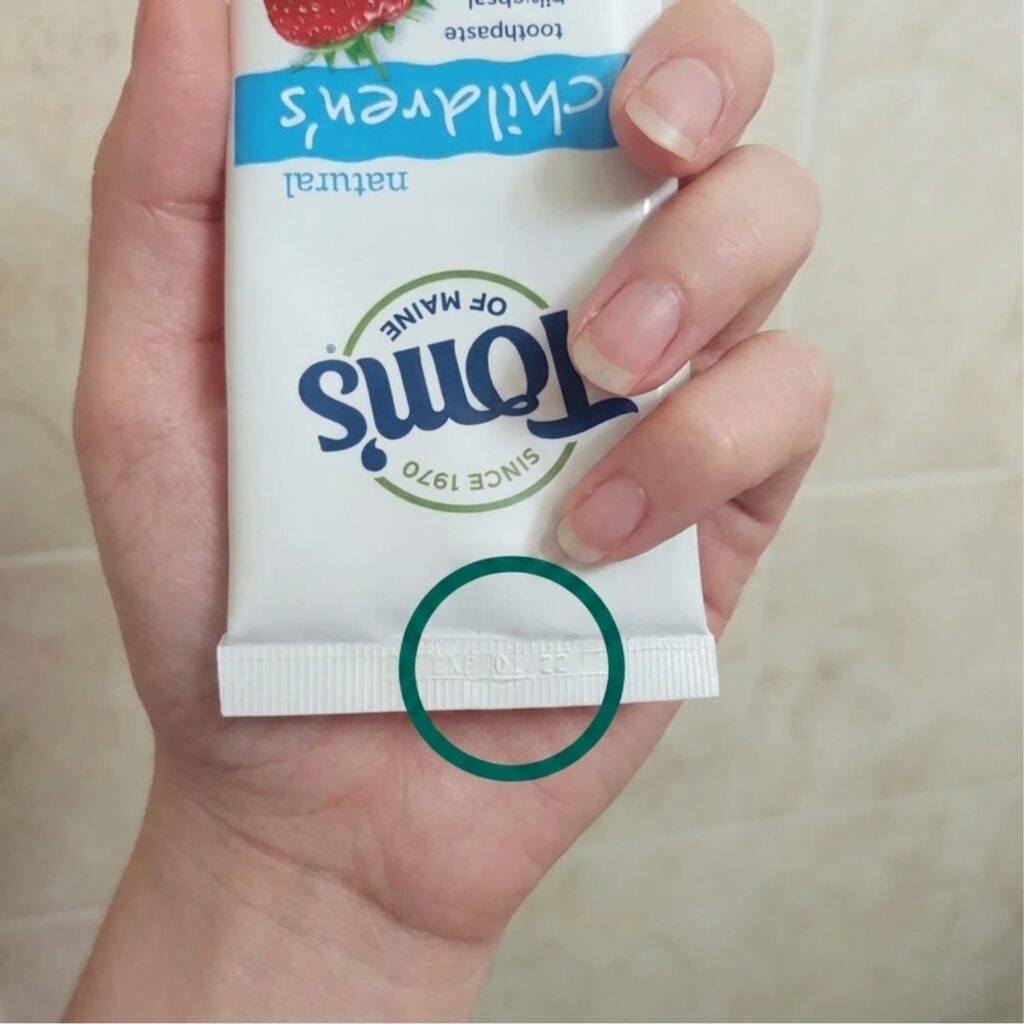
Look at the crimp, the flat sealed edge at the bottom of the tube. The expiration date is stamped there as a month and year, often next to a lot or batch code. On a box, check the bottom flap or side panel.
The expiration date is almost always stamped into the crimp, the flat sealed edge at the bottom of the tube where the metal or plastic is pressed together. On a box, look on the bottom flap or the side panel. The date is usually printed as a month and year, sometimes next to a lot or batch code that the manufacturer uses to track production.
If the number you find looks like a manufacturing date rather than an expiration date, add roughly two years to estimate when the tube is past its best. When in doubt, a quick look at the paste itself tells you more than the stamp ever will, and we cover those warning signs further down.
💫 now you know
What is a lot code?
A lot code is the manufacturer’s production fingerprint. Printed on the crimp beside the date, it identifies the exact batch, plant, and production run your tube came from, so a recall can be traced back to a single day of output. For you it works as a clue: when the crimp shows a code but no obvious expiration, that string is usually a manufacturing date in disguise.
Reading the crimp gets easy once you know the pattern. Most brands print a two-part stamp, a short alphanumeric lot code followed by a month and year like 09/2027. Others use a compressed six-digit format, where 092027 means exactly the same thing. If you find a single date and nothing else, treat it as the expiration, since that is what nearly every major brand prints.
Boxed toothpaste can be trickier, because the carton and the tube sometimes carry different stamps. Trust the tube. Once the box goes in the recycling, that crimp is the only record left, and it is the one that stays with the paste until the last squeeze.
What if there is no date printed at all?
Older tubes, travel samples, and some small-batch or artisan brands may not print a clear date. If you cannot find one, treat the tube as suspect. Go by condition instead: if it smells normal, looks smooth, and squeezes out evenly, it is likely fine for short-term use. If it is hard, separated, or smells strange, replace it.
Why Toothpaste Expires in the First Place
Toothpaste expires because its fluoride loses potency over roughly 2 years, while the flavor, preservatives, and texture break down too. The result is a paste that still cleans but no longer protects as well.
Toothpaste is not just one ingredient; it is a blend, and different parts of that blend age at different rates. Here is what is actually happening inside the tube.
🦷 Fluoride Loses Potency
This is the big one. Fluoride is the active ingredient that helps remineralize enamel and fight decay, and Colgate notes it “can start to break down over time, decreasing your protection from bacteria-causing decay.” Once the fluoride weakens, the paste still cleans, but it no longer does its most important job as well.
👅 Flavor and Texture Degrade
The mint or sweetening agents fade, and the paste can dry out, stiffen, or turn grainy. It will not taste as fresh, which quietly makes you less likely to brush for a full two minutes.
🦠 Preservatives Lose Strength
Preservatives keep bacteria and mold from growing in a moist product. As they weaken, and especially if the cap has been left off, there is a small risk of microbial growth in the tube.
💧 Ingredients Separate
Over time the abrasives, humectants, and liquids can split apart, leaving a watery layer or a chalky clump instead of a smooth paste. Heat speeds this up, which is why storage matters.
Don’t Miss: Non-Toxic Living, Where to Actually Start Swapping your toothpaste is one small piece. Here’s the room-by-room guide to a lower-tox home. Read more →What Happens If You Use Expired Toothpaste
Using expired toothpaste is usually safe but less effective. You get weaker cavity protection and it may taste or feel off. The one time to throw it out is if it smells bad or shows signs of mold.
For most people, using slightly expired toothpaste is not a health emergency. Colgate says expired toothpaste “can work in a pinch and is usually safe.” The real cost is effectiveness, not danger. Here is what to expect.
You get weaker cavity protection, because the fluoride has lost some of its strength. You may notice an off taste, a gritty or dried-out texture, or paste that has separated in the tube. In rare cases, if the tube was left uncapped or stored somewhere warm and damp, bacteria or mold can grow, and that is the one situation where you should throw it out rather than use it.
The bottom line: a tube a few months past its date is a minor downgrade, not a hazard. But if you are relying on that paste to protect a cavity-prone mouth, weaker fluoride is a real reason to replace it.
Shelf Life by Type of Toothpaste
Most toothpaste lasts about 2 years. Whitening pastes run shorter at around 18 months, natural and fluoride-free formulas can expire within 1 to 2 years, and dry tablets or powders often last longer.
Not every toothpaste ages the same way. Formulas with synthetic preservatives and fluoride tend to hold up for the full two years, while natural, preservative-light, and DIY options often have shorter windows. Here is a quick comparison. Always defer to the date printed on your specific tube, since formulas vary by brand.
| Type of toothpaste | Typical shelf life | What affects it |
|---|---|---|
| Conventional fluoride | About 2 years | Fluoride stability sets the date |
| Hydroxyapatite | About 2 to 3 years | Stable mineral, but check the brand’s date |
| Fluoride-free natural | Often shorter, roughly 1 to 2 years | Fewer or gentler preservatives |
| Charcoal | About 2 years | Varies widely by formula |
| Whitening | Around 18 months to 2 years | Peroxide and actives are less stable |
| Kids’ toothpaste | About 2 years | Same fluoride timeline as adult paste |
| Tablets and powders | Often longer, 2 years or more | Low moisture slows spoilage |
Notice the pattern: the drier the product and the more synthetic preservatives it uses, the longer it tends to last. That is exactly why the clean formulas covered further down can expire sooner, and why toothpaste tablets and powders are a smart pick if you hate wasting a half-used tube.
Signs Your Toothpaste Has Gone Bad
Toss toothpaste if it has separated, hardened, changed color, or smells sour or off. Any one of these signs means it is past its usable life, no matter what the printed date says.
The printed date is a guideline. Your senses are the real test. Toss or replace a tube if you notice any of these:
- The paste has separated, with a watery layer or liquid oozing out first
- It has turned hard, crusty, or dried out and will not squeeze smoothly
- It smells sour, musty, or just off
- The taste is strange or the mint is flat and chemical
- The color has shifted or you see any spots that could be mold
Any one of these, especially an off smell or visible spots, means the tube is done regardless of what the date says.
How to Store Toothpaste So It Lasts
Store toothpaste capped, cool, and dry in a closed cabinet, away from bathroom heat and humidity. Good storage helps a tube reach its full 2-year shelf life, and it matters most for natural formulas.
You cannot stop toothpaste from expiring, but good storage helps it reach its full shelf life. Keep it cool, dry, and sealed.
Always cap the tube or close the flip-top fully, with no paste left around the edges where dust and germs collect. Store it in a closed cabinet rather than out on the counter, and keep it away from heat, which makes ingredients separate and even liquefy. That last point matters most for natural formulas: a steamy bathroom is the worst place for a preservative-light paste, so a cabinet away from the shower is a small change that pays off.
✨ TIP
Move It Out of the Shower Zone
Steam is the enemy of a preservative-light paste. Keep natural toothpaste in a drawer or closed cabinet a few feet from the shower, and cap it fully every single time. That one habit can buy you months on a tube that would otherwise stiffen and separate early.
Natural and Fluoride-Free Toothpaste Can Expire Sooner
Yes. Natural and fluoride-free pastes made with fewer synthetic preservatives can expire faster than conventional toothpaste, sometimes within 1 to 2 years. Buy smaller tubes and check them often.
This is where clean formulas differ from the drugstore standard, and it is worth understanding if you have made the switch. Conventional toothpaste leans on synthetic preservatives like sodium benzoate and potassium sorbate to keep bacteria out for two full years. Many natural and fluoride-free pastes use gentler preservative systems, fewer preservatives, or none at all, which is often exactly why people choose them.
The tradeoff is a shorter usable life. With a lighter preservative system, a natural paste has less of a buffer against moisture and microbes once it is opened, so the window between best and past-its-best can be narrower. It is not a downside so much as a reason to buy smaller tubes, store them well, and trust your senses. If you lean toward fluoride-free options for safety reasons, just build a habit of checking the tube every few weeks.
Mineral pastes are a bit of an exception. Nano-hydroxyapatite is a stable ingredient, so those formulas often hold up as well as conventional paste, roughly two to three years, though the exact date still varies by brand. Homemade toothpaste sits at the far other end. A DIY blend of coconut oil, baking soda, and essential oils has no preservative system at all, so treat it like fresh food and mix small batches you will finish within a month.
Other Ways to Use Expired Toothpaste
Expired toothpaste works as a mild household cleaner for silver, chrome, sneaker scuffs, and water rings on wood. Skip putting it on skin or pimples, that popular trick is a myth.
Do not automatically throw an expired tube in the trash. Toothpaste is a mild abrasive with a bit of detergent, which makes it a handy household cleaner. People use it to polish silver and chrome fixtures, buff scuffs off white sneaker soles, remove water rings from wood, clean up crayon marks on walls, and defog or lightly buff small scratches.
One thing it is not good for: your skin. The old trick of dabbing toothpaste on a pimple is a myth worth skipping. Hackensack Meridian Health points out that the alcohol, hydrogen peroxide, and baking soda in toothpaste can redden, dry, and irritate skin, and that hydrogen peroxide may work against the skin’s natural healing process and make scarring worse. Save the expired tube for your sneakers instead.
Don’t Miss: How to Reduce Plastic Use From toothpaste tubes to takeout, here are 21 easy ways to cut plastic that actually stick. Read more →When to Toss and Replace Your Toothpaste
Toss toothpaste once it is past the printed date and shows any warning sign. Even a fine-looking tube is worth replacing regularly so the fluoride stays full strength, and swap your toothbrush every 3 months.
The rule is simple. Past the printed date plus any warning sign, separation, hardness, off smell, strange taste, or color change, means toss it. No questions.
Even if a tube looks and smells fine, it is worth replacing your toothpaste regularly if you use it daily, since a fresh tube guarantees full-strength fluoride. And do not forget the companion habit: swap your toothbrush every three months, or sooner if the bristles fray. Fresh paste and a worn-out brush are a mismatched pair.
FAQs About Toothpaste Expiration
It is not dangerous, but it is weaker. A tube a year past its date usually still cleans and is safe to use, but the fluoride has lost enough strength that you get noticeably less cavity protection. Replace it when you can.
Almost never. Expired toothpaste is usually safe, and the main downside is reduced effectiveness, not illness. The one exception is a tube left uncapped or stored somewhere warm and damp long enough to grow bacteria or mold, in which case you should throw it out.
Generally, until the printed expiration date, as long as you keep it capped and cool. Opening the tube does not reset the clock, but poor storage, heat, moisture, and an open cap can shorten the usable life, especially for natural formulas.
Opening the tube does not start a new clock. A capped, well-stored tube stays good right up to the printed expiration date, whether you opened it yesterday or a year ago. What shortens the window is moisture and heat, so a tube left uncapped in a steamy bathroom can turn well before its date.
Not all those chemicals are shelf-stable. Fluoride loses potency, preservatives weaken, and ingredients separate over time. The American Dental Association requires that at least 90% of the labeled fluoride still be available in aged samples for a paste to carry its Seal, so the date is how manufacturers back that promise.
Often, yes. Natural and fluoride-free pastes with fewer or gentler preservatives can have shorter shelf lives than conventional formulas built around synthetic preservatives. Buy smaller tubes and check them regularly.
They do, but they usually outlast paste. Tablets and powders contain almost no water, and low moisture slows both microbial growth and ingredient breakdown. Most brands print a date around two years out or longer, so check the tin and keep it somewhere dry.
Skip it. Toothpaste is not an acne treatment, expired or fresh. Hackensack Meridian Health notes that the alcohol, hydrogen peroxide, and baking soda in toothpaste can redden, dry, and irritate skin, and that hydrogen peroxide may interfere with healing and worsen scarring. Use an expired tube on your sneakers, not your face.
Very little in practice. Both mark the point where the manufacturer no longer guarantees full ingredient effectiveness. A best by date is a quality marker rather than a safety cutoff, but for toothpaste the practical advice is the same: use it before that date for full-strength results.
Final Thoughts About Toothpaste Expiration
Toothpaste expires roughly 2 years after it is made, and the stamp on the crimp is the manufacturer’s guarantee that the fluoride still works. Past that point the paste is weaker, not dangerous.
Checking the crimp takes about three seconds, and it is worth doing the next time you restock. If your tube is past its date, you are not in any danger, you are simply brushing with weaker protection than you paid for. For anyone who has switched to a natural or fluoride-free paste, the habit matters a little more, since lighter preservative systems leave a narrower window between fresh and finished. Buy the smaller tube, keep it out of the steam, and trust your nose over the stamp.
📚 References
- American Dental Association. (n.d.). Toothpastes. ADA Oral Health Topics. https://www.ada.org/resources/ada-library/oral-health-topics/toothpastes
- American Dental Association. (2025). Acceptance program requirements: Fluoride-containing dentifrices. ADA Seal of Acceptance. https://www.ada.org/-/media/project/ada-organization/ada/ada-org/files/resources/research/seal/2025/fluoride-dentifrices-2025.pdf
- Colgate-Palmolive. (2023). Does toothpaste expire? Colgate Oral Care Center. https://www.colgate.com/en-us/oral-health/nutrition-and-oral-health/does-toothpaste-expire
- Hackensack Meridian Health. (2022). Does toothpaste help with acne? Healthier You. https://www.hackensackmeridianhealth.org/en/healthier-you/2022/08/30/does-toothpaste-help-with-acne
- U.S. Food and Drug Administration. (2023). Over-the-counter monograph M021: Anticaries drug products for OTC human use. https://www.accessdata.fda.gov/drugsatfda_docs/omuf/monographs/OTC Monograph M021 Anticaries Drug Products for OTC Human Use
- U.S. Food and Drug Administration. (n.d.). 21 CFR 211.137: Expiration dating. Electronic Code of Federal Regulations. https://www.ecfr.gov/current/title-21/chapter-I/subchapter-C/part-211/subpart-G/section-211.137
More Non-Toxic Personal Care Reads
We’ve scored every personal care product on plastic — see them in the Personal Care directory.