
Key Takeaways
- Wool dryer balls are a reusable, plastic-free alternative to dryer sheets that reduce static, soften fabrics, and cut drying time by up to 40%.
- Dryer sheets shed microplastics and release synthetic chemicals into your home and the environment with every load.
- Switching to dryer balls lowers waste, energy use, and exposure to harmful VOCs, making it the cleaner, safer choice for your laundry and the planet.
In the dryer balls vs dryer sheets debate, wool dryer balls come out ahead on cost, health, and environmental impact. Dryer sheets are single-use polyester squares that shed microplastics and release synthetic chemical fumes with every load, whereas one set of wool balls handles roughly 1,000 loads without any added chemicals. We compared both in terms of softening power, static control, drying time, cost, and research on dryer sheet emissions. Here’s the full breakdown, plus how to switch without losing softness or fighting static.
What Are Dryer Sheets?
Dryer sheets are single-use polyester squares coated with fabric softener chemicals that melt onto clothes in the dryer, shedding microplastics and releasing VOCs with every load.
Dryer sheets were created to make laundry feel softer, smell fresher, and stay static-free, all without extra effort. They look simple: thin, fabric-like squares that you toss in the dryer and forget about. But behind that convenience lies a mix of synthetic materials and chemical coatings designed to alter how your clothes feel.
Most dryer sheets are made from polyester or other plastic-based fibers coated with a blend of quaternary ammonium compounds (quats), silicone lubricants, and fragrance chemicals. When the dryer heats up, these coatings melt and transfer onto your clothes, smoothing fibers and leaving behind that familiar “fresh” scent.
While that coating helps reduce static, it’s also what makes dryer sheets a hidden source of pollution and chemical exposure.
- Environmental Impact: Every load releases microplastic particles from the polyester sheet itself and volatile organic compounds (VOCs) from its chemical coatings. These emissions vent into the air or settle on your clothes, contributing to both indoor air pollution and outdoor particulate waste. And because dryer sheets are single-use, millions of them end up in landfills each year, where their synthetic fibers can take decades to break down.
- Health Concerns: Research from the University of Washington found that scented dryer sheets emit hazardous chemicals, such as acetaldehyde and benzene, through dryer vents, pollutants linked to respiratory irritation, headaches, and long-term health risks. These compounds can cling to fabrics, leaving chemical residues that increase exposure with each wear.
💡NOw you know
What Are Quaternary Ammonium Compounds?
Quaternary ammonium compounds, or quats, are synthetic chemicals used in dryer sheets to make fabrics feel softer and reduce static. But they don’t break down easily in the environment and can be toxic to aquatic life. Some studies have linked long-term quat exposure to skin irritation, asthma symptoms, and even fertility issues in lab tests.
What Are Dryer Balls?
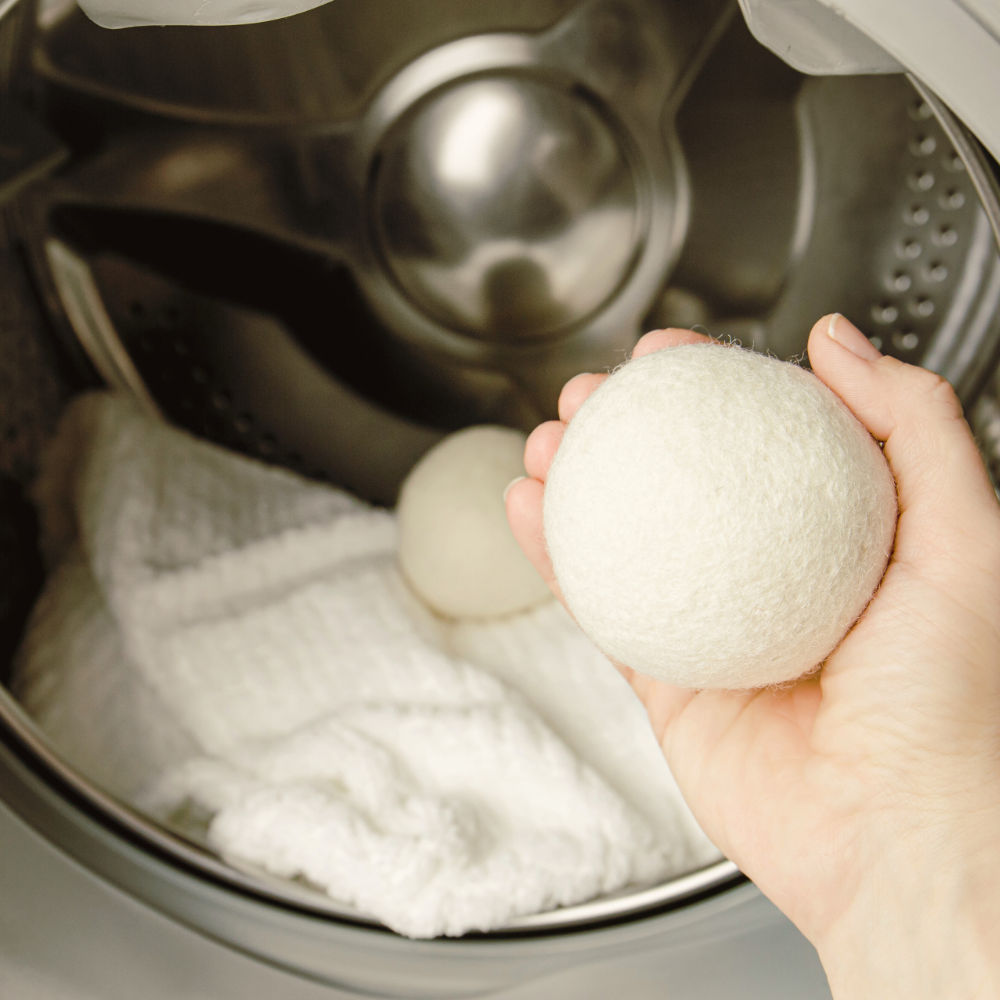
Dryer balls are reusable spheres made from 100% wool that soften fabric and speed drying by separating clothes and boosting airflow, with no chemicals or coatings.
Dryer balls are a simple, natural alternative to dryer sheets designed to soften fabrics, reduce wrinkles, and shorten drying time without chemicals or synthetic coatings. As they tumble through the dryer, they gently separate clothing and boost airflow, allowing heat to circulate more evenly. The result? Softer clothes, less static, and faster drying cycles that save both energy and money.
While dryer balls come in several materials, wool dryer balls are the most effective and sustainable choice. They’re made from tightly wound layers of 100% natural wool with no dyes, plastics, or synthetic fibers. Wool is naturally absorbent, helping draw moisture from fabrics to speed up drying, while its soft texture helps reduce friction that can cause wear or pilling over time.
- Performance Benefits: Wool dryer balls can cut drying time by 20–40%, depending on load size, while reducing static and softening fabrics naturally. Because they don’t rely on chemical coatings, there’s no buildup on clothes and no synthetic residue in the dryer.
- Longevity and Cost Savings: A single set of wool dryer balls lasts through roughly 1,000 loads, replacing hundreds of single-use dryer sheets. Over time, that means less waste, fewer purchases, and lower household energy costs.
- Sustainability Edge: Unlike rubber or plastic dryer balls, which can release microplastics when heated, wool dryer balls are fully biodegradable and compostable at the end of their life. Once they start to lose shape, they can be cut up and added to your compost or repurposed around the home.
Save This Before You Buy Dryer Sheets Again 📌
Environmental Impact: Microplastics and Waste
Dryer sheets shed plastic microfibers and create single-use landfill waste, while wool dryer balls are reusable for about 1,000 loads and fully compostable at the end of their life.
When it comes to sustainability, dryer sheets and dryer balls couldn’t be more different.
❌ Dryer Sheets: Hidden Microplastics in Every Load
Most dryer sheets are made from polyester or other synthetic fibers and are coated with fabric softeners that melt under heat. Each load releases tiny microplastic fibers into the air and onto your clothes, pollution you can’t see, but that lingers long after drying.
Over time, those fibers wash out in the next cycle or vent into the environment, contributing to widespread plastic pollution. The International Union for Conservation of Nature (IUCN) estimates that synthetic textiles are responsible for roughly 35% of microplastics in the ocean. When you consider that the average household does hundreds of loads per year, the cumulative effect adds up fast.
Beyond microplastics, dryer sheets are single-use products, meaning every load generates waste. Since most are made from plastic-based materials, they can take decades to decompose in landfills, all while leaching chemical residues such as quaternary ammonium compounds and synthetic fragrances.
✅ Dryer Balls: Reusable, Biodegradable, and Plastic-Free
Wool dryer balls offer a completely different approach. Made from 100% natural fibers, they soften fabrics and reduce static without any coatings, plastics, or synthetic fragrances. Because they don’t shed microplastics or release VOCs, they’re a zero-waste, low-tox alternative for your laundry routine.
A single set of wool dryer balls can last up to 1,000 loads, replacing hundreds of disposable dryer sheets and significantly reducing household waste. When they finally wear out, they’re fully biodegradable and compostable, meaning they return safely to the earth instead of lingering in landfills.
Don’t Miss: Microplastics — Health Risks, Sources, and How to Reduce Exposure Microplastics are everywhere — from the clothes we wash to the food we eat. Find out where they come from and how to limit your exposure. Read more →Dryer Balls vs. Dryer Sheets: Environmental Comparison
In the dryer balls vs dryer sheets comparison, wool dryer balls are the lower-impact choice: no microplastics, no chemical emissions, and one set replaces hundreds of disposable sheets.
When you look at dryer balls vs. dryer sheets, the difference is bigger than it seems. One is meant to be tossed after a single use, while the other can last for years. Take a look at how these two laundry helpers stack up and how a simple swap can make your routine cleaner and greener.
Performance Comparison: Dryer Balls vs. Dryer Sheets
Wool dryer balls match dryer sheets for softness and cut drying time by 20% to 40%, while dryer sheets only edge them out on static control for synthetic fabrics.
Now that we’ve looked at the environmental side, let’s see how dryer balls and dryer sheets compare when it comes to performance. Both promise softer, fresher laundry, but how they work (and what they leave behind) makes all the difference.
👚 Softening Power
Dryer sheets coat your clothes with synthetic softeners that make fabrics feel smooth. The downside? Those coatings can build up over time, leaving clothes less absorbent and more prone to trapping odors.
Wool dryer balls, on the other hand, soften clothes naturally. As they tumble, they gently fluff fabric fibers without chemicals or residue. The result feels just as soft, and it’s better for your skin and the planet.
⚡ Static Reduction
Dryer sheets fight static by coating fabrics with chemicals that reduce friction. They work, but the same coatings that fight static also transfer synthetic residues onto your clothes.
Wool dryer balls reduce static by keeping clothes separated and boosting airflow. For extra help on dry winter days, you can add a slightly damp washcloth or a pinch of moisture to your load to neutralize static naturally.
🔋 Drying Time & Energy Efficiency
Wool dryer balls help air move more freely through your laundry, cutting drying time by up to 20–40%, depending on the load. Less time in the dryer means lower energy bills and a smaller carbon footprint.
Dryer sheets don’t speed up drying; they only change texture and scent, so energy use stays the same.
🌸 Scent Options
Dryer sheets are loaded with synthetic fragrances that can linger long after drying. For some people, that “fresh” scent can actually cause headaches, allergies, or skin irritation.
Wool dryer balls are fragrance-free by default, but you can easily add a few drops of essential oil to them for a light, natural scent. Lavender, citrus, or eucalyptus are great options for clean, uplifting freshness.
💰 Reusability & Cost Over Time
Dryer sheets are single-use, meaning you throw one away with every load and keep buying more. That cost adds up quickly.
Wool dryer balls are reusable for about 1,000 loads, saving money and waste in the long run. You buy them once, use them for years, and they still end up compostable instead of in the trash.
Health and Safety Considerations
Dryer sheets leave skin-contacting chemical residues and emit VOCs such as acetaldehyde and benzene, while wool dryer balls contain no fragrances, dyes, or coatings, making them gentler for sensitive skin and asthma.
When it comes to health and indoor air quality, dryer balls and dryer sheets are very different stories. Dryer sheets can leave behind invisible chemical residues, while wool dryer balls keep things clean and simple.
Dryer Sheets
Dryer sheets might smell fresh, but that scent often comes from a mix of synthetic chemicals, many of which aren’t listed on the label. These coatings melt at high temperatures and transfer to your clothes, where they can cling to fabric and come into contact with your skin all day.
Common chemicals in dryer sheets include:
- Benzyl acetate — linked to respiratory irritation.
- Benzyl alcohol — can irritate skin and eyes.
- Chloroform — a suspected carcinogen.
- Dichlorobenzene — associated with liver and kidney damage.
- Methylisothiazolinone — a preservative known to cause allergic reactions.
Research from the University of Washington also found that scented dryer sheets emit VOCs such as acetaldehyde and benzene through dryer vents, both of which are linked to asthma, headaches, and other health issues.
Wool Dryer Balls
Wool dryer balls skip the chemicals altogether. They’re made from 100% natural fibers with no coatings, dyes, or artificial scents. That means no VOCs, no residue, and no buildup on your clothes or in your dryer.
They’re beneficial for people with:
- Sensitive skin or eczema.
- Allergies to fragrance or dyes.
- Asthma or respiratory sensitivities.
If you like a light scent, you can safely add a few drops of essential oils (like lavender, lemon, or peppermint) to your wool balls for a natural alternative that won’t irritate your skin or lungs.
How to Make Your Own Wool Dryer Balls
You can make wool dryer balls at home by winding 100% wool yarn into tight balls, weaving in the loose ends, then felting them in a hot wash and high-heat dry until solid.
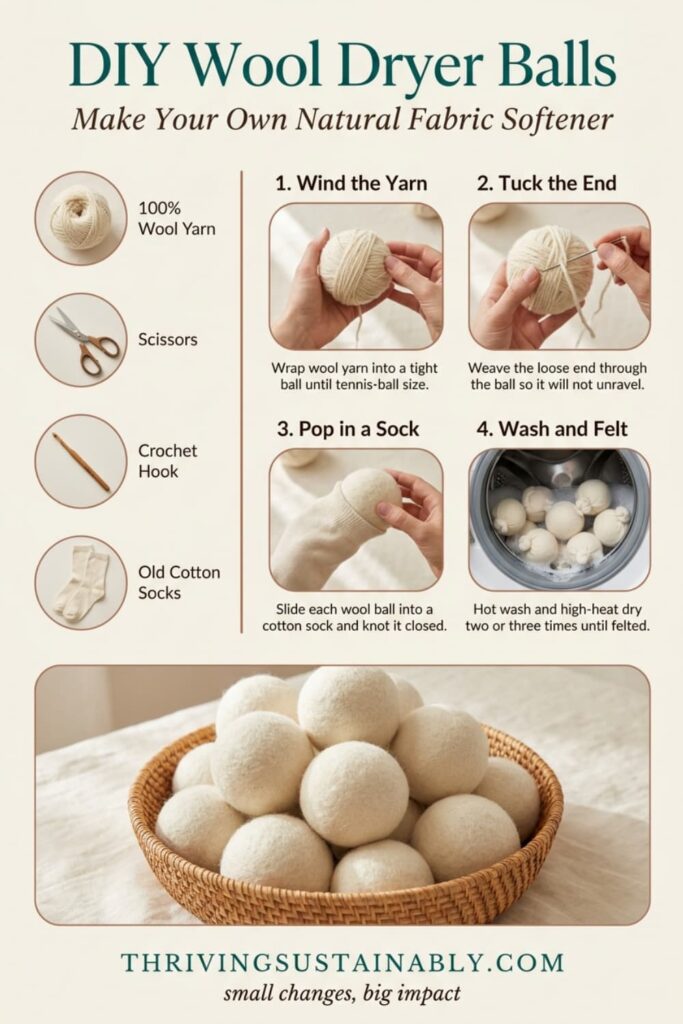
You don’t have to buy wool dryer balls to use them. A homemade set works just as well as a store-bought one, costs very little, and is mostly hands-off felting time. All you need is wool yarn and a few things you probably already have around the house.
You’ll need:
- A skein of 100% wool yarn
- Scissors
- A crochet hook or large yarn needle
- A few old cotton socks
✨ Tip
Skip the Shrink
Check that your yarn is 100% wool and not labeled “superwash.” Superwash wool is treated so it won’t shrink, which also means it won’t felt into a firm ball.
Once you have your supplies, follow these four steps:
- Wind the yarn. Wrap the wool yarn into a tight ball, switching directions as you go, until it is about the size of a tennis ball.
- Tuck the end. Thread the loose end onto the crochet hook or a yarn needle and weave it back and forth through the ball several times in different directions, so the strands lock together and won’t unravel.
- Pop it in a sock. Slide each ball into an old cotton sock and tie a knot to keep it snug. This stops the yarn from unraveling while it felts.
- Wash and felt. Run the socks through a hot wash with a load of towels, then a high-heat dry, two or three times. The heat, moisture, and friction formed the wool into a solid ball.
When the balls are firm and the strands have fused together, slide them out of the socks. They’re ready for the dryer. A homemade set of three to six lasts for years, and when they finally wear out, they compost just like any 100% wool ball.
How to Use Dryer Balls
One wool dryer ball will soften and fluff a load, but the real drying-time savings come from using three to six, enough to separate clothes so hot air can move through them.
Using wool dryer balls is simple and low-maintenance, and the right number depends on what you want out of them. If softer, fluffier laundry is the goal, even a single ball makes a noticeable difference, and that part really is a matter of preference. The faster-drying, lower-energy benefit works differently.
It comes from the balls separating your clothes so hot air can move through the load rather than around a wet clump, and a single ball can’t break up a full load on its own. For that, three is the working minimum, and five or six suits bulky loads like towels or bedding. Drop your dryer balls in the drum before starting the cycle, and they do the rest, tumbling through the fabrics to improve airflow and help everything dry more evenly.
Adding Natural Scent
If you prefer a light fragrance, add a few drops of your favorite essential oil to each ball and let them absorb for about 10–15 minutes before tossing them in the dryer. This prevents the oil from transferring directly onto clothes. Lavender, lemon, or eucalyptus oils are popular for their clean, refreshing scents.
Cleaning and Care
Over time, dryer balls can collect lint or pet hair. To clean them, place the balls in a mesh laundry bag and wash on a gentle cycle with warm water. Then, air-dry completely before using again. Occasional cleaning helps them maintain their absorbency and texture.
How to Dispose of Wool Dryer Balls
Worn-out 100% wool dryer balls are compostable: cut them up for a home compost bin, or repurpose the pieces as drawer fresheners or plant-pot drainage, since untreated wool biodegrades naturally.
🌱 Compost Them (Yes, really!)
If your wool dryer balls are 100% natural wool and haven’t been treated with synthetic fragrances or chemicals, they’re compostable. Simply cut them up into smaller pieces (this helps them break down faster) and toss them into your home compost bin. They’ll eventually return to the earth.
🏠 Repurpose Around the House
Old dryer balls still have plenty of life outside the laundry room. You can:
- Use them as natural air fresheners, just add a few drops of essential oil and tuck them into drawers or closets.
- Add them to your pet’s toy stash (if they’re not too chewed up).
- Use them as stuffing for homemade pillows or crafts.
🌷 Use Them in the Garden
Got old wool dryer balls past their prime? Don’t toss them—repurpose them! Cut them up and use the pieces to line the bottom of plant pots. They help improve drainage while still holding onto a bit of moisture, giving your plant roots a happy, balanced environment. Over time, the wool naturally breaks down in the soil and can even add a touch of nitrogen, giving your plants a slow-release nutrient boost. It’s like compost with a side hustle!
♻️ Recycle as a Last Resort
Recycling isn’t the most sustainable path here, but it’s better than sending them straight to the landfill. Regarding sustainability, the goal is always to reduce waste at every step, and even our laundry tools deserve a thoughtful sendoff.
Don’t Miss: 10 Best Non-Toxic Laundry Detergents 2026 Buyer’s Guide Ready to clean up your laundry routine even more? See the plastic-free, non-toxic detergents that are tough on dirt and gentle on the planet. Read more →FAQs on Dryer Balls vs. Dryer Sheets
There’s no single magic number, but three is the floor if you want the drying-time benefit, not just a suggestion. One ball will soften and fluff your laundry, but the faster-drying effect depends on enough balls separating clothes so hot air can circulate. Use three for small to medium loads and five or six for large or bulky items like towels and bedding.
They help reduce static, especially in natural fibers like cotton and linen. However, they may not eliminate static as effectively as dryer sheets for synthetic fabrics. To boost performance, try adding a safety pin to one ball (to discharge static) or air-drying synthetics.
Yes, they can cut drying time by 10–25% by improving hot air circulation and absorbing moisture. This not only saves energy but also helps extend the life of your clothes by reducing heat exposure.
They can be. The waxy coating that transfers to your clothes also builds up on the lint screen and can film over the moisture sensor inside the drum. Over time, that buildup makes the dryer read loads as wetter than they are, so it runs longer and uses more energy. Wool dryer balls leave no coating behind, so there’s nothing to scrub off.
You can, but it cancels out most of the benefit. The dryer sheet still sheds microplastics and coats your clothes with chemicals, even with wool balls in the drum. If you want both softness and static control, skip the sheet and pair wool balls with a splash of white vinegar in the wash instead.
No. They tumble gently and have no coatings, snaps, or rough edges. Because they cut drying time and friction, they actually reduce wear and pilling compared to a long, hot cycle. Tightly wound, good-quality wool balls hold their shape and won’t leave fuzz on your laundry.
They can thump a little at first, especially with small or light loads. The sound softens as the wool felts down with use, and a fuller load or an extra ball or two quiets things down quickly.
Not really. Tennis balls can off-gas a rubbery smell when heated, and the dye or felt may transfer marks onto light fabrics. Wool dryer balls are purpose-made, chemical-free, and built to handle dryer heat load after load
In most cases, yes. Wool dryer balls don’t rest against your skin the way a sweater does, and quality balls leave no fibers or residue on your clothes. If you’re highly sensitive to wool, an organic cotton dryer ball or a simple white vinegar rinse is an easy alternative.
Final Thoughts on Dryer Balls vs. Dryer Sheets
It’s funny how something as simple as a dryer sheet can have such a significant impact on our air, our clothes, and the environment. Making the switch to wool dryer balls is one of those small, feel-good changes that actually sticks. They last for ages, skip the chemicals, and keep your laundry routine simple.
What I love most is how many thoughtful brands are behind them, from fair-trade artisans in Nepal to family-run companies focused on clean ingredients and less waste. It’s proof that sustainable choices don’t have to be complicated or expensive; they take a little intention.
So next time you reach for a new box of dryer sheets, pause and try something different. Your clothes and the planet — will thank you.
📚 References
- Steinemann, A. (2011). Fragranced consumer products: Chemicals emitted, ingredients unlisted. Air Quality, Atmosphere & Health, 4(3), 225–233. University of Washington. https://www.washington.edu/news/2011/08/24/scented-laundry-products-emit-hazardous-chemicals-through-dryer-vents/
- Ocean Conservancy. (2024, June). Fibers to filters: A toolkit for microfiber solutions. https://oceanconservancy.org/trash-free-seas/take-deep-dive/fiberstofilters/
More Laundry & Plastic-Free Living Reads
- 10 Best Non-Toxic Laundry Detergents 2026 (Plastic-Free)
- Eco-Friendly Laundry Hacks: 10 Genius Tips for a Greener Clean
- Homemade Laundry Powder Detergent: 5 Easy DIY Recipes
- Best Plastic-Free Dishwasher Detergent Options Reviewed
- Oven Cleaning Hacks: Easy, Fume-Free Methods That Actually Work
- How to Reduce Plastic Use: 21 Easy Ways That Actually Work
- How to Spot Greenwashing: 7 Sneaky Tricks Hidden on “Eco” Labels
We’ve scored every cleaning product on plastic — see them in the Cleaning directory.