
Key Takeaways
- A 2025 University of Queensland study found the first boil in a new polypropylene kettle released almost 12 million nanoplastic particles per milliliter, about 3 billion in a single cup.
- A glass body alone does not keep plastic out of your water, because many glass kettles still use a plastic lid, spout, or filter where the steam and boiling water hit.
- The best glass electric kettle for most homes is the COSORI. Four of our 9 picks keep plastic out of the water, and for the other five, we show where the plastic is or what the brand doesn’t say.
Most of us boil water without a second thought, so it’s a little unsettling to learn the kettle itself might be adding something to your tea. Researchers at the University of Queensland boiled water in brand-new plastic kettles and found billions of tiny plastic particles in a single cup on the first boil. The number dropped with use, but it never reached zero, even after 150 boils. That’s why the best glass electric kettle keeps plastic away from the boiling water, not just out of the body.
A glass electric kettle is the easy fix, but only if you pick the right one. Plenty of kettles sold as glass still have a plastic lid, a plastic spout, or a plastic filter right where the boiling water and steam land. We dug through brand spec pages, retailer material listings, and brand answers to buyer questions to rank the 9 best glass electric kettles, and every pick shows exactly what touches your water.
We have not tested these kettles in our own kitchen, so every material claim below comes from the brand or a retailer listing, and we say which. Each kettle we recommend is on its way into our Plastic Footprint Directory, where you can see exactly how it scores once it’s live.
Our Top Picks at a Glance
The COSORI Electric Glass Kettle is the best glass electric kettle for most people. The Vianté Alba, Bodum Bistro Double Wall, and ASCOT round out the four picks that keep plastic out of the water, while the Chefman Lightning, Hamilton Beach, Pure Over, and Breville One-Touch Tea Maker have plastic in the water path or don’t say where it is.
The plastic column is the one most kettle reviews leave out. It shows whether plastic touches your water in each kettle, based on what the brand or a retailer says. Tap a name to jump to its full review.
| Kettle | Best For | Plastic Touching the Water? | Capacity | Temperature Control |
|---|---|---|---|---|
| COSORI Electric Glass Kettle | Best overall | No, per the brand | 1.7 L | No |
| Vianté Alba | Best variable temperature | No, per the brand | 1.5 L | 4 presets |
| Bodum Bistro Double Wall | Best small kettle | No, per the brand (plastic outer shell) | 1.1 L | 5 settings |
| ASCOT Glass Kettle | Best looking | No plastic, per the brand (silicone spout filter) | 1.5 L | No |
| Chefman Lightning | Best large capacity | Yes: rim, spout, inner lid, and mesh | 1.8 L | Yes |
| Hamilton Beach 1.7L Glass | Best budget | Not disclosed: lid material isn’t listed | 1.7 L | No |
| Pure Over Glass Electric Kettle | Best for pour-over | Not disclosed: lid knob and seals aren’t listed | 0.85 L | Yes |
| Breville One-Touch Tea Maker | Best for loose-leaf tea | Yes: tea basket and lids | 1.5 L | 5 tea types |
| Capresso H2O Glass | Best classic design | Not disclosed: brand doesn’t say which parts | 1.42 L | No |
How We Chose These Kettles
We checked every part that touches the water or the steam: the body, the underside of the lid, the spout, the filter, and the heating plate. Kettles where the brand says those parts are glass or stainless steel rank first, and popular glass kettles with plastic in those spots follow, with the plastic named.
Glass is the part you can see, so it’s also the part brands love to talk about. The parts that matter just as much are the ones you don’t notice until you go looking, like the inside of the lid that steam condenses on, or the little mesh filter in the spout that every cup pours through. For each kettle, we went to the brand’s own product page first, then to retailer material listings and the brand’s answers to buyer questions to fill the gaps.
Plastic on the outside, like a handle or the power base, doesn’t count against a kettle, since the water never touches it. We still name it on every card so you know what you’re buying. We also looked at capacity, temperature control, and safety features like auto shut-off and boil-dry protection, because a kettle has to work well every morning to be worth buying.
That way, you can see the whole picture in one place. If you already own one of the popular kettles, you’ll know where its plastic is, and if you’re shopping, you’ll know which picks skip it.
Don’t Miss: Plastic-Free Living: Where to Actually Start, Room by Room Your kettle is one small swap. This room-by-room guide shows which plastic swaps matter most in your kitchen and the rest of your home. Read more →The 9 Best Glass Electric Kettles
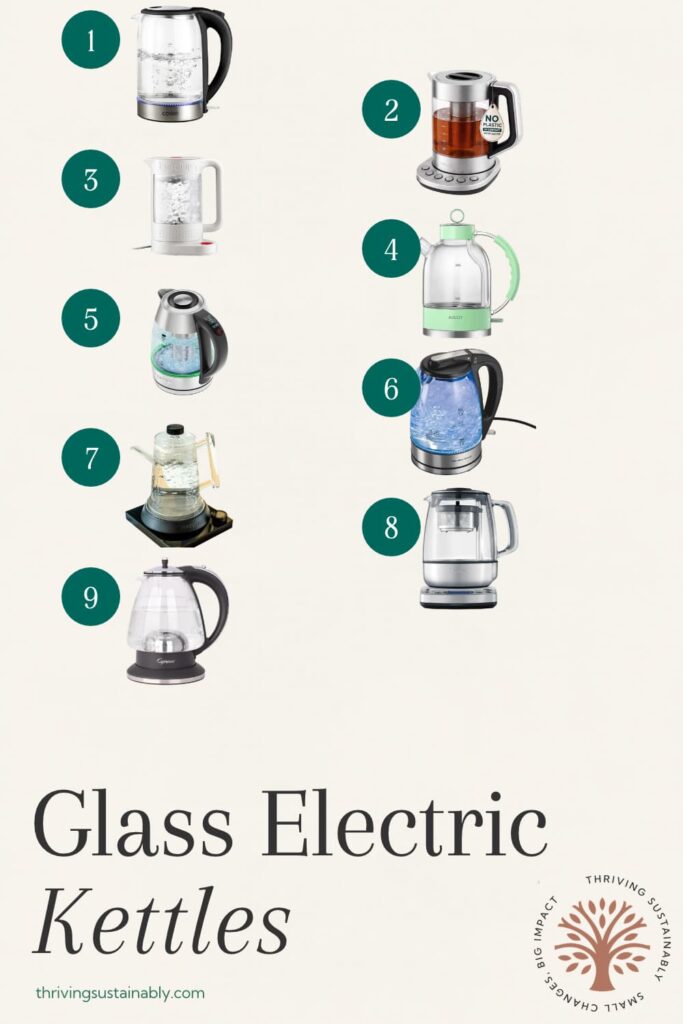
The 9 best glass electric kettles are the COSORI, Vianté Alba, Bodum Bistro Double Wall, ASCOT, Chefman Lightning, Hamilton Beach 1.7L Glass, Pure Over Glass Electric Kettle, Breville One-Touch Tea Maker, and Capresso H2O Glass. The first four keep plastic out of the water, per their brands, and for the last five, we show where the plastic sits or what the brand doesn’t say.
Picks 1 to 4 are the ones we’d buy for the least plastic in your cup. Picks 5 to 9 each do a specific job well, from big batches to pour-over coffee, so we show exactly where any plastic is and name the lower-plastic swap where there is one.
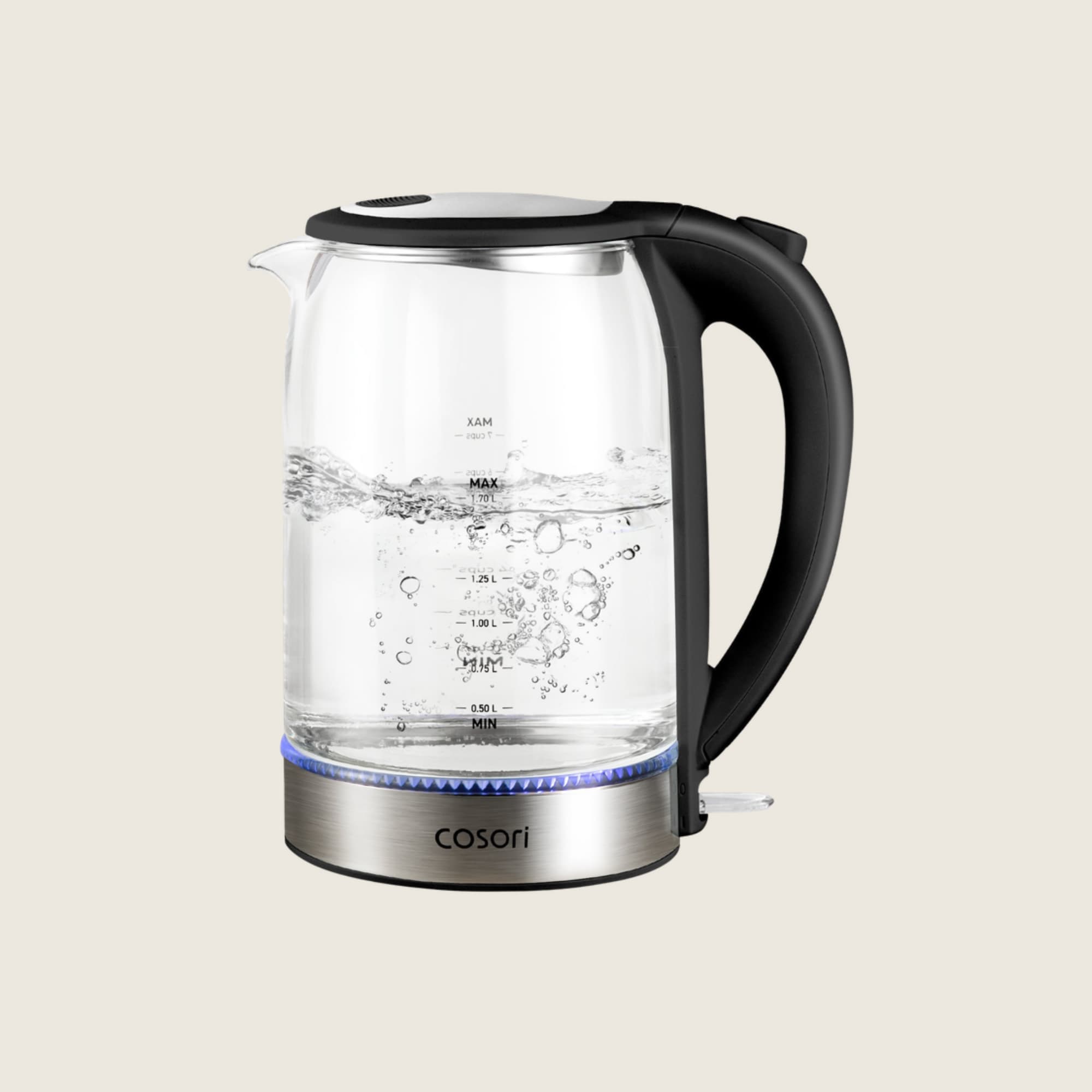
COSORI Electric Glass Kettle
A simple glass kettle that keeps plastic out of the water
The COSORI Electric Glass Kettle is the one we’d hand to most people. The body is borosilicate glass, and COSORI says the filter is plastic-free and the water never touches plastic, which covers the lid underside and spout where so many glass kettles slip up.
It holds 1.7 liters, boils in about 3 to 7 minutes according to COSORI, and shuts itself off with boil-dry protection. The handle and power base are plastic, but they sit outside the water. There’s no temperature control, so tea lovers who brew green or white tea will want the Vianté instead.
The easiest way to get plastic out of your kettle without spending much. A simple, fast kettle that does one job well.
- No plastic in the waterCOSORI says the water never touches plastic, including the filter.
- Borosilicate glassBorosilicate glass body, per the brand.
- Contains plasticHandle and power base are plastic. Neither touches the water.
At a glance
- Body
- Borosilicate glass
- Water path
- Glass and stainless steel, per the brand
- Capacity
- 1.7 L
- Warranty
- 2 years, per COSORI
Keep in mind
- No temperature control or keep warm
- Plastic handle and base
- Carries a California Prop 65 lead warning on COSORI’s site
This is the kettle for anyone who just wants hot water fast and doesn’t want to think about plastic while it boils. You can watch the water through the glass, which also makes it easy to spot limescale before it builds up. It costs about the same as a basic plastic kettle, so there’s no real price penalty for the upgrade.
- Best for anyone replacing a plastic kettle on a budget.
- Skip it if you brew delicate teas and need exact temperatures.
- Look for the glass model with the stainless steel filter, since COSORI also sells stainless and gooseneck kettles under similar names.
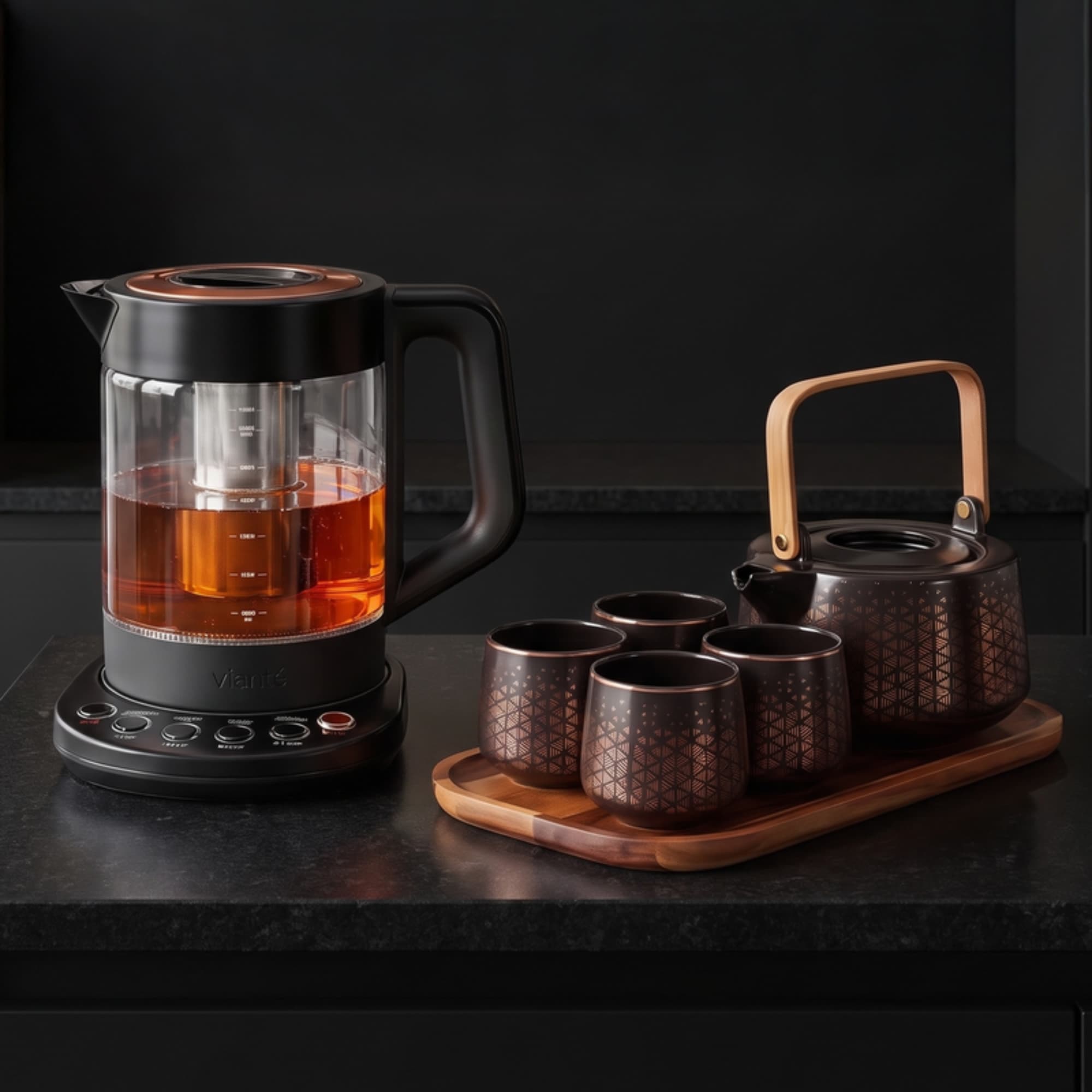
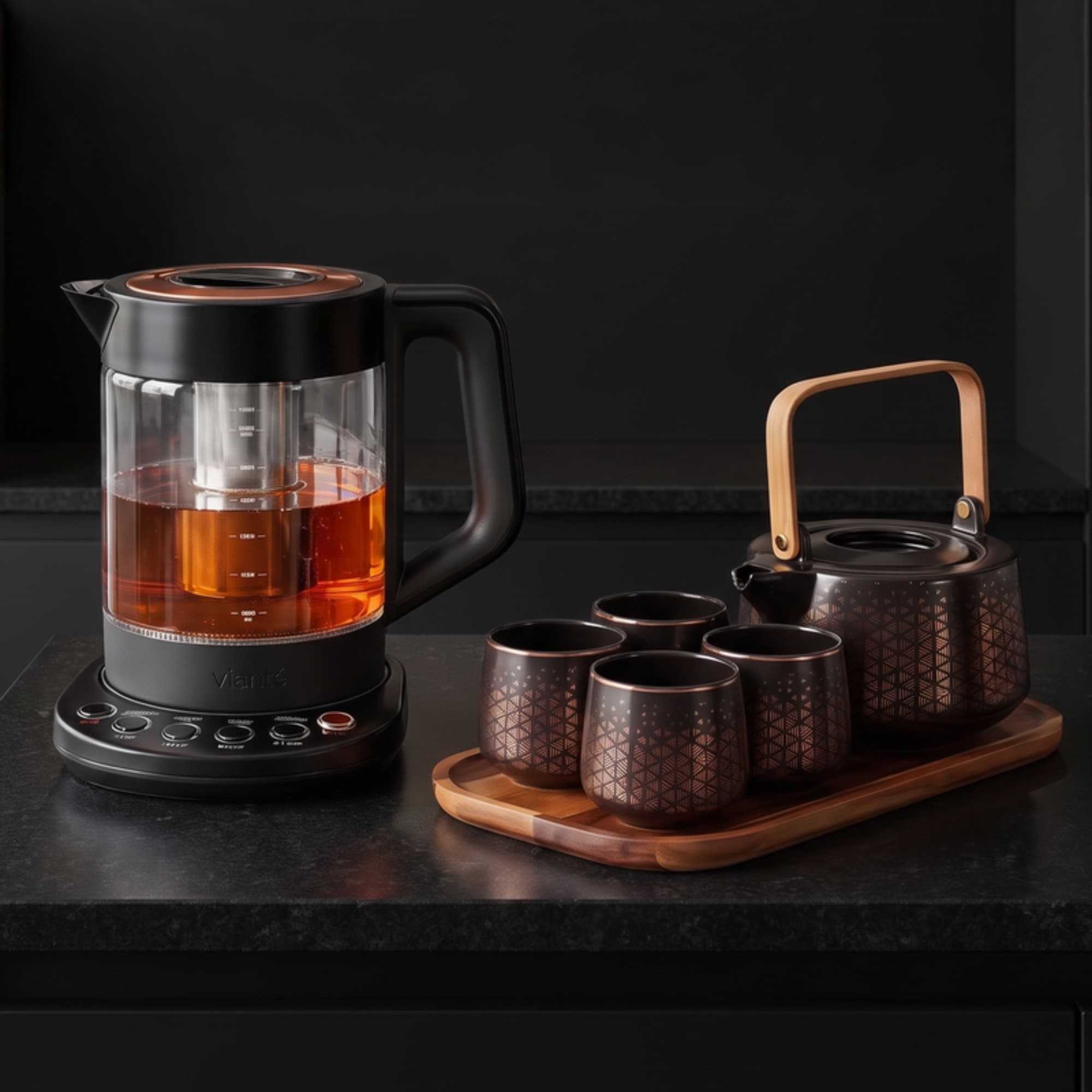
Vianté Alba Electric Tea Kettle
Four tea presets and an infuser, all in glass and steel
The Vianté Alba is the kettle to look at if you drink a lot of tea and want your water at the right temperature for it. Vianté says every surface that touches your water is borosilicate glass or 304 stainless steel, with no plastic lid liner and no plastic spout.
It holds 1.5 liters and has four presets: 175°F for green and white tea, 195°F for oolong, 200°F for French press, and 212°F for a full boil. It also has keep-warm and a removable stainless steel infuser. Vianté lists BPA-free plastic among its materials, so there is plastic on the kettle, just not where the water goes, according to the brand.
A great pick for tea drinkers who want set temperatures and an infuser in one glass kettle.
- No plastic in the waterVianté says every surface that touches the water is borosilicate glass or 304 stainless steel.
- Borosilicate glassThe body is borosilicate glass, per the brand.
- Contains plasticVianté lists BPA-free plastic among its materials, outside the water path.
At a glance
- Body
- Borosilicate glass
- Water path
- Glass and stainless steel, per the brand
- Presets
- 175, 195, 200, 212°F
- Capacity
- 1.5 L
Keep in mind
- Mamavation notes a polymer part on the inner lid that steam can reach
- Lists BPA-free plastic among its materials
- A little smaller than a 1.7 L kettle
Vianté says the Alba is the kettle that started the brand, and keeping plastic away from the water has been its focus from the beginning. The four presets cover the teas most people drink, and the infuser lets you brew loose leaf right in the kettle, then lift it out when you just need hot water for oatmeal or a pour-over.
- Best for tea drinkers who want set temperatures and an infuser in one kettle.
- Skip it if you only ever need boiling water, since the COSORI does that for far less.
- Lift the infuser out when you only need hot water, so it stays easy to clean.
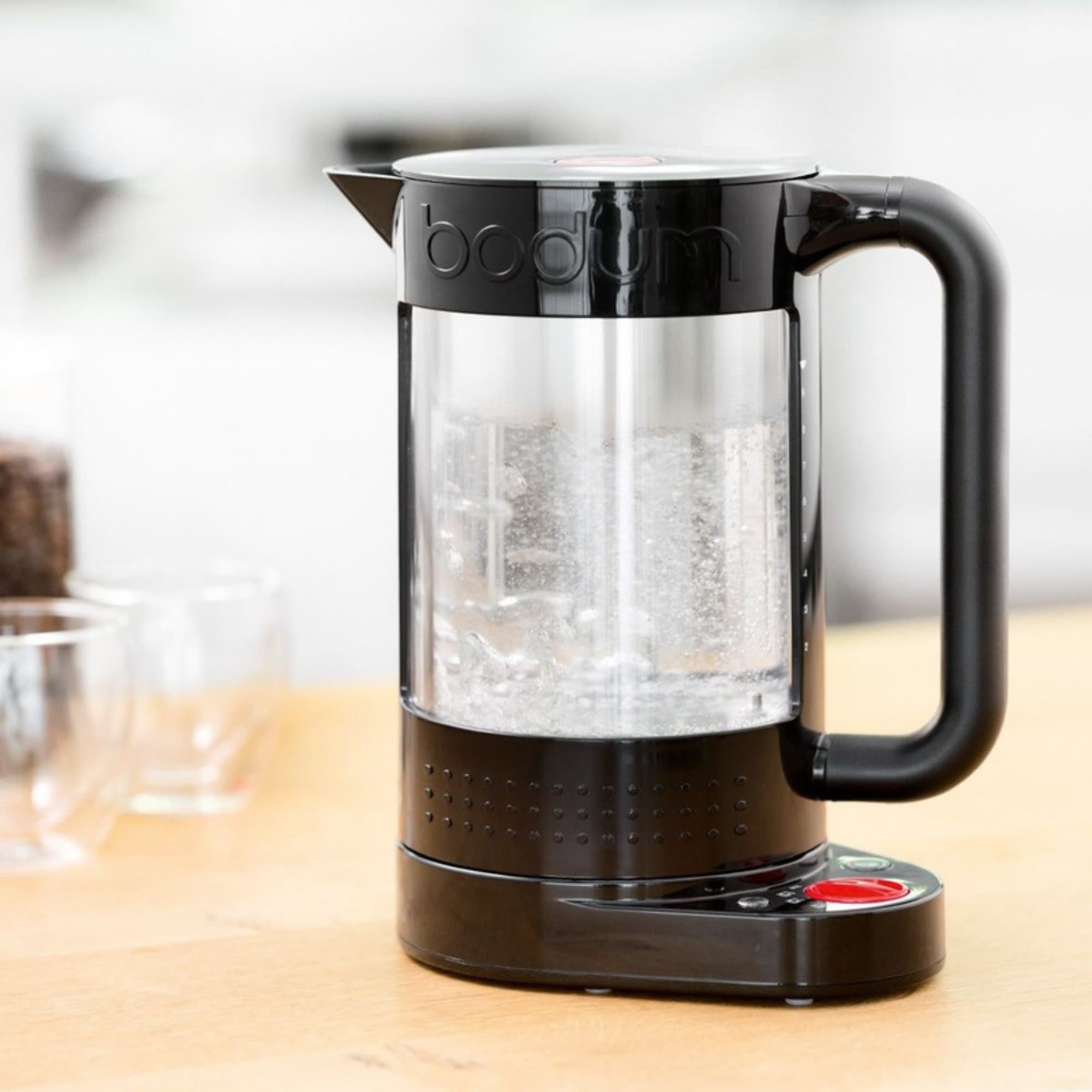
Bodum Bistro Double Wall Electric Kettle
Glass inside, cool to the touch outside
The Bodum Bistro Double Wall Electric Kettle with temperature control has two walls. The inside wall is borosilicate glass, and Bodum says the water only comes into contact with glass. The outside wall is clear plastic, which protects the glass and keeps the outside cooler to the touch.
It holds 1.1 liters, which suits one or two people, and has five temperature settings from 140°F to 212°F plus a 30-minute keep-warm. The plastic outer shell is the trade-off. It never touches the water, but this kettle has more plastic overall than our other picks.
A smart pick for small kitchens, kids in the house, or anyone who has burned a hand on a hot glass kettle. Choose it for the cool-touch design, knowing the shell is plastic.
- No plastic in the waterBodum says the water only comes into contact with glass.
- Borosilicate glassThe inner wall is borosilicate glass, per the brand.
- Contains plasticOuter wall: clear plastic. Bodum also lists silicone and rubber parts.
At a glance
- Inner wall
- Borosilicate glass
- Outer wall
- Clear plastic
- Settings
- 140, 158, 176, 194, 212°F
- Capacity
- 1.1 L
Keep in mind
- More plastic overall than our other picks
- Small capacity for a family
- Bodum’s regular Bistro kettle is all plastic, so check the model number, 11659
Single-wall glass kettles get hot on the outside, which is the one real downside of glass. The Bodum fixes that with a second wall, and it keeps temperature control in a small footprint. Just be careful when you shop, because Bodum sells a plain Bistro kettle that looks similar and is made of plastic.
- Best for one or two people, small counters, and homes with kids.
- Skip it if you want the least plastic possible in the whole kettle.
- Match the model number 11659 before you buy.
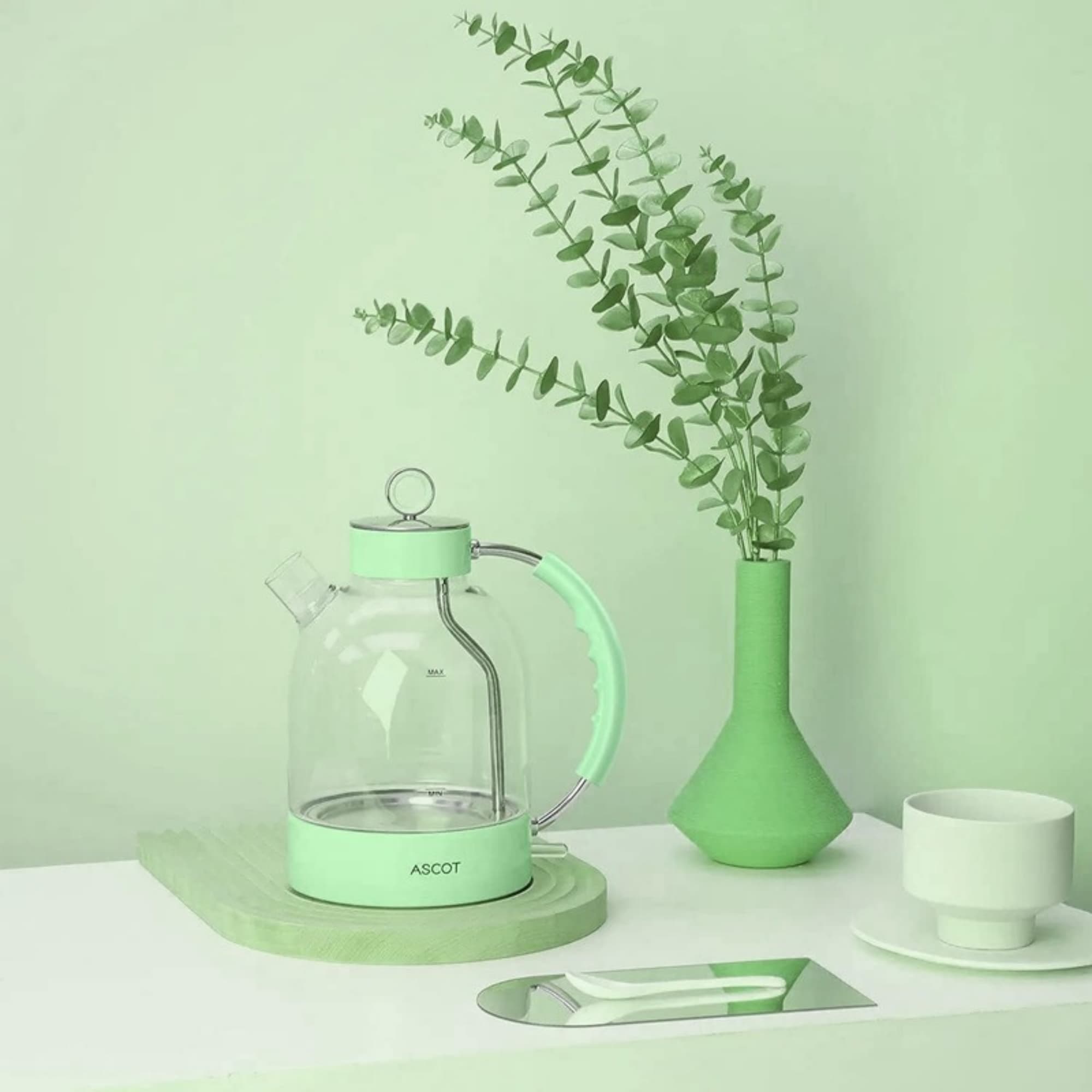
ASCOT Glass Electric Kettle
Danish design with no plastic in the lid
The ASCOT Glass Electric Kettle is a simple, good-looking kettle for anyone who just wants clean boiling water. ASCOT says no plastic touches the boiling water inside, including the lid, which is one of the spots where so many glass kettles slip up.
It holds 1.5 liters and boils a full kettle in about 5 minutes, according to ASCOT, with auto shut-off and boil-dry protection. There’s no temperature control, so it’s a boiling-water kettle like the COSORI, just with a softer, Danish-inspired look.
A nice pick if you want the COSORI’s simplicity in a kettle that looks a little more special on the counter.
- No plastic in the waterASCOT says no plastic touches the boiling water, including the lid.
- Borosilicate glassThe body is borosilicate glass, per the brand.
- Contains plasticASCOT lists the spout filter as food-grade silicone and BPA-free plastic.
At a glance
- Body
- Borosilicate glass
- Water path
- Glass and stainless steel, per the brand
- Capacity
- 1.5 L
- Power
- 1,500 W
Keep in mind
- No temperature control or keep-warm
- The spout filter is food-grade silicone, and the water pours through it
- The glass body gets hot to the touch
Glass kettles show every bit of limescale, which sounds like a downside but makes cleaning easy to keep up with. The ASCOT has a separate lid that lifts off, so you can reach in and wipe the bottom without a fight.
- Best for anyone who wants a simple boiling-water kettle with a nicer look.
- Skip it if you brew green or white tea and need set temperatures.
- ASCOT sells several similar kettles, so make sure the one you pick says borosilicate glass.
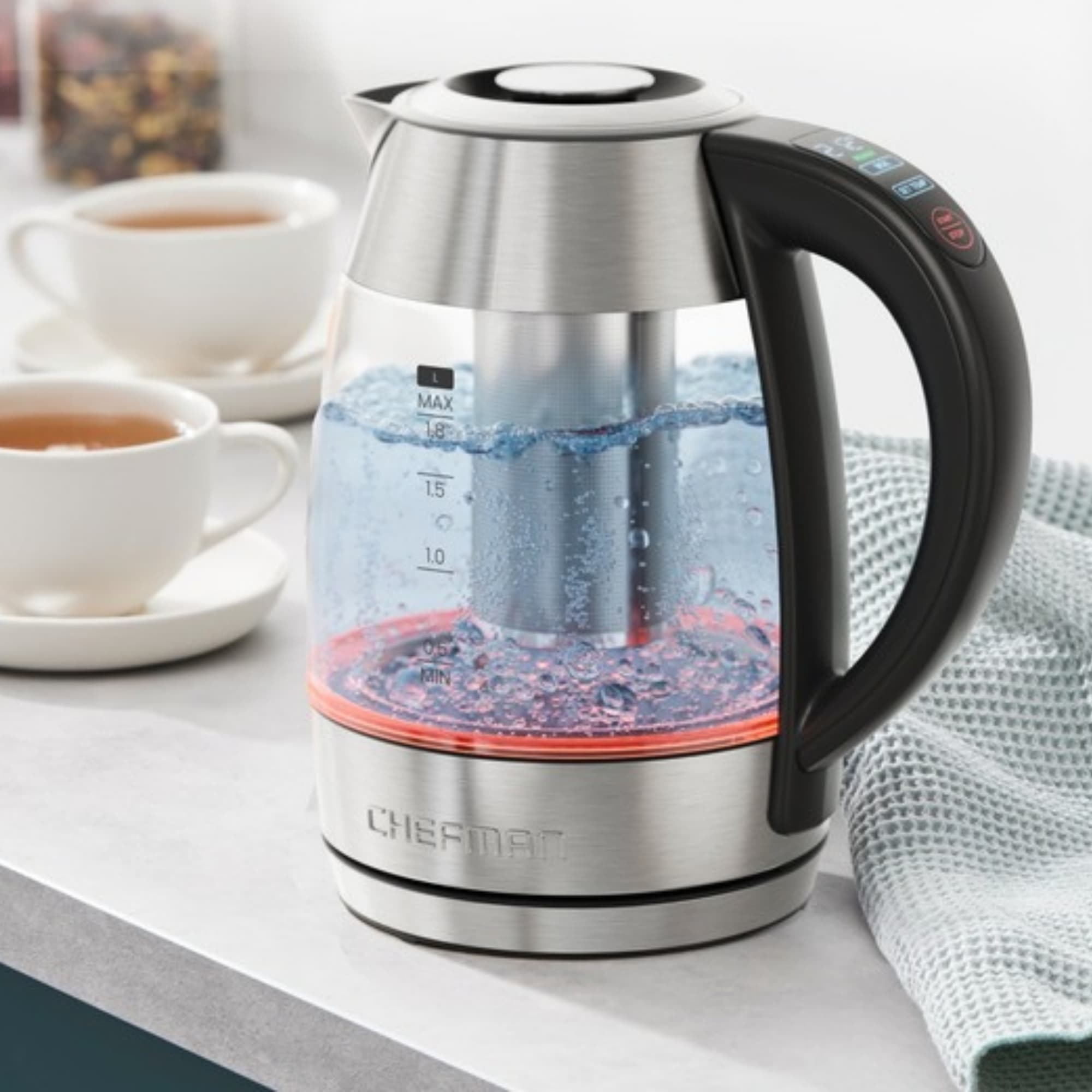
Chefman Lightning Glass Electric Kettle
Fast and affordable, with plastic in the lid and spout
The Chefman Lightning is one of the most popular glass kettles you can buy, and it’s easy to see why. It boils 2 cups of water in about 2 minutes, lets you pick your temperature, and keeps water hot for up to an hour, all for under $50.
The glass body and stainless steel infuser make it look plastic-free, but that isn’t the whole story. When a shopper asked on Target whether there’s any plastic inside, the answer was that the rim, the spout, the inside of the lid, and the mesh the water flows through are all plastic. Chefman says every part that touches water is BPA-free.
A good choice if speed and price matter most to you. If you want a low price with no plastic in the water, the COSORI is the lower-plastic swap.
- Plastic in the waterA Target buyer reports a plastic rim, spout, inner lid, and mesh filter.
- Borosilicate glassThe body is borosilicate glass, per Chefman.
At a glance
- Body
- Borosilicate glass
- Plastic parts
- Rim, spout, inner lid, and mesh filter
- Power
- 1,750 W
- Capacity
- 1.8 L
Keep in mind
- Plastic where the water pours out and steam collects
- BPA-free only means one chemical was left out
- Glass body gets hot to the touch
- Best for big households that want fast boiling and temperature control.
- Lower-plastic swap: the COSORI Electric Glass Kettle.
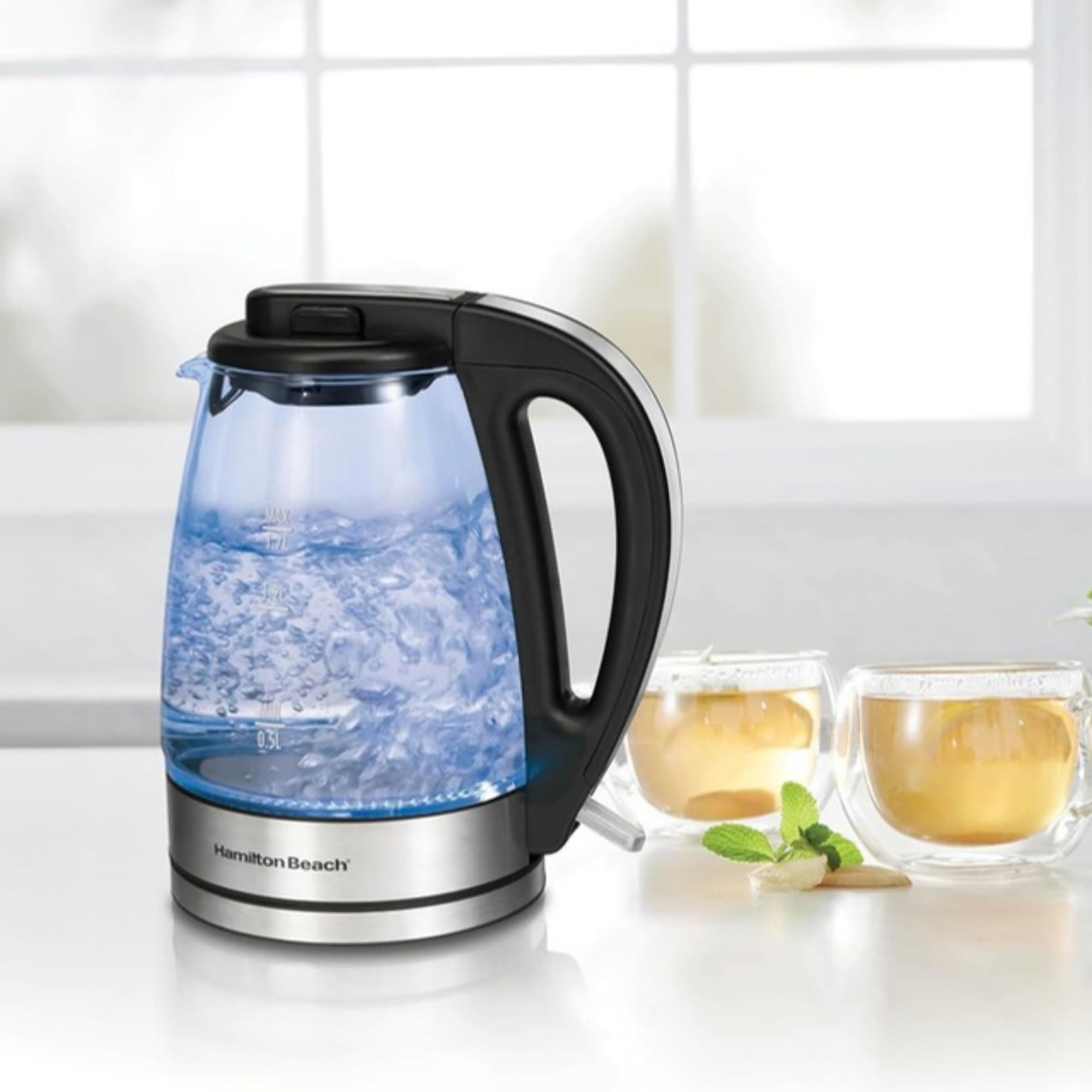
Hamilton Beach 1.7L Glass Electric Kettle
A bestselling budget kettle, but the lid material isn’t listed
The Hamilton Beach 1.7 Liter Glass Electric Kettle is one of the most-reviewed glass kettles on Amazon, with more than 10,000 ratings, and it usually costs around $30. It holds 1.7 liters, runs at 1,500 watts, and shuts off on its own with boil-dry protection.
Hamilton Beach says the inside is borosilicate glass walls and a stainless steel heating plate, but it doesn’t say what the black lid and rim are made of. On its other glass kettles, the brand’s own answers to shoppers confirm plastic lids, and for one model it said the water does come into contact with plastic parts.
A fine pick if price matters most. If you want the same low price with no plastic in the water, the COSORI is the lower-plastic swap.
- Plastic not disclosedHamilton Beach doesn’t list the lid material for this model.
- Borosilicate glassBorosilicate glass walls, per Hamilton Beach.
At a glance
- Body
- Borosilicate glass
- Heating plate
- Stainless steel
- Lid
- Not disclosed by Hamilton Beach
- Capacity
- 1.7 L
Keep in mind
- The brand doesn’t say what the lid and rim are made of
- No temperature control or keep-warm
- The glass body gets hot to the touch
- Best for anyone who wants a basic glass kettle for the lowest price.
- Lower-plastic swap: the COSORI Electric Glass Kettle.
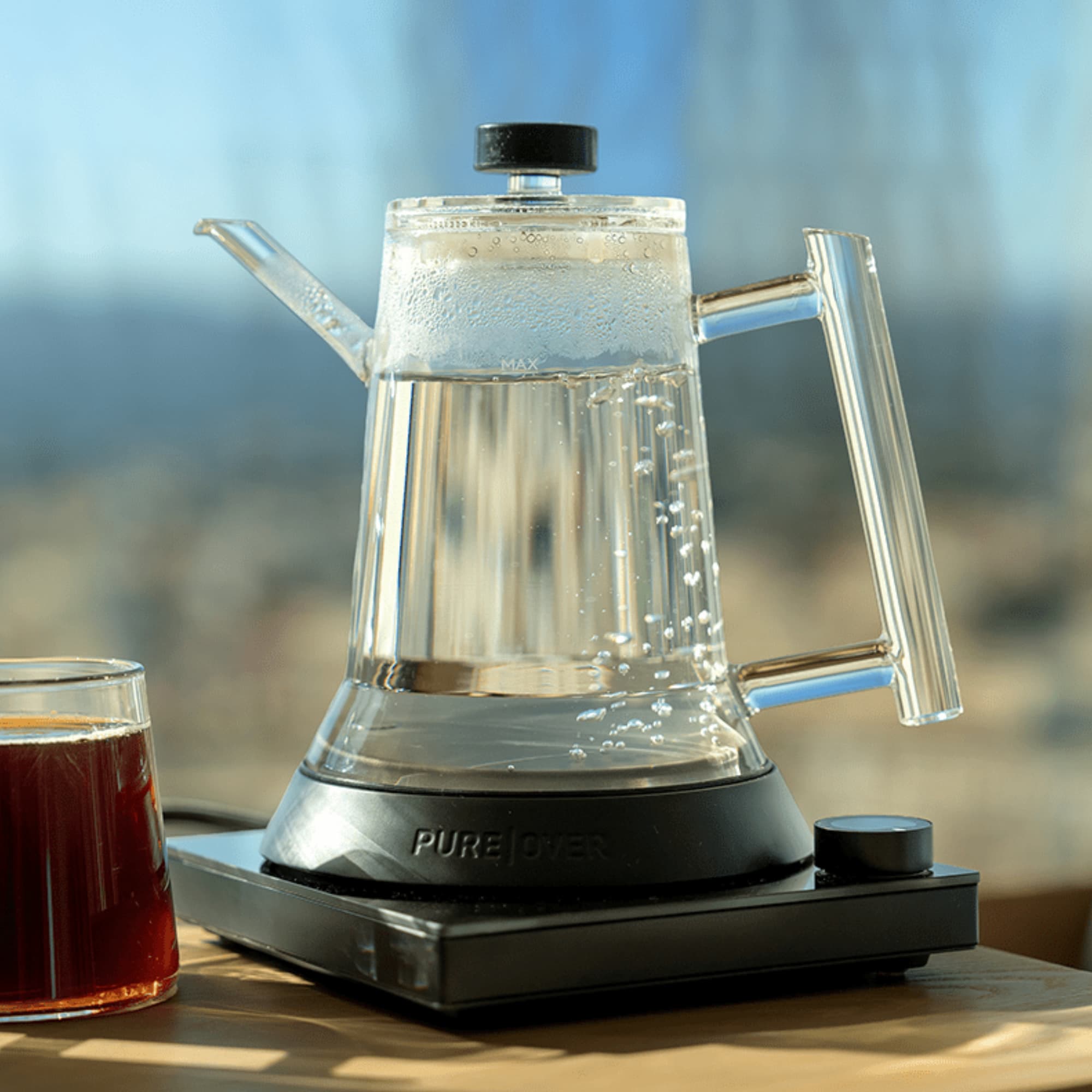
Pure Over Glass Electric Kettle
A glass gooseneck with a glass water path and a titanium heating plate
Pour-over coffee needs a slow, steady stream, and a glass gooseneck kettle is hard to find. Pure Over makes one where the spout and the channel the water flows through are both borosilicate glass, and the heating plate is pure titanium instead of the usual stainless steel.
You can set the exact temperature anywhere from 104°F to 212°F, and it holds that temperature for up to an hour, which is handy when you go back for a second cup. It holds 0.85 liters, enough for a few cups of coffee or tea.
Pure Over doesn’t say what the lid knob or seals are made of, so we can’t promise no plastic touches the steam. It’s also made in small batches, so order early if it’s a gift.
- Glass water pathPure Over says the water channel is borosilicate glass and the heating plate is titanium.
- Lid not disclosedPure Over doesn’t list what the lid knob and seals are made of.
At a glance
- Body
- Borosilicate glass
- Heating
- Grade 1 titanium plate
- Plastic parts
- Lid knob and seals not disclosed
- Capacity
- 0.85 L (28.7 oz)
Keep in mind
- Sold in small batches, so it can sell out
- Smaller capacity than most picks
- Pricier than the other kettles here
- Best for anyone who brews pour-over coffee or loose tea and wants the exact temperature every time.
- Order ahead for gifts, since it ships in small batches.
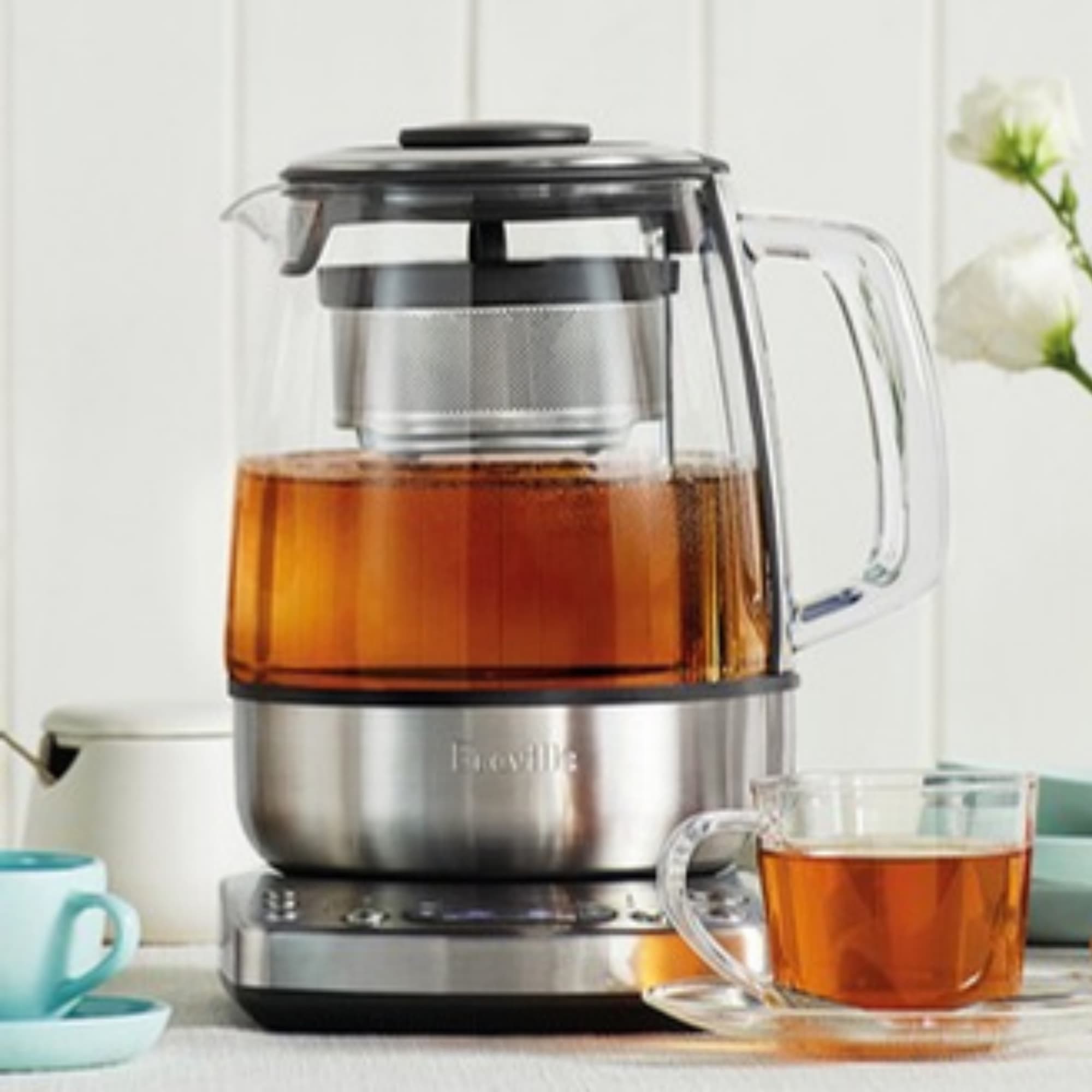
Breville One-Touch Tea Maker
Hands-off tea brewing, with plastic in the tea basket and lids
The Breville One-Touch Tea Maker is the kettle tea lovers dream about. You add loose tea to the basket, pick your tea type, and the basket lowers itself into the water, steeps for just the right time, and lifts back out so your tea never turns bitter.
The body is borosilicate glass, but plastic sits right where the water and steam go. Breville’s replacement parts list the tea basket as metal and plastic, and the basket lid and main lid as plastic, and that basket sits in the hot water for the whole brew.
A beautiful machine for anyone who drinks loose-leaf tea every day and is okay with some plastic touching the water. If you want set temperatures without it, the Vianté Alba is the lower-plastic swap.
- Plastic in the waterBreville’s parts list the tea basket as metal and plastic, and the lids as plastic.
- Borosilicate glassThe body is borosilicate glass, per Breville.
At a glance
- Body
- Borosilicate glass
- Plastic parts
- Tea basket, basket lid, and main lid
- Presets
- 5 tea types
- Capacity
- 1.5 L
Keep in mind
- The plastic tea basket sits in the water while it brews
- Plastic lids where the steam collects
- A big investment at around $330
- Best for daily loose-leaf tea drinkers who want completely hands-off brewing.
- Lower-plastic swap: the Vianté Alba Electric Tea Kettle.
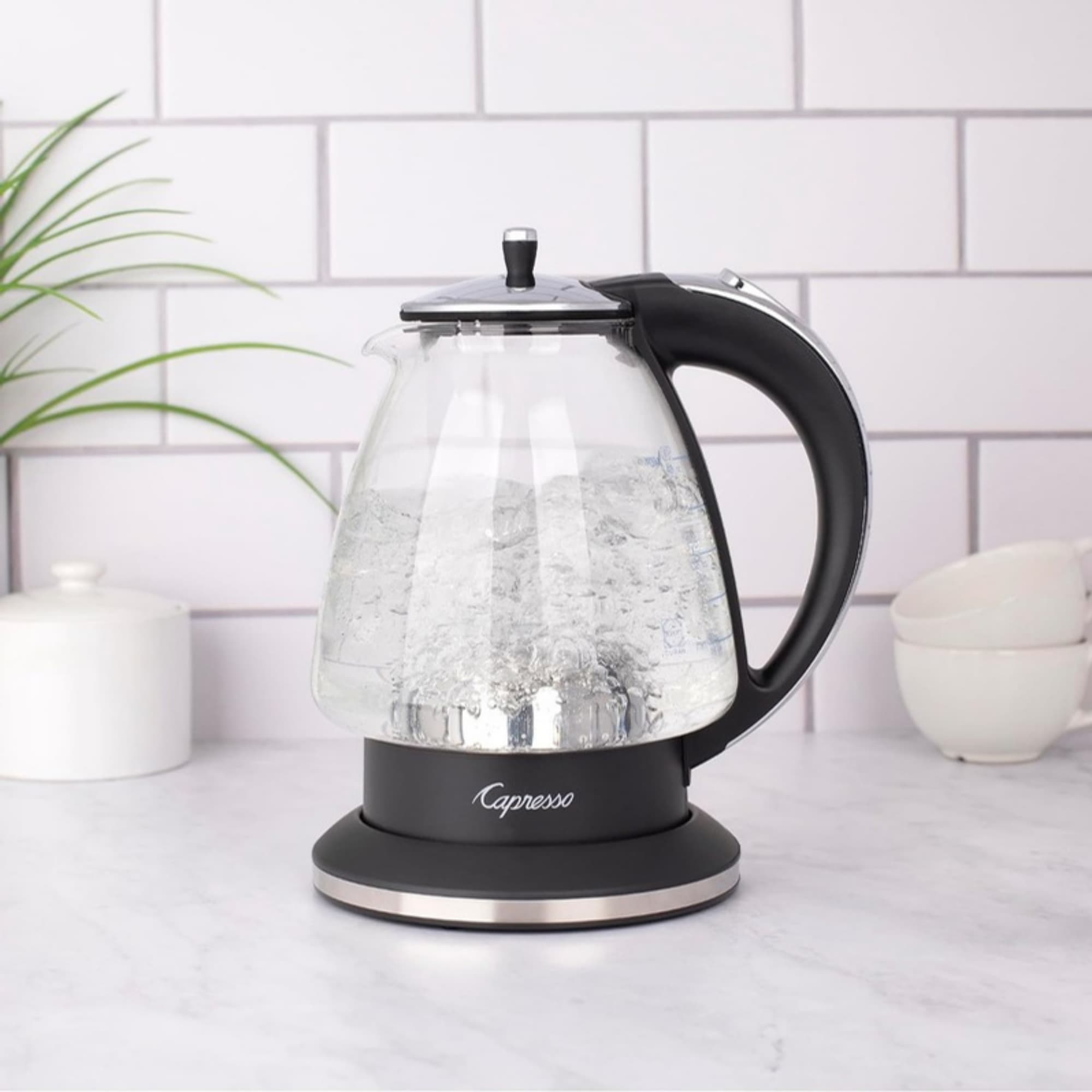
Capresso H2O Glass Kettle
Beautiful German glass, but Capresso doesn’t say where the plastic is
The Capresso H2O Glass has been around for years, and its rounded Schott DURAN glass body and stainless steel heating dome still look lovely on a counter. It holds 48 ounces and shuts itself off once the water boils.
Retailers like Sur La Table list its materials as Schott glass, stainless steel, and plastic, but Capresso’s manual and product page don’t say which parts are plastic or what the inside of the hinged lid is made of. Since we can’t tell you where the plastic is, we can’t tell you it stays out of the water.
A pretty, simple kettle if you love the look. If you’d rather know for sure, the ASCOT is the lower-plastic swap, with a brand that says no plastic touches the boiling water.
- Plastic not disclosedRetailers list plastic among its materials, but Capresso doesn’t say which parts.
- Borosilicate glassThe body is Schott DURAN borosilicate glass.
At a glance
- Body
- Schott DURAN glass
- Heating
- Stainless steel dome
- Plastic parts
- Not disclosed by Capresso
- Capacity
- 48 oz (1.42 L)
Keep in mind
- Capresso doesn’t say which parts are plastic
- The lid material isn’t listed
- No temperature control
- Best for anyone who wants a classic glass kettle with a simple, elegant look.
- Lower-plastic swap: the ASCOT Glass Electric Kettle.
What to Look for in a Glass Electric Kettle
Look for a borosilicate glass body, a stainless steel lid underside, spout, and filter, a concealed stainless heating plate, auto shut-off, and boil-dry protection. Then pick the capacity and temperature features that fit how you drink.
Borosilicate vs. Soda-Lime Glass
Borosilicate glass is the type used in lab beakers, baking dishes, and good glass food storage containers. SCHOTT classes its DURAN borosilicate glass as chemically and thermally highly resistant. Ordinary soda-lime glass, the kind in drinking glasses and windows, handles sudden heat changes far less well, which matters in something that goes from cold tap water to a rolling boil several times a day.
Every kettle in this guide uses borosilicate glass. If a glass kettle you’re considering doesn’t say borosilicate anywhere on the box or product page, skip it.
The Hidden Plastic Parts
This is the number one thing buyers miss. Check four spots before you buy: the underside of the lid, the spout, the filter, and any water level window on the side. If the product page doesn’t say what those parts are made of, look at the questions section, where brands often answer directly, or ask the brand before you buy.
Heat is what makes plastic shed. A 2025 study in npj Emerging Contaminants found new polypropylene kettles released almost 12 million nanoplastic particles per milliliter on the first boil, and particles were still showing up after 150 boils.
A kettle is one of the few kitchen tools that brings plastic and boiling water together every single day. The University of Queensland team, led by Ke Shi and Dr. Elvis Okoffo, boiled water in new polypropylene kettles and counted what came out. On the first boil, they measured almost 12 million nanoplastic particles in each milliliter of water, which works out to roughly 3 billion in a 250 mL cup.
✨ TIP
Keeping a Plastic Kettle for Now?
If you just bought a plastic kettle and aren’t ready to replace it, fill it, boil it, and pour the water out several times before you make a drink. The researchers found that a quick rinse does not do the same job as repeated boiling and discarding.
Heating Element: 304 vs. 316 Stainless Steel
A concealed stainless steel heating plate at the bottom is easier to clean than an exposed coil and doesn’t trap scale. Most kettles use 304 stainless steel, a food-grade steel that resists rust well. Some brands step up to 316, which adds molybdenum for better corrosion resistance against chlorides like the salt in tap water.
Either grade is a good choice for a heating plate. Both are far better than having plastic in the water path, so focus on the lid and spout first.
Wattage and Boil Time
Most of the kettles here run at 1,500 watts, the common power level for electric kettles in the U.S. More watts means a faster boil. The Chefman Lightning runs at 1,750 watts and boils 2 cups in about 2 minutes, according to Chefman, while COSORI says its kettle takes about 3 to 7 minutes depending on how full it is.
Heating only the water you need is the easiest way to speed things up, and it saves energy too.
Capacity and Footprint
A 1.7 liter kettle covers a family’s morning, while a 1 liter kettle suits one or two people and heats a little faster. If you mostly drink coffee or black tea, boiling water is fine. If you drink green, white, or oolong tea, a kettle with set temperatures pays for itself in better-tasting tea.
Measure the space under your cabinets before you buy, since a 1.7 liter glass kettle stands about 10 inches tall on its base. A compact kettle like the Bodum Bistro Double Wall fits better on a small counter.
Safety Features
Auto shut-off turns the kettle off once it boils, and boil-dry protection cuts the power if you switch it on empty. Both are standard on good kettles, so don’t buy one without them. If kids will be around the kettle, a double-wall design like the Bodum keeps the outside cooler to the touch.
💫 Now You Know
What BPA-Free Claims Really Mean
BPA-free only means one chemical was left out. The part is still plastic, and the kettle study tested polypropylene, a plastic that is BPA-free by nature. So a BPA-free lid or spout can still shed plastic particles into hot water.
Labels don’t settle it either. The FDA still considers BPA safe at the levels found in food, so going BPA-free is a choice brands make, not a rule. A part certified to NSF/ANSI 51, the standard for materials in commercial food equipment, can still be plastic, since the standard covers plastics and gaskets too.
Glass vs. Stainless Steel vs. Plastic Kettles
Glass lets you see the water and adds no taste, stainless steel is tougher and holds heat longer, and plastic is cheap but is the material shown to shed particles into boiling water. Glass and stainless steel are both good choices when the lid and spout aren’t plastic.
| Material | What It Does Well | Where It Falls Short |
|---|---|---|
| Glass | See the water and scale, no added taste, easy to clean | Can break, gets hot unless double wall |
| Stainless steel | Tough, holds heat longer, often has stainless lids and spouts | Can’t see inside, some use plastic water windows |
| Plastic | Cheapest and lightest | Shown to shed nanoplastics into boiling water |
Glass wins when you want to see what’s going on and keep your water tasting like water. Stainless steel wins if you knock things over, since it won’t break. Either way, the lid, spout, and filter decide more than the body does.
If you’d rather skip electric altogether, a stovetop kettle takes plastic out of the picture completely. Xtrema makes 100% ceramic tea kettles, and it doesn’t even add a whistle, because a whistle would mean adding another material. Xtrema’s pure ceramic skillet is already scored in our directory if you want to see how the brand rates.
How to Clean and Descale a Glass Kettle
Fill the kettle halfway with equal parts white vinegar and water, or water with a spoonful of citric acid, bring it to a boil, let it sit for 20 minutes, then pour it out and rinse with two plain boils.
🧼 What That White Film Is
The white film that builds up on the bottom is limescale, minerals left behind by hard water. It isn’t harmful, but it slows heating and can flake into your cup. Glass makes it easy to see when it’s time to clean.
📅 How Often to Descale
In hard-water areas, a monthly descale keeps things clear, and in soft-water areas every few months is usually enough. Check your kettle’s manual first, since some brands give their own method.
🔬 Limescale Can Trap Microplastics
Limescale has an unexpected upside, too. A 2024 study in Environmental Science & Technology Letters found that boiling hard tap water and then filtering it removed up to about 90% of the nano and microplastics, because the plastic particles got trapped in the limescale as it formed. So the scale you pour out when you descale may be holding some plastic you didn’t drink.
🚰 Fill It With Cold Tap Water
One more habit worth starting is filling your kettle with cold tap water, not hot. The EPA recommends using only cold water for drinking and cooking, since warmer water can pull more lead from older pipes and faucets.
✨ TIP
Skip the Dishwasher
Electric kettles have wiring in the base and the handle, so don’t put them in the dishwasher or dunk them in the sink. Retailer listings for the COSORI glass kettle say hand wash only. Wipe the outside, descale the inside, and the kettle will last much longer.
Common Glass Kettle Problems to Avoid
The four most common glass kettle problems are cracking, cloudiness, limescale, and hidden plastic in the lid or spout. Gentle handling, regular descaling, and checking the lid and spout before you buy prevent nearly all of them.
Cracking or Shattering
Glass kettles can chip or crack if they take a hard knock. Russell Hobbs told Which? that filling the kettle through the spout while it touches the tap can leave tiny fractures around the rim that spread once the water heats. Sudden temperature changes are the other big cause, like pouring cold water into a kettle that just boiled.
To prevent it, lift the lid to fill, set the kettle down gently, and let a hot kettle cool a little before you refill it. Which? also recommends borosilicate or tempered glass, which it says tolerates temperatures up to 170°C (338°F).
Cloudiness
A cloudy look inside is usually a thin mineral film from hard water, and it wipes away with the vinegar or citric acid descale above. Skip scouring pads and stiff brushes, which Which? warns against on glass kettles, and use a soft cloth instead.
Limescale
Limescale is the white crust that builds on the heating plate in hard-water areas. It slows heating and can flake into your cup, so descale monthly if you have hard water. The good news is that glass shows you exactly when it’s time.
Plastic Lids and Spouts
The most common problem is one you can’t see from the outside. These popular glass kettles look like they skip plastic, but each one has plastic where the steam or the water goes.
- Chefman Fast-Boil Glass Kettles: when a shopper asked on Target’s site, Chefman’s brand expert said the spout is BPA-free plastic, and every cup pours through it. Better swap: the COSORI.
- Willow Kitchen Glass Kettle: Target’s listing gives the lid material as plastic, right where the steam condenses. Better swap: the Vianté Alba.
- Bodum Bistro Standard Kettle: Bodum confirms the standard Bistro is made of BPA-free plastic, unlike the double wall model 11659. Better swap: the Bodum Bistro Double Wall.
- CUCKOO Glass Kettle with Tea Infuser: one buyer reported that both the regular lid and the infuser lid are plastic made to look like metal. Better swap: the Vianté Alba.
Save This Guide for Later 📌
FAQs on Glass Electric Kettles
The Vianté Alba Electric Tea Kettle, because it has four presets for different teas, a stainless steel infuser, and Vianté says the water only touches glass and stainless steel. For hands-off loose-leaf brewing, the Breville One-Touch Tea Maker is the splurge, though its tea basket and lids are plastic.
A gooseneck spout gives you the slow, steady pour that pour-over needs. The Pure Over Glass Electric Kettle is our pick, since its gooseneck and water channel are borosilicate glass, the heating plate is titanium, and you can set the exact temperature.
There isn’t solid data comparing the two. A glass kettle can last for years with gentle handling and regular descaling, while stainless steel holds up better to knocks. The warranty is the clearest sign of how long a brand expects its kettle to last.
For most people, yes. An electric glass kettle is faster, shuts itself off, and often has set temperatures, which a stovetop kettle can’t offer. If you’d rather skip plastic and electronics completely, a stovetop kettle made entirely of ceramic or stainless steel is the simplest option.
The Verdict: Which Glass Electric Kettle Should You Buy?
The best glass electric kettle is one where the lid, spout, and filter are glass or stainless steel, not just the body. Of our 9 picks, the COSORI is the best for most homes, the Vianté Alba is best for tea, and each of the popular kettles with plastic has a lower-plastic swap on this list.
Swapping your kettle is one of the simplest lower-plastic changes you can make, because it touches something you drink every day. Once you know to check the lid and spout, you’ll spot the glass kettles that only look the part. Pair your new kettle with water from a glass water filter pitcher and loose-leaf tea, and your morning cup gets a lot less plastic in it. If you take your tea on the go, our plastic-free water bottles keep it that way all day.
📚 References
- Bodum. (n.d.). BISTRO electric water kettle, double wall with temperature control, 11659 [Product description and user manual]. https://www.bodum.com/
- Carpenter Technology. (n.d.). 316 stainless steel. https://www.carpentertechnology.com/alloy-finder/316
- COSORI. (n.d.). Electric glass kettle. https://cosori.com/products/electric-glass-kettle-co171-gk2
- Hamilton Beach. (n.d.). 1.7 liter glass electric kettle, model 40864 [Product listing]. Amazon. https://www.amazon.com/dp/B07L5HT585
- NSF. (n.d.). Food equipment standards. https://www.nsf.org/nsf-standards/standards-portfolio/food-equipment-standards
- Pure Over. (n.d.). Glass electric kettle [Product page]. https://pureover.com/products/glass-electric-kettle
- SCHOTT. (2017). DURAN technical data. https://media.schott.com/api/public/content/d43d3a52c79d4b10a2f358d9c097e77b
- Shi, K., Okoffo, E. D., Fu, H., Bapp, C., Jiang, J., Rauert, C., & Thomas, K. V. (2025). Release of nanoplastic from polypropylene kettles. npj Emerging Contaminants, 1, 16. https://doi.org/10.1038/s44454-025-00018-w
- The University of Queensland. (2025, December 1). Australians are drinking plastic particles in their tea, UQ research finds. https://news.uq.edu.au/2025-12-australians-are-drinking-plastic-particles-their-tea-uq-research-finds
- U.S. Environmental Protection Agency. (n.d.). Basic information about lead in drinking water. https://www.epa.gov/ground-water-and-drinking-water/basic-information-about-lead-drinking-water
- U.S. Food and Drug Administration. (n.d.). Bisphenol A (BPA): Use in food contact application. https://www.fda.gov/food/food-packaging-other-substances-come-contact-food-information-consumers/bisphenol-bpa-use-food-contact-application
- Which?. (n.d.). Why glass kettles shatter and how to prevent it. https://www.which.co.uk/news/article/why-glass-kettles-shatter-and-how-to-prevent-it-aRjZ02W7NgiM
- Yu, Z., Wang, J.-J., Liu, L.-Y., Li, Z., & Zeng, E. Y. (2024). Drinking boiled tap water reduces human intake of nanoplastics and microplastics. Environmental Science & Technology Letters. https://doi.org/10.1021/acs.estlett.4c00081