
Key Takeaways
- The best wooden cooking utensils are dense hardwood tools with an honest, food-safe finish, gentle on nonstick and ceramic pans and free of the plastic that sheds off cheap nylon.
- Wood is not the germ trap people fear. In UC Davis food-safety research, bacteria placed on wood surfaces could not be recovered and slowly died off.
- Skip the mystery-wood bargain sets. If a listing will not name the wood species and the finish, that is the sign to walk away.
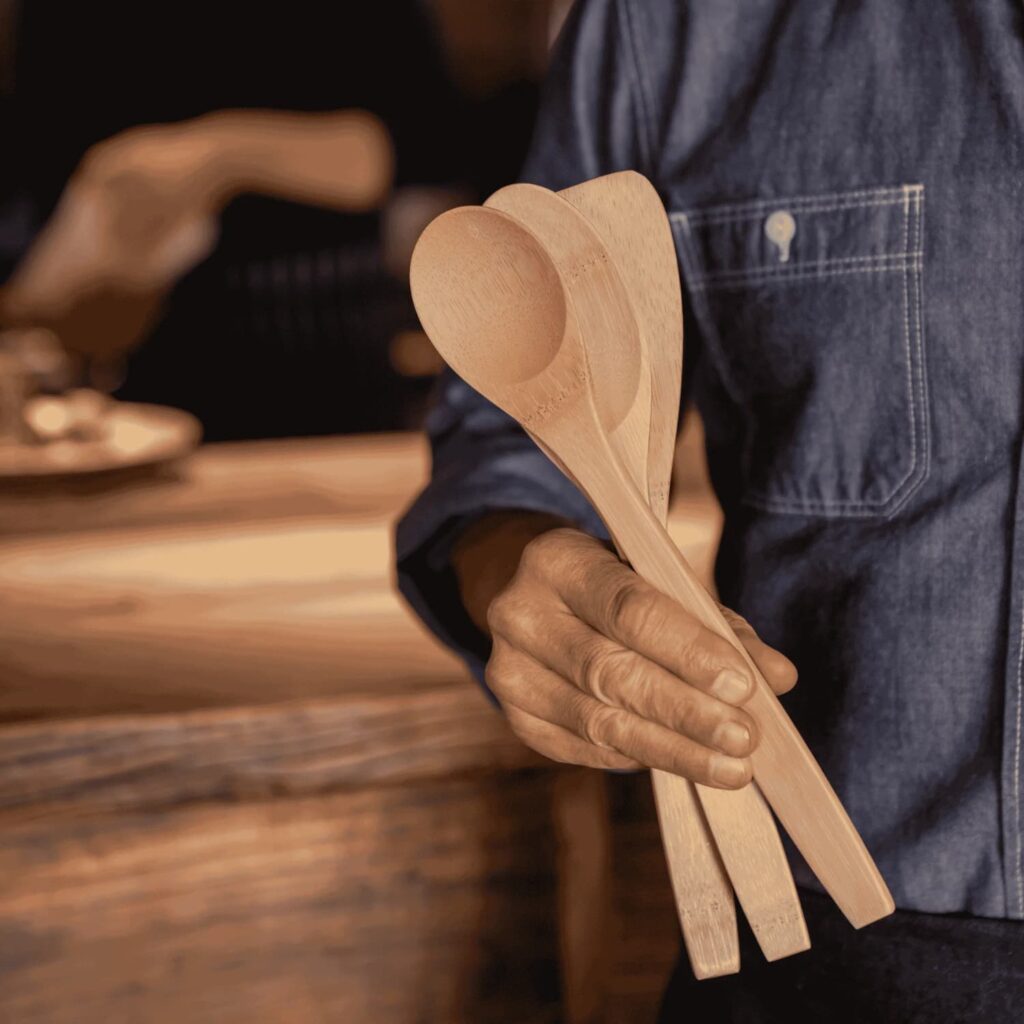
If you have moved to nonstick or ceramic pans to get away from scratched coatings, wood is the utensil to reach for. A wooden spoon will not gouge a coating the way metal does, it will not melt or shed like cheap nylon, and a solid hardwood piece has no plastic in it at all. That is the short answer: for a non-toxic kitchen, a good hardwood utensil is the safest everyday choice.
Not all wood is equal, though. A carved maple spatula and a glued bargain set with a mystery finish are very different objects, even when they sit in the same online category. We chose the 9 best wooden cooking utensils below for named, food-safe woods, honest finishes, and lasting construction, then measured how they hold up to heat, staining, and repeated washing. Here are the ones we would put in a drawer, plus the ones we would leave on the shelf.
The Expert Behind the Research
- Dean O. Cliver, Ph.D., food microbiologist at the University of California, Davis Food Safety Laboratory, whose peer-reviewed studies on how wood versus plastic surfaces handle bacteria are the basis for the safety guidance in this article.
Our Top Picks at a Glance
For most kitchens, the best wooden cooking utensil is a single-piece, dense hardwood tool with a plain, food-grade oil finish, like the Earlywood sauté spatula. It resists staining and warping and has no glue seam to fail.
| Utensil | Best for | Wood | Price |
|---|---|---|---|
| Earlywood Sauté Spatula | Best overall | Exotic hardwood / maple | $$ |
| Jonathan’s Spoons Spootle | Best wooden spoon | Wild cherry | $$ |
| Bambu Kitchen Basics | Best sustainable set | Organic bamboo | $ |
| Caraway Wooden Utensil Set | Best non-toxic set | FSC birch | $$$ |
| Made In Wooden Spoon | Best for nonstick and ceramic | Beech | $ |
| Le Creuset Revolution Slotted Spoon | Best slotted spoon | Beech | $$ |
| OXO Good Grips Wooden Set | Best budget set | Beech | $ |
| Williams Sonoma Walnut Essentials | Best splurge | Walnut | $$$ |
| Verve Culture Olivewood Ladle | Best olivewood | Olivewood | $$ |
How We Chose These Picks
We chose these wooden cooking utensils by researching the wood species, finish, and construction of each one against primary sources, then ranking them on density, heat and stain resistance, and honest sourcing. We did not lab-test them, so nothing here claims bench results we did not run.
What We Looked At
Every pick had to clear four things: a named, food-safe wood rather than “wood,” a disclosed or trustworthy finish rather than a mystery coating, sound construction that holds up to daily washing, and enough density to resist staining and warping. Denser woods dent less, soak up less liquid, and hold an edge on a spatula longer, which is why hardness matters more than looks.
The Non-Toxic Criteria
A wooden utensil earns the non-toxic label three ways. The species has to be a food-safe wood with no natural toxicity. Its finish has to be something you would happily eat off, which in practice means food-grade mineral oil, beeswax, or an unsealed raw surface, not a lacquer or a chemical stain. And the sourcing has to be honest, which is why picks like Bambu, with its USDA-organic, glue-free build, and Caraway, with its FSC-certified birch labeled free of microplastics, score well: they tell you exactly what you are buying.
The Research We Reviewed
The safety section leans on peer-reviewed food-microbiology work from Dean Cliver’s lab at UC Davis, plus each brand’s own material disclosures. Where a maker would not say what the wood or finish was, that counted against the product rather than for it.
The Best Wooden Cooking Utensils, Reviewed
The best wooden cooking utensils span single-piece hardwood tools from Earlywood and Jonathan’s Spoons, honest sets from Bambu and Caraway, and specialty picks from Made In, Le Creuset, OXO, Williams Sonoma, and Verve Culture.
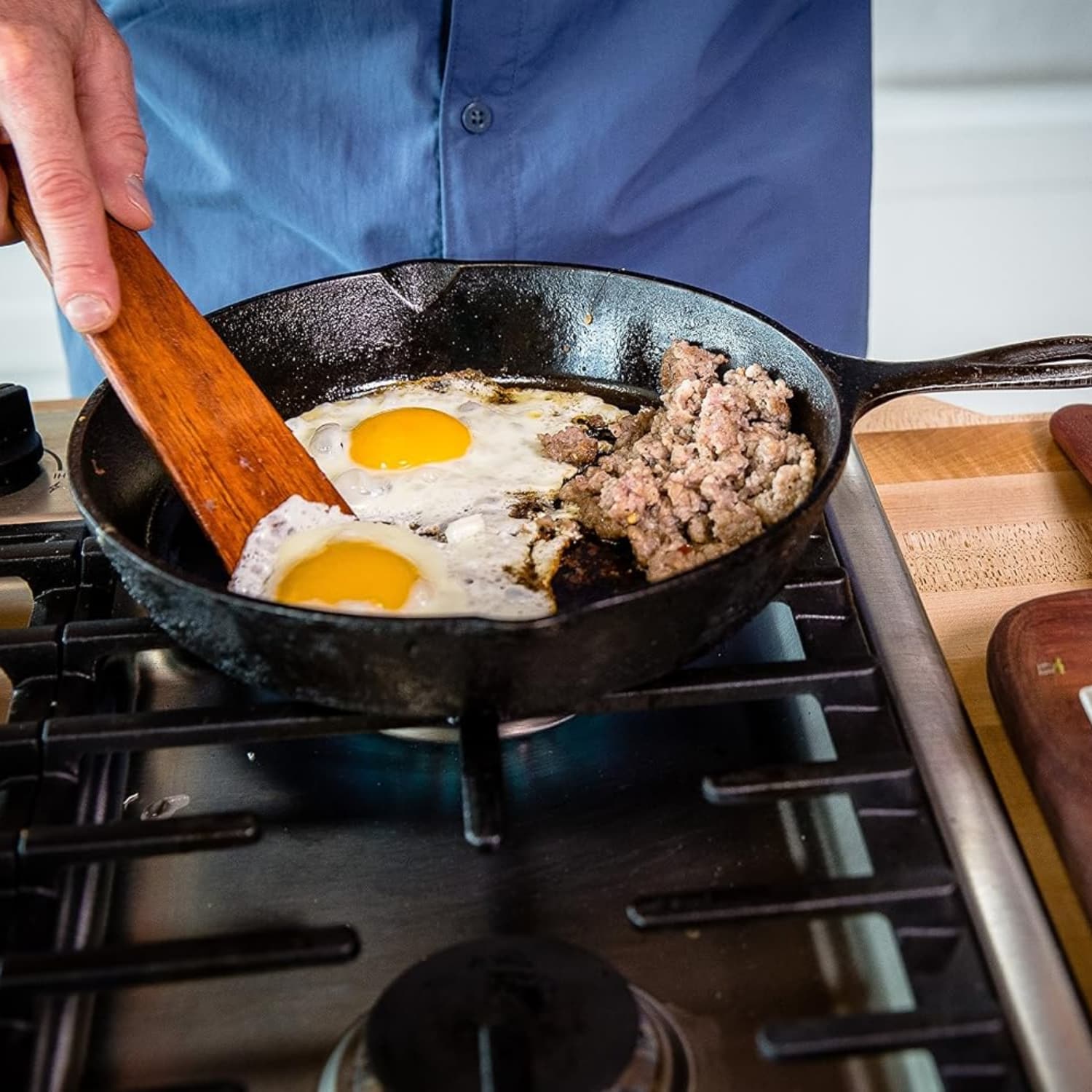
Dense exotic hardwood, single carved piece, made in the USA
$$
Earlywood carves this multi-purpose sauté spatula from a single block of dense hardwood, one of four exotic species, and has made heirloom kitchen tools in Montana since 2011. There is no stain and no glue, just the wood and a food-grade mineral oil finish, so the color you see is the grain itself.
On the materials side, the dense hardwood resists staining and warping far better than soft beech, and the thin straight edge scrapes fond off the bottom of a pan and slips under a fried egg. Hand wash it, oil it now and then, and it will outlast a whole drawer of nylon.
Body
Hardwood
✓ Plastic FreeFinish
Mineral Oil
✓ Plastic FreeBuild
Single Piece
✓ Plastic FreeMade Without
Glue, Stain
✓ Plastic FreePros
- Dense exotic hardwood resists staining and warping
- No stain or lacquer, just food-grade oil
- One piece, no glue seam to fail
- Hand-made in the USA
Cons
- Darkest woods need occasional re-oiling
- Premium price
The one to own first, and the tool most cooks reach for daily. If you buy one wooden utensil, make it this.
Single-piece wild cherry, hand-carved in the USA since 1983
$$
Jonathan’s Spoons has hand-carved wild cherry into kitchen tools in Pennsylvania since 1983, and the Spootle is its signature piece, a spoon with a flattened, slotted front that works as a spoon and a spatula at once.
Cherry is a softer hardwood, which makes it gentle on nonstick and ceramic and gives it that warm reddish grain. Each piece is a single carving with no glue, finished in food-safe oil, so there is nothing to delaminate or leach into your food.
Body
Wild Cherry
✓ Plastic FreeFinish
Food-Safe Oil
✓ Plastic FreeBuild
Single Piece
✓ Plastic FreeOrigin
Made in USA
✓ Plastic FreePros
- Single-piece wild cherry, no glue
- Gentle on ceramic and nonstick
- Spoon and spatula in one tool
- Hand-made by a small US maker
Cons
- Cherry is softer, so it shows wear sooner
- Treat it gently to keep the edge
A do-everything wooden spoon that will outlast a drawer of nylon. The one spoon to keep by the stove.
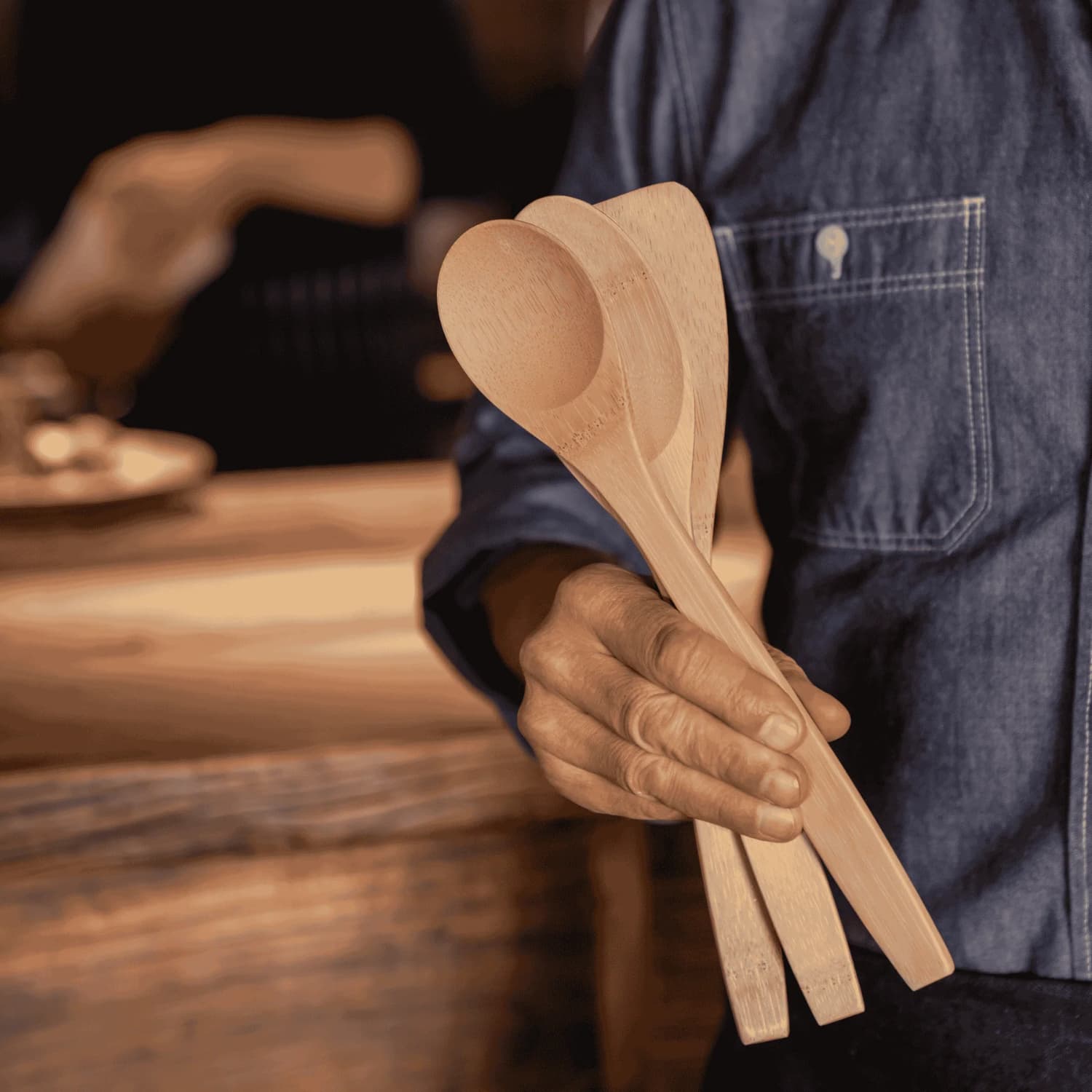
USDA-organic and FSC-certified bamboo, glue-free, B Corp
$
Bambu is one of the original US brands built around bamboo home goods, certified USDA Organic and FSC and a B Corp since 2003. The Kitchen Basics trio is sold through Grove Collaborative at one of the friendliest entry prices on this roundup.
On the materials side, each piece is hand-burnished organic bamboo made without glue or lacquer and finished in food-grade oil. Bambu publishes its sourcing openly and donates a share of sales to environmental work, so it is an easy, credentialed way to swap out plastic utensils.
Material
Organic Bamboo
✓ Plastic FreeFinish
Food-Grade Oil
✓ Plastic FreeBuild
Glue-Free
✓ Plastic FreeCertified
FSC, Organic
✓ Plastic FreePros
- FSC-certified organic bamboo
- Made without glue or lacquer
- B Corp and woman-owned
- Gentle on coated pans, budget-friendly
Cons
- Bamboo is lighter and wears a little faster
- Re-oil to keep it from drying out
The honest budget set, with sustainability credentials that hold up. Proof plastic-free does not have to cost much.
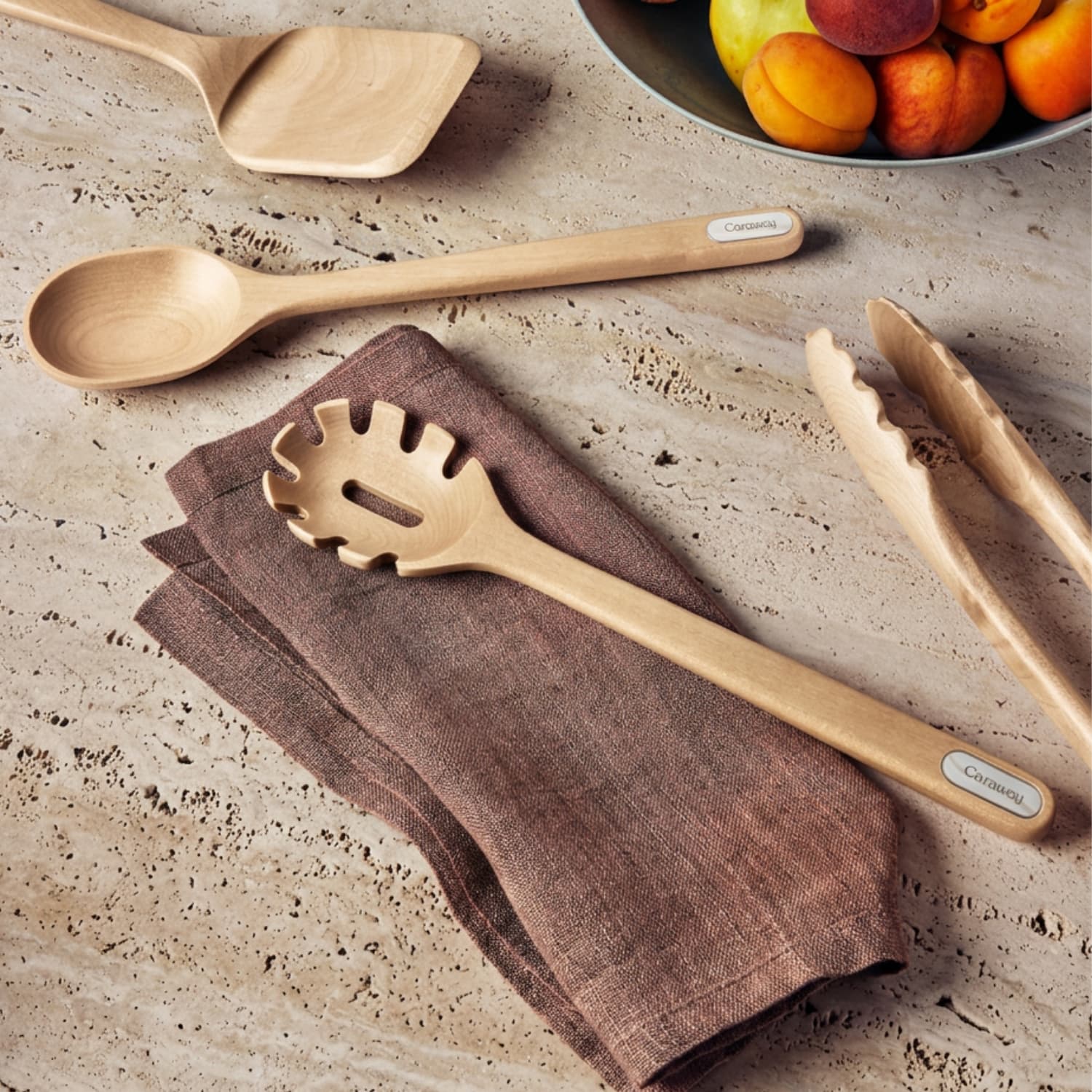
FSC-certified birch, no microplastics, five-piece set
$$$
Caraway built its name on non-toxic cookware, and this five-piece utensil set carries the same thinking, made from FSC-certified birch and labeled free of microplastics.
The set covers a spoon, server, scraper, spatula, and tongs, all color-matched to Caraway pans. Birch is a mid-density wood, so keep it oiled, but the plain material disclosure is what earns it a place here, and it is the set to reach for if you already cook on Caraway.
Wood
FSC Birch
✓ Plastic FreeFinish
Food-Safe
✓ Plastic FreePieces
Five Tools
✓ Plastic FreeCertified
FSC
✓ Plastic FreePros
- FSC-certified birch
- Labeled free of microplastics
- Five tools including spatula and tongs
- Coordinates with Caraway cookware
Cons
- Birch is softer, so it stains and wears faster
- Premium price for a utensil set
The coordinated non-toxic set, especially for a Caraway kitchen. Buy it as a set, not piece by piece.
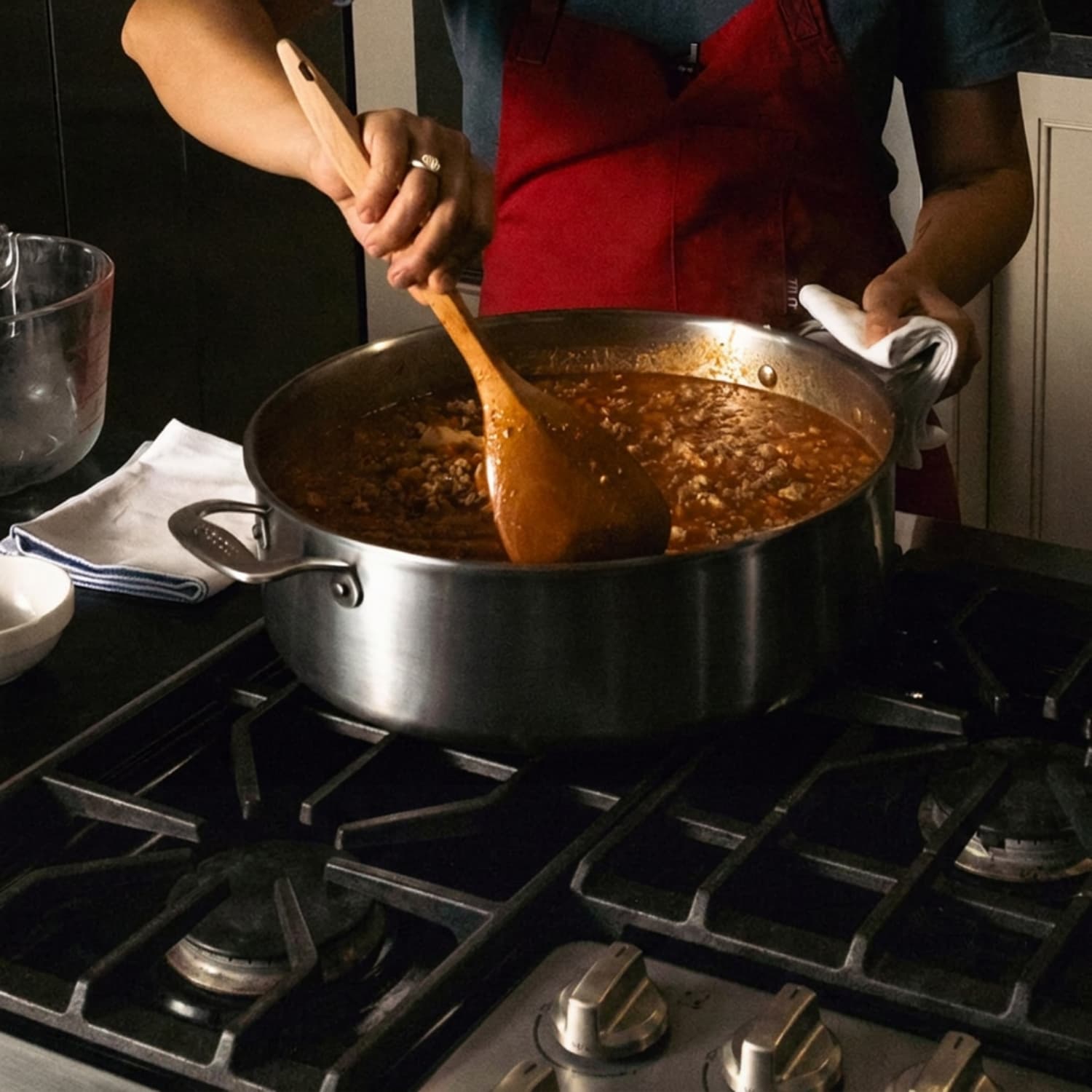
Single-piece beech, gentle on coatings, crafted in Hungary
$
Made In hand-crafts this beech spoon in Hungary, part of the same pro-grade line as its cookware, and builds it specifically to protect coated pans.
The smooth rounded edges will not scratch a nonstick or ceramic surface, and the wide bowl moves a lot of food at once. It is a single, well-made piece of beech, a natural companion to a Made In or any coated pan.
Wood
Beech
✓ Plastic FreeFinish
Food-Safe
✓ Plastic FreeBuild
Single Piece
✓ Plastic FreeMade In
Hungary
✓ Plastic FreePros
- Smooth edges are gentle on coatings
- Solid single-piece beech
- Wide bowl moves a lot of food
- Affordable and well-made
Cons
- Beech needs regular oiling or it grays
- One spoon, not a full set
The spoon to pair with your nonstick or ceramic pan. Gentle where metal utensils do damage.
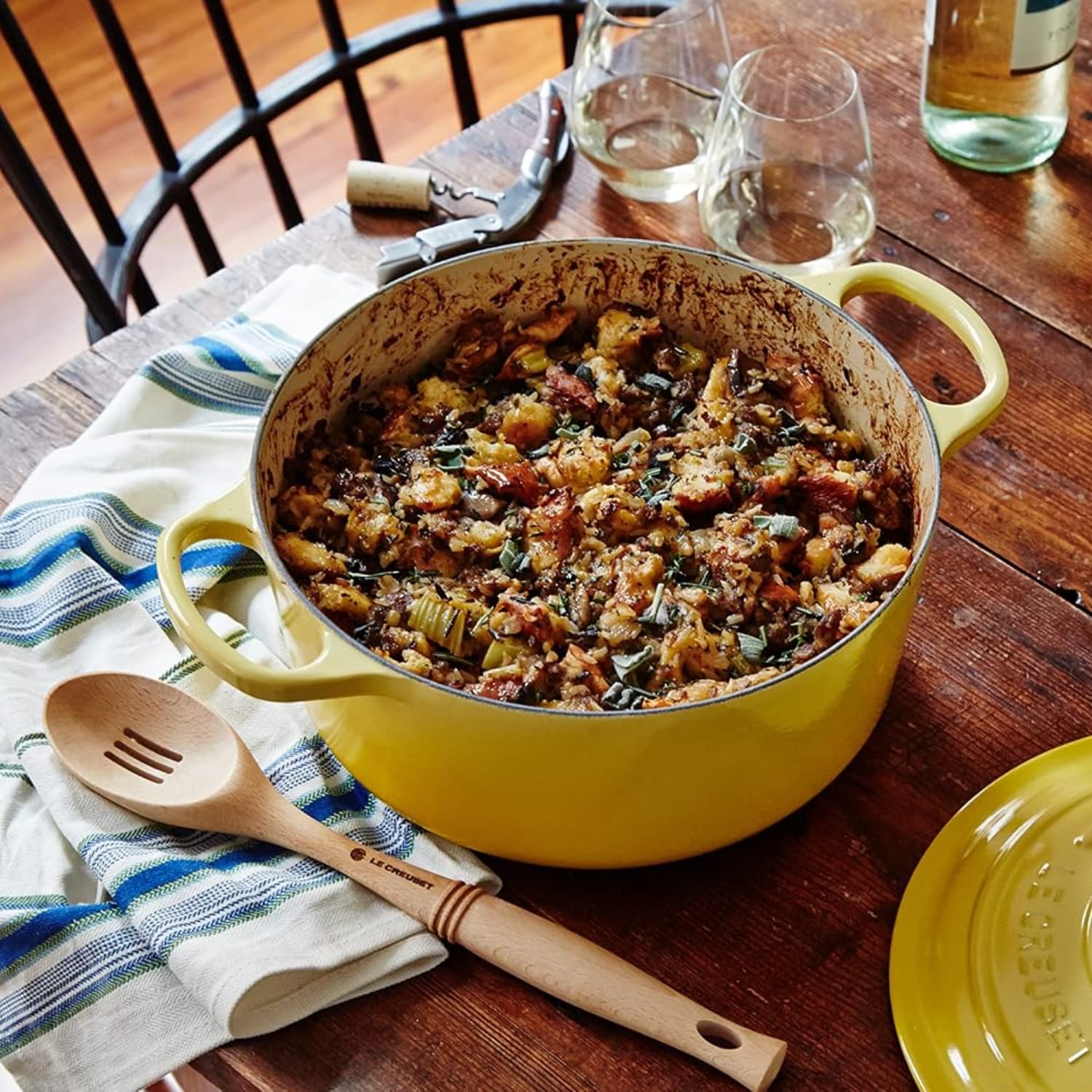
Durable beech, elliptical grip, slotted for draining
$$
Le Creuset makes its Revolution slotted spoon from durable beech with a comfortable elliptical grip and grip rings, sized to drain and serve.
The rounded edges are gentle on a coated pan, and the slots clear water cleanly. It is the premium single slotted spoon in this lineup, and it coordinates with Le Creuset cookware if you already own it.
Wood
Beech
✓ Plastic FreeFinish
Food-Safe
✓ Plastic FreeBuild
Single Piece
✓ Plastic FreeDesign
Slotted
✓ Plastic FreePros
- Durable beech with a comfortable grip
- Slots drain cleanly
- Gentle on coated pans
- Coordinates with Le Creuset
Cons
- Beech needs oiling to stay smooth
- Premium price for one utensil
The nicest single slotted spoon in the lineup. Worth it if you drain often.
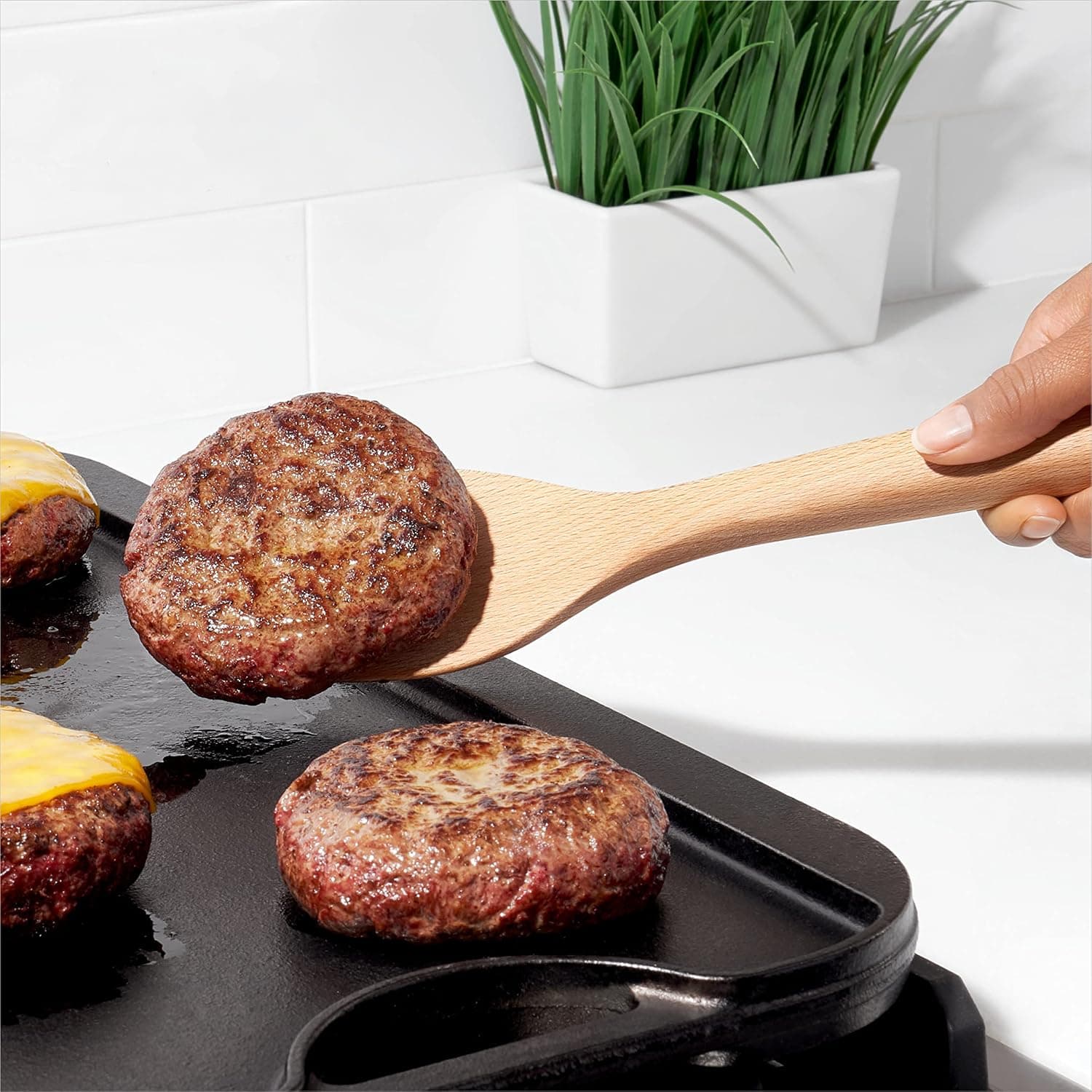
Solid beech trio, spoon, slotted spoon, and turner
$
OXO covers the everyday trio in one inexpensive set, a spoon, a slotted spoon, and a turner, all in solid beech.
The pieces are heat-resistant and easy on nonstick, so kept oiled and out of the dishwasher they earn their keep. It is the most tool for the least money and a clean upgrade from a set of scratched plastic.
Wood
Beech
✓ Plastic FreeFinish
Food-Safe
✓ Plastic FreePieces
Three Tools
✓ Plastic FreeHeat
Heat-Resistant
✓ Plastic FreePros
- Covers the three everyday tools
- Solid beech, gentle on nonstick
- Very affordable
- Widely available
Cons
- Beech grays without oiling
- Mass-produced, so the finish is basic
The most tool for the least money. A clean upgrade from scratched plastic.
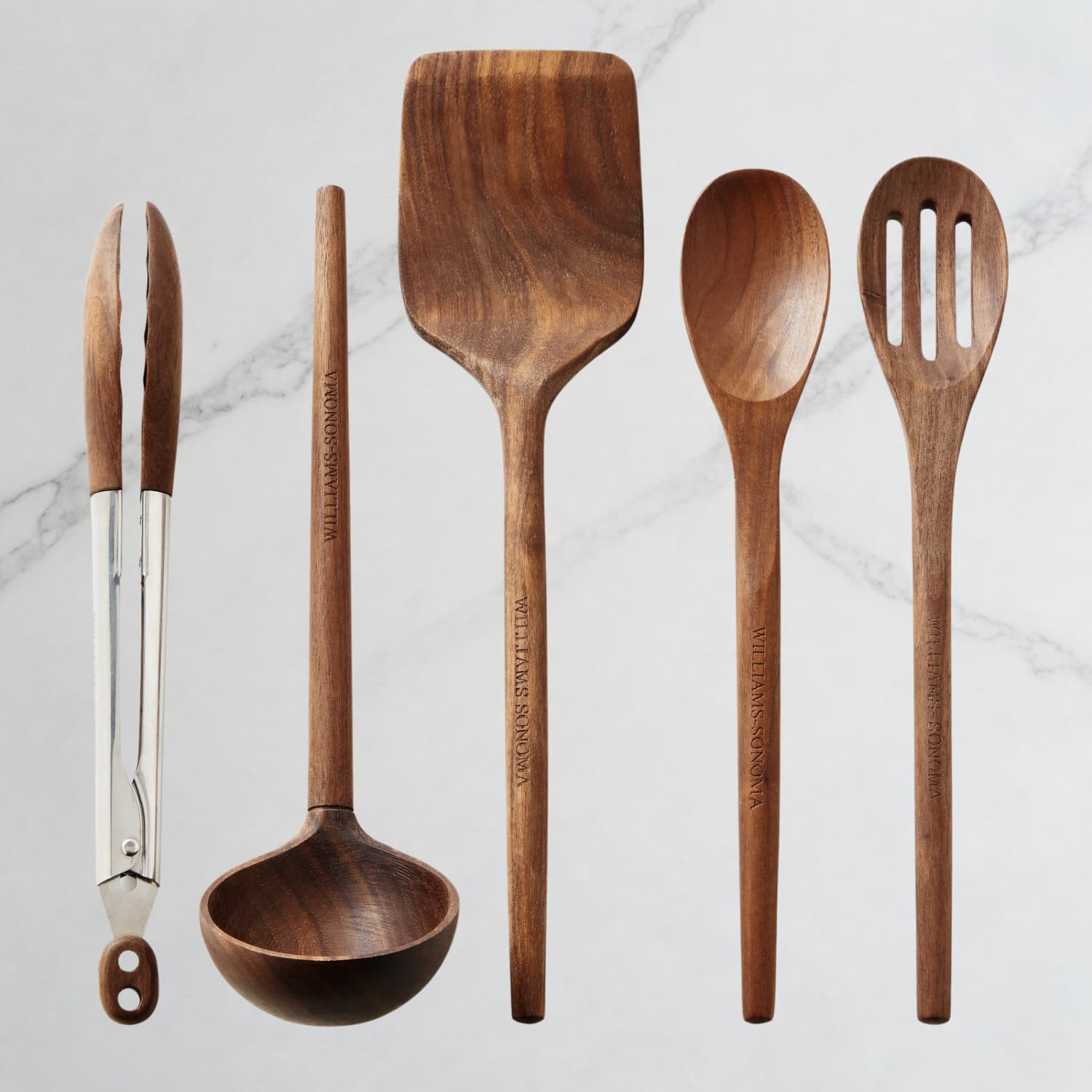
American black walnut, five-piece heirloom set
$$$
Williams Sonoma makes this five-piece collection from American black walnut, a rich, close-grained hardwood that ages beautifully. The set covers a spatula, spoon, slotted spoon, ladle, and tongs.
Walnut is dense enough to resist staining and gentle enough for coated pans, and a cared-for set lasts for decades. It is the splurge pick here on looks and longevity.
I love the Williams Sonoma wooden utensils. They feel heavier in the hand than most, and they are beautiful.
Wood
Black Walnut
✓ Plastic FreeFinish
Food-Safe
✓ Plastic FreePieces
Five Tools
✓ Plastic FreeLook
Heirloom Grain
✓ Plastic FreePros
- Gorgeous dark walnut grain
- A full five-piece matched set
- Heirloom longevity
- Coordinates as a set
Cons
- The priciest option here
- Walnut, like all wood, needs oiling
The heirloom set, on looks and longevity. Buy once, keep for decades.
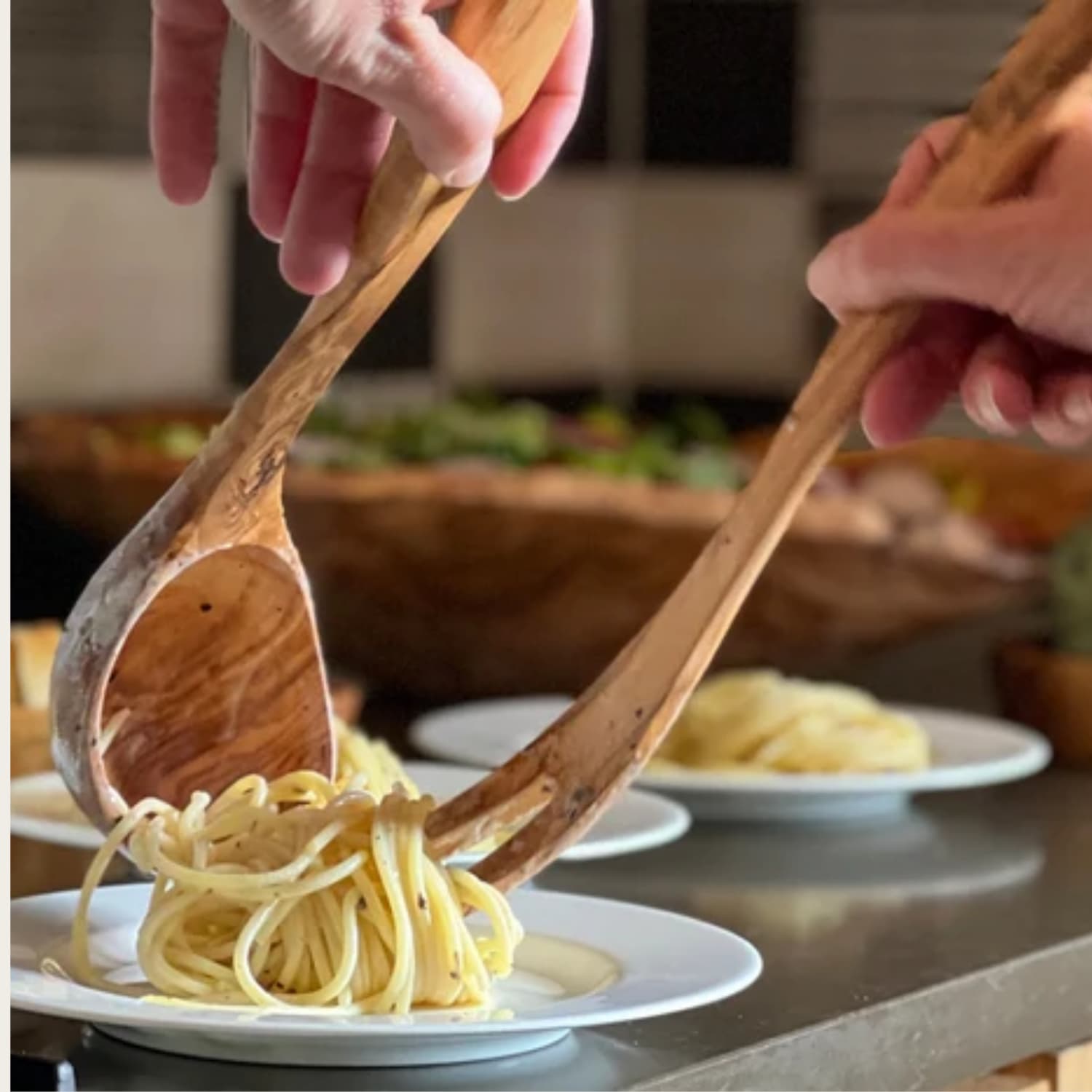
Single-piece Italian olivewood, hand-carved in Umbria
$$
Verve Culture hand-carves this ladle from a single piece of sustainably sourced Italian olivewood in Umbria, with an oil finish and no stain.
A women-owned company, Verve Culture works with artisan partners in Italy on every piece. Olivewood is the densest common kitchen wood, with a tight swirling grain that resists water, and a deep bowl that makes this ladle a beautiful way to serve soups and sauces.
Wood
Olivewood
✓ Plastic FreeFinish
Food-Safe Oil
✓ Plastic FreeBuild
Single Piece
✓ Plastic FreeOrigin
Made in Italy
✓ Plastic FreePros
- Single-piece pure Italian olivewood
- Very dense and water-resistant
- Women-owned, artisan-made
- Safe on coated pans
Cons
- Olivewood can be brittle if dropped
- EarthHero shipping to factor in
The artisan olivewood piece, as pretty as it is useful. A ladle you will want on the counter.
What to Look For in Wooden Cooking Utensils
Look for a named, dense hardwood like maple, walnut, or teak, a disclosed food-safe finish such as mineral oil or beeswax, and sound construction with no mystery glued seams. Those three things separate a lifetime utensil from a six-month one.
Wood Species Compared
Hardness is the single best predictor of how a wooden utensil ages. Denser woods dent less, absorb less liquid, and stain less. The Janka scale measures that hardness in pounds-force, and it is the quickest way to compare species.
| Wood | Janka hardness (lbf) | In the kitchen |
|---|---|---|
| Black cherry | 950 | Soft and gentle on coatings, warm grain, shows wear sooner |
| Black walnut | 1,010 | Rich dark grain, ages beautifully, heirloom looks |
| Teak | 1,155 | Naturally oily and water-resistant, great value hardwood |
| Birch | about 1,260 | Mid density, affordable, keep it well oiled |
| Beech | 1,300 | Common and affordable, must stay oiled or it grays |
| Bamboo (natural) | 1,380 | Technically a grass, light and gentle, check that it is glue-free |
| Hard maple | 1,450 | The food-safe standard, dense and closed-grain |
| Olivewood | about 2,700 | Densest common kitchen wood, water-resistant, can be brittle |
Heat is rarely the deciding factor. Any of these woods handles the heat of normal stovetop cooking without trouble, since wood does not begin to char until it is well past the temperature of a simmering pot. The one rule is to keep a wooden tool moving and not leave it resting in a dry, ripping-hot pan.
❌ Finishes to Avoid
- Mystery lacquers and varnishes: hard clear coatings can chip and end up in your food, and cheap ones are not food-rated.
- Chemical wood stains and dyes: color that is not the wood’s own means a coating you did not ask for.
- “Food-safe” with no detail: if the maker will not name the finish, treat the claim as marketing.
- Fragranced or scented oils: a lemon or “natural” scent can hide the actual oil used.
✅ Finishes to Trust
- Food-grade mineral oil: inert, never goes rancid, the industry standard for kitchen wood.
- Beeswax or carnauba blends: natural waxes that add water resistance over mineral oil.
- Walnut or other drying oils: food-safe and durable, though note the tree-nut allergy point.
- Raw, unfinished hardwood: perfectly fine if you season it yourself with mineral oil.
One-Piece vs Glued Construction
A single carved utensil has no seam to fail and no adhesive at all, which is why the hero picks here are one-piece tools. Laminated and glued products, some bamboo and many multi-wood sets, depend on an adhesive to hold together, and cheap imports sometimes use formaldehyde-based resins that are never disclosed. Bambu is the exception that proves the rule, since it is bamboo but explicitly made without glue. If you buy a glued or laminated piece, choose a maker who names the adhesive as food-safe, and look for FSC certification and a formaldehyde-free claim.
Handle Length and Weight
A longer handle keeps your hand away from a hot pan and gives leverage for stirring thick batters, while a shorter one has more control for delicate work. Weight is personal, since a dense walnut or maple tool feels substantial and a bamboo one feels light. Hold a few if you can, because the one that feels right in your hand is the one you will actually reach for.
Wooden Utensils and Food Safety
Wooden cooking utensils are safe, and research suggests wood is at least as hygienic as plastic. In UC Davis studies, bacteria placed on wood surfaces could not be recovered and gradually died, while knife-scarred plastic stayed contaminated even after cleaning.
The old worry is that wood is porous and traps germs. Food microbiologist Dean Cliver at UC Davis tested that with Salmonella, E. coli O157:H7, Listeria, Campylobacter, and Staph. On wood, the bacteria quickly disappeared from the surface, moved down into the wood, and died there without multiplying, so they could not be recovered even minutes after being applied. New plastic cleaned up fine, but once plastic was knife-scarred the way real cutting surfaces get, it became nearly impossible to clean by hand, and more bacteria survived on used plastic than on used wood.
For utensils, which spend far less time against raw meat than a cutting board does, the takeaway is simple. A washed, dried, well-oiled wooden spoon is a safe tool. The real risks are letting wood sit wet, which invites cracking and surface mold, and buying a piece with an undisclosed finish, not the wood itself.
💫 now you know
What “porous” really means for wood
Wood’s structure pulls moisture and bacteria below the surface, where they dry out and die instead of sitting on top waiting to transfer. That is the opposite of the sponge people imagine.
How to Care for Wooden Utensils So They Last a Decade
To make wooden cooking utensils last, hand wash them in warm soapy water, dry them flat right away, and rub in food-grade mineral oil about once a month or whenever the wood looks dry. Never put them in the dishwasher.
🧼 Handwashing Rules
Wash by hand with warm water and a little dish soap, rinse, and dry with a towel rather than letting the piece air-dry in a wet sink. Keep the dishwasher out of it entirely, because the long soak plus the heat is what splits and warps wood, and it is the single fastest way to ruin a good utensil. Leaving a wooden tool soaking in the sink does the same damage.
🗓️ The Oiling Schedule
Wood dries out with use and washing, and a dry utensil is one on its way to cracking. About once a month, or any time the wood looks pale, gray, or fuzzy, warm a little food-grade mineral oil, rub it in with a cloth, let it sit an hour or overnight, then wipe off the excess. A beeswax-and-mineral-oil blend adds extra water resistance if you want it. Denser woods need this less often; softer beech and birch need it a little more.
⚠️ When to Retire a Utensil
Even a well-loved wooden tool eventually wears out. Retire it when you see a crack that runs through the piece, splinters that will not sand smooth, a surface that stays fuzzy or soft after oiling, or a deep stain and smell that washing will not lift. A cracked utensil can harbor bacteria in the split, so that is the clear signal to replace it.
Wooden Utensils We Do Not Recommend
Skip any wooden utensil that will not name its wood species or finish, glued bamboo and multi-wood sets with undisclosed adhesive, and brightly painted or thickly lacquered tools. Undisclosed materials are the whole problem.
The bargain bin is full of “natural wooden” sets that never say what the wood is or what coats it, and that silence is the tell. The specific ones to leave on the shelf: unlabeled sets that list “wood” with no species and no finish detail; bamboo utensils bonded with an adhesive the seller will not identify, since cheap imports can use formaldehyde-based resin; and brightly painted or heavily lacquered tools where a coating you cannot verify sits between the wood and your food.
Sets that glue a silicone head into a wooden handle and market the whole thing as “wood” belong here too. If you are tempted by one of these, the better swap is a named-wood tool from a maker who discloses its sourcing, such as the Earlywood, Bambu, or Caraway picks above.
FAQs About Wooden Cooking Utensils
No. The prolonged soak and high heat of a dishwasher cycle warp, crack, and split wood. Hand wash in warm soapy water and dry flat right away.
Wash by hand with warm water and dish soap, rinse, and towel dry. For a deeper clean, scrub with coarse salt and a cut lemon, then rinse and re-oil.
Food-grade mineral oil is the standard because it is inert and never goes rancid. A beeswax and mineral oil blend adds water resistance. Avoid edible cooking oils like olive or vegetable oil, which turn rancid.
A well-cared-for hardwood utensil lasts many years. Replace it when it cracks through, splinters, stays fuzzy after oiling, or holds a stain and smell that will not wash out.
Dense, closed-grain hardwoods like hard maple, walnut, and teak are the best all-around choices because they resist staining, warping, and water. Cherry, beech, and birch are softer and gentler but wear sooner.
Yes, and they are one of the safest choices for coated pans. Wood will not scratch a nonstick or ceramic surface the way metal utensils do. Choose a thin, smooth-edged spoon or turner for the best results.
It is not necessary and not a good idea. Boiling saturates the wood and can cause cracking. Normal hand washing plus the occasional salt-and-lemon scrub is enough.
Wood cracks when it dries out or goes through repeated wet-and-dry cycles, like a dishwasher. Prevent it by hand washing, drying flat, and re-oiling regularly so the wood never fully dries out.
Final Thoughts About Wooden Cooking Utensils
The best wooden cooking utensils are the honest ones, a named hardwood with a finish you could eat off, cared for with a monthly rub of mineral oil.
For a non-toxic kitchen, a good wooden utensil is a quietly excellent choice: no coating to scratch, no plastic to shed, and, contrary to the old myth, a surface that handles bacteria at least as well as plastic. Spend a little more on a tool from a maker who tells you the wood and the finish, keep it out of the dishwasher, and oil it now and then, and it will outlast every plastic utensil you have ever thrown away. Start with one good spoon or the Earlywood spatula, and build from there.
📚 References
- Ak, N. O., Cliver, D. O., & Kaspar, C. W. (1994). Cutting boards of plastic and wood contaminated experimentally with bacteria. Journal of Food Protection, 57(1), 16–22. https://doi.org/10.4315/0362-028X-57.1.16
- Cliver, D. O. (n.d.). Plastic and wooden cutting boards. University of California, Davis, Food Safety Laboratory. https://faculty.vetmed.ucdavis.edu/faculty/docliver/Research/cuttingboard.htm
- Forest Stewardship Council. (n.d.). FSC certification. https://us.fsc.org/get-certified/certification
- The Wood Database. (n.d.). Janka hardness. https://www.wood-database.com/wood-articles/janka-hardness/