
Key Takeaways
- Washing soda measures around pH 11.4 while baking soda sits near pH 8.3, which is why baking soda recipes never cut grease the way people expect.
- The best homemade dish soap for hard water uses Sal Suds instead of castile, because true soap reacts with hard-water minerals and leaves a film on glasses.
- Castile-based homemade dish soap costs more per ounce than a bottle of ECOS, so the honest reason to make it is ingredient control and less plastic, not savings.
Almost every homemade dish soap recipe on the internet has the same two problems. Half of them tell you to stir vinegar into castile soap, which curdles it. The other half leans on baking soda, which has a pH of around 8.3 and simply isn’t alkaline enough to break down cooking grease.
The best homemade dish soap combines 1 cup liquid castile soap, 1 cup hot distilled water, 1 tablespoon washing soda, and 1 teaspoon vegetable glycerin. That blend lifts grease, rinses without film in soft water, and skips the preservatives and synthetic fragrance in a conventional bottle. Below you get four recipes, the chemistry behind why the popular ones fail, a real cost comparison, and an honest section on when buying beats making.
The Experts Behind the Research
- Lisa Bronner, third-generation Dr. Bronner’s family member and author of the company’s official dilution guides, whose published guidance on why vinegar breaks down true soap shapes the ingredient rules in this article
- Alina Kunicka-Styczynska, PhD, food and cosmetic microbiologist at Lodz University of Technology, whose 2009 Journal of Applied Microbiology study on lavender, tea tree, and lemon oils is cited here for what essential oils can and cannot do
Why make your own dish soap?
Making your own dish soap gives you control over every ingredient, removes the preservatives and undisclosed fragrance blends found in conventional formulas, and cuts one more plastic bottle out of your kitchen. Homemade dish soap will not out-clean a commercial detergent on baked-on grease, and it rarely saves money, so ingredient control is the real payoff.
Three reasons hold up once you look at what is actually in a standard bottle.
🖐️ What stays on your hands and dishes
Conventional dish soap needs a preservative to stay shelf-stable for years. Methylisothiazolinone is a common choice, and the Environmental Working Group flags it as a skin sensitizer linked to allergic contact dermatitis. Fragrance blends are the other issue, since a single word on the label can stand in for dozens of undisclosed components. Neither of those has to exist in a jar you mixed this morning.
🧪 What comes with the surfactant
Sodium laureth sulfate, or SLES, appears in many mainstream dish soaps. The ingredient itself is not the concern so much as the manufacturing process behind it, which can leave traces of 1,4-dioxane, a compound the EWG lists as a likely human carcinogen. Reformulation pressure has pushed those levels down in recent years, though the contamination is a byproduct rather than a listed ingredient, so the label will never tell you.
🌍 What the bottle itself costs the planet
A dish soap bottle is mostly water shipped in plastic. Refilling one glass or metal pump from a concentrate you dilute at home removes that bottle from your grocery run permanently. For anyone working through the kitchen sink one swap at a time, this is among the easiest places to start.
Don’t Miss: Non-Toxic Living: Where to Actually Start, Room by Room Dish soap is one bottle under the sink. Here is the room-by-room walkthrough for everything else. Read more →Save This Dish Soap Guide 📌
What to know before you start
Homemade dish soap needs a real surfactant to work, because water and baking soda alone cannot lift grease off a plate. Castile soap curdles when it meets vinegar or hard water, so households on hard water should build their recipe around Sal Suds instead.
Three pieces of chemistry decide whether your batch works or ends up in the drain. Reading them first will save you a wasted jar.
Surfactants do the actual cleaning
A surfactant is a molecule with a water-loving end and an oil-loving end. Grease will not dissolve in water on its own, so the surfactant grabs the grease at one end, holds onto the rinse water at the other, and carries the mess down the drain. Castile soap and Sal Suds both supply that molecule. Baking soda, vinegar, and lemon juice do not, which is why any recipe built only from pantry acids leaves a greasy film no matter how hard you scrub.
💫 now you know
What Saponification Means
Saponification is the reaction that turns fat into soap. Mix an oil with a strong alkali such as lye and the two rearrange into soap molecules plus glycerin. That reaction is why true soap is always alkaline, and it is also why an acid like vinegar can run it partway backwards and leave you with a curdled, oily mess.
Hard water changes which recipe you should pick
True soap reacts with the calcium and magnesium in hard water and forms soap scum, the same chalky residue that dulls a shower door. Dr. Bronner’s says this plainly in its own guidance, noting that soap binds well with oils on the body but can react with hard-water minerals and leave residue on surfaces.
The USGS classifies water at 121 mg/L or higher as hard, and much of the Midwest, Southwest, and Great Plains falls well past that threshold. Check the USGS hardness map before you choose, since a castile recipe that performs beautifully in Seattle can leave spotted glassware in Phoenix.
Set realistic expectations
Commercial dish detergent contains enzymes that digest protein and starch, plus foam boosters engineered in a lab. Nothing you mix at home will match that on a lasagna pan. What homemade dish soap does well is everyday dishes, glassware, and light grease. Soak the hard stuff first and you will not notice the gap.
Core ingredients explained
Homemade dish soap relies on six ingredients: liquid castile soap or Sal Suds as the surfactant, washing soda as the grease-cutting alkali, glycerin for slip, salt or xanthan gum to thicken, distilled water as the base, and essential oils for scent only.
Liquid castile soap
Castile soap is a true soap made by saponifying plant oils, most often coconut, olive, and hemp. Dr. Bronner’s is the reference brand, and its official cheat sheet recommends pre-diluting 1 part soap to 10 parts water for handwashing dishes, or using 1 to 2 tablespoons in a full sink. Castile is gentle, biodegradable, and widely available, and it is the wrong pick if your water is hard.
Sal Suds, and why it is not castile
Sal Suds comes from the same company and gets confused with castile constantly, though the two are chemically unrelated. Dr. Bronner’s describes Sal Suds as a synthetic detergent built on plant-derived surfactants rather than a soap: sodium lauryl sulfate sourced from coconut and palm kernel oils, coco-betaine, sodium sulfate, citric acid, and fir and spruce essential oils. Because detergents do not react with mineral ions the way soap does, Sal Suds rinses clean in hard water. The company reports greater than 60% biodegradation after 28 days under ISO 14593 testing.
Washing soda versus baking soda
These two get swapped in recipes as though they were interchangeable, and the substitution is the single most common reason a batch fails. Sodium carbonate is what makes up washing soda, and a 1% solution has a pH of roughly 11.4. Baking soda is sodium bicarbonate, and the same solution has a pH between 8.0 and 8.6. Alkalinity is what saponifies grease on contact, so that gap decides whether your soap cuts through bacon fat or slides over it. Wear gloves when handling washing soda directly, as it is caustic in undiluted form.
White vinegar, and when to keep it away from castile
Vinegar earns its reputation on mineral deposits and hard-water spots. Stirring it into castile soap ruins both. Lisa Bronner explains that vinegar unsaponifies the soap, breaking the molecule back into fatty acids and leaving a whitish, curdled, oily mess. Use vinegar sequentially instead: wash with soap, rinse fully, then dip glassware in water with a splash of vinegar for a spot-free finish.
Essential oils are for scent, not sanitizing
Lemon and tea tree oils do have measurable antimicrobial activity in a lab. In the Kunicka-Styczynska study, tea tree and lavender oils each needed a 0.5% concentration, and even then worked best alongside a conventional preservative rather than in place of one. A dozen drops in a 16 oz jar lands nowhere near that. Add them because you like the smell, then let hot water and the surfactant do the sanitizing work.
Glycerin, salt, and thickeners
Homemade dish soap runs thin, and thin feels wrong in your hand even when it cleans perfectly. Vegetable glycerin adds slip and softens the effect on skin. A pinch of salt dissolved in warm water thickens detergent-based blends, though it does very little for castile. Xanthan gum works on both, and 1/8 teaspoon per cup is plenty, since more turns the mixture slimy.
4 Homemade Dish Soap Recipes
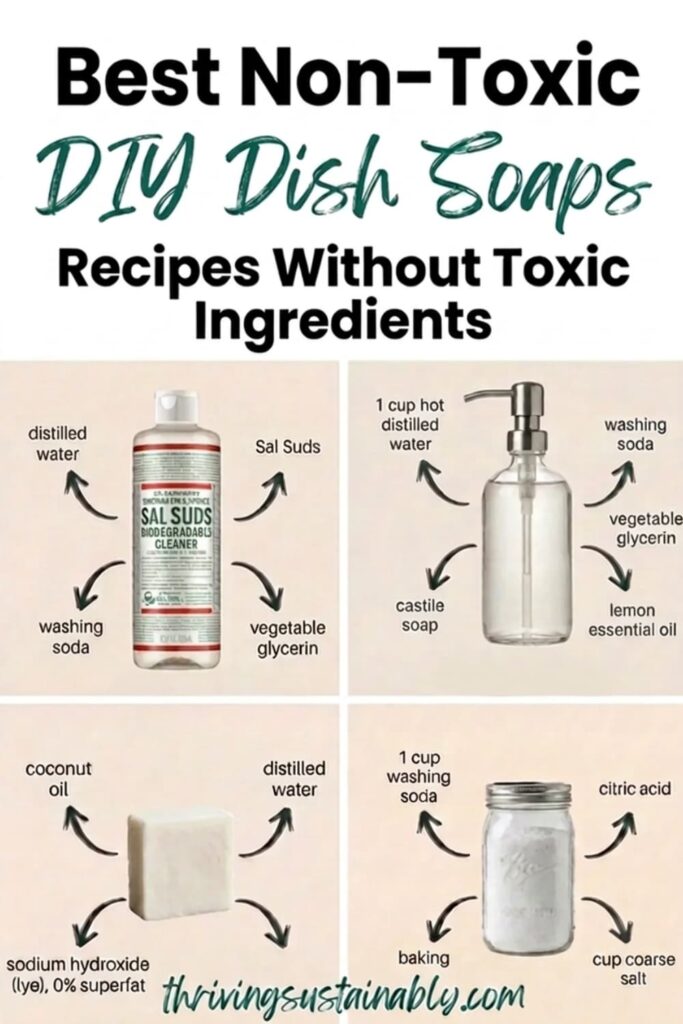
These four homemade dish soap recipes cover every setup: a castile blend for soft water, a Sal Suds blend for hard water, a coconut oil bar for zero packaging, and a citric acid powder for the dishwasher. Start with the one that matches your water and your sink.
Recipe 1: 3-ingredient liquid dish soap
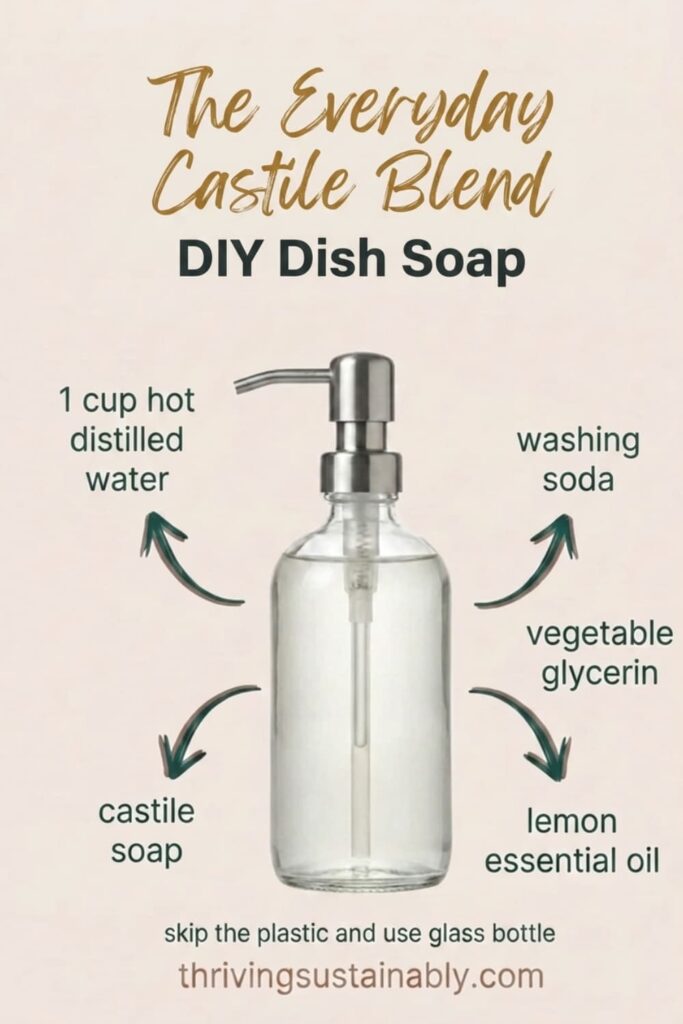
This is the one to make first. It handles daily plates, mugs, and glassware, and it takes about five minutes start to finish.
- 1 cup hot distilled water
- 1 tablespoon washing soda
- 1 cup liquid castile soap
- 1 teaspoon vegetable glycerin
- 15 drops lemon essential oil (optional)
Dissolve the washing soda in the hot water first and let it cool to room temperature, because pouring hot liquid onto castile makes it foam over.
Stir in the castile soap slowly with a spoon rather than shaking, then add the glycerin and oil. Pour into a glass pump bottle and give it a gentle swirl before each use.
Recipe 2: Grease-cutting Sal Suds blend
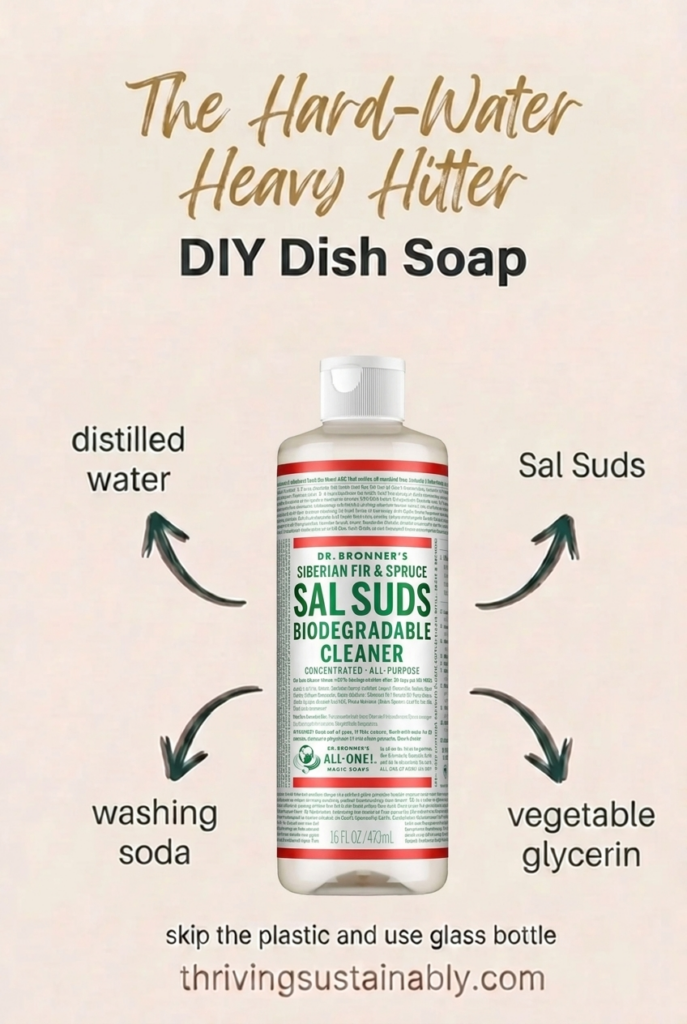
Reach for this one if your glasses come out cloudy, if you cook with a lot of oil, or if you live anywhere with hard water.
- 2 cups distilled water
- 2 tablespoons Sal Suds
- 1 teaspoon washing soda
- 1/2 teaspoon vegetable glycerin (optional)
Dissolve the washing soda in warm water, let it cool, then stir in the Sal Suds gently to avoid whipping up foam. Store in a glass pump bottle.
Sal Suds is concentrated enough that Dr. Bronner’s calls for as little as half a teaspoon in a full sink, so resist the urge to use more.
✨ tip
A Little Goes A Long Way
Dr. Bronner’s puts dishwashing at 1/2 to 1 1/2 teaspoons of Sal Suds in a large sink of water, or a single drop for one pot, which tells you how little you need. Diluting it into a pump bottle mostly makes portioning easier. One caution worth repeating: Sal Suds is a strong degreaser, so wear gloves if your hands run dry, and keep it off wool and silk.
Recipe 3: 100% coconut oil dish bar (advanced)
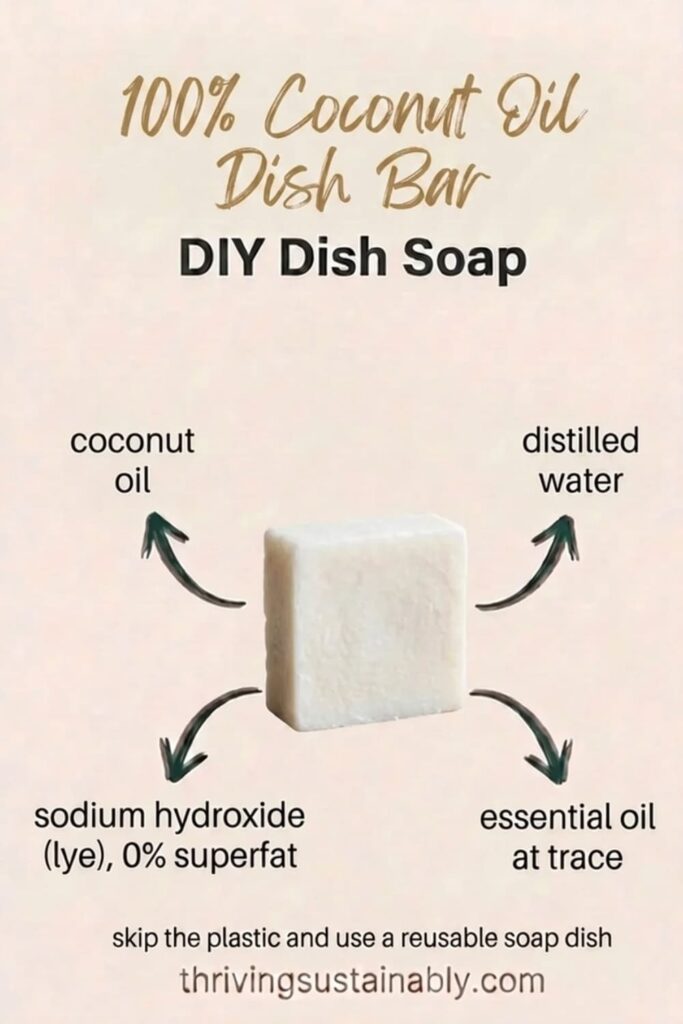
A solid bar is the zero-packaging option, and it is genuinely advanced. Attempt it only after you have read a full cold process tutorial.
- 16 oz (454 g) coconut oil
- 83 g sodium hydroxide (lye), 0% superfat
- 166 g distilled water
- 1/2 oz essential oil at trace (optional)
Add the lye to the water, never water to lye, and stir in a ventilated space until clear. Cool both the lye solution and the melted coconut oil to about 100°F, combine, and blend to a light trace.
Pour into a mold, cover, unmold after 24 hours, then cure for four to six weeks before use.
Zero superfat matters here. Superfatting leaves unreacted oil in the bar, which is lovely on skin and counterproductive on a greasy plate. If you would rather not handle lye at all, that is a reasonable call, and a bought bar is covered further down.
✨ tip
Run Your Own Lye Numbers
Never scale a lye recipe by hand. Put your exact oil weights through a soap calculator such as SoapCalc or Bramble Berry’s, and confirm the result before you mix. The Handcrafted Soap and Cosmetic Guild recommends goggles, gloves, and a heat-resistant glass or stainless steel container, never aluminum, which reacts with lye to release hydrogen gas.
Recipe 4: Citric acid dishwasher powder
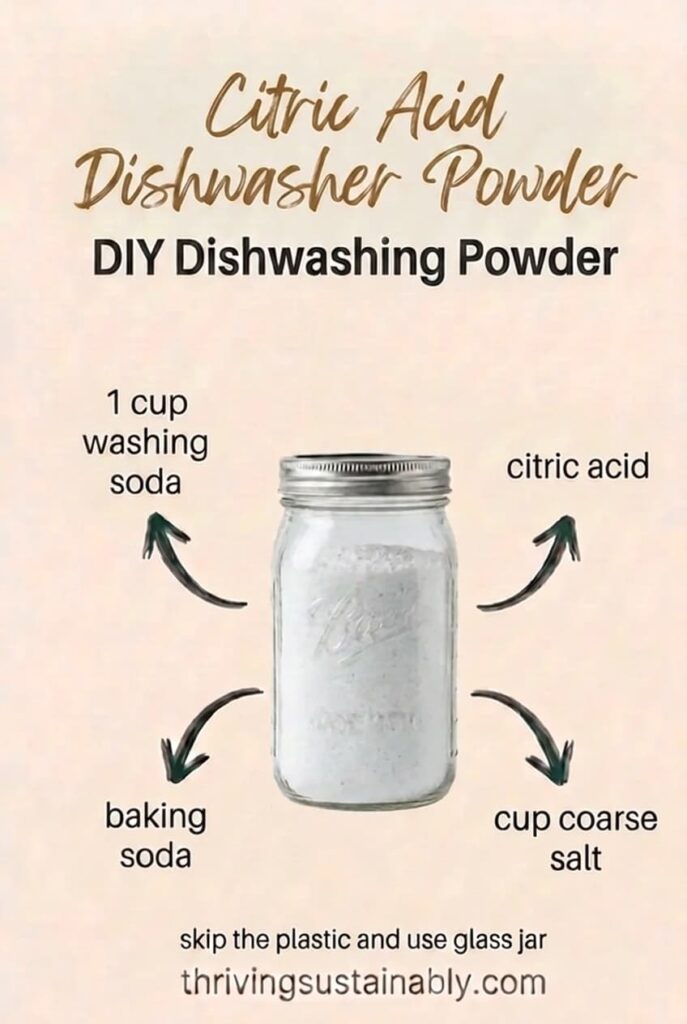
A bonus recipe for the machine, since the dishwasher is where most people ask about DIY next. This one skips borax entirely.
- 1 cup washing soda
- 1 cup citric acid
- 1/2 cup baking soda
- 1/2 cup coarse salt
Whisk everything in a dry bowl and store in a sealed glass jar with a tight lid, because citric acid pulls moisture from the air and the mix will clump.
Use 1 tablespoon in the detergent cup per load, and fill the rinse aid compartment with white vinegar.
Citric acid is doing the heavy lifting in this blend. Commercial tablets rely on it to strip the mineral film that makes glassware look foggy, and it is the reason this powder outperforms the old washing-soda-and-borax formulas. Homemade powder has no enzymes, so scrape plates well and skip the pots.
How to store homemade dish soap and how long it lasts
Homemade dish soap keeps for about one month in a sealed glass pump bottle stored away from heat and direct sun. Liquid recipes contain no preservative, so make 16 oz batches rather than gallons, and discard any batch that smells sour or looks cloudy.
Glass is the better container for two reasons. Essential oils degrade some plastics over time, and a glass pump keeps one more plastic bottle out of the cycle. Label the bottle with the recipe and the date you mixed it, which sounds fussy until you have three unlabeled jars under the sink.
Separation is normal and not a sign of spoilage. Castile blends often settle into layers within a few days, and a gentle swirl brings them back together. Shaking hard just fills the bottle with foam. Dishwasher powder is the exception on shelf life, since it stays good for months as long as it stays completely dry.
Troubleshooting homemade dish soap
Homemade dish soap usually fails for four reasons: vinegar or lemon juice curdled the castile, hard water reacted with the soap and left film, the recipe used baking soda instead of washing soda, or the mixture was over-diluted. Switching to Sal Suds solves the first two at once.
Why is mine not sudsy?
Suds and cleaning power are different things, and castile has never been a big foamer. Real thinness usually means too much water. Cut the water by a quarter and see whether it improves. If your batch went from foamy to flat overnight, an acidic ingredient is the likely culprit.
Why did it turn into a solid gel?
Salt is almost always the answer. Adding salt to a castile blend seizes it into a rubbery gel rather than thickening it smoothly, since true soap and detergent respond to salt in opposite ways. Warm water and patient stirring can rescue a mild case. Badly gelled batches are easier to remake.
Why is there a white film on my dishes?
Soap scum means your water is hard. The film is calcium and magnesium bound to the soap, which is exactly the reaction Dr. Bronner’s warns about. Two fixes work: rinse dishes in water with a splash of vinegar after washing, or rebuild your recipe around Sal Suds so the reaction never happens.
How do I fix weak grease cutting?
Check your washing soda first, since a lot of people reach for the orange baking soda box by mistake. Wash in genuinely hot water, because heat softens grease before the surfactant ever touches it. Failing both, move to Recipe 2, which was built for exactly this problem.
Cost comparison: homemade versus store-bought
Homemade dish soap made with Sal Suds costs roughly $0.04 per ounce, while the castile version runs about $0.28 per ounce, more than a bottle of ECOS at $0.18. Making your own saves money only when the recipe starts from a concentrated detergent.
This is the part most DIY posts skip, and it changes the recommendation. Prices below were checked in July 2026 using each brand’s own listing.
| Option | What you buy | Cost per oz of finished soap | Plastic per refill |
|---|---|---|---|
| Recipe 2, Sal Suds blend | Sal Suds 32 oz, $16.99 | About $0.04 | 1 bottle per 34 batches |
| ECOS liquid dish soap | 25 oz bottle, about $4.47 | About $0.18 | 1 bottle per 25 oz |
| Recipe 1, castile blend | Castile 32 oz, $17.19 | About $0.28 | 1 bottle per 4 batches |
| Blueland powder refill | 16 oz pouch, about $9.60 | About $0.30 | None, compostable pouch |
Read the table honestly and the conclusion is uncomfortable for DIY purists. Castile-based homemade dish soap is the most expensive liquid option on this list. Sal Suds is far and away the cheapest, at roughly a fifth of what ECOS costs per ounce, and it also generates the least packaging waste since one 32 oz bottle makes about 34 batches.
When to skip DIY and buy instead
Buy dish soap instead of making it if you wash pots daily, if you cannot store small batches safely, or if you want third-party certification behind the ingredient list. Homemade dish soap has no preservative system and no enzymes, which are the two things heavy kitchen use most needs.
Three situations make buying the better choice.
❌ Skip DIY when
- You cook heavy meals nightly. Enzymes handle baked-on protein and starch, and no home recipe contains them.
- You want verified claims. A finished product can carry EWG Verified or MADE SAFE certification; your jar cannot.
- Small batches are not realistic. Preservative-free soap spoils, and a big batch mixed once a season will go off before you finish it.
✅ Make your own when
- Fragrance bothers you. Mixing your own removes undisclosed fragrance blends completely.
- You are cutting plastic. One concentrate bottle replacing dozens of dish soap bottles is a real reduction.
- Your dishes are everyday dishes. Plates, mugs, and glassware are exactly what these recipes handle well.
Whichever way you go, the ingredient list is what to judge, not the marketing on the front. Our Plastic Footprint Directory scores products on material and packaging rather than claims, and the same skepticism applies to anything labeled natural on a store shelf.
Don’t Miss: Best Plastic-Free Dishwasher Detergent Options Reviewed If the homemade powder is not cutting it, here are the vetted plastic-free options that are. Read more →FAQs About Homemade Dish Soap
Yes, as long as the recipe includes a real surfactant and washing soda rather than baking soda. Castile soap and Sal Suds both lift grease effectively on everyday dishes. Neither will match a commercial detergent on baked-on food, because home recipes contain no enzymes.
Liquid dish soap of any kind should never go in a dishwasher. Manufacturers including Whirlpool warn that handwashing soap generates suds the machine has no de-sudsing agents to control, which can push water out and damage the pump. Use the citric acid powder in Recipe 4 instead.
Plan on about one month for liquid recipes, since they contain no preservative. Store the bottle out of direct sun and away from the wet edge of the sink. Discard any batch that smells sour, looks cloudy, or develops visible growth.
Cast iron tolerates a small amount of mild soap, though the washing soda in these recipes is alkaline enough to strip seasoning with repeated use, so save it for occasional deep cleans. Non-stick coatings do better with the diluted castile version and a soft cloth. Skip Sal Suds on both, since it degreases aggressively.
Not at the amounts used in these recipes. Published testing found tea tree and lavender oils needed roughly 0.5% concentrations to show meaningful antimicrobial activity, and even then worked best alongside a conventional preservative. Add essential oils for scent, and rely on hot water and the surfactant for cleaning.
Final Thoughts About Homemade Dish Soap
Start with the Sal Suds blend in Recipe 2. It costs the least per ounce, works in any water hardness, generates the least packaging waste, and avoids the curdling problem that ruins most castile recipes.
Make one 16 oz batch, use it for two weeks, and judge it on your own dishes rather than on a promise. Keep vinegar in the cabinet for rinsing rather than mixing. Once you see that four pantry ingredients and a glass pump handle the daily load, the plastic bottle stops earning its place under your sink.
📚 References
- Bronner, L. (n.d.). A word of caution about vinegar and castile soap. Going Green with Lisa Bronner. https://www.lisabronner.com/a-word-of-caution-about-vinegar-and-castile-soap/
- Bronner, L. (2022). Dilutions cheat sheet: Pure-castile liquid soap. Dr. Bronner’s. https://info.drbronner.com/wp-content/uploads/2023/02/Castile-Dilution-Cheat-Sheet-52022.pdf
- Dr. Bronner’s. (n.d.). Sal Suds dilutions cheat sheet. https://www.drbronner.com/pages/sal-suds-all-purpose-cleaner-dilutions-cheat-sheet
- Dr. Bronner’s. (n.d.). The science of Sal Suds: Understanding its biodegradable ingredients. https://www.drbronner.com/pages/sal-suds-ingredients
- Environmental Working Group. (n.d.). 1,4-Dioxane. EWG’s Guide to Healthy Cleaning. https://www.ewg.org/cleaners/substances/16663-14DIOXANE/
- Environmental Working Group. (n.d.). Methylisothiazolinone. EWG’s Guide to Healthy Cleaning. https://www.ewg.org/cleaners/substances/3596-METHYLISOTHIAZOLINONE/
- Handcrafted Soap & Cosmetic Guild. (n.d.). How to make cold process soap. https://www.soapguild.org/tools-and-resources/resource-center/42/make-cp-soap/
- Kunicka-Styczyńska, A., Sikora, M., & Kalemba, D. (2009). Antimicrobial activity of lavender, tea tree and lemon oils in cosmetic preservative systems. Journal of Applied Microbiology, 107(6), 1903-1911. https://doi.org/10.1111/j.1365-2672.2009.04372.x
- U.S. Geological Survey. (n.d.). Hardness of water. Water Science School. https://www.usgs.gov/water-science-school/science/hardness-water
- Whirlpool. (n.d.). Can you put dish soap in the dishwasher? https://www.whirlpool.com/blog/kitchen/can-you-put-dish-soap-in-dishwasher.html
More Non-Toxic Cleaning Reads
We’ve scored every cleaning product on plastic — see them in the Cleaning directory.