
Key Takeaways
- The best cloth diapers use OEKO-TEX or GOTS-certified organic cotton, hemp, or wool, and skip the cheap polyester ones sold as “eco” in big box stores.
- A full cloth stash costs $400 to $700 upfront and saves $1,000 to $2,000 per child compared to disposables, with even bigger savings for second and third babies.
- Top picks for 2026: Esembly (best overall), Smart Bottoms (best all-in-one), EcoAble (best overnight), and OsoCozy or Green Mountain (best budget).
If you’ve been searching for the best cloth diapers, you’ve already done the hard part of asking the right question. The honest answer is that most “eco” diapers in big box stores are often mass-produced, cheap polyester from factories with zero transparency, and most of the brands that pop up in roundup articles are paid placements. This guide is different. It’s eight sustainable cloth diaper brands that pass real ingredient and sourcing tests, ranked by what they’re actually best for.
Disposable diapers add roughly 4.1 million tons of waste to US landfills every year, per the EPA’s most recent Municipal Solid Waste report, and a single disposable diaper can take an estimated 500 years to break down. It’s hard to wrap my head around the fact that every disposable diaper my son ever wore is probably still sitting in a landfill somewhere. The catch is that not every cloth diaper is made of clean materials, and not every brand is honest about what’s inside. The 8 picks below are the ones we’d actually put on a baby.
What Are Cloth Diapers?
Cloth diapers are reusable baby diapers made from natural or synthetic fabric that can be washed and worn hundreds of times, replacing single-use disposables and dramatically cutting landfill waste over a baby’s diapering years.
Cloth diapers are exactly what the name suggests, fabric-based diapers you wash and reuse instead of throwing away. Modern cloth has come a long way from the flat squares and safety pins your grandmother used. Today’s cloth diapers come in fitted shapes with snaps or hook-and-loop closures, waterproof outer layers, absorbent cores, and inserts you can swap out as your baby grows.
The category covers a wide range of styles, from one-piece designs that work as easily as a disposable to layered systems where you mix and match a cover with separate inserts. The best cloth diapers also use clean materials. That means organic cotton, hemp, bamboo viscose, or wool for the parts that touch baby’s skin, and recycled polyester (rPET) or polyurethane laminate (PUL) for the waterproof outer.
Cloth diapers can last through one baby or three or four, depending on how well they’re cared for. That’s the part that makes the math work for both your wallet and the planet.
Why Switch to Cloth Diapers?
Switching to cloth diapers reduces landfill waste, cuts diapering costs by $1,000 to $2,000 per child, and removes the chemical residues like dioxins, fragrance, and lotion compounds that single-use diapers leave on a baby’s skin.
The case for cloth comes down to four things: waste, cost, baby’s skin, and what disposables don’t put on the label. Each one is a real reason on its own, and most cloth families come for one and stay for the rest.
✅ The Waste Problem With Disposable Diapers
Disposable diapers are the third-largest single consumer item in US landfills. The EPA’s 2018 Municipal Solid Waste report (the most recent year with full product-specific data) put disposable diaper generation at 4.1 million tons, or 1.4 percent of total municipal solid waste, with no significant recycling or composting recorded. Industry estimates suggest US households throw away around 27 billion disposable diapers per year. A single baby in disposables generates roughly 6,000 to 8,000 used diapers from birth to potty training.
Decomposition timing is harder to pin down because disposable diapers in their current plastic-heavy form have only existed since the 1960s, but conservative estimates put it at around 500 years. The plastic outer shell, the superabsorbent polymer (SAP) core, and the synthetic top sheet all break apart at different rates, and most of what’s left is still buried in landfills today.
Cloth diapers don’t solve the waste problem perfectly (you still wash them, which uses water and energy), but life-cycle studies consistently show that cloth has a smaller overall footprint when reused for one or more children.
✅ The Cost Difference Is Significant
A baby in disposables runs roughly $2,200 to $3,000 from birth to potty training, depending on the brand and how long it takes. A complete cloth diaper stash, including covers, inserts, wet bags, and accessories, costs $400 to $700 upfront. Add about $150 to $250 per year in extra water, energy, and detergent, and you’re still saving $1,000 to $2,000 over a single child.
The real magic shows up with a second or third baby. Cloth diapers can be reused across siblings, and a stash that lasted through baby one will usually last through baby two with very little new purchasing. That pushes total household savings to $3,000 to $4,500 for two kids, even higher for three.
✅ What’s Actually in a Disposable Diaper
Most parents never read what’s inside a disposable. A typical store-brand diaper contains polypropylene, polyethylene, sodium polyacrylate (the gel that swells when wet), wood pulp bleached with chlorine dioxide (which can leave dioxin residue), adhesives, and undisclosed fragrance compounds in the scented versions. Brands like Honest, Coterie, and Hello Bello have cleaned up the worst of this list, but even the cleanest disposable still uses a synthetic plastic shell against baby’s skin.
Cloth diapers made from organic cotton, hemp, or wool put a soft, natural fiber against a baby’s bottom for the first two to three years of their life, full stop. That’s the swap most parents notice first when they make the switch.
✅ Fewer Diaper Rashes
Cloth-diapered babies tend to get fewer diaper rashes than disposable-diapered babies, and most parents notice the difference within a few weeks of switching. Two factors are at play. First, clothes change more often (because you can feel them getting wet faster), which means less time sitting in moisture. Second, cloth doesn’t carry the fragrance, lotion, and adhesive residues that some sensitive babies react to in disposables.
That said, cloth isn’t a magic cure for rashes. Detergent buildup, ammonia from old urine in the fabric, or a yeast infection can all cause rash in cloth, too. The wash routine matters as much as the diaper itself, which we cover further down.
How Much Plastic Is Hiding in a Single Disposable Diaper?
A single disposable diaper contains roughly 30 to 50 grams of plastic, including polypropylene, polyethylene, and a superabsorbent polyacrylate gel that sits directly against the baby’s skin and sheds microplastics throughout the diaper’s life and long after it hits the landfill.
Most parents have heard the line that “disposable diapers are bad for the planet.” Far fewer have heard the specific number behind that headline. A modern disposable diaper is roughly half plastic by weight, and that plastic doesn’t stop being plastic when you throw it away. It also doesn’t stop touching your baby while it’s on.
What’s Actually Plastic in a Disposable Diaper
Industry estimates put the typical disposable diaper at around 30 to 50 grams of plastic. That plastic is split across several layers:
- Polypropylene in the outer shell and the inner top sheet that touches the baby
- Polyethylene in the waterproof back sheet
- Sodium polyacrylate (SAP) is the gel that swells when wet
- Adhesives holding the layers together
- Polyester or polypropylene in the elastic, tabs, and leg cuffs
A baby in disposables uses roughly 6,000 to 8,000 diapers from birth to potty training. Multiply that by 30 to 50 grams of plastic per diaper, and one baby’s diapering window generates 180 to 400 kilograms of plastic waste, the weight of a full-grown adult, in under three years. None of it biodegrades on any reasonable human timeline.
The Microplastics Problem Most Parents Don’t Hear About
Disposables don’t just contain plastic. They shed it. Wear and tear during normal use, friction against the skin, and slow breakdown in landfills all release microplastic particles into the environment and into babies’ day-to-day surroundings.
A 2021 study published in Environmental Science & Technology Letters by Zhang and colleagues at NYU School of Medicine and the New York State Department of Health analyzed stool samples from 6 infants and 10 adults. They found that infants had roughly 10 times more polyethylene terephthalate (PET) microplastics in their stool than adults, at an average concentration of 36,000 nanograms per gram. The study traced the exposure to the everyday surfaces babies touch most: bottles, sippy cups, toys, and disposable diapers.
Disposables aren’t the only source of microplastic exposure for babies, and the study didn’t specifically isolate diapers. But they are among the largest plastic-to-skin contact points in a baby’s first three years. A baby in disposables spends roughly 25,000 hours with their bottom resting against a layer of polypropylene and polyacrylate gel.
The 5 Types of Cloth Diapers
The five types of cloth diapers are all-in-one (AIO), pocket, prefold or flat, hybrid or all-in-two (AI2), and fitted, each balancing convenience, absorbency, and cost differently.
Cloth diapers come in five main styles, and the best one for your family depends on how you want to balance ease, absorbency, drying time, and budget. Most cloth families end up using a mix of two or three styles, not just one. Here’s a quick side-by-side, then a closer look at each one.
All-in-One (AIO)
An all-in-one is the closest cloth equivalent to a disposable. The waterproof outer, absorbent core, and inner liner are sewn together into a single piece. You put it on, snap it shut, and you’re done.
AIOs are the easiest cloth diapers to use, especially for daycare, grandparents, or partners who haven’t cloth diapered before. The trade-off is drying time. Because the absorbent layer is permanently attached, AIOs take longer to dry than systems that let you pull the insert out. They’re also the most expensive cloth diaper per piece.
Best for: parents who want the simplest possible cloth experience, daycare-friendly bags, and anyone who values quick changes over budget.
Pocket Diapers
A pocket diaper has a waterproof outer layer and a soft inner layer (usually fleece or microfleece), creating a pocket between the two. You stuff your absorbent insert (cotton, hemp, bamboo, or microfiber) into the pocket before putting the diaper on the baby.
Pockets give you the most flexibility in absorbency. You can stuff one insert for a daytime change or double up for nighttime. The whole system also dries faster than an AIO because you take the wet insert out before washing. The downside is the extra step of stuffing each diaper after the wash.
Best for: customizable absorbency, fast wash-and-dry cycles, and households that want one diaper to handle daytime and nighttime needs.
Prefold and Flat Diapers
Prefolds and flats are the simplest, oldest, and cheapest form of cloth diaper. A prefold is a rectangular piece of cotton or hemp fabric with extra layers sewn into the middle for absorbency. A flat is a single large square of fabric that you fold yourself.
You secure either one onto the baby with a Snappi, Boingo, or pins, then put a waterproof cover over the top. Prefolds dry in a fraction of the time AIOs and pockets need (they’re just one layer of fabric), and they cost roughly $2 to $5 per prefold versus $20 to $30 for an AIO.
Best for: budget builds, fast drying, hot and humid climates where mold and mildew are real concerns, and parents who want a system that scales easily across multiple kids.
Hybrid or All-in-Two (AI2)
Hybrid (also called all-in-two or AI2) systems separate the waterproof shell from the absorbent insert. You snap the insert into the shell, change the insert when it’s wet, and reuse the same shell for several changes if it’s not soiled. When the shell does need a wash, you swap it for another.
This is the most economical “easy” system on the market. Because shells last several changes per use, you only need three to six shells and 18 to 24 inserts to cloth diaper full-time. Esembly and Buttons Diapers both use this design.
Best for: parents who want easy changes without owning a full set of complete diapers, hybrid households (cloth at home, disposable on the go), and longer trips.
Fitted Diapers
A fitted is a fully shaped absorbent diaper with no waterproof outer of its own. The entire diaper is made of absorbent fabric (usually organic cotton, hemp, or bamboo), so you need to put a separate cover, usually wool or PUL, over it.
Fitteds are the king of cloth absorbency. Because the entire diaper is absorbent (not just an insert), they handle heavy wetters and overnight stretches better than any other style. The drawback is bulk and dry time. Fitteds are the thickest cloth diapers on the market, and the natural fibers take a long time to dry.
Best for: overnight diapering, heavy wetters, sensitive skin (no synthetic stay-dry layer), and parents who prefer all-natural fibers against baby’s skin.
Key Factors to Consider When Choosing Cloth Diapers
The best cloth diapers balance certified-clean materials (OEKO-TEX or GOTS organic cotton), strong absorbency without bulk, leak-free fit through the legs and waist, and a price-per-use that makes sense across your full diapering window.
Once you know the five types, picking specific diapers comes down to seven factors. Use this list as a checklist when comparing brands or reading reviews.
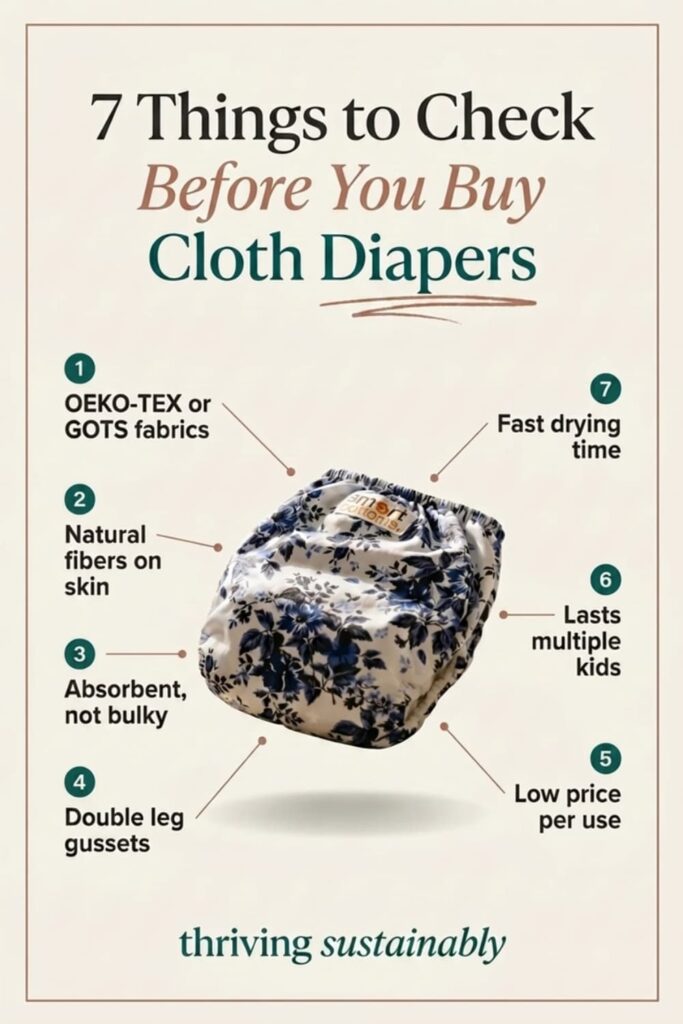
1. Materials and Certifications
The fabric touching your baby’s skin should be certified clean. Look for OEKO-TEX Standard 100 (tests for harmful substances) or GOTS (Global Organic Textile Standard, the strictest organic textile certification). Brands like Esembly, Smart Bottoms, OsoCozy, and Green Mountain Diapers’ Cloth-eez line all carry one or both.
Avoid cheap polyester systems sold without certification, especially bulk packs from no-name big-box and discount retailer brands. The lining often contains manufacturing residues, and the dyes are rarely tested.
2. Absorbency
Cotton, hemp, and bamboo all absorb differently. Cotton holds moisture quickly but can release some of it back under pressure (called compression leaking). Hemp is the most absorbent natural fiber per ounce of fabric, but it absorbs slowly. Bamboo viscose splits the difference, fast and absorbent but slightly less durable than cotton or hemp over hundreds of washes.
The best heavy-wetter and nighttime systems pair cotton with hemp. The cotton handles the initial wetness, the hemp catches everything else, and the combined absorbency lasts 10 to 12 hours overnight.
3. Fit and Leakage Protection
A great diaper that doesn’t fit your baby is the same as a bad diaper. Cloth diapers come in two sizing approaches: sized (newborn, small, medium, large) and one-size (adjustable from roughly 8 pounds to 35 pounds via rise snaps).
Look for double leg gussets (an inner layer of elastic plus the standard leg elastic) on AIOs and pockets. They make the difference between a leak-proof fit and three outfit changes per day. Brands like Esembly and Buttons have well-tested gusset designs. Brands without inner gussets tend to leak around the thighs once the baby is mobile.
4. Ease of Use
Some cloth systems have a nearly flat learning curve. AIOs and one-size pockets fit in your diaper bag just like disposables do. Prefolds and flats need folding, snappi placement, and a separate cover, which adds 20 to 30 seconds to every change.
If your baby will be in daycare, check whether the daycare allows cloth at all (some do, some don’t). If they do, AIOs or pre-stuffed pockets are usually the best choice because daycare staff don’t have to learn a fold.
5. Drying Time
Drying time is the difference between two stash sizes for the same family. AIOs take 60 to 90 minutes in a dryer or a full day on a line. Prefolds and flats dry in 20 to 30 minutes. If you live in a humid climate, want to line-dry, or have a small washer that can’t handle a full AIO load, drying time matters more than you’d think.
6. Durability and Resale Value
A well-made cloth diaper lasts through one to three babies. A cheap one starts to pill, lose elasticity, or delaminate after six months. Established brands (Esembly, Smart Bottoms, OsoCozy, Buttons) hold up. Bulk Amazon brands often don’t.
Resale value also matters. Cotton, hemp, and wool diapers from reputable brands routinely sell for 50 to 70% of their retail price on used cloth diaper marketplaces (Diaper Swappers, Facebook groups, Mercari). That further reduces the lifetime cost.
7. Total Price Per Use
The metric that matters isn’t the sticker price, it’s the price per use. A $30 organic AIO that lasts 300 washes costs 10 cents per use. A $5 cheap pocket diaper that delaminates after 50 washes costs 10 cents per use. The cheap one didn’t actually save you anything, and you threw away six diapers along the way.
When comparing brands, divide the price by an honest estimate of how many uses you’ll get. The best cloth diapers in this guide cost between $0.05 and $0.15 per use over a full diapering window.
The 7 Best Cloth Diapers of 2026 (Plus 2 Plastic-Free Covers)
The 7 best cloth diapers of 2026 are Esembly, Smart Bottoms, EcoAble, OsoCozy (a fitted and a flat), Green Mountain Diapers Cloth-eez, and Buttons Diapers, plus two plastic-free wool covers from Disana and Sloomb, each chosen for a specific household need.
These 8 brands meet all seven criteria above. Each one uses certified-clean materials, is made by a transparent company you can actually research, and has a track record of lasting through real cloth diapering, not just photo shoots. Each card below breaks down what the diaper is, who it’s best for, and where it falls short.
Best Overall
$$$
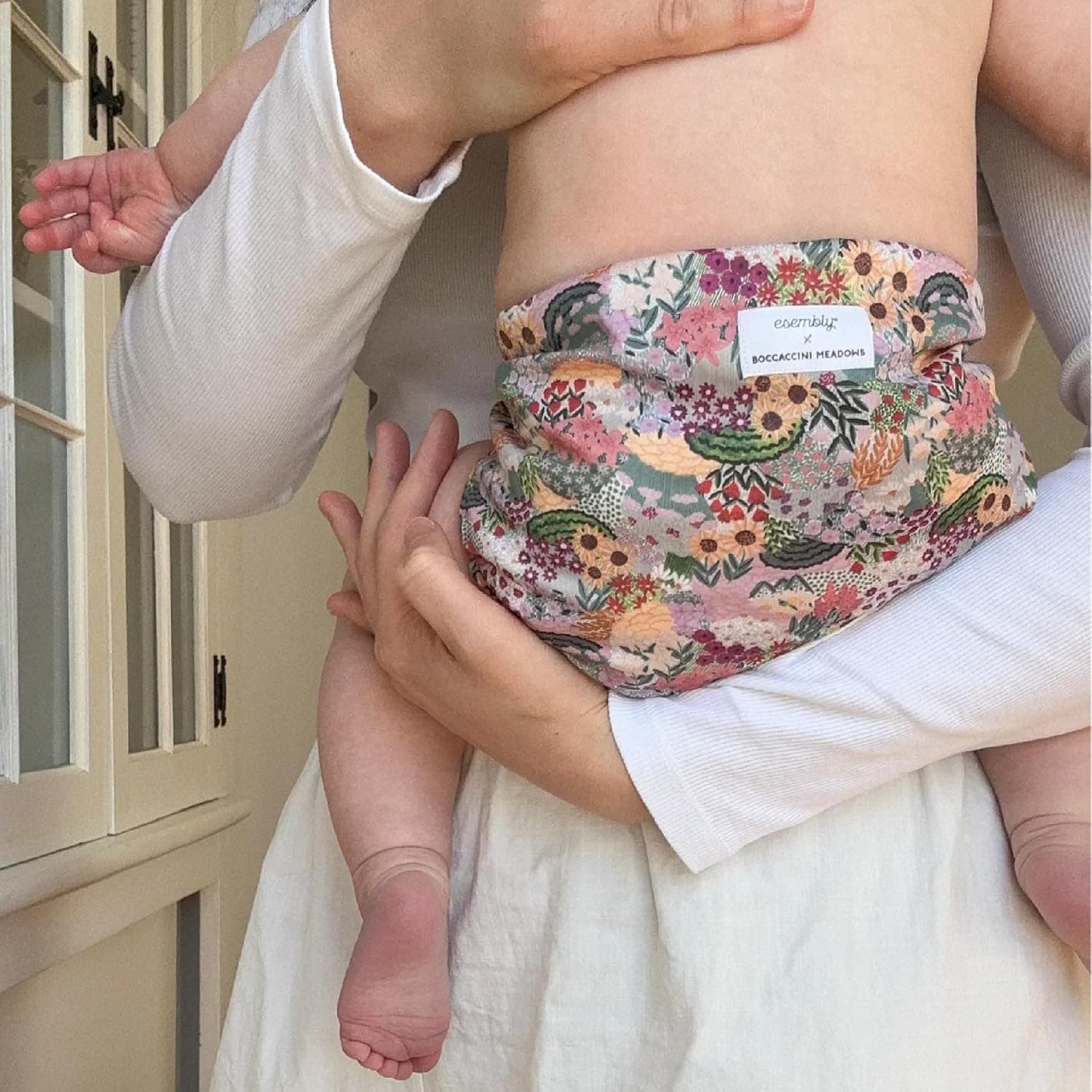
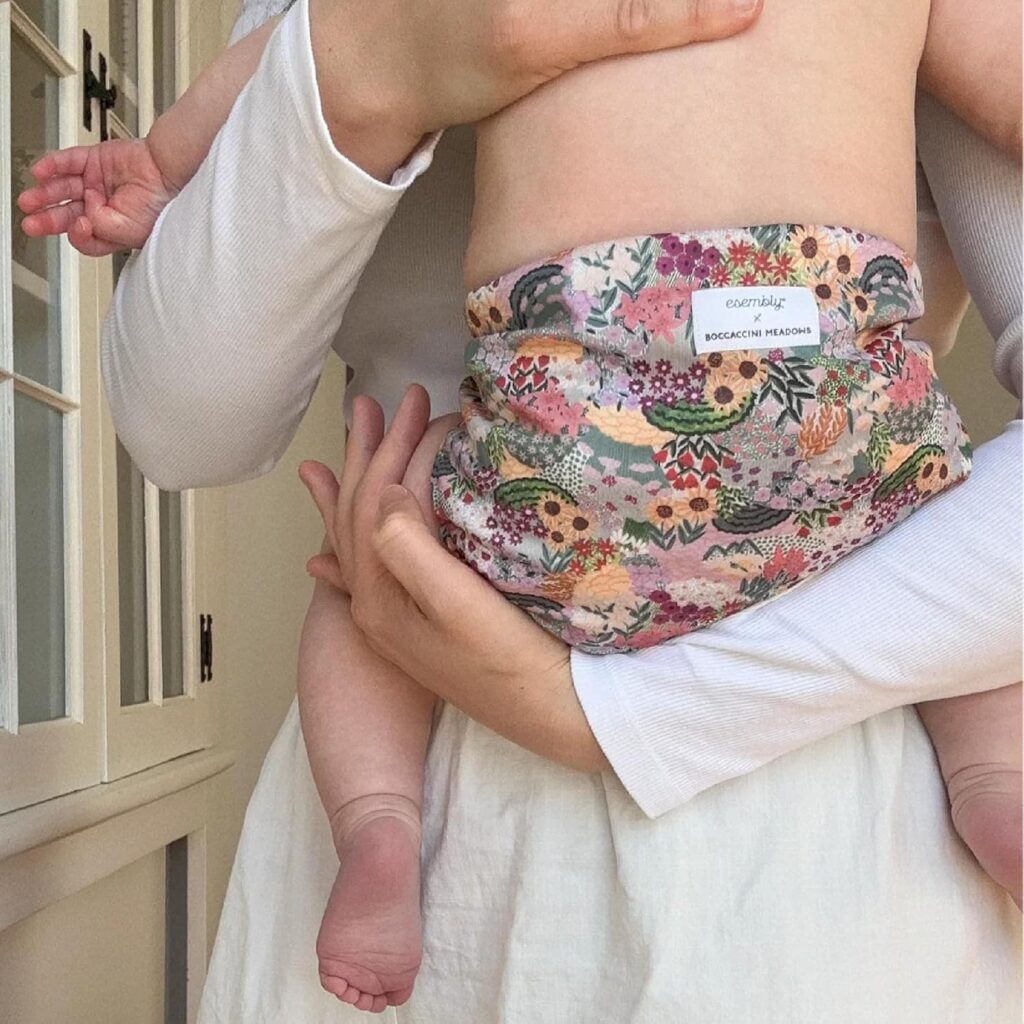
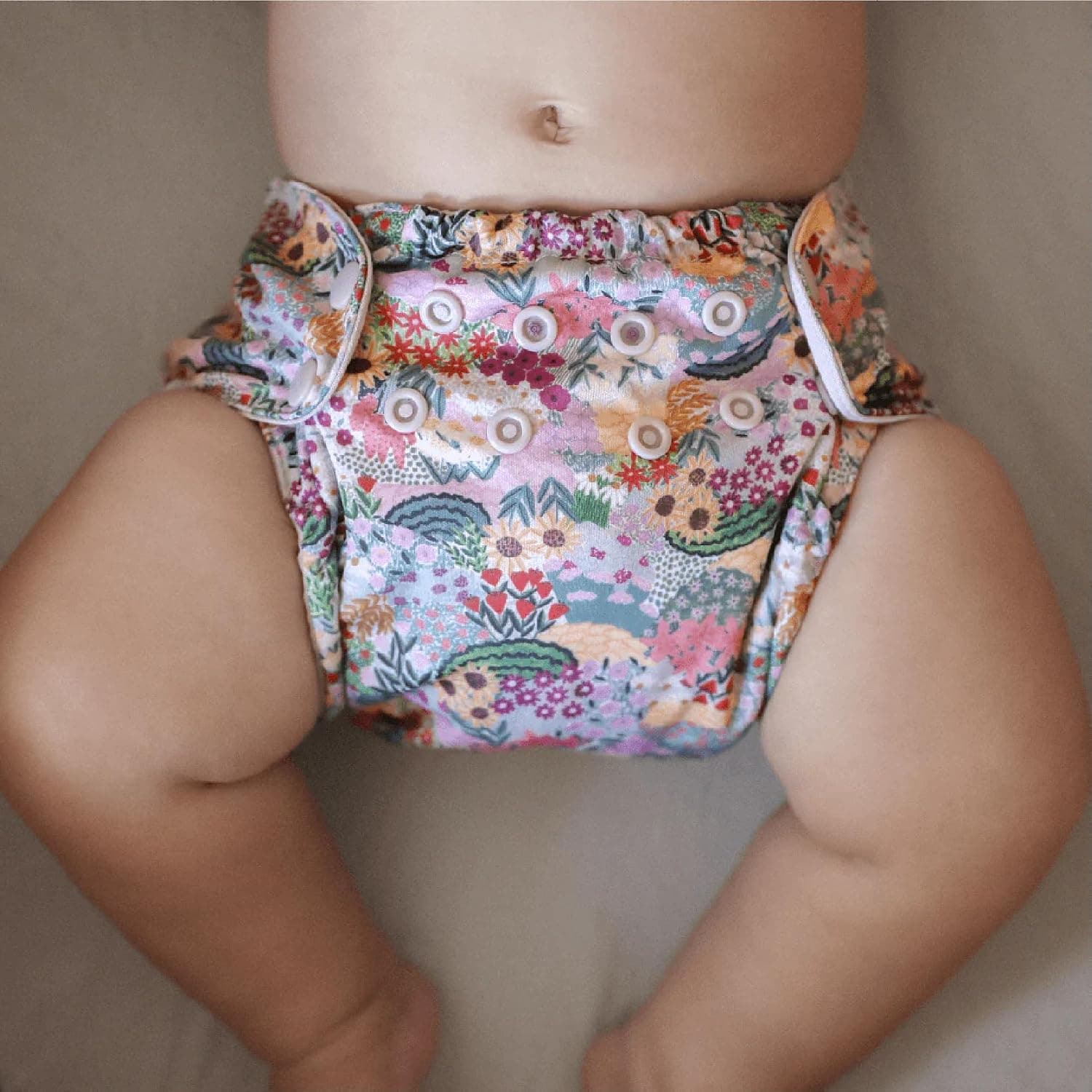
Esembly is a two-piece organic cotton system: a soft OEKO-TEX organic cotton Inner under a waterproof Outer made from upcycled recycled-plastic TPU. Swap the Inner at each change and reuse the Outer.
It is the most polished clean-materials setup on the market, with a well-tested fit and leak gussets. Sized (1 and 2) rather than one-size.
Inner Layer
Organic Cotton
✓ Plastic FreeAbsorbent Core
Organic Cotton
✓ Plastic FreeWaterproof Outer
Recycled-PET TPU
⚠ No Skin ContactClosure
Plastic Snaps
⚠ No Skin ContactPros
- Certified organic cotton against the skin
- Fewest pieces to manage
- Well-tested fit and leak gussets
Cons
- Higher upfront cost than budget systems
- Sized, not one-size, so two rounds of buying
The most polished clean-materials system on the market. If you want one system that just works, start here.
Best All-in-One
$$
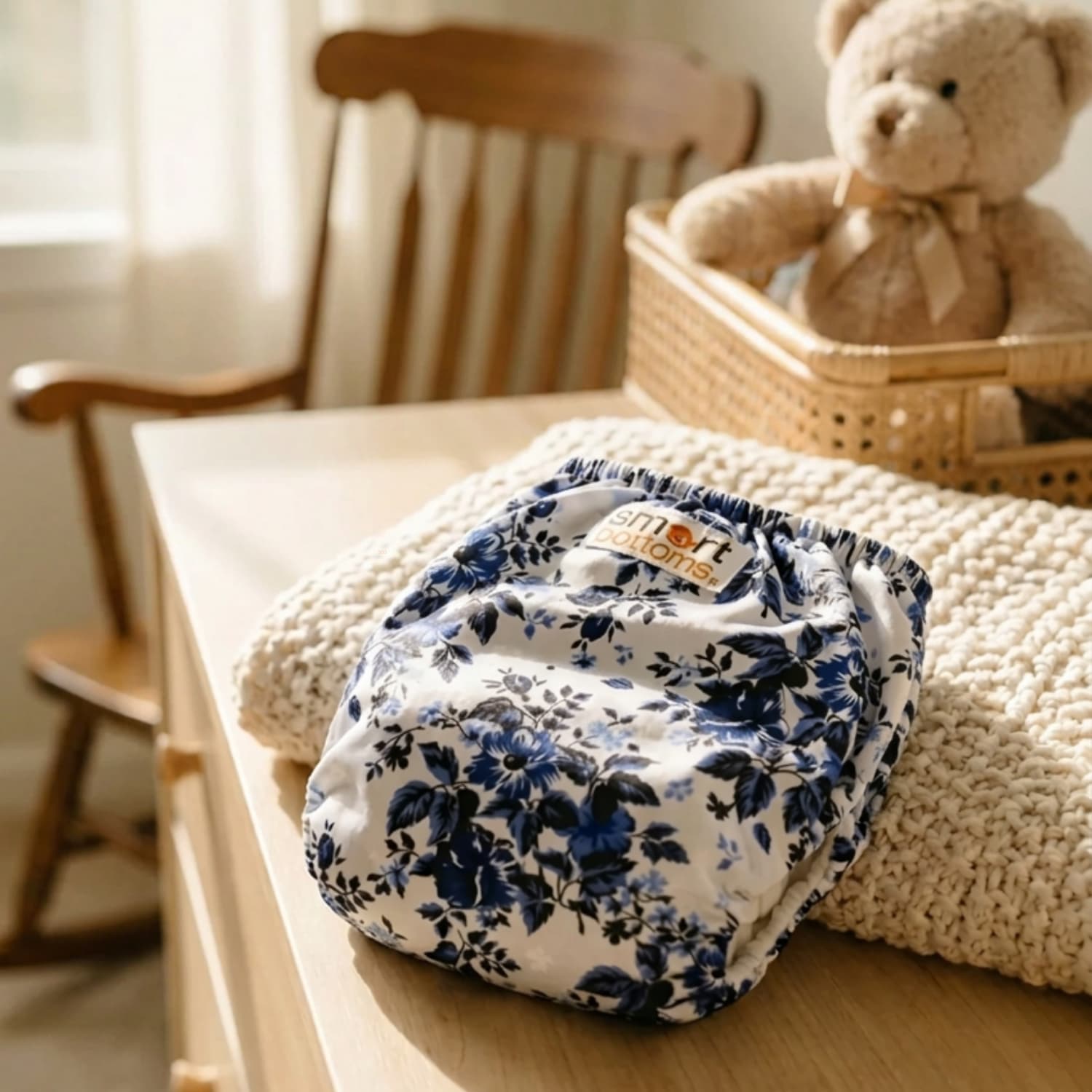
Smart Bottoms Smart One 3.1 is a one-size, sewn-together AIO with a 100% certified organic cotton interior and a PUL waterproof outer, made in the USA.
Four rise settings fit roughly 10 to 35 lbs, and it goes on and comes off as easily as a disposable, which makes it the one to hand a partner or daycare.
Inner Layer
Certified Organic Cotton
✓ Certified OrganicAbsorbent Core
Organic Cotton
✓ Plastic FreeWaterproof Outer
PUL
⚠ No Skin ContactClosure
Plastic Snaps
⚠ No Skin ContactPros
- Certified organic cotton interior
- Genuinely one-and-done, like a disposable
- Made in USA with a transparent supply chain
Cons
- Attached core is slow to dry
- Pricier per diaper than pockets or prefolds
The easiest clean all-in-one to live with. If you want cloth that works like a disposable, this is it.
Best for Heavy Wetters & Overnight
$$
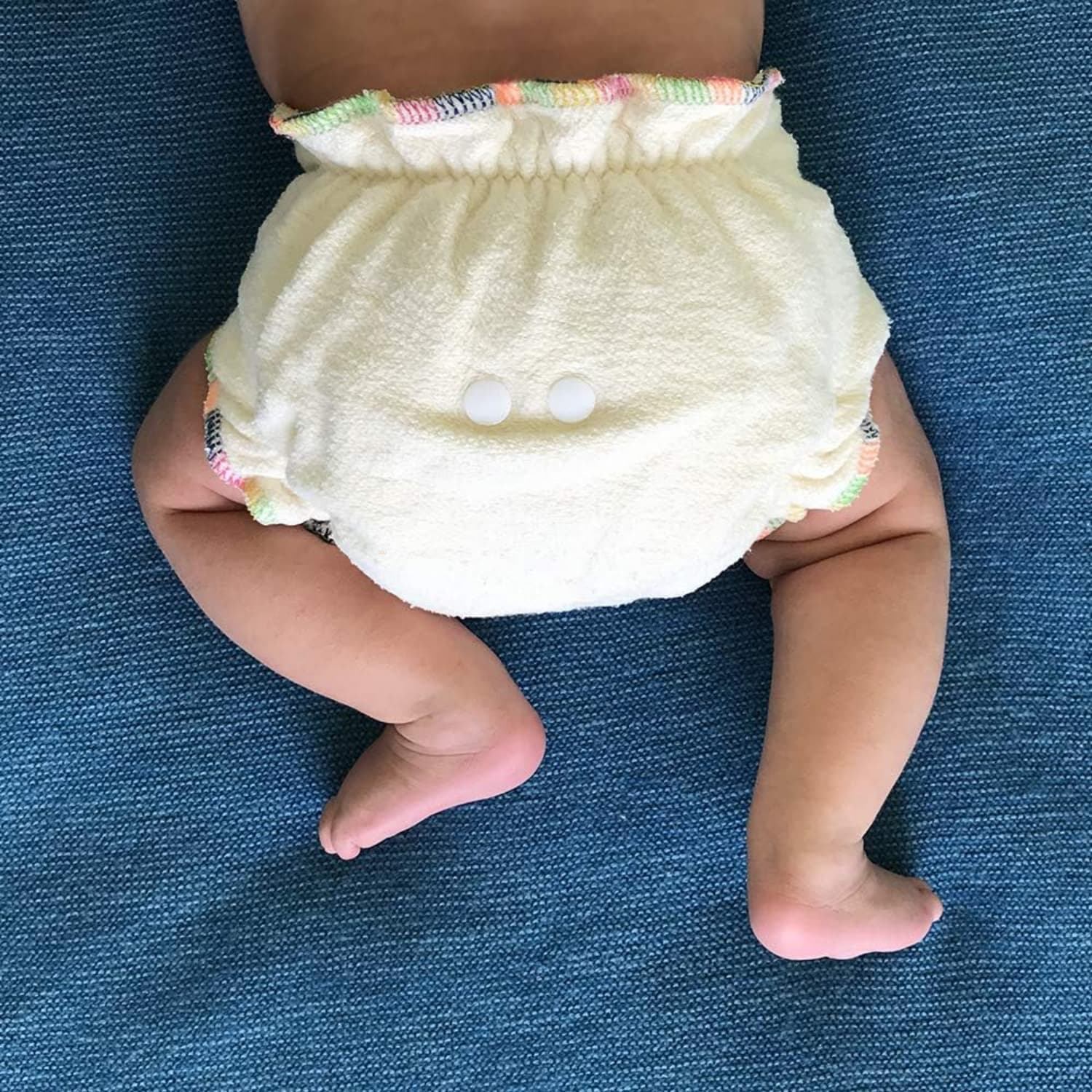
EcoAble‘s overnight fitted is an adjustable one-size diaper made from hemp and organic cotton, with two cotton-hemp inserts for serious absorbency. Pair it with a wool cover for a plastic-free overnight system.
Natural fibers all the way through, with no synthetic stay-dry layer, so it doubles as a sensitive-skin option for babies who react to fleece.
Inner Layer
Cotton & Hemp
✓ Plastic FreeInserts
Cotton-Hemp
✓ Plastic FreeBody
Hemp / Organic Cotton
✓ Natural FiberClosure
Plastic Snaps
⚠ No Skin ContactPros
- Hemp-cotton holds huge overnight volume
- All-natural, no synthetic stay-dry layer
- One-size with two inserts included
Cons
- Needs a separate cover
- Thick, and slow to dry
The overnight workhorse. If your baby soaks through by morning, choose EcoAble.
Best All-Natural for Sensitive Skin
$$
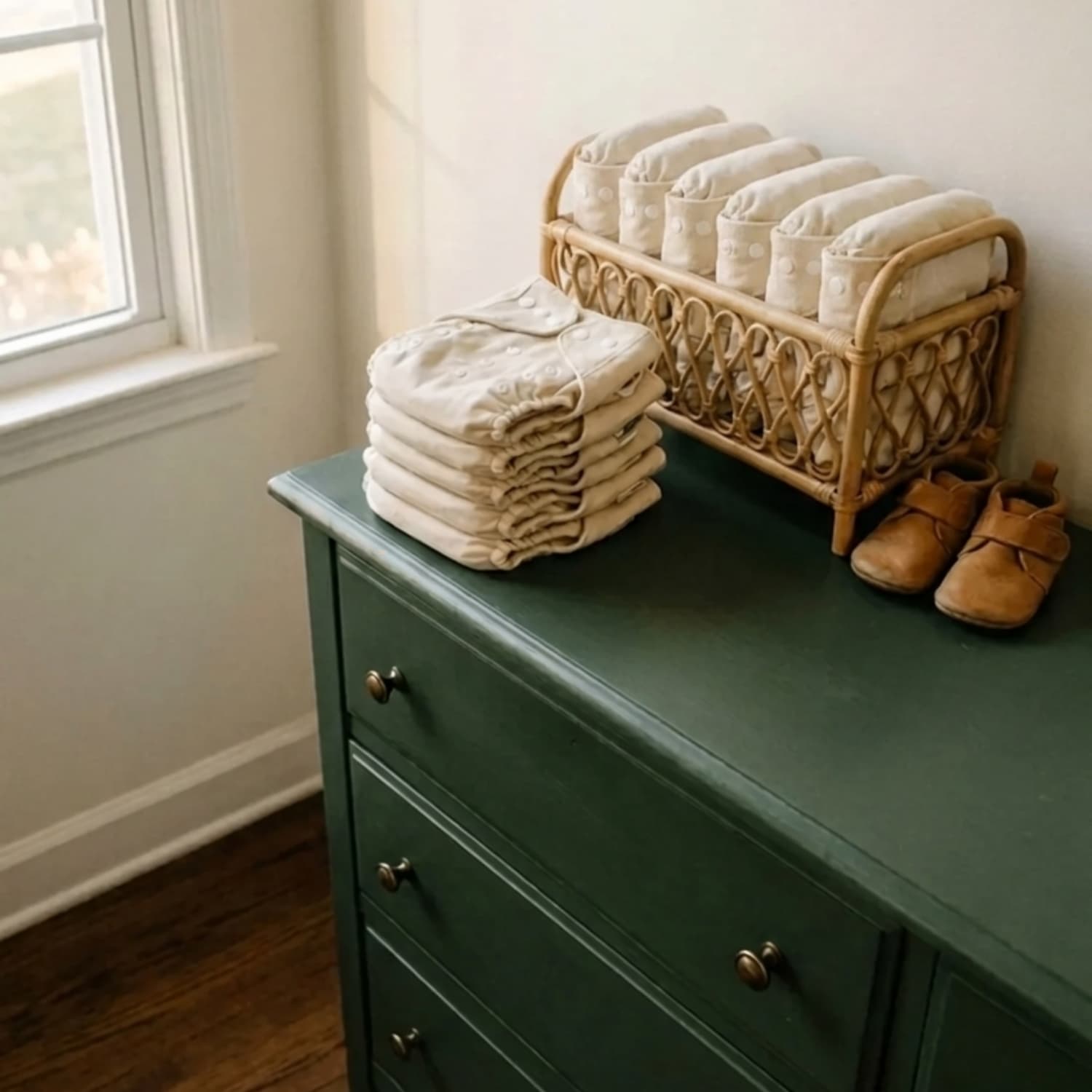
The OsoCozy fitted diaper is 100% GOTS-certified organic cotton in a soft birdseye weave, sewn in the USA with easy snap closures. Nothing synthetic touches your baby.
It is the everyday all-natural choice for sensitive skin. Add a wool or PUL cover and you have a breathable, certified-clean diaper.
Inner Layer
GOTS Organic Cotton
✓ Certified OrganicAbsorbent Body
Organic Cotton
✓ Plastic FreeWeave
Birdseye Cotton
✓ BreathableClosure
Plastic Snaps
⚠ No Skin ContactPros
- 100% GOTS organic cotton against skin
- No synthetic stay-dry layer
- Sewn in the USA, budget-friendly
Cons
- Needs a separate cover
- Natural cotton is slower to dry
The all-natural everyday choice. If sensitive skin is your concern, choose OsoCozy.
Best Trusted Workhorse
$
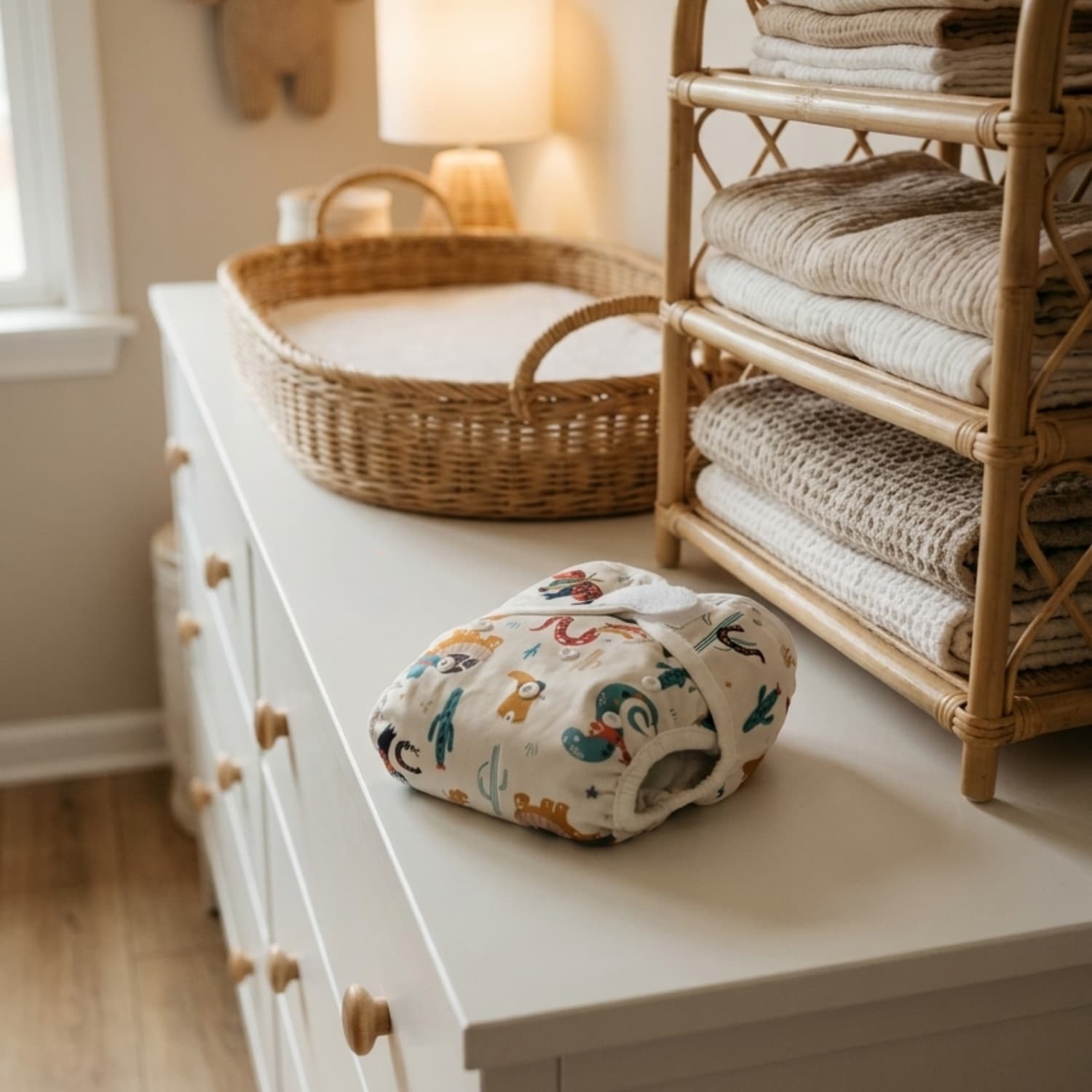
Green Mountain Diapers’ Cloth-eez prefolds are the most-recommended workhorse in cloth diapering: thick, durable cotton (unbleached or organic) that you fold and close with a Snappi or pins under any cover.
They are the cheapest clean way to build a stash, they last across multiple kids, and their newborn sizing is a favorite for the early weeks.
Fabric
100% Organic Cotton
✓ Plastic FreeCertification
OEKO-TEX Std 100
✓ CertifiedTrim Thread
Polyester
⚠ Minimal PlasticClosure
Snappi or Pins
✓ No Plastic SnapsPros
- Trusted, tested cotton quality
- Cheapest clean cost per use
- Lasts across several babies
Cons
- Folding and a separate cover to learn
- Direct from the brand, not on Amazon
The backbone of a smart cloth stash. If you want the most trusted budget system, choose Cloth-eez.
Best Budget
$
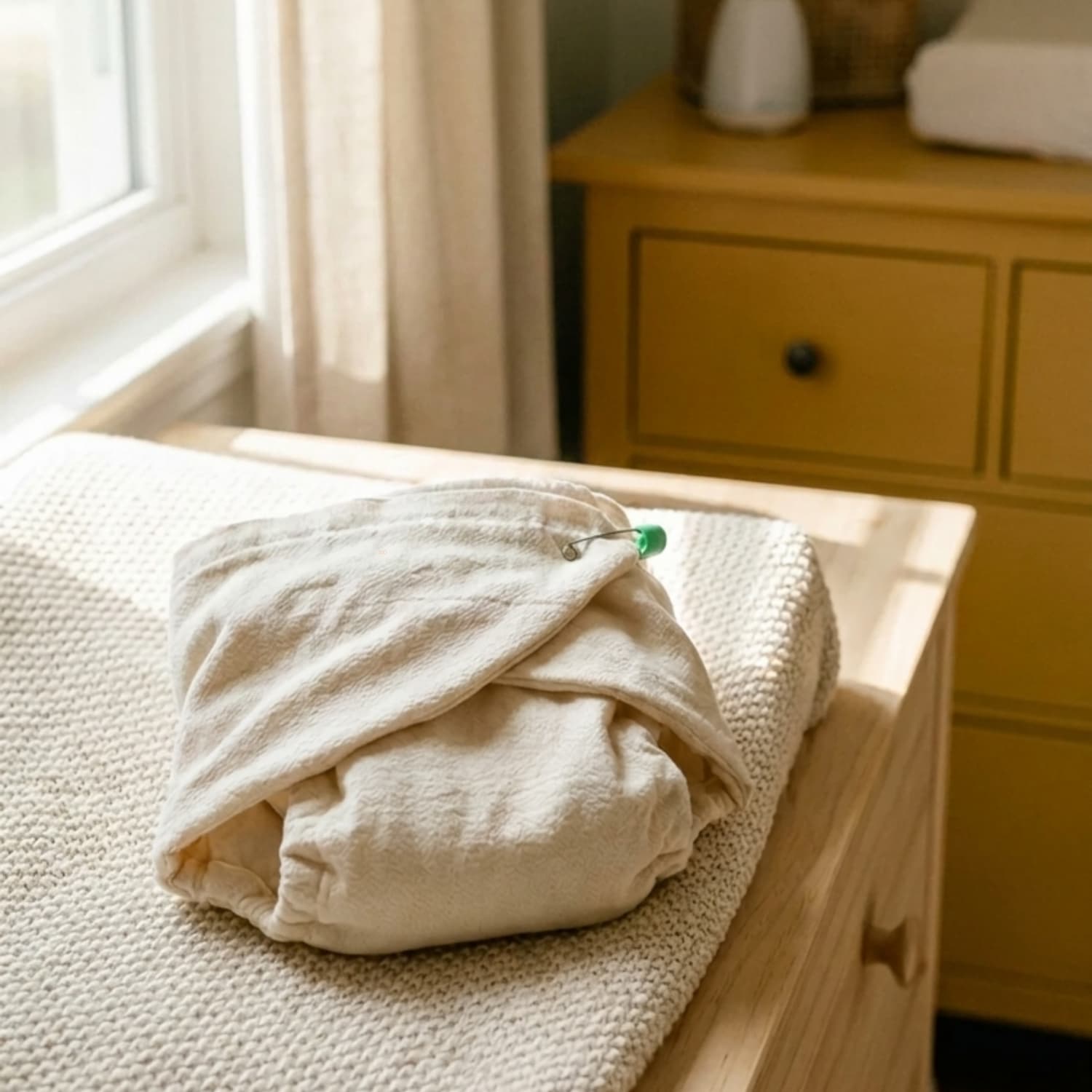
The OsoCozy organic flat is a single layer of 100% GOTS-certified organic cotton birdseye. You fold it to fit, pin or Snappi it, and add a cover.
One layer means it washes clean easily and dries the fastest of any diaper here, which is why flats are the budget backbone of most stashes.
Fabric
GOTS Organic Cotton
✓ Certified OrganicLayers
Single-Layer Birdseye
✓ Fast-DryingClosure
Fold + Pin
✓ Plastic FreeBest Cover
Pair with Wool
✓ Plastic-Free PairingPros
- 100% GOTS organic cotton
- Cheapest and fastest-drying
- Folds to fit any size, grows with baby
Cons
- Folding has a small learning curve
- Needs a separate cover
The lowest cost per use in the lineup. If budget is the priority, start with OsoCozy flats.
Best Budget One-Size System
$
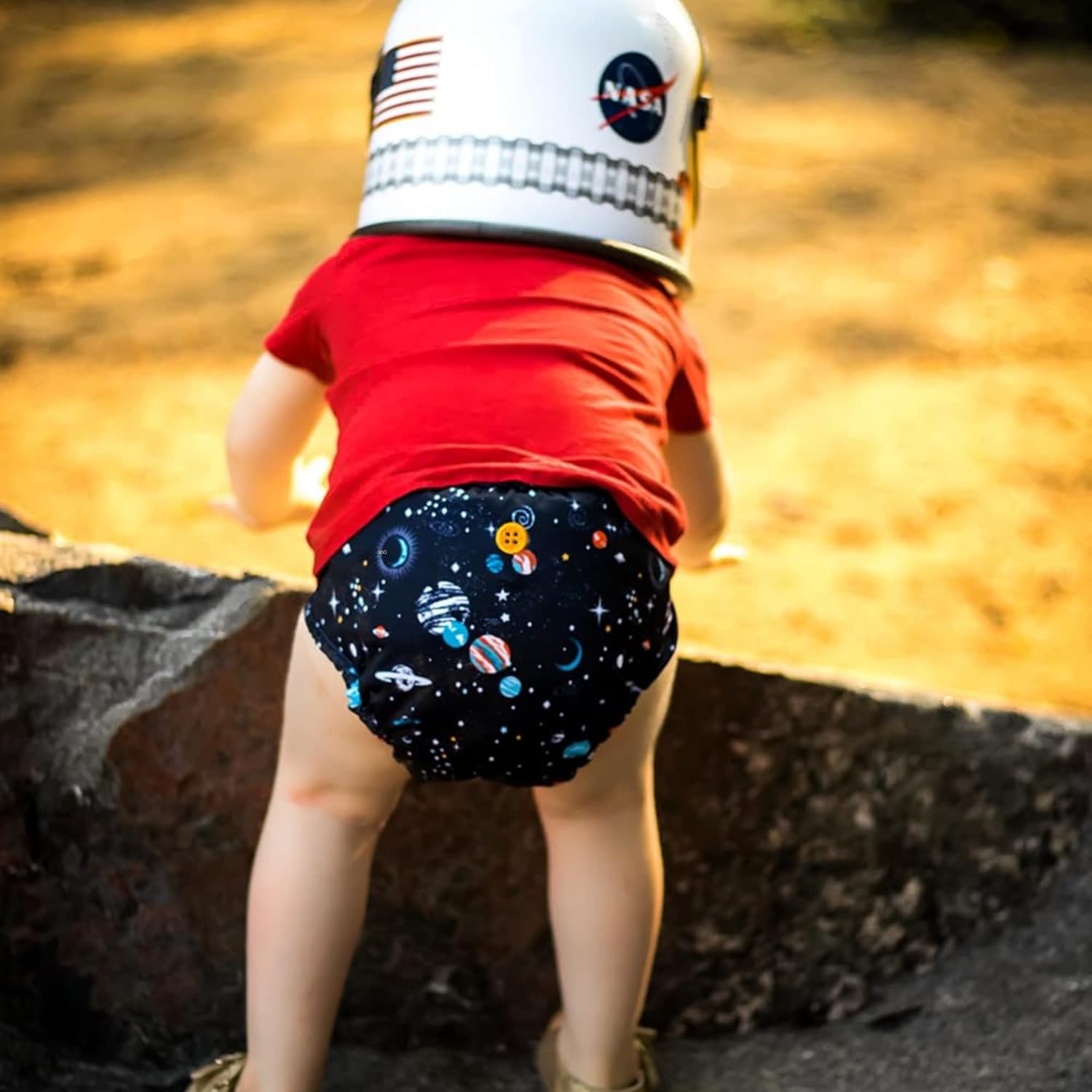
Buttons Diapers is a made-in-USA one-size cover with double leg gussets and snap-in inserts. Reuse the cover across changes and only wash the insert, which keeps the full-time cost very low.
Choose the cotton-hemp inserts over microfiber for a cleaner layer against your baby. A great budget hybrid that doesn’t cut corners on fit.
Insert (Best)
Cotton / Hemp
✓ Plastic FreeCover Lining
Polyester Tricot
⚠ No Skin ContactWaterproof Cover
PUL
⚠ No Skin ContactClosure
Plastic Snaps
⚠ No Skin ContactPros
- Very low cost for a full-time stash
- Double gussets contain messes
- Reusable cover stretches your dollar
Cons
- PUL cover is not plastic-free
- Microfiber insert option is synthetic
The budget hybrid that still fits well. If you want one-size on a tight budget, choose Buttons.
Best Everyday Cover (Plastic-Free)
$$
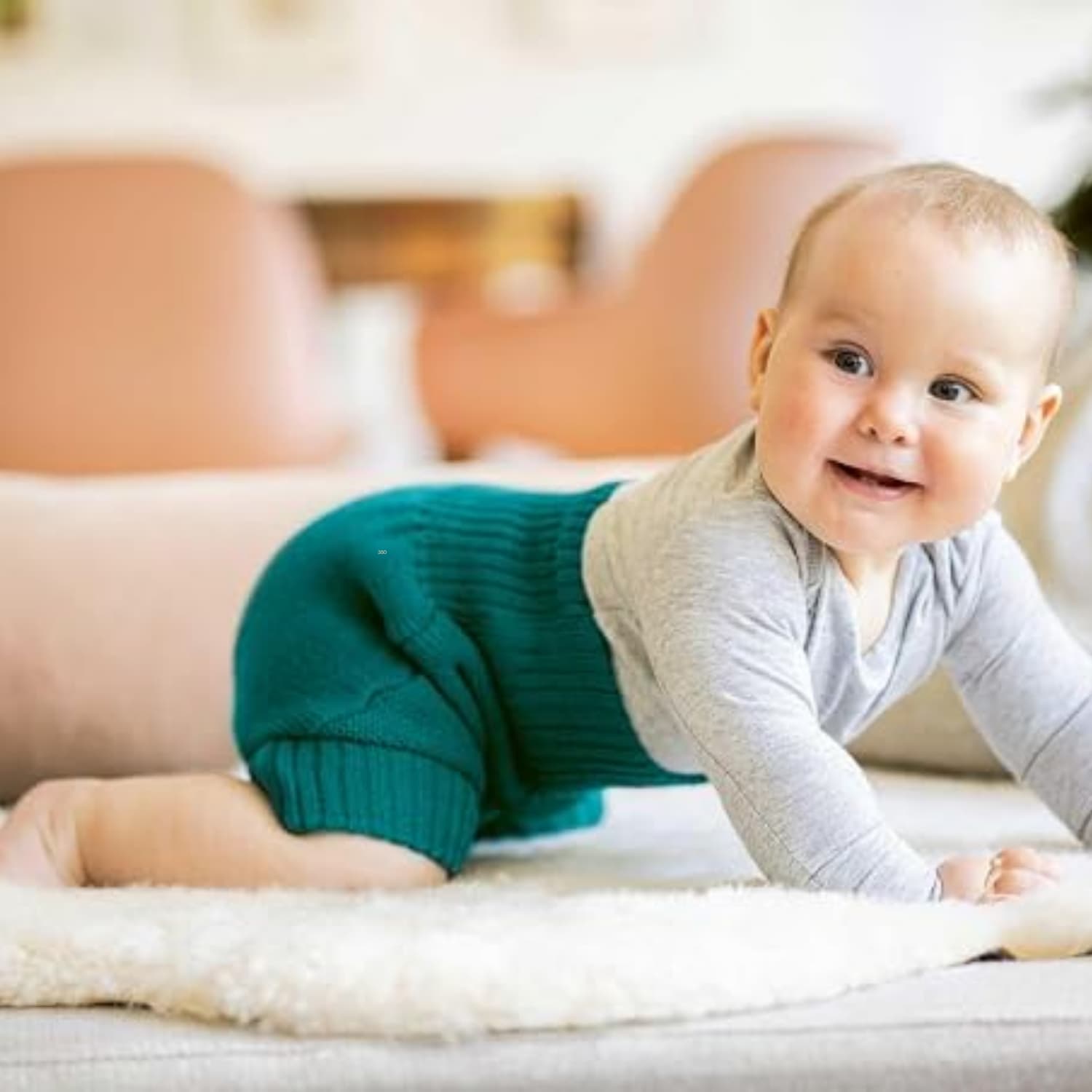
The Disana cover is 100% certified organic merino wool (kbT), made in Germany. Wool is the only genuinely plastic-free waterproof cover, and once lanolized it keeps leaks in while staying breathable.
Pull it over any fitted, flat, or prefold for a natural, no-plastic overnight or everyday system. Hand-wash and re-lanolize occasionally.
Material
100% Merino Wool
✓ Plastic FreeWater Barrier
Lanolized Wool
✓ NaturalClosure
Pull-On, No Snaps
✓ Plastic FreeFibers
Organic Merino (kbT)
✓ Certified OrganicPros
- 100% organic merino, fully plastic-free
- Breathable and naturally antibacterial
- Only needs washing every few weeks
Cons
- Must be lanolized and hand-washed
- Higher upfront cost than PUL
The plastic-free way to keep leaks in. If you want a natural cover, choose Disana.
Best Overnight Wool Cover
$$$
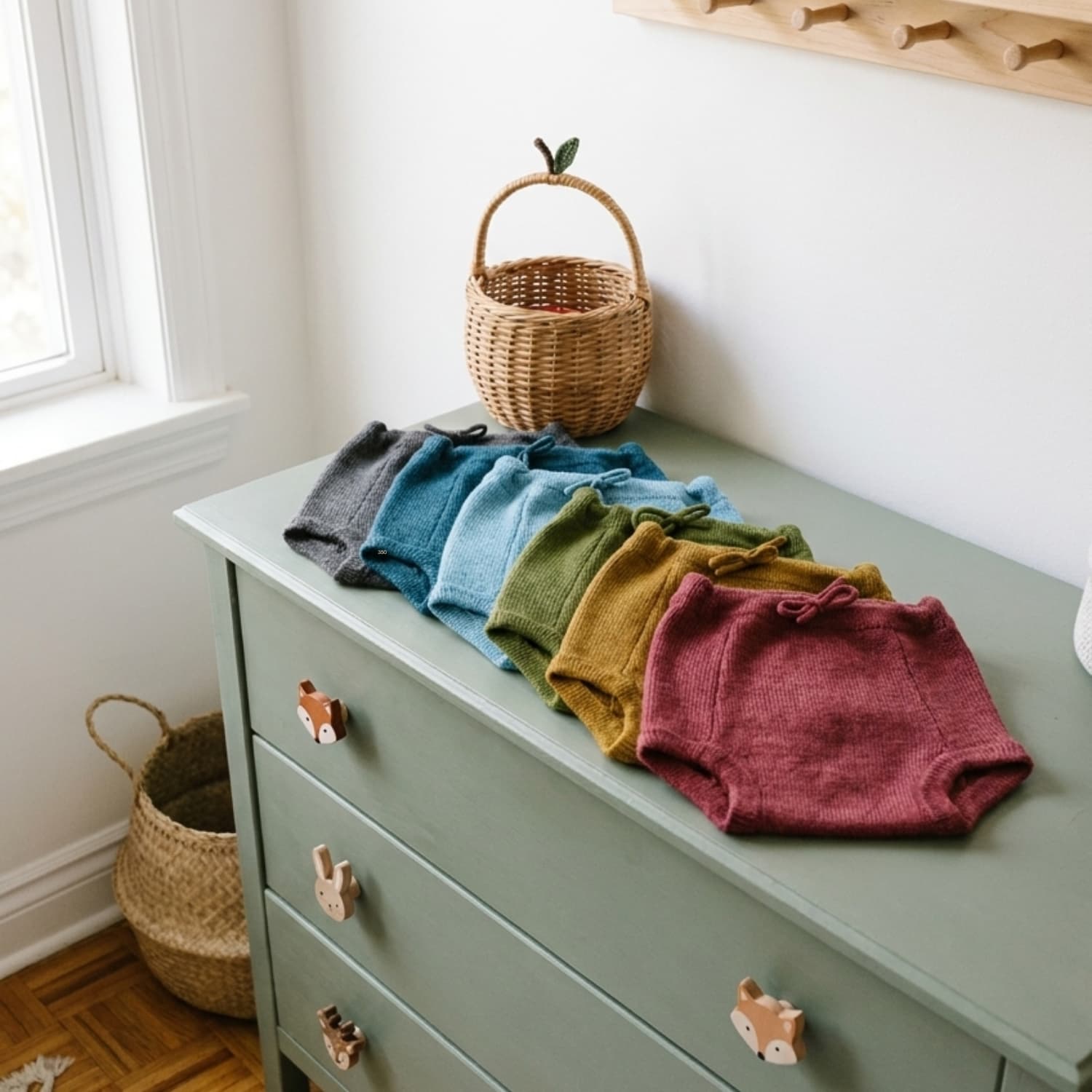
Sloomb (Sustainablebabyish) Coverwoolies are a high-rise interlock wool cover, hand-made in Denver by fairly-paid workers from OEKO-TEX and bluesign-certified wool.
The taller rise and denser double-layer knit are built to contain thick overnight fitteds, making it the premium pair for your heaviest wetter.
Material
100% Merino Wool
✓ Plastic FreeCertification
OEKO-TEX + bluesign
✓ CertifiedWater Barrier
Lanolized Wool
✓ NaturalClosure
Pull-On, No Snaps
✓ Plastic FreePros
- High-rise fit for thick overnight diapers
- 100% OEKO-TEX and bluesign certified wool
- Ethically made in the USA
Cons
- Hand-wash and lanolize only, no machine wash
- Premium price, direct-only
The overnight upgrade for wool covers. If you want the best overnight cover, choose Sloomb.
How We Chose These Cloth Diapers
Every diaper on this list was chosen against four hard criteria: certified-clean materials, transparent manufacturing, strong durability across hundreds of washes, and a real-world fit that prevents leaks for both newborns and toddlers.
This isn’t a sponsored roundup or a list pulled from Amazon’s bestsellers. We started with a screen of 35-plus cloth diaper brands, then cut anything that failed any of the four criteria below.
Materials had to be clean, and certified wherever possible.
We prioritized OEKO-TEX Standard 100 or GOTS certification, and most picks carry one or both. A couple, like EcoAble and Buttons, don’t hold a third-party fabric certificate but earned their spot on all-natural hemp and organic cotton with transparent sourcing. What we cut were the uncertified synthetic-polyester bulk packs with no material disclosure, which removed most of the bulk Amazon options.
Manufacturing had to be transparent.
We had to know where the diaper was made, by whom, and under what conditions. Brands like Smart Bottoms and Green Mountain Diapers publish full supply chain details. Brands that hid behind “ethically sourced” without specifics didn’t make the list.
Durability had to be proven.
Each brand had to have a track record of lasting through at least one full child’s worth of cloth diapering (roughly 300 washes per diaper) without elastic failure, delamination, or significant pilling. We pulled from independent reviews on Padded Tush Stats, real Diaper Swappers, Facebook cloth diaper community feedback, and brand warranty data.
Fit had to work for real babies.
A diaper that only fits chunky thighs or only fits skinny ones isn’t a roundup pick. Each brand on this list has been confirmed to fit a wide range of baby shapes from newborn through toddler.
We also factored in price, but only at the price-per-use level, not sticker price. A $30 diaper that lasts 300 washes is a better value than a $10 diaper that lasts 60. The eight picks above all land between $0.05 and $0.15 per use across a full diapering window.
Cloth Diapers vs Disposable: Cost Breakdown
Cloth diapers cost $400 to $700 upfront and roughly $150 to $250 per year in laundry, totaling about $775 to $1,325 over one child. Disposables cost $2,200 to $3,000 over the same window, making cloth diapers $1,000 to $2,000 cheaper for one baby and up to $7,500 cheaper across three.
The cost-savings argument is the one most parents come for. Here’s the breakdown side by side, from the upfront purchase through three babies.
The numbers behind the table: a newborn goes through roughly 330 diapers in the first month, at $0.25 to $0.40 each for mid-range or premium disposable brands. A newborn cloth starter stash runs $300 to $500 because you’re buying a dozen to fifteen newborn-sized diapers, wet bags, and cloth wipes all at once. Cloth costs more in month one, but the disposable bill keeps coming every month after, while cloth’s only ongoing cost is laundry. Across a full diapering window, a baby in disposables uses 6,000 to 8,000 diapers, at $0.30 to $0.45 each for mid-range to clean brands (Coterie, Honest, Hello Bello).
The multi-kid savings are where cloth really wins. A stash that survived child one may need $50 to $100 in elastic replacements and a few new inserts before child two, and the same set can carry through a third baby if you’ve taken decent care of it.
How to Wash Cloth Diapers (The Routine That Actually Works)
The right cloth diaper wash routine is a cold prewash, a hot main wash with a strong detergent like Tide Free and Gentle or a clean alternative like Meliora, no fabric softener, and either tumble dry low or line dry. That’s it.
Washing cloth diapers isn’t complicated, but the rumors around it are. You don’t need a special diaper detergent. You don’t need to soak overnight. You don’t need to add vinegar to every wash. What you do need is a routine that gets the diapers actually clean, which means strong agitation, hot water, and a real detergent dosed at the full amount.
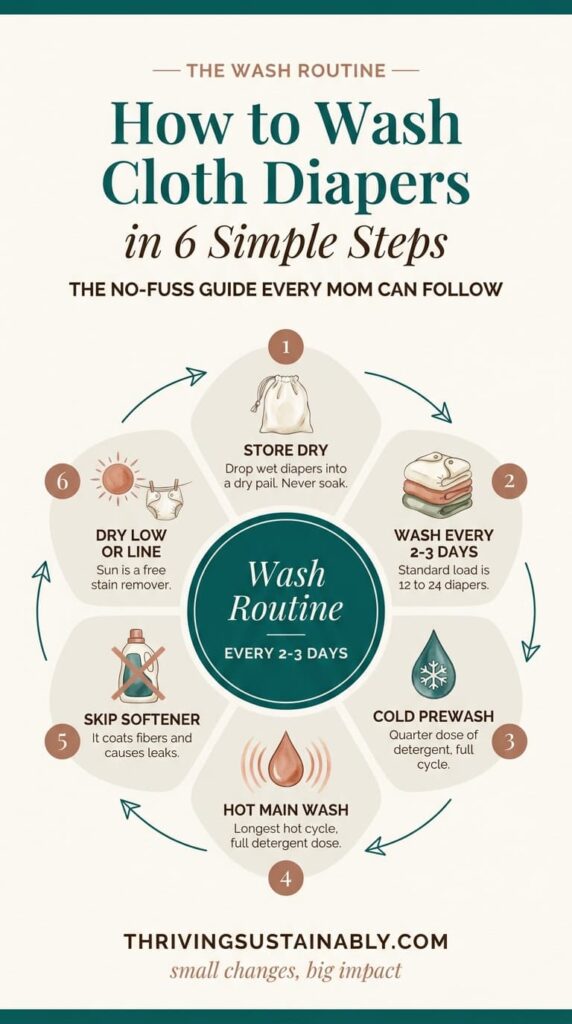
The Standard Cloth Diaper Wash Routine
Step 1: Store dry. Once a diaper is wet or dirty, knock any solid waste into the toilet (a diaper sprayer helps), then drop the diaper into a dry pail or wet bag. Don’t soak. Standing water grows ammonia and breaks down elastic.
Step 2: Wash every 2 to 3 days. Diapers that sit longer than that start to grow ammonia and stains. A standard load is 12 to 24 diapers.
Step 3: Cold prewash with a small amount of detergent. This rinses out solid waste and urine before the main wash. Use about a quarter of your normal detergent dose. Run a regular cycle, not a quick wash.
Step 4: Hot main wash with a full dose of detergent. This is where the cleaning actually happens. Use the longest, hottest wash cycle your machine offers, with the largest load size setting (you want maximum agitation and water). Use the full recommended detergent amount, not less.
Step 5: Skip fabric softener. Always. It coats the fibers and creates a repelling effect, which causes the diaper to leak.
Step 6: Tumble dry low or line dry. Cotton and hemp can be dried on low in the dryer. Wool and PUL covers should air-dry. Sun is a free stain remover for cotton.
Detergent Choice Matters
The single biggest source of wash problems in cloth diapering is the wrong detergent. You need a detergent strong enough to actually clean diapers, which rules out most “free and clear” or “baby” formulas (they’re weaker on purpose). Strong mainstream picks include Tide Free and Gentle and Persil ProClean.
If you want a clean alternative, Meliora powder and Molly’s Suds powder are both strong enough to clean cloth diapers without the fragrance, optical brighteners, or other additives you’d want to avoid. We cover both in our non-toxic plastic-free laundry detergent guide.
Avoid detergents marketed specifically as “cloth diaper detergent” unless you’ve researched them carefully. Some are too weak to actually clean, leading to ammonia buildup and stink problems within weeks.
How Often to Strip Wash
You shouldn’t need to strip wash every month. If your routine is right, you’ll go a year or more without needing one. Signs you need to strip: persistent ammonia smell after a fresh wash, repelling (water beads on the inner fabric), or rashes that started after switching detergents.
A stripping wash uses RLR Laundry Treatment or a homemade mix of borax, washing soda, and Calgon to remove mineral and detergent buildup from the fibers. Run it on hot, then rinse repeatedly until no suds appear in the rinse water.
Cloth Diapers for Newborns vs One-Size
Most cloth families use a small dedicated newborn stash for the first 2 to 3 months, then transition to one-size diapers (8 to 35 pounds) once baby fits the smallest rise setting. Skipping the newborn stage with one-size diapers is possible but tricky for babies under 8 pounds.
The newborn-versus-one-size question is one of the first you’ll face when building a stash. Here’s how to think through it.
Why Most Parents Recommend a Small Newborn Stash
One-size diapers are designed to fit babies from roughly 8 pounds up to 35 pounds, but the smallest rise setting on most one-size diapers is too bulky for a 7-pound newborn. The diaper sticks out above the umbilical stump and gaps at the legs.
A small newborn stash (10 to 15 dedicated newborn-sized diapers) covers the first 8 to 10 weeks while the baby is too small for one-size. Newborn AIOs from Esembly or Smart Bottoms fit babies from about 6 pounds to 12 pounds, with an umbilical cord notch built in.
The “Skip Newborn” Approach
Some families skip the newborn stash entirely and use prefolds with newborn covers from day one. A small ($15 to $25) newborn cover over a flat or small prefold works for babies as small as 6 to 7 pounds.
This approach is cheaper than building a full newborn AIO stash, but it requires more folding and a learning curve in those exhausted first weeks. If this is your first baby, the newborn AIO stash is usually worth the $200-$300.
Daycare-Friendly Sizing Tips
If your baby will be in daycare, ask the provider what they’re comfortable with before building your stash. Most cloth-friendly daycares prefer pre-stuffed pocket diapers or AIOs (no folding required). Send 8 to 10 diapers per day, along with a labeled wet bag for soiled ones.
If a daycare won’t do cloth at all, hybrids work well. You can run cloth at home and disposables (or eco-disposable inserts that snap into your hybrid shell) at daycare.
Cloth Diapering Tips for Beginners
The fastest way to make cloth diapering stick is to start small (10 to 12 diapers), commit to a 30-day trial, get your wash routine working before adding more diapers, and join a community for troubleshooting.
Most cloth diapering failures come from doing too much too fast. Here’s the order most experienced cloth families recommend if you’re starting out.
Start With a Mini Stash, Not a Full One
Buy 10 to 12 diapers to start. Run them through your machine for 30 days. See how the routine fits your life before spending another $300 on a full stash.
This also lets you try two or three different styles before committing. You might think you want all-in-ones and discover you actually love prefolds. Or vice versa.
Build the Wash Routine First
A clean wash routine is more important than which diapers you own. Get the routine working before you scale up the stash. Once a wash routine is broken (ammonia smell, stink issues, repelling), it’s hard to recover, and most beginners blame the diapers when the real problem is detergent dose or water hardness.
Solve Hard Water Early
If your water is hard (above 7 grains per gallon), you’ll likely need to add Calgon or a water softener to every wash. Soft water doesn’t need additives. You can buy a $10 hardness test strip to find out.
Hard water is the silent culprit behind most cloth-washing problems, and it’s the easiest one to fix once you know.
Don’t Use Diaper Cream Without a Liner
Most diaper rash creams contain ingredients that coat cloth fibers, causing them to repel. If you need to use a cream, use a fleece or bamboo liner between the cream and the diaper. Or switch to a cloth-safe cream like Earth Mama Organics Diaper Balm.
Join a Cloth Diaper Community
Real-time troubleshooting from experienced cloth families is the fastest way to fix problems. The Cloth Diapers Facebook groups (Cloth Diaper Newbies, Fluff Love University) have thousands of active members who can diagnose leaks, smell issues, or fit problems in minutes.
Use Cloth Wipes While You’re at It
If you’re already running cloth diapers, the leap to cloth wipes is small. A dozen flannel squares, a spray bottle of water with a drop of castile soap, and you’ve eliminated another household waste stream and saved another $200 a year in disposable wipes.
FAQs on Cloth Diapers
Both are sanitary when handled correctly. Cloth requires you to knock solids into the toilet and wash every 2 to 3 days, which is where waste is supposed to go anyway (disposables technically instruct the same thing, though almost no one does it). The key is a proper hot wash with full detergent. A correct wash routine kills the bacteria that cause smell and rash.
Yes, with the right absorbency. A single daytime diaper usually won’t last 11 hours. For overnight, use a fitted diaper under a wool cover, or add a hemp fitted like EcoAble to a pocket. The combination of cotton for speed and hemp for capacity is what gets most babies through the night dry.
Plan on 24 to 36 diapers if you wash every 2 to 3 days. Fewer than 24 means washing daily; more than 36 is usually overbuying. Hybrid systems need less: 6 to 8 shells plus 24 inserts covers full-time use because you reuse shells across changes.
Yes, but you may need to trick the machine into using more water. HE washers sense load weight and add minimal water, which reduces the agitation diapers need. Add a wet towel to increase the sensed weight, or use the “bulky” or “deep fill” setting if your machine has one.
Carry a wet bag. A zippered, PUL-lined wet bag holds soiled diapers without odor until you get home, then goes in the wash with the diapers. Most parents keep a large one in the diaper bag and a small one in the car.
Not until baby starts solids. Exclusively breastfed baby waste is water-soluble and rinses out in the wash, so you can toss the whole diaper in the pail. Once solids start (around 6 months), a diaper sprayer that rinses waste straight into the toilet is the cleanest option. Skip the “flushable” liners: most are made with plastic fibers that don’t fully break down, so flushing them can shed microplastics into the water system and clog your pipes. A reusable fleece or bamboo liner that you shake off over the toilet does the same job with zero waste.
Final Thoughts About Cloth Diapers
Cloth diapering is one of the few swaps that’s better for your baby’s skin, your budget, and the landfill all at once. You don’t have to be perfect about it. Plenty of families run cloth at home and reach for a clean disposable on travel days, and that mix still keeps thousands of diapers out of the trash.
If you’re on the fence, start small. Order 10 to 12 of one of the picks above, run them for 30 days, and get your wash routine dialed in before you build a full stash. That short trial tells you more than any review, and it’s the single best way to find out whether cloth fits your life.
And if you’re doing this partly to cut your family’s plastic and microplastic exposure, cloth diapers are one of the highest-impact swaps you can make in the early years, because it’s a plastic-to-skin contact point you remove for a solid two to three years.
📚References
- Buttons Diapers. (n.d.). Cloth diaper covers and inserts made in the USA. Buttons Diapers. https://www.buttonsdiapers.com
- Disana. (n.d.). Organic merino wool diaper cover. Disana. https://www.disana.de/en/
- EcoAble. (n.d.). Overnight hemp fitted cloth diaper. EcoAble. https://ecoable.net
- Environment Agency. (2008). An updated lifecycle assessment study for disposable and reusable nappies. UK Government. https://www.gov.uk/government/publications/an-updated-lifecycle-assessment-for-disposable-and-reusable-nappies
- Esembly. (n.d.). Organic cotton cloth diaper system. Esembly. https://esembly.com
- Green Mountain Diapers. (n.d.). Cloth-eez prefold diapers. Green Mountain Diapers. https://www.greenmountaindiapers.com/products/cloth-eez-prefold-diapers
- OsoCozy. (n.d.). Organic cotton prefold and fitted cloth diapers. OsoCozy. https://www.osocozy.com
- Smart Bottoms. (n.d.). Smart One 3.1 organic all-in-one cloth diaper. Smart Bottoms. https://smartbottoms.com
- Sustainablebabyish (Sloomb). (n.d.). Interlock wool diaper covers. Sloomb. https://sloomb.com
- US Environmental Protection Agency. (2020). Nondurable goods: Product-specific data (2018 Facts and Figures). US EPA. https://www.epa.gov/facts-and-figures-about-materials-waste-and-recycling/nondurable-goods-product-specific-data
- Zhang, J., Wang, L., Trasande, L., & Kannan, K. (2021). Occurrence of polyethylene terephthalate and polycarbonate microplastics in infant and adult feces. Environmental Science & Technology Letters, 8(11), 989-994. https://doi.org/10.1021/acs.estlett.1c00559