


You flip a pair of leggings inside out, check the tag, and there it is: 100% nylon. Then the question hits: is this stuff actually safe to have against your skin all day?
It’s a fair thing to wonder. Nylon shows up in everything from activewear and swimsuits to underwear, tights, raincoats, and backpacks, and most of us wear it for hours without a second thought. Here’s the short version: for most people, wearing nylon won’t poison you. But “is nylon toxic?” is really three questions stacked into one: is it bad for your skin, your health, and the planet? The honest answer is a little different for each.
This guide walks through all three in plain language, then gives you a few easy swaps and habits to lower your exposure without tossing your whole wardrobe.
What Is Nylon?
Nylon is a synthetic fiber made from petroleum, basically a soft plastic spun into thread.
It doesn’t come from a plant or an animal. The raw chemicals are pulled from crude oil, then linked into long, springy strands.
It was the world’s first fully synthetic fiber, invented at DuPont back in the 1930s as a stand-in for silk. The two most common versions you’ll see are labeled nylon 6 and nylon 6,6, and for everyday purposes, they behave about the same.
Because it’s strong, lightweight, and quick-drying, nylon ended up nearly everywhere: leggings and sports bras, swimwear, tights and stockings, underwear, windbreakers, umbrellas, backpacks, and even toothbrush bristles. That’s a lot of skin contact, which is exactly why the “is it toxic” question comes up so often.
Is Nylon Toxic?
Nylon itself is considered safe enough to wear, and it is not classified as a poison. The real concerns are the chemicals added during dyeing and finishing, mild skin irritation in sensitive people, and the microplastics that nylon sheds into the environment.
The word “toxic” is used loosely, so it helps to break it down. When people ask if nylon is toxic, they usually mean one of two very different things:
First, is it harmful to you: your skin, your hormones, your long-term health? And second, is it harmful to the planet: water, wildlife, and the growing pile of plastic waste?
On the personal-health side, the finished nylon fiber is fairly stable and is not known to leach dangerous amounts of anything into your body during normal wear. The fairer worry is what gets added to it. On the environmental side, the picture is heavier because nylon is plastic, and plastic doesn’t break down. Let’s take each part in turn.
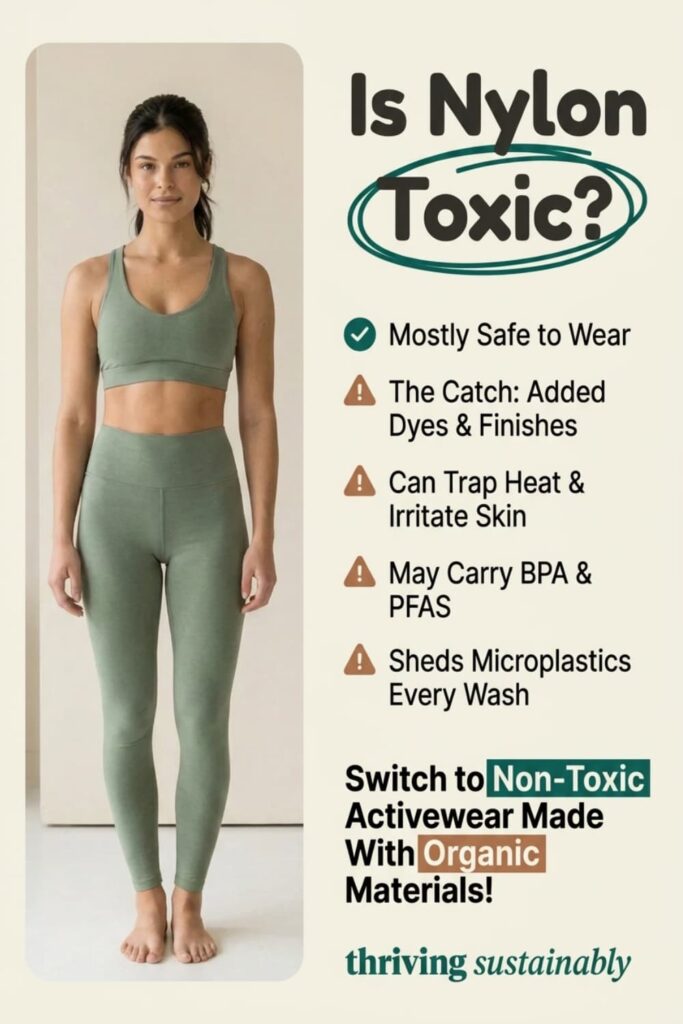
Is Nylon Toxic? Pin This Quick Answer 📌
How Nylon May Affect Your Health
For most people, nylon is harmless to wear, but it can irritate the skin, trap heat, and contain added chemicals such as formaldehyde finishes, PFAS, and BPA.
Most of us wear nylon without a second thought, and for most people, that’s perfectly fine. Still, a handful of things about how nylon behaves can bother sensitive skin, and knowing them helps you tell a real fabric problem from a finish or fit problem.
Skin Irritation and Sensitivity
Nylon doesn’t breathe well and isn’t very absorbent, so it can leave skin feeling hot, damp, and a little itchy. For people with sensitive skin or eczema, that combination can trigger redness or a rash. Often, the fiber isn’t even the main culprit. It’s the dyes and finishes layered on top.
Heat and Sweat Trapping
Because nylon holds moisture against your skin instead of wicking it away, it can create a warm, damp environment. That’s uncomfortable on a hot day and can make some skin and yeast issues worse, especially in close-fitting pieces.
Chemical Finishes and Treatments
This is the part actually worth paying attention to. To make clothes wrinkle-free, water-resistant, or stain-resistant, manufacturers coat the fabric with additional chemicals. Some wrinkle-resistant finishes release small amounts of formaldehyde, a chemical that can irritate skin. A U.S. Government Accountability Office report found that while formaldehyde levels in clothing are generally low, allergic skin reactions are a genuine issue for sensitive people. Water- and stain-resistant pieces may also contain PFAS, the “forever chemicals” that accumulate in the body and the environment over time.
There’s also BPA, a hormone-disrupting chemical, to keep on your radar. Testing by the Center for Environmental Health found high levels of BPA in synthetic activewear, with some pieces exposing wearers to up to 40 times California’s safe limit. That testing centered on polyester-and-spandex leggings and sports bras, but nylon is blended into many of the same tight, sweat-it-out garments, so it’s worth knowing about.
Why Do Some People React More Than Others?
Most folks wear nylon with zero issues. People who notice problems tend to have sensitive skin, eczema, allergies, or a reaction to a specific dye or finish rather than to the fiber itself. If a new top leaves you itchy, the finish is likely the culprit.
Is Nylon Safe to Wear?
Yes, nylon is safe to wear for most people. The exception is tight, sweaty, close-contact items like underwear and leggings, where a breathable natural fiber is the better pick.
A nylon raincoat, backpack, or pair of running shorts is nothing to lose sleep over. The fiber is stable, and brief or loose-fitting contact gives chemicals little opportunity to affect it.
Where it’s reasonable to be choosier is with the pieces that sit tight against your skin for hours, especially where you sweat. Sweat and warmth help your skin absorb whatever is on the fabric, so close-contact items are where switching to a natural fiber pays off the most.
The three worth prioritizing are underwear, activewear, leggings, and sleepwear. These hug your skin, trap heat, and stay on for a long stretch. For those, a breathable natural fiber is the gentler, more comfortable choice. For a jacket or a bag, nylon is genuinely fine.
Nylon and the Environment
Nylon’s biggest downside is environmental: it’s an oil-based plastic that doesn’t biodegrade and sheds microplastics into waterways with every wash.
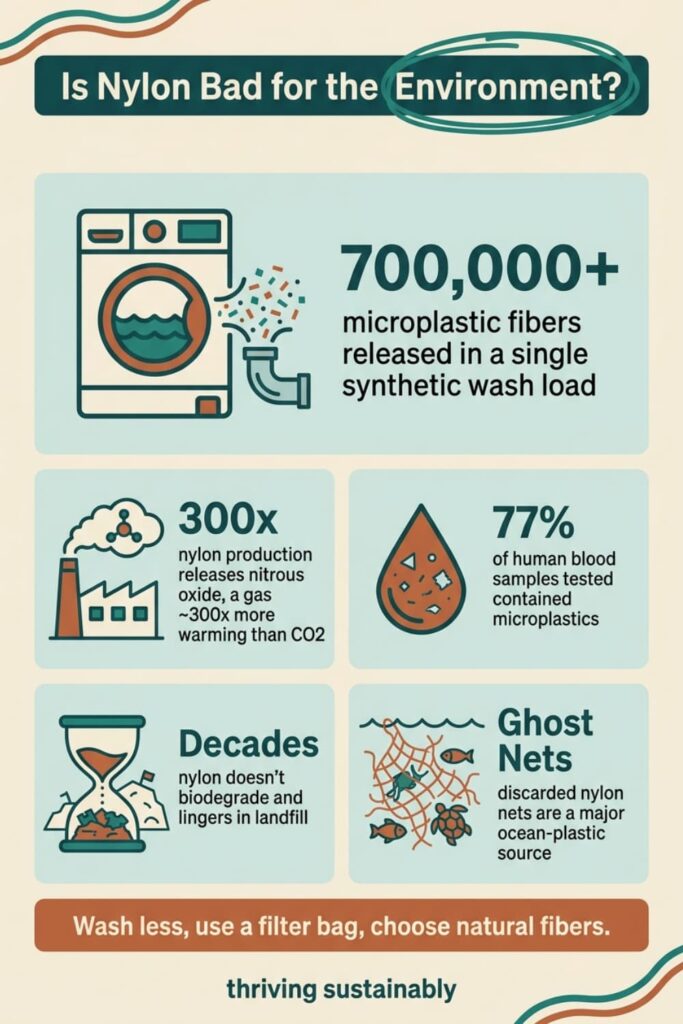
This is where the bigger problem lives, and it ties straight into the microplastics story.
Remember, nylon is made from oil, and it’s a form of plastic. That gives it two environmental downsides. Making it is energy-intensive and tied to fossil fuels, and one step in its production releases nitrous oxide, a greenhouse gas that is nearly300 times more warming than carbon dioxide. And at the end of its life, nylon doesn’t biodegrade, so a single garment can sit in a landfill for decades.
The concern that hits closest to home, though, is microplastics. Every time you wash a synthetic garment, it sheds thousands of microscopic plastic threads that are too small for wastewater treatment plants to capture, so they flow into rivers and oceans. A widely cited study by Napper and Thompson found that a single wash load of synthetic fabric can release more than 700,000 of these tiny fibers. The good news for nylon specifically: in their tests, tightly woven nylon sheds less than fluffy polyester fleece. Construction matters as much as the fiber name.
Those shed fibers are now showing up in tap water, seafood, soil, and even our bodies. One 2022 study (Leslie et al.) found microplastics in 77% of the blood samples it tested, and PET, the plastic used to make polyester, was among the most common types. That’s why cutting microplastic shedding has become such a practical, worthwhile goal.
Discarded nylon fishing nets, known as ghost nets, are another large piece of the ocean-plastic problem, and that’s exactly the waste recycled nylon sets out to reclaim.
Safer Alternatives to Nylon
The safest alternatives to nylon are natural fibers: organic cotton, linen, wool or merino, and wood-based Tencel.
They breathe better, hold less odor, and don’t shed plastic in the wash, which makes them the simplest upgrade for your closest-contact clothes.
Good swaps to look for include organic cotton for everyday basics and underwear, linen for warm-weather pieces, wool or merino for socks and base layers, and Tencel or lyocell, a soft fiber made from wood pulp, for a silky synthetic-style feel without the plastic.
When alternatives are worth it: prioritize natural fibers for underwear, leggings, bras, and sleepwear, the items that stay tight against your skin longest. For outerwear, gym bags, and rain gear, nylon’s durability is a fair trade, and there’s a greener version of it (more on that below).
A few quick buying tips. Read the full label, not just the big print, since “cotton” pieces are often blended with a slice of nylon or spandex. Aim for more cotton or wool in the blend for close-contact clothes. For the cleanest options, look for third-party labels like GOTS-certified organic cotton or OEKO-TEX STANDARD 100, which limit the harmful chemicals allowed in the finished fabric. And treat vague marketing words like “performance” or “easy-care” as a hint that a chemical finish may be involved.
How to Reduce Exposure If You Already Own Nylon
To lower your exposure, wash new nylon before wearing it, skip heavily treated finishes, and use a microfiber filter bag in the laundry.
You don’t need to throw anything out. A handful of small habits handle most of the concern.
🧼 Wash new pieces before wearing. One wash removes most of the leftover factory dye and finishing residue from the fabric’s surface.
🚫 Skip the heavily treated stuff when you can. Wrinkle-free, stain-proof, and water-repellent finishes are most likely to contain irritating or unwanted chemicals. Plainer fabric means fewer add-ons against your skin.
🧵 Choose breathable, better-made fabrics for sensitive uses. For underwear and workout gear, pick natural fibers or at least better-constructed pieces, and look for underwear with a cotton gusset.
💧 Wash synthetics in a filter bag and less often. A microfiber-catching laundry bag like the Guppyfriend or a Cora Ball tossed in the drum traps shed fibers before they reach the drain. Washing nylon only when it’s actually dirty, on a cooler cycle, cuts both shedding and wear. That protects both your clothes and the water.
FAQs on Answering: Is Nylon Toxic?
It can. BPA, a hormone-disrupting chemical, has been found in synthetic clothing, and watchdog testing flagged high levels in some athletic wear. It isn’t in every nylon item, but it’s a reason to wash new synthetic activewear before wearing and to favor natural fibers for sweaty, close-fitting pieces.
Plain nylon underwear is fine for most people for short stretches, but it traps heat and moisture, which can lead to irritation or yeast issues for some. If you’re prone to either, choose breathable cotton or look for nylon undies with a cotton gusset.
Recycled nylon like ECONYL, made by reprocessing old fishing nets and fabric scraps, is the same fiber as virgin nylon, so it isn’t necessarily gentler on your skin. Its big win is environmental: it skips a lot of new oil and keeps plastic waste out of the ocean.
Wearing finished nylon clothing is not established as a cause of cancer. The concerns are about certain chemicals sometimes added to textiles, not the everyday fiber, which is another reason to rinse new pieces and lean toward natural for close-contact items.
They’re close cousins, both plastic-based fibers made from oil. In shedding tests, tightly woven nylon often released fewer microplastics than fluffy polyester fleece, but neither is a natural fiber. For skin comfort and the planet, cotton, linen, and wool still beat both.
A true allergy to the nylon fiber itself is uncommon. Most reactions blamed on nylon are actually caused by the dyes or finishes on the fabric, or by heat and sweat trapped against the skin. A doctor or dermatologist can help pin down the real trigger.
Final Thoughts About Whether Nylon Is Toxic
So, is nylon toxic? Not in the dramatic sense. The fiber itself is stable and safe enough for most people to wear every day. The fair concerns are smaller and more specific: the dyes and finishes added in the factory, the heat and irritation that close-fitting synthetics can cause, and the steady stream of microplastics every wash sends downstream.
That’s actually good news, because it means you’re in control. You don’t have to fear your raincoat or replace your whole wardrobe. You just get a little choosier where it counts, picking natural fibers for underwear, leggings, and sleepwear, and a little smarter in the laundry room with a filter bag and fewer washes.
References 📚
- American Oil & Gas Historical Society. (n.d.). Nylon, a petroleum polymer. https://aoghs.org/products/petroleum-product-nylon-fiber/
- Aquafil. (n.d.). ECONYL® regenerated nylon. https://econyl.aquafil.com/
- Center for Environmental Health. (2022). New testing shows high levels of BPA in sports bras and athletic shirts. https://ceh.org/latest/press-releases/new-testing-shows-high-levels-of-bpa-in-sports-bras-and-athletic-shirts/
- Global Efficiency Intelligence. (2021). Stopping a super-pollutant: N2O emissions abatement from global adipic acid production. https://www.globalefficiencyintel.com/
- Leslie, H. A., van Velzen, M. J. M., Brandsma, S. H., Vethaak, A. D., Garcia-Vallejo, J. J., & Lamoree, M. H. (2022). Discovery and quantification of plastic particle pollution in human blood. Environment International, 163, 107199. https://doi.org/10.1016/j.envint.2022.107199
- Napper, I. E., & Thompson, R. C. (2016). Release of synthetic microplastic plastic fibres from domestic washing machines: Effects of fabric type and washing conditions. Marine Pollution Bulletin, 112(1-2), 39-45. https://doi.org/10.1016/j.marpolbul.2016.09.025
- U.S. Government Accountability Office. (2010). Formaldehyde in textiles (GAO-10-875). https://www.gao.gov/products/gao-10-875
More Microplastics & Plastic-Free Living Reads
We’ve scored every clothing and textile pick on plastic — see them in the Fashion & Textiles directory.