
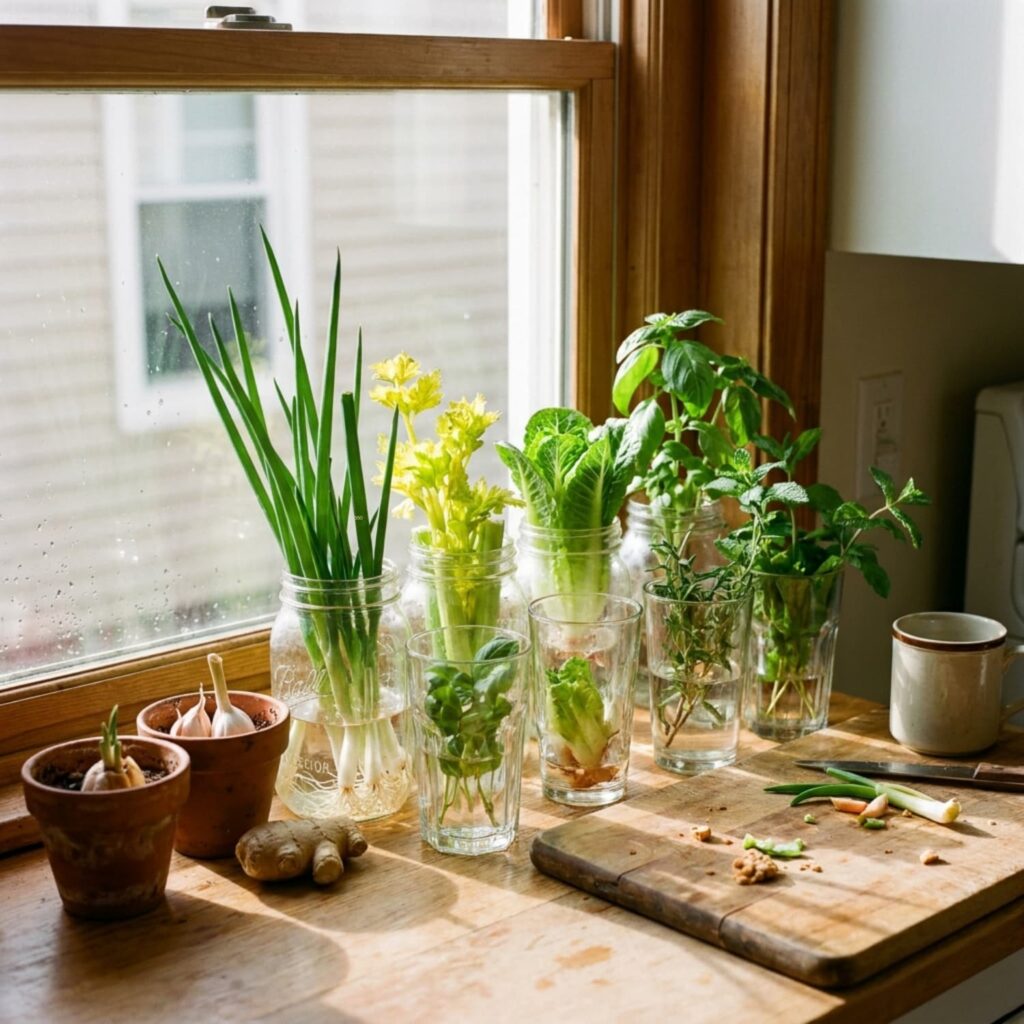
Key Takeaways
- Many foods you can regrow from scraps need nothing but a jar of water and a sunny windowsill, including green onions, celery, romaine, and fresh herbs.
- Some scraps give you a full new crop (garlic, potatoes, ginger), while others only regrow leafy greens for garnish or pesto, so it helps to know which is which before you start.
- Regrowing cuts food waste and skips the plastic clamshells and produce bags your store herbs and greens usually come wrapped in.
You buy a bunch of green onions, use two of them for one dinner, and the rest go slimy in the crisper drawer before the week is out. It happens with celery, with herbs, with half the produce aisle.
Here’s the part most people never learn: the very scrap you’d normally toss, the little white root end of those green onions, will grow you a whole new bunch on your windowsill in about a week. For free. No garden, no seeds, not even soil for a lot of them.
This is a beginner’s guide to the foods you can regrow from scraps, sorted by how you do it (a glass of water or a pot of soil) and how much you actually get back. We looked at which ones work, which ones only give you a garnish, and which are more of a fun science project than a real harvest, so you don’t waste a windowsill on a pineapple that takes two years. Grab a jar and let’s put those scraps to work.
How Regrowing Food From Scraps Works
Most kitchen scraps regrow one of two ways: leftover roots and stems sprout new growth in a glass of water, or sprouted bits like garlic and potatoes go straight into soil for a full new crop.
The idea sounds like a trick, but it’s just basic plant biology. A lot of the vegetables you buy are still alive when you get them home. The base of a celery stalk, the root end of a green onion, a sprouting clove of garlic: each one still has a growing point that will keep going if you give it water and light.
There are two simple methods, and almost every food on this list uses one of them.
💧 Water First
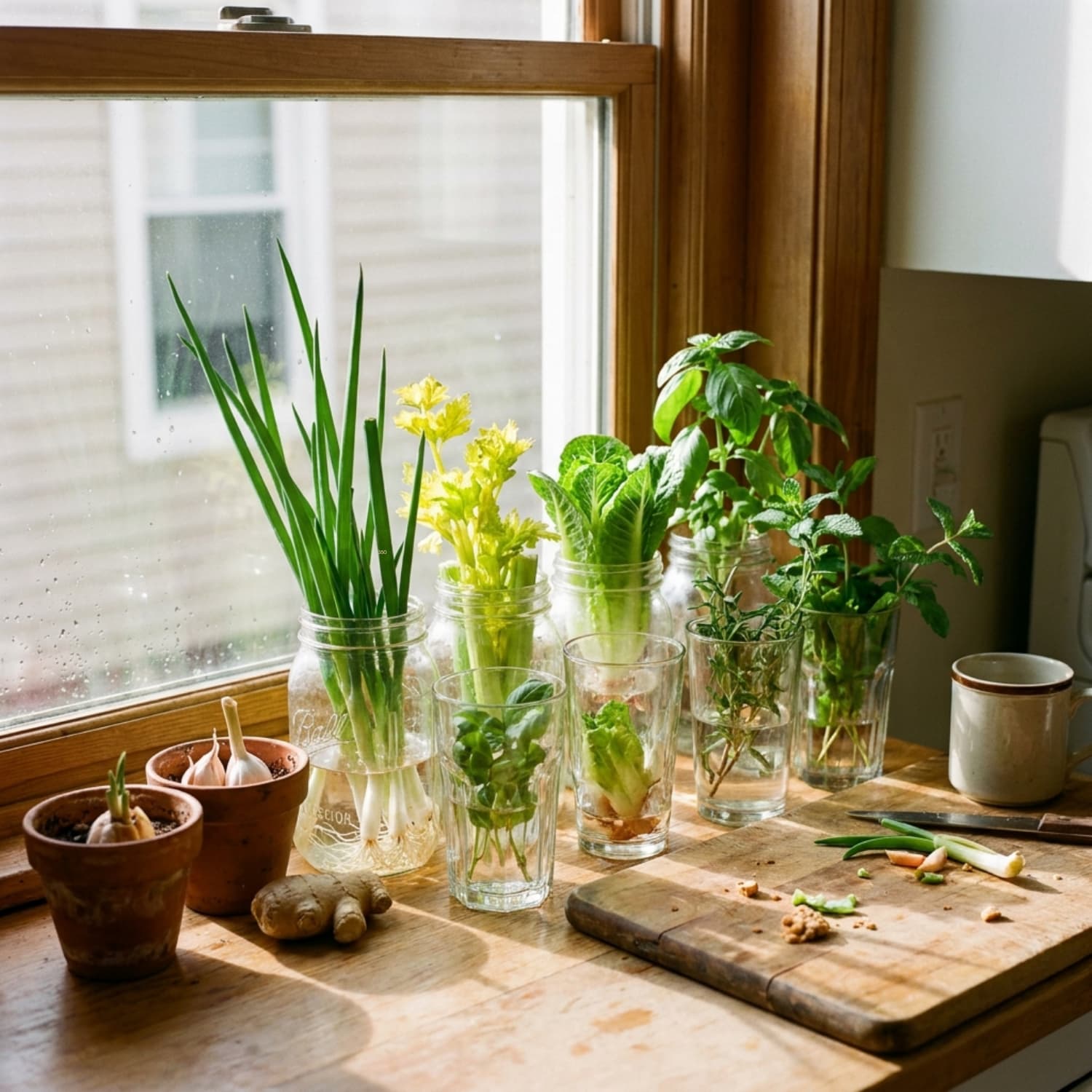
For anything with a root base or a stem, you set the cut end in a shallow glass of water on a sunny windowsill and change the water every day or two. Within days you’ll see fresh green growth. This is the fastest, tidiest way to start, and for some foods (like green onions and herbs) you can keep them in water the whole time.
🪴 Then Soil, for a Real Harvest
Water regrowth is great for a quick handful of greens, but the plant runs out of steam because water alone has no nutrients. To get a full, lasting crop, you move the rooted scrap into a pot of soil or your garden once it has roots. A few foods (garlic, potatoes, ginger) skip the water step and go straight into soil.
One note before you start: not every scrap gives you a full vegetable back. Some, like carrot tops, only regrow leafy greens, not a new carrot. That’s still useful, but it helps to know what you’re getting so you’re not disappointed.
Don’t Miss: Composting for Beginners For every scrap that won’t regrow, here’s the simple way to turn it into free soil instead of trash. Read more →Foods You Can Regrow in a Glass of Water
Green onions, leeks, celery, leafy greens, fennel, lemongrass, and soft herbs all regrow from the base or a cutting in a jar of water on a windowsill, usually within a week.
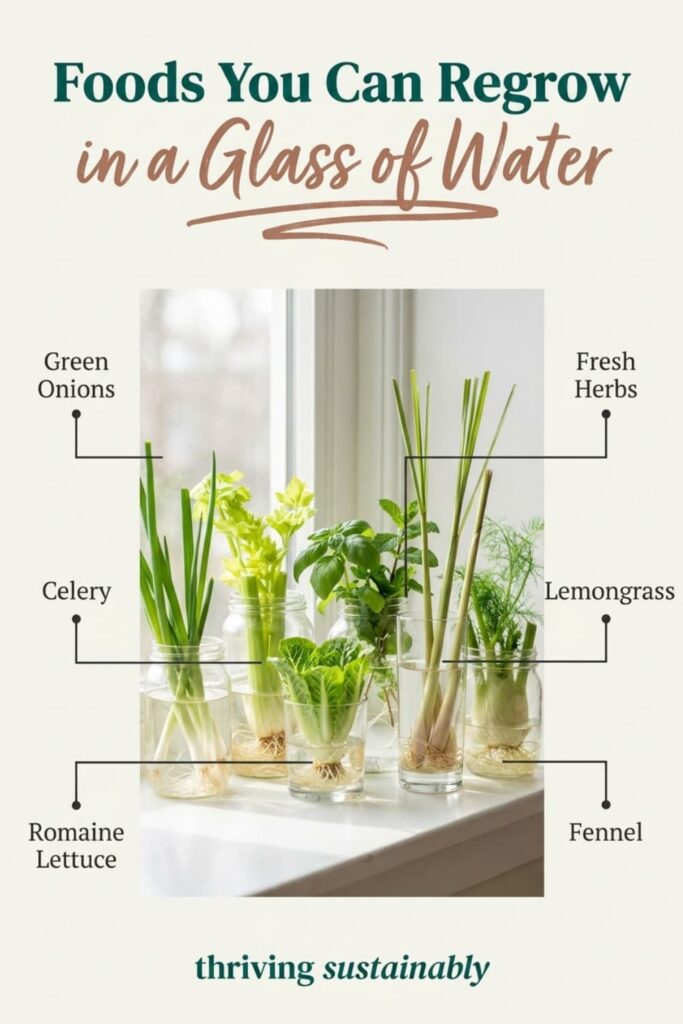
These are the beginner wins. No soil, no special gear, just a jar, some water, and a sunny spot. Change the water every day or two so it stays fresh, and you’ll see growth fast.
Green Onions, Scallions, and Leeks
This is the one to start with. Green onions are the easiest food to regrow from scraps, and it barely counts as effort. When you cut your green onions for a recipe, leave the bottom inch or two with the little roots attached. Stand those root ends up in a glass with about an inch of water, set it on a windowsill, and you’ll see new green shoots within a few days.
The University of Michigan School for Environment and Sustainability tried this and found green onions the most straightforward of all, mostly because they already have established roots. Even better, you can snip what you need, and they’ll grow back several times over. Leeks and scallions work exactly the same way.
Celery
Celery is the classic scrap-to-plant project, and it’s oddly satisfying to watch. Cut the base off the bunch, leaving a stump about two inches tall. Set it cut-side up in a shallow bowl with an inch of water, put it somewhere sunny, and change the water daily.
New leaves push up from the center within a week or so. Celery is a slower grower than green onions, and the water-grown stump gives you tender inner stalks and leaves rather than a full grocery-store bunch. For the best result, once you see roots forming, plant the base in a pot of soil where it can really take off.
Leafy Greens: Romaine, Bok Choy, and Cabbage
Romaine lettuce, bok choy, and cabbage all regrow from the base the same way celery does. Keep the bottom couple of inches of the head, set it cut-side up in a little water, and park it in the sun. Fresh leaves sprout from the middle in a few days.
One realistic expectation: you’ll get enough new leaves for a small salad or a stir-fry handful, not a whole new head from the base alone. The University of Michigan team grew “enough romaine leaves to make a small salad” in about a week. To keep it producing, move it to soil once roots appear.
Fennel
Fennel regrows just like the leafy greens. Save the base with the roots intact, stand it in an inch of water in a sunny window, and refresh the water daily. You’ll get feathery new fronds you can snip for cooking. Transfer it to soil if you want it to bulb up again.
Lemongrass
Lemongrass is a fun one because it looks nothing like a plant when you buy it, just a woody stalk. Pop a leftover stalk (with the base intact) into a glass of water in a bright spot. In a week or two it sends out roots and fresh green shoots from the top. Once rooted, plant it in a pot, and it’ll grow into a tall, grassy clump you can harvest from all season.
Fresh Herbs: Basil, Mint, and Cilantro
Soft-stemmed herbs are some of the most rewarding scraps to regrow, because store herbs are expensive and always come in a plastic clamshell. Take a four to six inch cutting, snip off the lower leaves, and set the bare stem in water below a leaf node (the little bump where leaves grow out). Basil and mint root especially easily this way. Give it a sunny spot, change the water every couple of days, and roots appear within a week or two. When the roots reach about two inches, pot it up in soil for a plant that keeps giving.
✨ Tip
Finicky Basil? Try This
Basil can be finicky in water and sometimes wilts before it roots. Take two or three cuttings at once so at least one takes, and you’ve lost nothing but a stem you were tossing anyway.
Foods You Can Regrow in Soil
Garlic, ginger, turmeric, potatoes, sweet potatoes, and onions skip the water jar and go into soil, where a single sprouted clove, root, or piece can grow a whole new crop.
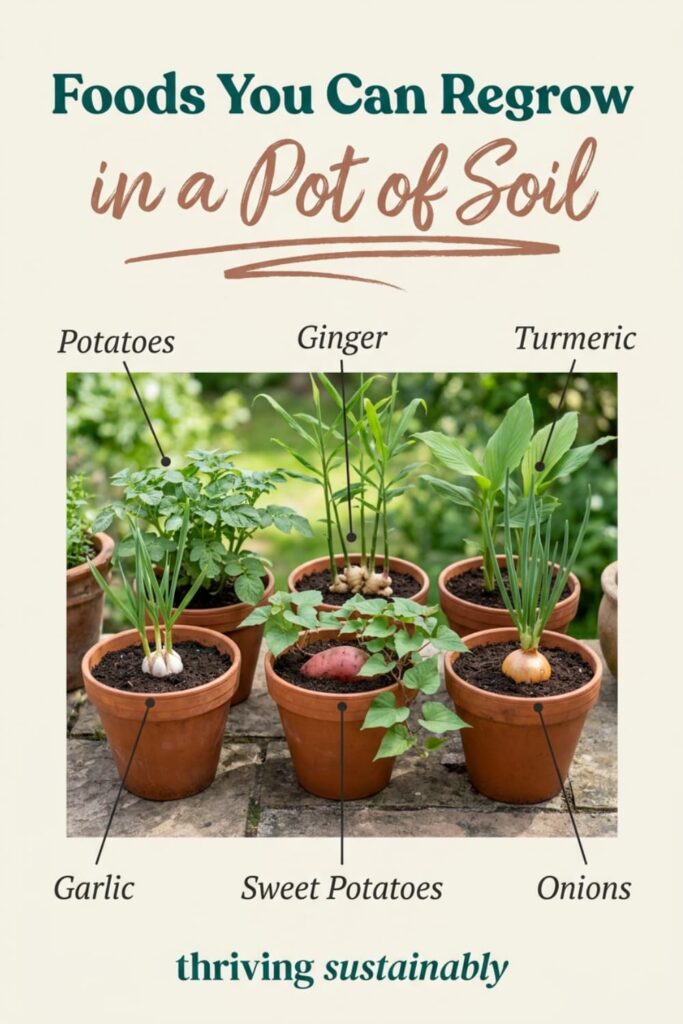
These take a little more patience and a pot of soil, but the payoff is bigger: an actual harvest rather than a handful of greens. They’re perfect for that garlic clove that sprouted a green shoot or the potato growing eyes in the back of the pantry.
Garlic
Found a clove sprouting a little green tail? That’s a free garlic plant. Plant the sprouted clove pointy-side up in soil, about an inch deep. In the short term you’ll get garlic greens, which taste like a mild garlicky chive and are great snipped over eggs or potatoes. Leave it in the ground for the long haul (garlic likes to be planted in fall and harvested the next summer) and that one clove multiplies into a whole new bulb.
Ginger and Turmeric
Ginger and turmeric are the same trick, since both are rhizomes (underground stems, not roots). Take a knob with a few of the little bumps, or “eyes,” on it, and plant it just under the surface of a wide, shallow pot of soil, eyes pointing up. Keep it warm and lightly moist. It’s slow, so give it patience, but over a few months it grows leafy shoots above the soil and fresh rhizome below that you can harvest and replant. One knob from the store can keep you in ginger indefinitely.
Potatoes
Any potato that’s grown “eyes” (those little sprouting dimples) can become new potato plants. Cut the potato into chunks so each piece has one or two eyes, let the cut sides dry for a day, then plant them a few inches deep in soil. Each piece grows into a plant that produces a handful of new potatoes underground. It’s one of the highest-payoff scraps on this list.
Sweet Potatoes
Sweet potatoes grow a little differently. A sweet potato sprouts leafy shoots called “slips.” Set the sweet potato half in water (toothpicks can hold it up) or nestle it in damp soil, and it sends up slips. Snap those slips off, root them in water, then plant the rooted slips. Each sweet potato can produce a dozen or more slips, and each slip becomes its own plant.
Onions
The root end of an onion regrows too. Save the bottom inch with the roots, let it dry for a few hours, and plant it in soil. It’ll sprout green shoots, and given time and space, work toward forming a new bulb. Even if you only ever use the green shoots, that’s fresh oniony flavor from a scrap headed for the bin.
Save This Scrap-to-Plant List for Later 📌
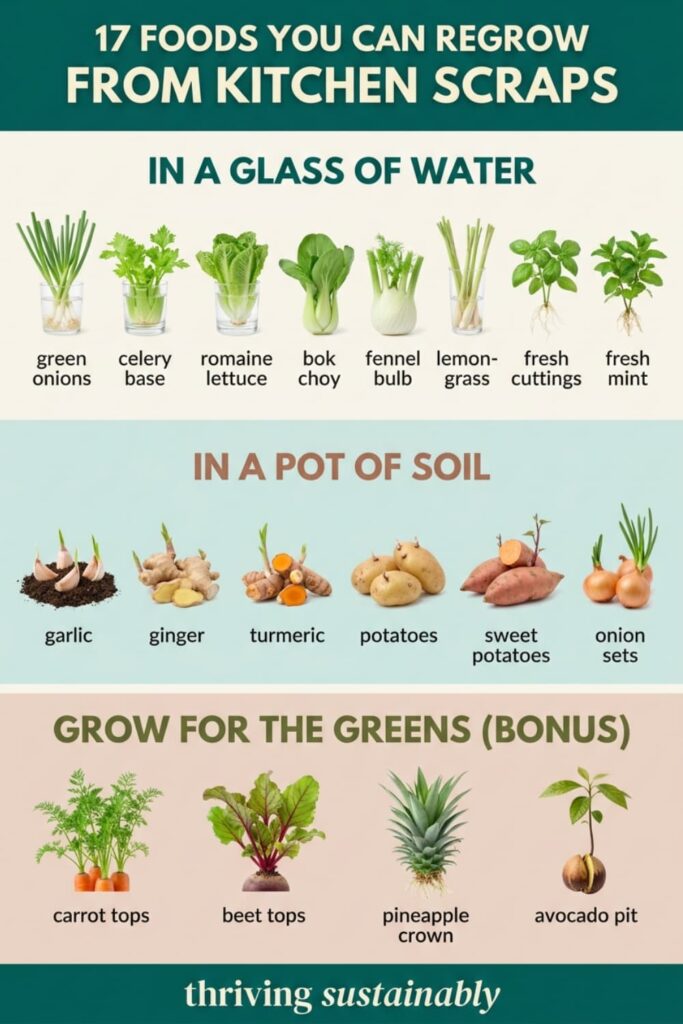
Bonus: Grow These for the Greens (and Manage Your Expectations)
Carrot and beet tops regrow edible leafy greens but not new roots, while pineapple and avocado can sprout from scraps but are slow, fussy houseplants more than a real harvest.
Not every scrap is a full meal, and that’s fine as long as you know it going in. A few are worth doing for the greens or just for fun.
Carrot tops. Set the flat top of a carrot (the end with the stubby bit where the leaves were) in a shallow dish of water. It won’t grow a new carrot, but it sprouts feathery green tops that are edible and mildly carroty. Chop them into pesto, soups, or a salad instead of buying an herb you’ll only half use.
Beet tops. Same story as carrots. The top of a beet regrows leafy greens, not a new beet, and beet greens are genuinely delicious sauteed like chard.
Pineapple. You can twist the leafy crown off a pineapple, dry it a couple of days, and root it in water or soil. It makes a striking houseplant. Just know it can take two years or more to fruit, and often won’t indoors, so grow it for the plant, not the pineapple.
Avocado. The classic toothpicks-and-a-pit project. It’ll sprout into a leafy little tree, which is a lovely windowsill plant, but a homegrown pit rarely produces fruit and can take many years to even try. Do it with kids for the wonder of it, not for guacamole.
How Much Money (and Plastic) This Actually Saves
Regrowing scraps trims a grocery bill and cuts food waste, and it quietly skips the plastic clamshells and produce bags that herbs and greens almost always come wrapped in.
The savings look small on any single jar of green onions, but they add up in two directions.
First, waste. According to the U.S. Department of Agriculture, more than one-third of the food produced in the United States goes uneaten, and the average American family of four loses about $1,500 a year to food they buy and never eat. A big chunk of that is exactly the stuff on this list: herbs and greens that wilt before you finish them. Regrowing the ends you’d toss turns that waste into a second (and third) harvest.
Second, plastic. Fresh herbs come in rigid plastic clamshells. Green onions and greens come banded or bagged in film. When you regrow your own on the windowsill, you stop buying those single-use containers over and over. It’s a small swap, but since a lot of us buy herbs weekly, the packaging you skip adds up fast over a year.
You won’t grow your whole grocery list on a windowsill, and that’s not the point. Regrowing a few high-turnover items you already buy, like green onions and herbs, is where the money, the waste, and the plastic savings actually meet.
Don’t Miss: How to Avoid Microplastics (Without Overhauling Your Life) Skipping plastic-wrapped produce is one small piece. Here are the simple swaps that cut the most plastic. Read more →Frequently Asked Questions
Yes. You’re just continuing a plant that’s already alive, so nothing about regrowing makes food unsafe. Give regrown greens a good wash before eating. One tip: some conventional potatoes are treated with a sprout inhibitor and grow slowly, so organic potatoes and garlic tend to sprout more reliably.
In a jar of water, no, but plain water has no nutrients, so growth slows and yields stay small. That’s fine for a quick harvest of green onions or herbs. Once you move a scrap into soil for a full crop, a little compost or all-purpose plant food helps it produce.
Usually it’s old or stagnant water, or too little light. Change the water daily, keep the cutting in a bright spot, and if a base starts to rot or brown, start fresh with a new one. Moving it to soil once roots appear also helps it push past the browning stage.
The greens and herbs taste like a milder, fresher version of what you bought. Water-grown regrowth can be a little less intense than a full soil-grown plant since it has fewer nutrients. Soil-grown crops like garlic and potatoes taste just like any other homegrown version.
Fast growers like green onions and herbs show new growth in a few days to a week. Soil crops like garlic, ginger, and potatoes take months to reach harvest. Pineapple and avocado are the slowpokes, often a year or more, and mainly worth it as houseplants.
Skip regrowing things from the seeds inside a fruit, like tomatoes or peppers, unless you enjoy the project, since planting seeds is faster. Mushrooms won’t regrow from a store scrap either. And pineapple or avocado makes lovely plants but rarely fruits indoors, so grow those for looks, not fora harvest.
Final Thoughts About Regrowing Food From Scraps
You don’t need a garden, a yard, or any experience to do this. You need a sunny windowsill, a couple of jars, and the scraps you were already about to throw away. Start with the sure thing, a bunch of green onions, and once you’ve watched those grow back, you’ll want to try celery and herbs too.
Keep your expectations matched to the food. Green onions and herbs are the everyday workhorses that genuinely save money and plastic. Garlic, potatoes, and ginger reward a little patience with a real crop. Pineapple and avocado are the fun ones you do for the wonder of it, not the harvest.
Either way, every scrap you regrow is one less thing wilting in the crisper, one less plastic clamshell in the cart, and one small, free win sitting right there on your windowsill. That’s a pretty good return on a jar of water.
📚References
- U.S. Department of Agriculture. (n.d.). Food loss and waste. https://www.usda.gov/about-food/food-safety/food-loss-and-waste
- University of Michigan School for Environment and Sustainability. (2021). Propagating veggies from kitchen scraps. https://seas.umich.edu/news/propagating-veggies-kitchen-scraps