


Key Takeaways
- At least 45% of US tap water contains one or more PFAS, according to a 2023 USGS study, and the CDC finds four PFAS in the blood of nearly every American tested.
- PFAS (per- and polyfluoroalkyl substances) are called forever chemicals because their carbon-fluorine bonds do not break down in nature, and PFOA and PFOS have blood half-lives of about 3 years, so fully clearing them takes a decade or more.
- The EPA limit for PFOA and PFOS in drinking water is 4 parts per trillion, and a certified reverse osmosis filter is the most reliable way to get below it at home.
PFAS are a family of nearly 15,000 man-made chemicals built to resist water, grease, and heat. They make a raincoat shed water, a pan shed eggs, and a fast-food wrapper shed grease. The trouble is that nothing in nature breaks them down, so they have spread into the tap water, food, and blood of almost everyone in the country. A 2023 US Geological Survey study found at least 45% of US tap water contains one or more PFAS, and the CDC’s national biomonitoring program finds four of them in the blood of nearly all the people it tests.
So what is PFAS, exactly, and how worried should you be? This guide explains what the name means, why these chemicals stick around, where they hide in your home, what the health research shows, and the handful of changes that cut your exposure the most. We researched the primary sources (EPA, ATSDR, NIEHS, peer-reviewed studies) so you get the facts without the panic.
What Does PFAS Stand For?
PFAS stands for per- and polyfluoroalkyl substances, a group of nearly 15,000 synthetic chemicals that all share at least one carbon atom fully bonded to fluorine. Well-known members include PFOA, PFOS, and GenX.
The name sounds intimidating, but it describes a simple idea. “Alkyl” is chemistry shorthand for a chain of carbon atoms. “Fluoro” means fluorine atoms are attached to that chain. The “per” and “poly” prefixes tell you how many.
- The “per” ones, like PFOA and PFOS, are completely coated in fluorine. That makes them the toughest and longest-lasting of the bunch.
- The “poly” ones are only partly coated, so they are a little less stubborn. But over time they can break down into the “per” kind anyway, which is why scientists watch both as one group.
You may also see the older term PFC, short for perfluorinated chemicals. Same family, older label. NIEHS and most agencies switched to PFAS because it covers the poly group too.
How many PFAS are there? The EPA’s CompTox chemicals dashboard tracks a master list of roughly 15,000 structures, while the USGS cites more than 12,000. Exact counts depend on the definition used, but every agency agrees on the important part: current water tests can only detect a few dozen of them.
Why Are PFAS Called Forever Chemicals?
PFAS are called forever chemicals because the carbon-fluorine bond is one of the strongest in organic chemistry, so sunlight, water, and microbes cannot break them apart. Once released, PFAS persist in soil and water for decades and build up in living things.
Think of a carbon-fluorine bond as a knot that nature never learned to untie. The same toughness that makes PFAS so useful in a frying pan or a firefighting foam is exactly what makes them a problem. Normal pollutants eventually rot, rust, or get eaten by bacteria. PFAS just move: from a factory into a river, from a river into a well, from a well into a glass of water, and from that glass into your bloodstream.
Two words come up constantly in PFAS research, and they explain the whole concern.
- Persistence: the chemical does not break down in the environment. Long-chain PFAS like PFOA and PFOS have no known natural half-life in soil or water.
- Bioaccumulation: the chemical builds up in a body faster than the body can clear it. Long-chain PFAS bind to proteins in blood and get reabsorbed by the kidneys instead of passing out in urine, which is why they linger for years.
How Long Do PFAS Persist in the Body?
The best human data comes from Ronneby, Sweden, where a town drank water contaminated by firefighting foam for decades until the source was shut off in 2013. Researchers led by Ying Li and Tony Fletcher then tracked how fast blood levels fell. Their 2018 study in Occupational and Environmental Medicine estimated average half-lives of 2.7 years for PFOA, 3.4 years for PFOS, and 5.3 years for PFHxS. A half-life is the time it takes for the amount in your blood to drop by half, so getting from a high level to a low one takes several half-lives, often a decade or more.
Shorter-chain replacements clear faster. PFBS leaves the body in roughly a month, and the EPA notes that GenX chemicals “do not appear to accumulate as much in humans” as PFOA and PFOS. Faster clearance is better, but it is not the same as safe, since ongoing exposure from water keeps topping the level back up.
💫 now you know
What Is a Half-Life?
Half-life is the time it takes for half of a chemical to leave your body. If your PFOS level is 20 nanograms per milliliter today and PFOS has a 3.4-year half-life, you would be at about 10 in 3.4 years, 5 in 6.8 years, and 2.5 in about 10 years, assuming no new exposure. That “assuming no new exposure” part is why cutting the source matters more than anything else.
Types of PFAS: PFOA, PFOS, GenX, and 15,000 Others
The most studied PFAS are PFOA (used to make Teflon), PFOS (the original Scotchgard chemical), PFHxS (from firefighting foam), and GenX (DuPont’s PFOA replacement). PFOA and PFOS were phased out of US manufacturing by 2015, but they remain in water, soil, and people, and thousands of newer PFAS have taken their place.
PFAS get sorted by chain length. Long-chain compounds (8 or more carbons, like PFOA and PFOS) stay in the body longest and have the most health data behind them. When manufacturers phased those out, they moved to short-chain versions (PFBS, PFBA) and newer versions like GenX. Those clear the body faster but are just as persistent in the environment, and the health data on them is thinner. Here is how the big names compare.
| PFAS | Full Name | Common Use | US Regulatory Status (2026) | Half-Life in Humans |
|---|---|---|---|---|
| PFOA (C8) | Perfluorooctanoic acid | Making Teflon (PTFE), grease-proof packaging | EPA drinking water limit 4 ppt; CERCLA hazardous substance; IARC Group 1 carcinogen | About 2.7 years |
| PFOS | Perfluorooctane sulfonic acid | Original Scotchgard, firefighting foam (AFFF) | EPA drinking water limit 4 ppt; CERCLA hazardous substance; IARC Group 2B | About 3.4 years |
| PFHxS | Perfluorohexane sulfonic acid | Firefighting foam, stain repellents | 10 ppt limit set in 2024; EPA proposed rescinding it in May 2026 | About 5.3 years |
| PFNA | Perfluorononanoic acid | Processing aid for fluoropolymers | 10 ppt limit set in 2024; EPA proposed rescinding it in May 2026 | Years (similar to PFOA) |
| GenX (HFPO-DA) | Hexafluoropropylene oxide dimer acid | PFOA replacement in fluoropolymer manufacturing | 10 ppt limit set in 2024; EPA proposed rescinding it in May 2026 | Much shorter; does not build up like PFOA |
| PFBS | Perfluorobutane sulfonic acid | PFOS replacement in stain and water repellents | Regulated only as part of a mixture “hazard index” (also proposed for rescission) | About 1 month |
One more name worth knowing: PTFE, the plastic sold as Teflon. PTFE is itself a PFAS (a very large one called a fluoropolymer), but it’s very stable and doesn’t dissolve into your food the way PFOA does. The concern with nonstick pans is less about the coating and more about the smaller PFAS used to manufacture it, plus fumes if the pan overheats.
Don’t Miss: Best Reverse Osmosis Systems: 8 PFAS-Certified Picks Already know you want PFAS out of your tap water? We vetted the under-sink and countertop systems that carry real NSF PFOA and PFOS certification. Read more →Where Are PFAS Found? Common Sources of Exposure
PFAS are found in drinking water, nonstick cookware, grease-resistant food packaging, waterproof and stain-resistant fabrics, some cosmetics and dental floss, and firefighting foam. For most people, drinking water and diet are the two largest sources of PFAS exposure.
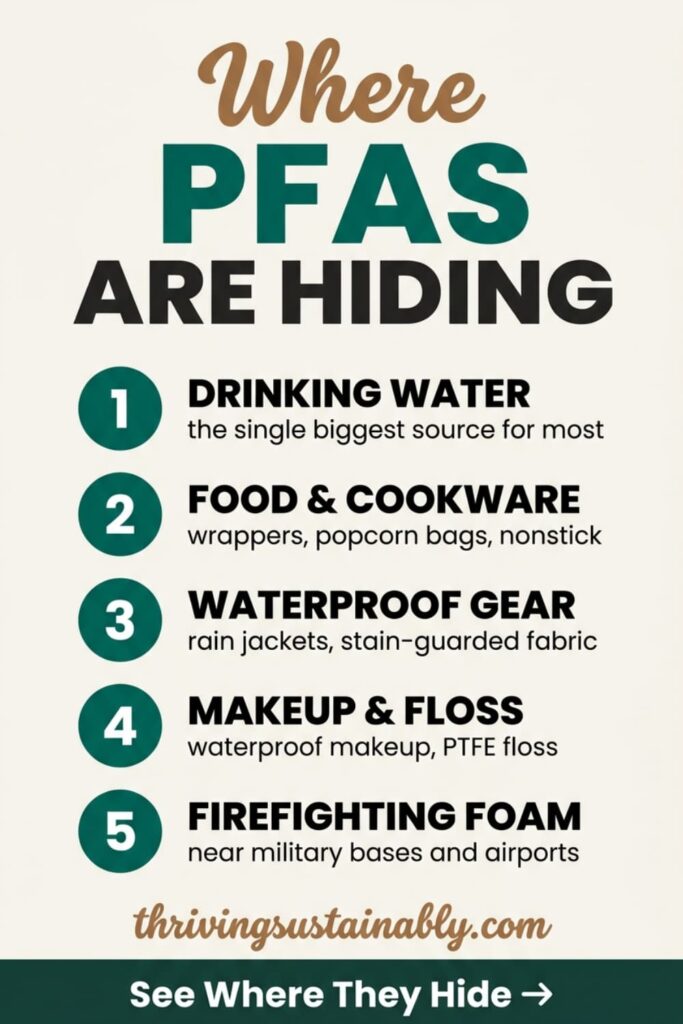
Since the 1940s, PFAS have been added to anything that needed to repel water, oil, or stains. That is a long list. The good news is that the sources are not equal. A few account for most of what ends up in your blood, and those are the ones worth changing first.
🚰 Drinking Water
Tap water is the single biggest PFAS source for people who live near a contaminated site, and a meaningful one for everyone else. The USGS study that found PFAS in at least 45% of tap water sampled 716 locations, including private wells, and tested for only 32 of the thousands of PFAS in use. Meanwhile, the EPA’s own nationwide survey (UCMR 5, covering more than 10,000 water systems) found about 8% of systems above the 4 ppt limit for PFOA and about 9% above it for PFOS, with large systems serving more than 10,000 people roughly twice as likely to exceed as small ones. Private wells are not covered by any of this monitoring, so if you are on a well, testing is on you.
🍕 Food Packaging and Cookware
For decades, the grease-proof coating on microwave popcorn bags, pizza boxes, and fast-food wrappers was a PFAS. That changed recently. In February 2024, the FDA announced that manufacturers had stopped selling PFAS grease-proofing agents for paper and paperboard into the US market, and in January 2025 it formally pulled 35 food-contact authorizations for those uses. The FDA calls this “the primary source of exposure to PFAS from authorized food contact uses,” so new packaging is much cleaner than it was five years ago. Imported and old-stock packaging can still carry it.
Nonstick cookware is a different story. The PTFE coating on a Teflon-style pan is still authorized by the FDA, which says negligible amounts migrate into food during normal cooking. Real risks come from overheating (PTFE starts breaking down above about 500°F, releasing fumes that are harmful to birds and can cause flu-like symptoms in people) and scratched, flaking coatings. PFOA has not been used to make Teflon in the US since 2013, but “PFOA-free” does not mean PFAS-free, since the coating itself is a PFAS. Cast iron, carbon steel, stainless steel, and glass are the swaps that skip the question entirely.
🧥 Textiles and Waterproof Gear
The durable water repellent (DWR) finish on rain jackets, hiking pants, and ski wear was traditionally a PFAS, and so was the stain guard on carpets, couches, and “performance” school uniforms. Scotchgard, made by 3M, was PFOS-based until 2000 and then reformulated with shorter-chain PFAS.
The exposure route here is mostly dust: the finish wears off over time, sheds into house dust, and gets breathed in or swallowed, which matters most for crawling babies and toddlers. Many outdoor brands have now switched to PFAS-free DWR, and Minnesota, Maine, and California have banned intentionally added PFAS in apparel and textiles on rolling deadlines through 2032.
💄 Cosmetics and Dental Floss
Long-wear foundation, waterproof mascara, and lipstick sometimes use PFAS for that smooth, water-resistant finish. Look for “fluoro” or “perfluoro” anywhere in the ingredient list, or the abbreviation PTFE. Dental floss is the sneaky one.
Several popular “glide” style flosses are made from PTFE, the same polymer as a nonstick pan, and a 2019 study in the Journal of Exposure Science and Environmental Epidemiology found women who used PTFE floss had higher blood levels of PFHxS. Waxed silk or plant-based floss avoids it. Our dental floss directory scores the plastic-free options so you can swap in one step.
🔥 Firefighting Foam (AFFF)
Aqueous film-forming foam, or AFFF, is the concentrated PFAS product used to smother fuel fires at military bases, airports, refineries, and fire training grounds. Decades of training exercises soaked the ground with PFOS and PFHxS, which then leached into groundwater.
AFFF is why so many contamination hotspots sit next to air bases, and it is the subject of the largest PFAS lawsuit in the country (more on that below). At least 11 states now restrict or ban its use.
✨ tip
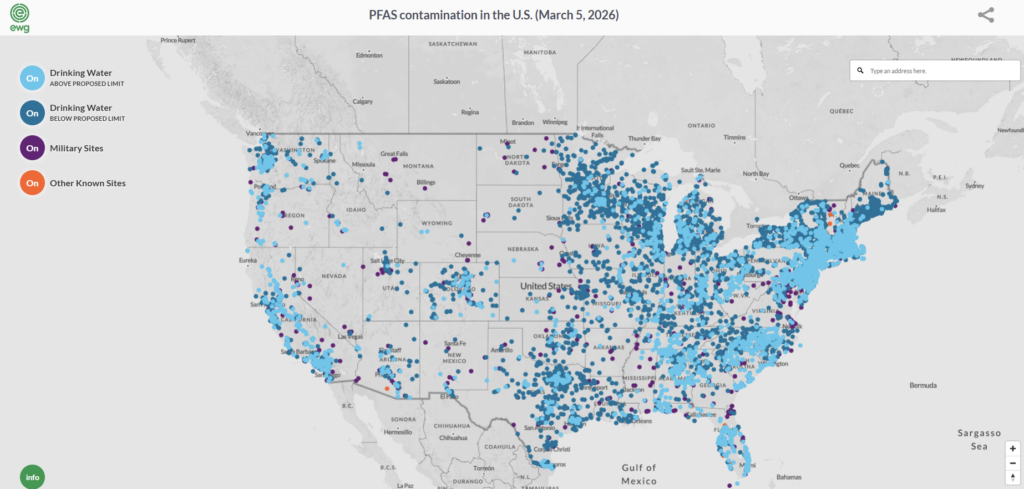
Check Your ZIP Code in 30 Seconds
The Environmental Working Group keeps an interactive PFAS contamination map built from EPA UCMR 5 data, state testing, and military site records. Type in your town and you will see whether your utility has reported PFAS, and at what level. Pair it with the EPA’s UCMR 5 Data Finder for the raw numbers.
PFAS Health Effects: What Does the Science Say?
So what does all this actually do to a body? According to the CDC’s ATSDR, PFAS have been tied to higher cholesterol, a weaker response to vaccines, liver changes, high blood pressure during pregnancy, slightly smaller babies at birth, and a higher risk of kidney and testicular cancer. The strongest evidence is for PFOA and PFOS, since those two have been studied the longest.
Health research on PFAS is unusual because of a single, massive natural experiment. After DuPont’s Parkersburg, West Virginia plant contaminated the Ohio River valley with PFOA (then called C8), a 2005 class-action settlement funded the C8 Health Project, which collected blood and health records from roughly 69,000 residents.
The independent C8 Science Panel spent seven years on the data and, between 2011 and 2012, reported “probable links” between PFOA and six conditions: kidney cancer, testicular cancer, thyroid disease, ulcerative colitis, high cholesterol, and pregnancy-induced hypertension. That list still anchors most of what agencies say about PFOA today.
The EPA’s own summary adds decreased fertility, developmental delays in children, hormone interference, reduced immune response, and increased risk of prostate, kidney, and testicular cancers. Not every study agrees on every effect, and dose matters. The clearest pattern is that immune and cholesterol effects show up at fairly ordinary exposure levels, while cancer signals come mostly from highly exposed communities and workers.
PFAS and Cancer
In November 2023, the International Agency for Research on Cancer (IARC), the cancer arm of the World Health Organization, classified PFOA as Group 1, “carcinogenic to humans,” based on sufficient evidence in animals and strong mechanistic evidence, with limited human evidence for kidney and testicular cancer. PFOS was placed in Group 2B, “possibly carcinogenic to humans.” Group 1 is the same category as tobacco smoke and asbestos. That label speaks to the strength of the evidence, not the size of the risk, so it does not mean PFOA is as dangerous as smoking. It means researchers are confident it can cause cancer under some conditions.
PFAS in Pregnancy and Children
PFAS cross the placenta and pass into breast milk, so a baby’s exposure starts before birth. The effects ATSDR lists with the most support are slightly lower birth weight, pregnancy-induced high blood pressure and preeclampsia in the mother, and a weaker antibody response to childhood vaccines. Breastfeeding is still recommended by every major health body because its benefits outweigh the PFAS concern. The practical move for parents is to filter the water used for formula and drinking, keep dust down in rooms where a baby crawls, and skip stain-treated furniture and PTFE-coated pans.
💫 now you know
Can You Test Your PFAS Blood Level?
Yes. A PFAS blood test exists, but most people never get one, and it is not part of a standard physical. You have to ask for it, and insurance often will not cover it. In 2022, the National Academies set the first guidance for reading the results: below 2 nanograms per milliliter, no health effects are expected; between 2 and 20, your doctor should watch your cholesterol and blood pressure; above 20, they add thyroid and cancer screening.
Most Americans land in that middle 2 to 20 range. The catch is that knowing your number does not lower it. Only cutting your exposure does, so for most people the filter matters more than the test.
How Do PFAS Get Into Drinking Water?
PFAS get into drinking water through three main routes: industrial discharge from factories that make or use PFAS, firefighting foam (AFFF) soaking into groundwater at military bases and airports, and leachate from landfills where PFAS-treated products were thrown away. Wastewater treatment plants and biosolids used as fertilizer spread them further.
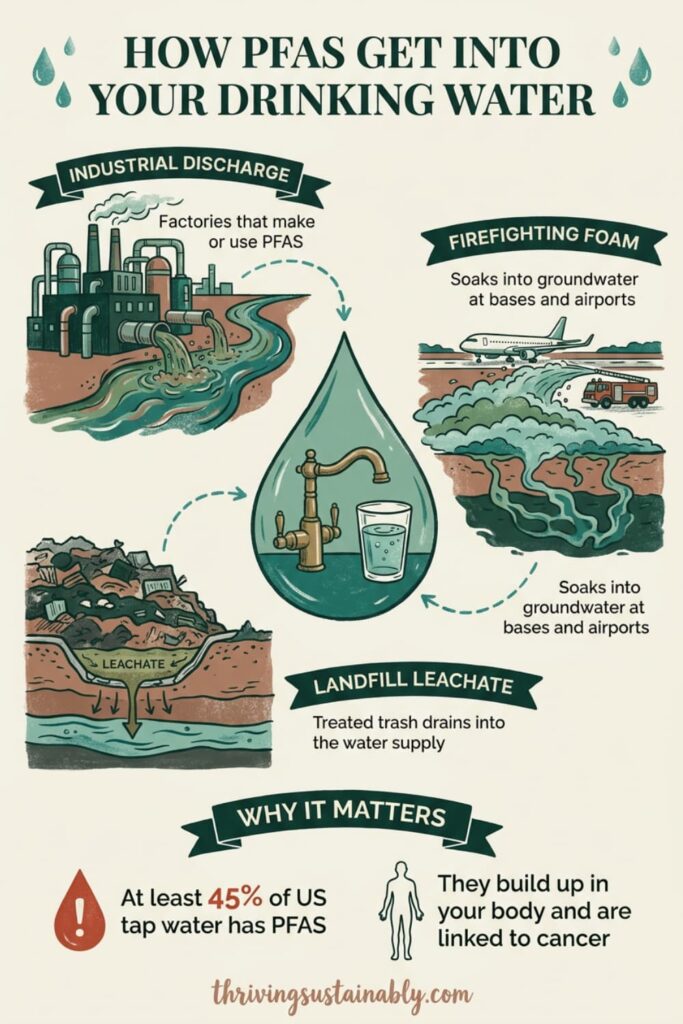
Water treatment plants were never built to catch PFAS. Standard steps like chlorination, sand filtration, and settling do nothing to them, so whatever is in the source water goes straight to the tap. Contamination follows a predictable geography. The worst hot spots sit downstream of fluorochemical plants (Parkersburg, West Virginia; Fayetteville, North Carolina; Cottage Grove, Minnesota), next to military airfields, and near paper mills, chrome platers, and textile finishers that used PFAS in their processes.
The landfill route is slower but everywhere. Every stain-guarded carpet, waterproof jacket, and greasy wrapper that goes to a dump eventually sheds PFAS into the liquid that drains out the bottom, called leachate. Landfills send that leachate to wastewater plants, which cannot remove PFAS either, so it flows out in the treated water they release or concentrates in the leftover sludge. When that sludge is spread on farm fields as fertilizer, it contaminates soil, crops, and the groundwater underneath. Maine banned sludge spreading in 2022 after PFAS turned up in milk and beef from affected farms.
PFAS Regulation in 2026: EPA Limits and State Rules
As of 2026, the federal limit for PFOA and PFOS in tap water is 4 parts per trillion, one of the strictest ever set. The EPA has proposed giving water systems until 2031 to meet it and dropping the limits on four other PFAS. More than a dozen states have gone further with their own rules.
Let’s put that limit in plain terms. Four parts per trillion is almost nothing. Picture one drop of water in 20 Olympic swimming pools. That is roughly the amount the EPA decided was the line for PFOA and PFOS, the two most-studied and most harmful chemicals in the PFAS family. They set it that low for a simple reason: their real goal is zero, and 4 ppt is just the smallest amount labs can reliably measure. When the rule passed in April 2024, it was the first new national drinking water standard in over 20 years.
Why the Federal Rules Keep Shifting
Here is where it gets messy. In 2025, the EPA said it would keep the strict limit for PFOA and PFOS, but give water companies two extra years, until 2031, to actually meet it. It also proposed dropping the limits on four other PFAS entirely. Those changes are still being finalized, so for now the original 2024 rules technically stand. In short, the finish line is real, but it keeps moving. One thing that has not changed: PFOA and PFOS are still labeled hazardous substances under the Superfund law, which means the companies that made the mess can be forced to help pay for the cleanup.
States Are Not Waiting
While Washington goes back and forth, states have charged ahead, and this is where the rules touch the products in your home. Minnesota passed Amara’s Law, which as of 2025 bans added PFAS in everyday things like cookware, cosmetics, dental floss, and kids’ products, building toward a near-total ban by 2032. Maine has a similar deadline, and California has already restricted PFAS in food packaging, cosmetics, and clothing. The rest of the world is moving too. PFOA, PFOS, and PFHxS are now listed under the Stockholm Convention, the same global treaty that phased out DDT, and Europe is weighing a ban on the entire PFAS family at once.
How to Test Your Water for PFAS
To test your water for PFAS, start with the free reports your utility already publishes, then order a mail-in lab test if you are on a well or want your own tap checked. Skip the cheap test strips. They cannot detect PFAS at the tiny levels that matter.
Start with what you can get for free. Once a year, your water company must mail you a report card on your water, called a Consumer Confidence Report. It lists what they found and how much. If your system was part of the EPA’s big national testing round, those numbers are online too, and you can look up your address in a couple of clicks. Many states also run their own testing pages. For most people on city water, this answers the question without spending a dime.
Wells are the exception, because nobody tests them for you. If you drink from a private well, testing is on you. You order a kit from a certified lab; they mail you a few little bottles, and you fill them at your tap. Follow the directions closely, since something as small as hand lotion or a rain jacket can throw off the sample. You mail the bottles back and get your results in a few weeks. A full panel usually costs a few hundred dollars.
⚠️ One warning: skip any “instant” PFAS test strip you see online. PFAS show up at levels so low that these strips can’t detect them, so a clean result tells you nothing. If you want a real number, it has to come from a lab.
How to Reduce Your PFAS Exposure (Action Checklist)
The fastest way to reduce PFAS exposure is to filter your drinking water with a reverse osmosis system or a carbon filter certified to NSF/ANSI 53 or 58 for PFOA and PFOS, then swap nonstick pans, PTFE floss, and stain-treated fabrics for PFAS-free versions. Water and food account for most exposure, so start there.
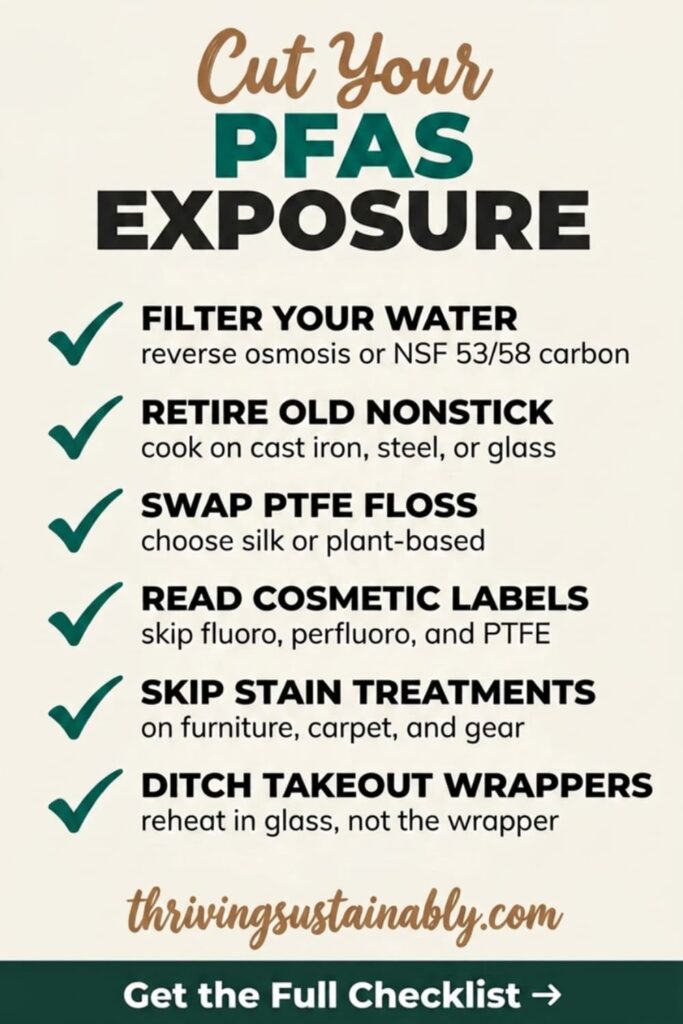
You cannot get to zero, and you do not need to. The goal is to shut off the biggest inputs so your body can slowly clear what it already holds. In rough order of impact, here is the checklist.
- Filter your drinking and cooking water. A 2020 Duke and NC State study tested 76 home filters and found reverse osmosis and two-stage systems removed 94% or more of PFAS, while activated carbon filters averaged 73% and ranged from complete removal to none at all. Look for certification to NSF/ANSI 53 (carbon) or NSF/ANSI 58 (reverse osmosis) that specifically names PFOA and PFOS, and change cartridges on schedule. Our best reverse osmosis systems guide lists the certified picks, and this explainer covers what RO does and does not catch.
- Retire scratched or old nonstick pans. Cook on cast iron, carbon steel, stainless steel, or glass. If you keep a nonstick pan for eggs, use it on low to medium heat, never preheat it empty, and replace it once the coating flakes.
- Swap PTFE dental floss for silk or plant-based floss. This is a five-second change with measurable results in the research. Our dental floss directory ranks the plastic-free options.
- Read cosmetic labels for “fluoro,” “perfluoro,” or PTFE. Long-wear foundation, waterproof mascara, and some lipsticks are the usual suspects. Minnesota’s ban means many brands have already reformulated, so newer products are more likely to be clean.
- Choose PFAS-free outdoor gear and skip stain treatments. Most major outdoor brands now sell PFAS-free DWR jackets; look for the phrase on the hang tag. Decline the optional stain-guard treatment on new furniture and carpet.
- Cut back on takeout wrappers and microwave popcorn bags. New US packaging is largely PFAS-free since 2024, but imported and older stock is not. Reheat food in glass or ceramic, not the wrapper it came in.
- Dust and vacuum often, especially with small children. Treated fabrics shed PFAS into house dust, and toddlers eat more dust than anyone else in the house. A HEPA vacuum and a damp cloth do the job.
- Carry your own bottle. Bottled water has no federal PFAS limit, and several brands have tested positive. Filtered tap in a plastic-free water bottle beats it on PFAS, microplastics, and cost.
✨ tip
Boiling Water Makes PFAS Worse, Not Better
Boiling kills bacteria but does nothing to PFAS. Because some water evaporates and the PFAS stay behind, boiling actually raises the concentration in what is left in the pot. Filtration is the only home fix.
The Growing PFAS Lawsuit Landscape
PFAS is now the subject of one of the biggest pollution lawsuits in US history. In 2023, 3M agreed to pay public water systems up to $10.3 billion, and DuPont, Chemours, and Corteva agreed to pay another $1.185 billion. Thousands of personal cancer claims are still working through the courts.
Here is the part most people don’t know: almost everything we understand about PFAS today started with one angry farmer. In the late 1990s, a West Virginia cattle rancher named Wilbur Tennant watched his cows sicken and die by the hundreds after a creek near a DuPont plant turned foamy and white.
He sued. What his lawyer dug up during that case, boxes of internal company memos, showed that DuPont had quietly known for decades that this chemical was building up in people’s blood and causing harm. That fight later became the movie Dark Waters, and it cracked the whole thing open.
The Farmer Who Exposed DuPont
That case forced DuPont to fund something remarkable: a health study of about 69,000 people who drank the contaminated water. An independent science panel spent years combing through the results, and in 2011 and 2012 they tied PFOA to six health problems, including kidney and testicular cancer. Almost every warning you read about PFAS today traces back to that panel’s work.
Where the PFAS Lawsuits Stand Now
Fast forward to now. Thousands of these cases got bundled together in one big federal court in South Carolina, most of them over firefighting foam. Water utilities brought the first round, and it ended in those giant 2023 settlements, one from 3M and one from DuPont and its chemical spinoffs, Chemours and Corteva. That money is what pays for the filters your town may be installing right now. The next round is personal: people with cancer and thyroid disease who drank tainted water are suing directly. Meanwhile, 3M says it stopped making PFAS at the end of 2025, though it still sells thousands of products that contain PFAS it now buys from other suppliers.
So why should you care about a bunch of lawsuits? Because if your town’s water tested positive for PFAS, your utility is very likely part of one of these settlements. The court fight is not just background news. It is the reason cleaner water may be coming out of your tap in the next few years.
Don’t Miss: How to Tell If Plastic Is BPA-Free PFAS are not the only chemical hiding in everyday products. Learn the recycling codes and label clues that flag BPA in your food containers. Read more →FAQs About PFAS
No. PFAS is the name of the whole family of nearly 15,000 fluorinated chemicals. PFOA and PFOS are two specific members of that family, and they are the most studied because they were the most widely used. Every PFOA and PFOS molecule is a PFAS, but most PFAS are neither.
Not as a class. PFOA and PFOS were voluntarily phased out of US manufacturing by 2015, and the EPA limits both in drinking water at 4 parts per trillion. Several states, led by Minnesota and Maine, ban intentionally added PFAS in specific products on deadlines running to 2032, but there is no federal ban on making or selling PFAS.
PFAS exposure does not cause immediate symptoms, which is part of why it went unnoticed for so long. The effects show up over years as higher cholesterol, weaker vaccine response, liver enzyme changes, high blood pressure in pregnancy, and increased risk of kidney and testicular cancer. A blood test is the only way to know your level.
No. Boiling does not break the carbon-fluorine bond, and because water evaporates while the PFAS stay behind, boiling slightly concentrates them. Only filtration (reverse osmosis, certified activated carbon, or ion exchange) removes PFAS at home.
Reverse osmosis is the most reliable, removing 94% or more of PFAS in independent testing. Activated carbon filters certified to NSF/ANSI 53 for PFOA and PFOS also work well when cartridges are changed on time, and ion exchange resins are used in larger systems. Basic pitcher filters without PFAS certification are hit or miss.
Yes. Teflon is the brand name for PTFE, which is itself a PFAS. What changed is that PFOA, the chemical once used to manufacture PTFE, has not been used in US production since 2013. A PFOA-free nonstick pan still has a PFAS coating, so cast iron, carbon steel, or stainless steel are the true PFAS-free choices.
Sometimes. The FDA has no PFAS limit for bottled water, and independent tests have found PFAS in a number of brands, usually at low levels. Bottled water also carries a microplastic load that filtered tap water does not, so a certified home filter plus a reusable bottle is the safer bet.
Yes, slowly. Once exposure stops, blood levels fall by half every few years for PFOA and PFOS, and within weeks for short-chain replacements. Some research suggests regular blood or plasma donation speeds that up. Cutting off new exposure through your water is still the main lever, since ongoing intake keeps topping the level back up.
Final Thoughts About PFAS
PFAS are everywhere, but your exposure is not fixed. Filtering your water, retiring PTFE pans and floss, and choosing PFAS-free fabrics shut off the largest sources, and your body clears the rest over time.
Reading a guide like this can make the problem feel too big to touch. It is not. The chemistry is stubborn, but the sources in your own home are a short list, and the biggest one, your tap, has a certified fix that costs less than a year of bottled water. Start with the filter, then work down the checklist as things wear out. That is how you turn a forever chemical into a manageable one.
📚 References
- 3M. (2024, March 29). 3M settlement with public water suppliers to address PFAS in drinking water receives final court approval. https://investors.3m.com/news-events/press-releases/detail/1836/3m-settlement-with-public-water-suppliers-to-address-pfas
- Agency for Toxic Substances and Disease Registry. (2024). PFAS and your health: Health effects. Centers for Disease Control and Prevention. https://www.atsdr.cdc.gov/pfas/about/health-effects.html
- Boronow, K. E., Brody, J. G., Schaider, L. A., Peaslee, G. F., Havas, L., & Cohn, B. A. (2019). Serum concentrations of PFASs and exposure-related behaviors in African American and non-Hispanic white women. Journal of Exposure Science & Environmental Epidemiology, 29, 206-217. https://doi.org/10.1038/s41370-018-0109-y
- C8 Science Panel. (2012). C8 probable link reports. http://www.c8sciencepanel.org/prob_link.html
- Centers for Disease Control and Prevention. (2024). Per- and polyfluorinated substances (PFAS) factsheet. National Biomonitoring Program. https://www.cdc.gov/biomonitoring/PFAS_FactSheet.html
- ChemSec. (2026, February 26). 3M promised to phase out PFAS by the end of 2025. How has it turned out? https://chemsec.org/3m-promised-to-phase-out-pfas-how-has-it-turned-out/
- Herkert, N. J., Merrill, J., Peters, C., Bollinger, D., Zhang, S., Hoffman, K., Ferguson, P. L., Knappe, D. R. U., & Stapleton, H. M. (2020). Assessing the effectiveness of point-of-use residential drinking water filters for perfluoroalkyl substances (PFASs). Environmental Science & Technology Letters, 7(3), 178-184. https://doi.org/10.1021/acs.estlett.0c00004
- International Agency for Research on Cancer. (2023, November 30). IARC Monographs evaluate the carcinogenicity of perfluorooctanoic acid (PFOA) and perfluorooctanesulfonic acid (PFOS). World Health Organization. https://www.iarc.who.int/news-events/iarc-monographs-evaluate-the-carcinogenicity-of-perfluorooctanoic-acid-pfoa-and-perfluorooctanesulfonic-acid-pfos
- Li, Y., Fletcher, T., Mucs, D., Scott, K., Lindh, C. H., Tallving, P., & Jakobsson, K. (2018). Half-lives of PFOS, PFHxS and PFOA after end of exposure to contaminated drinking water. Occupational and Environmental Medicine, 75(1), 46-51. https://doi.org/10.1136/oemed-2017-104651
- Minnesota Pollution Control Agency. (2026). PFAS in products. https://www.pca.state.mn.us/get-engaged/pfas-in-products
- National Academies of Sciences, Engineering, and Medicine. (2022, July 28). New report calls for expanded PFAS testing for people with history of elevated exposure, offers advice for clinical treatment. https://www.nationalacademies.org/news/new-report-calls-for-expanded-pfas-testing-for-people-with-history-of-elevated-exposure-offers-advice-for-clinical-treatment
- National Institute of Environmental Health Sciences. (2025). Perfluoroalkyl and polyfluoroalkyl substances (PFAS). https://www.niehs.nih.gov/health/topics/agents/pfc
- Smalling, K. L., Romanok, K. M., Bradley, P. M., et al. (2023). Per- and polyfluoroalkyl substances (PFAS) in United States tapwater: Comparison of underserved private-well and public-supply exposures and associated health implications. Science of The Total Environment, 881, 163540. https://doi.org/10.1016/j.scitotenv.2023.163540
- U.S. Environmental Protection Agency. (2023). Human health toxicity assessments for GenX chemicals: Fact sheet (March 2023 update). https://www.epa.gov/system/files/documents/2023-03/GenX-Toxicity-Assessment-factsheet-March-2023-update.pdf
- U.S. Environmental Protection Agency. (2025). Our current understanding of the human health and environmental risks of PFAS. https://www.epa.gov/pfas/our-current-understanding-human-health-and-environmental-risks-pfas
- U.S. Environmental Protection Agency. (2026). Occurrence data for the Unregulated Contaminant Monitoring Rule (UCMR 5). https://www.epa.gov/dwucmr/occurrence-data-unregulated-contaminant-monitoring-rule
- U.S. Environmental Protection Agency. (2026, May 20). Proposed PFOA and PFOS compliance extension rule. https://www.epa.gov/sdwa/proposed-pfoa-and-pfos-compliance-extension-rule
- U.S. Environmental Protection Agency. (2026, May 20). Rescission of regulatory determinations and removal of related provisions for four PFAS substances (proposed rule). Federal Register. https://www.federalregister.gov/documents/2026/05/20/2026-10085/rescission-of-regulatory-determinations-and-removal-of-related-provisions-for-four-pfas-substances
- U.S. Food and Drug Administration. (2025). Authorized uses of PFAS in food contact applications. https://www.fda.gov/food/process-contaminants-food/authorized-uses-pfas-food-contact-applications
- U.S. Geological Survey. (2023, July 5). Tap water study detects PFAS “forever chemicals” across the US. https://www.usgs.gov/news/national-news-release/tap-water-study-detects-pfas-forever-chemicals-across-us