
Key Takeaways
- The most effective self-care ideas are free: movement, sleep, sunlight, and breathwork cost nothing and need no products at all.
- Sorting self-care by how much time you have, and by how you actually feel, works better than a random list you scroll past.
- Many products sold as self-care add plastic and synthetic fragrance to your home, so a few swaps quietly upgrade the whole routine.
Self-care ideas fall into three buckets: what you can do in five minutes, what fits a free half hour, and what deserves a whole afternoon. Most lists ignore that and hand you 99 suggestions in no particular order, which is why you read them and still do nothing. This one is sorted by time, by mood, and by the part of you that needs attention, so you can find something useful in about ten seconds.
There are 120 ideas below. Most are free. A handful involve products, and where they do, we say plainly what those products are made of, because the wellness aisle sells a lot of plastic under the word “calm.”
What Self-Care Really Means (And What It’s Not)
Self-care is the everyday practice of protecting your physical, emotional, and mental health, not a luxury product or a once-a-year spa day, and sustainable self-care does it without adding plastic or toxins to your routine.
Walk into any drugstore right now, and “self-care” is plastered across pink eye masks, vibrating face rollers, and 12-step skincare kits. That’s marketing, not self-care. The clinical definition is simpler. The National Institute of Mental Health defines self-care as taking time to do things that help you live well, support your physical and mental health, manage stress, reduce your risk of illness, and increase your energy.
The World Health Organization goes further, calling self-care “the ability of individuals, families and communities to promote and maintain their own health, prevent disease and cope with illness, with or without the support of a health or care worker.” Notice what’s missing from both definitions. Products. A shopping list. A specific routine.
Two myths slow people down here. The first is that self-care is selfish. It isn’t, and people who look after themselves tend to show up better as partners, parents, and friends. A second myth says self-care has to be aesthetic or expensive. Twenty minutes of walking, a phone call to your sister, and a glass of water before bed all count. So does saying no to a Saturday plan you don’t have energy for.
Why Self-Care Matters for Mind and Body
Regular self-care reduces anxiety and depression, lowers stress hormones, improves sleep, and builds the kind of long-term resilience that helps you recover faster from hard days.
You already feel it in your body. Skip sleep for three nights, and the world feels harder. Move for 20 minutes and your mood lifts. The science backs the gut feeling. The Centers for Disease Control and Prevention reports that regular physical activity reduces the risk of depression and anxiety, improves sleep, and supports brain health, even in short bursts.
Time outdoors changes your body chemistry too. A 2024 systematic review of nature exposure therapies in the European Journal of Investigation in Health, Psychology and Education found that even brief time outside lowers cortisol, the main stress hormone, and reduces self-reported stress, with 20 to 30 minute doses showing the strongest effects.
The catch is that most adults aren’t getting the basics. Roughly one in three U.S. adults doesn’t get the recommended 7 hours of sleep, and only about 24% meet the minimum physical activity guidelines, according to CDC data. That gap is where self-care has the most room to make a difference. You don’t need a new product or a 90-minute morning routine. Sleeping, moving, and pausing more than you currently do will carry most of the benefit.
How sustainable self-care multiplies the benefit
Adding a sustainability layer to self-care isn’t a guilt trip, it’s a stress reducer. Clearing plastic clutter off your bathroom counter cuts visual noise. Choosing a beeswax candle over a paraffin one means you’re not breathing fossil fuel byproducts during your evening wind-down. Walking outside instead of scrolling pulls double duty for your nervous system and for the air around you. The habits stack.
Don’t Miss: Non-Toxic Living: Where to Actually Start, Room by Room If the self-care swaps below make you want to look at the rest of the house, start here instead of everywhere at once. Read more →The 7 Dimensions of Self-Care (The Self-Care Wheel)
The self-care wheel splits care into 7 dimensions: physical, emotional, mental, social, spiritual, professional, and financial. Burnout usually means one dimension has been starved while the others got all the attention.
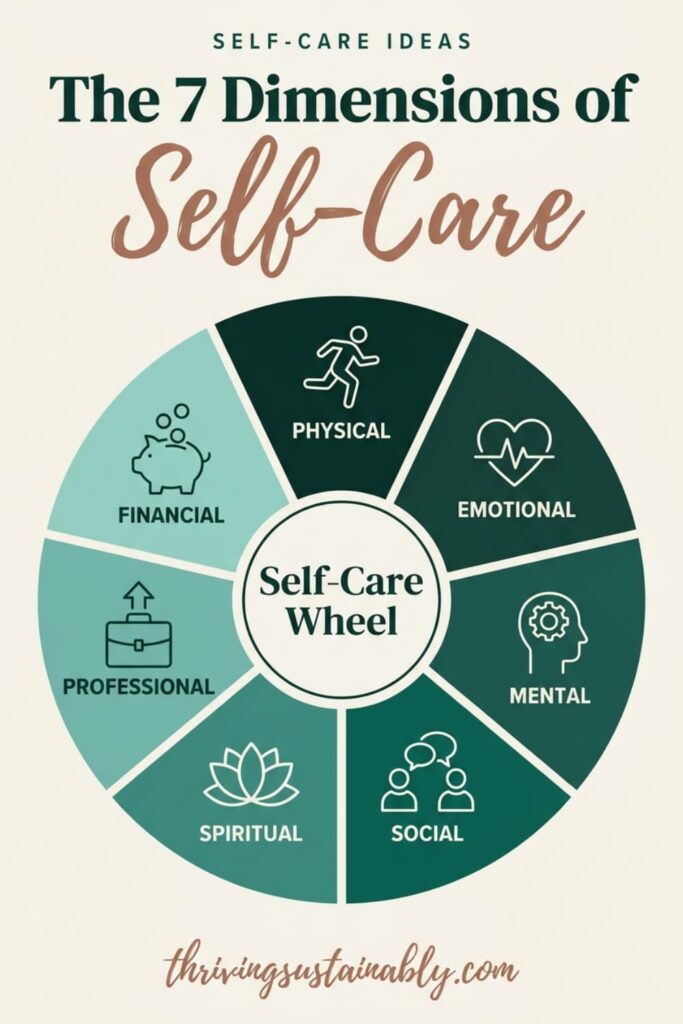
The wheel is a framework developed from wellness research and used widely by social work programs, including the University at Buffalo School of Social Work in its Self-Care Starter Kit. Rather than asking whether you did self-care, it asks where.
- Physical: sleep, movement, food, water, sunlight, medical care
- Emotional: naming feelings, journaling, therapy, crying, boundaries
- Mental: reading, learning, focus, rest from screens
- Social: friendship, family, community, asking for help
- Spiritual: meaning, nature, prayer, gratitude, ritual
- Professional: workload limits, breaks, saying no, career direction
- Financial: budgeting, spending that matches your values, reducing money stress
Why categorizing matters
Here’s the trap the wheel exposes. You take a bath, get eight hours of sleep, drink your water, and still feel hollow, so you conclude self-care doesn’t work for you. Usually the truth is narrower: you covered physical care thoroughly and haven’t touched social or emotional care in weeks. A bath cannot fix loneliness. Naming which dimension is empty is often the whole intervention.
✨ tip
Audit the wheel in 60 seconds
Score each of the 7 dimensions from 1 to 10 for the past week. Whichever scores lowest is where your next self-care idea should come from, even if it isn’t the one you feel like doing.
Self-Care Ideas by Time Available
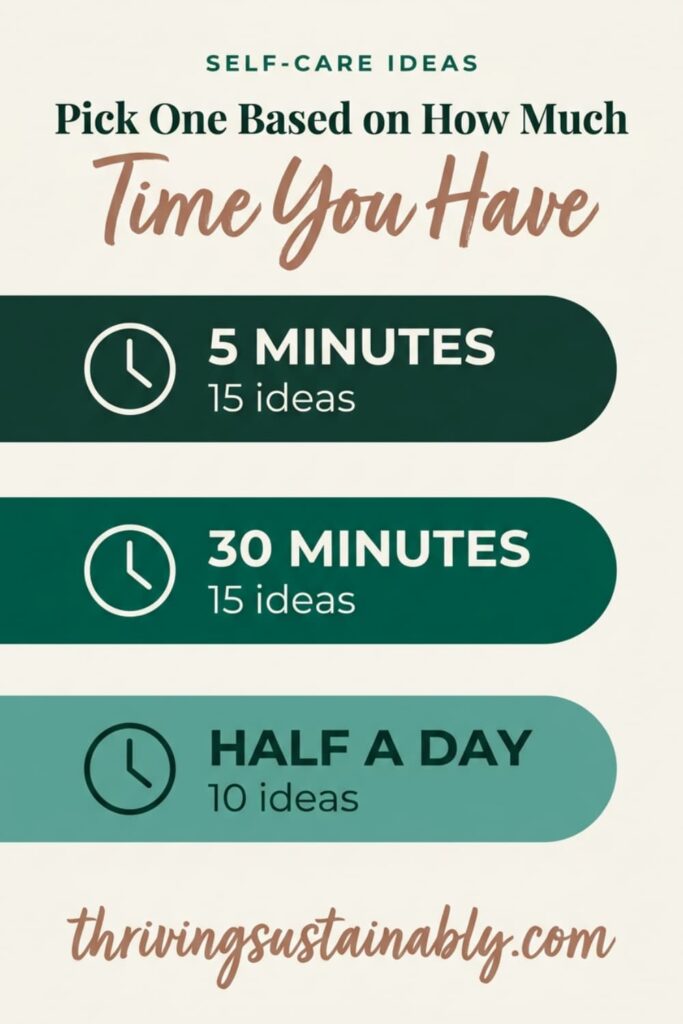
You do not need an hour. Research on nature exposure shows measurable stress reduction in as little as 20 minutes, and breathwork changes heart rate within 2 minutes, so the size of the window matters less than using it.
5-minute self-care ideas
- Box breathe for 2 minutes: in for 4, hold 4, out for 4, hold 4
- Step outside and put both feet on grass or bare ground
- Drink a full glass of water before your next coffee
- Open a window and let real air move through the room
- Text one person something specific you appreciate about them
- Do the 5-4-3-2-1 grounding scan: 5 things you see, 4 you hear, 3 you touch, 2 you smell, 1 you taste
- Stretch your neck and shoulders where the screen tension lives
- Wash your face with cool water and actually dry it with a clean towel
- Put on one song you loved at 17 and do nothing else
- Write down the single thing you are dreading, then close the notebook
- Step into sunlight for 5 minutes, ideally before 10am
- Clear one surface, not the whole room
- Put your phone in another room and set a timer
- Lie on the floor with your legs up the wall
- Make a cup of tea and drink it hot instead of forgetting it
One note on that last one. Most conventional tea bags are sealed with polypropylene, and some premium “silk” pyramid bags are plastic mesh that sheds into hot water. Loose leaf in a stainless steel infuser sidesteps the problem entirely, and a handful of brands now use fully plastic-free bags. We researched which ones pass in our guide to plastic-free tea bags.
30-minute self-care ideas
- Walk outside without headphones or a destination
- Cook one real meal instead of assembling snacks
- Journal three pages without editing yourself
- Take a shower with no time pressure and no phone
- Call someone rather than texting them
- Do a beginner yoga sequence on the floor
- Read a physical book in a chair, not in bed
- Deep clean one small space, like a single drawer or the bathroom sink
- Stretch properly, holding each position for a full minute
- Sit outside with coffee and no screen
- Write a list of everything on your mind, then cross off what isn’t yours to carry
- Take a nap without setting an alarm for once
- Do a body scan meditation from lying down
- Plan tomorrow so future you wakes up to less chaos
- Wash and put away the laundry that has been sitting in the basket
Half-day and Self-Care Sunday ideas
- Take a full digital sabbath, phone off from morning to evening
- Build an at-home spa afternoon: long bath, hair mask, no clock
- Go to a farmers market and cook whatever looks good
- Take yourself on a solo date to somewhere you’ve never been
- Batch cook so weeknight you has one less decision
- Do the errand you’ve been avoiding for a month
- Spend an afternoon in a library, park, or museum
- Deep clean your bedroom and change the sheets the same day
- Take a long hike where the trail is the whole point
- Have an unhurried meal with someone you love
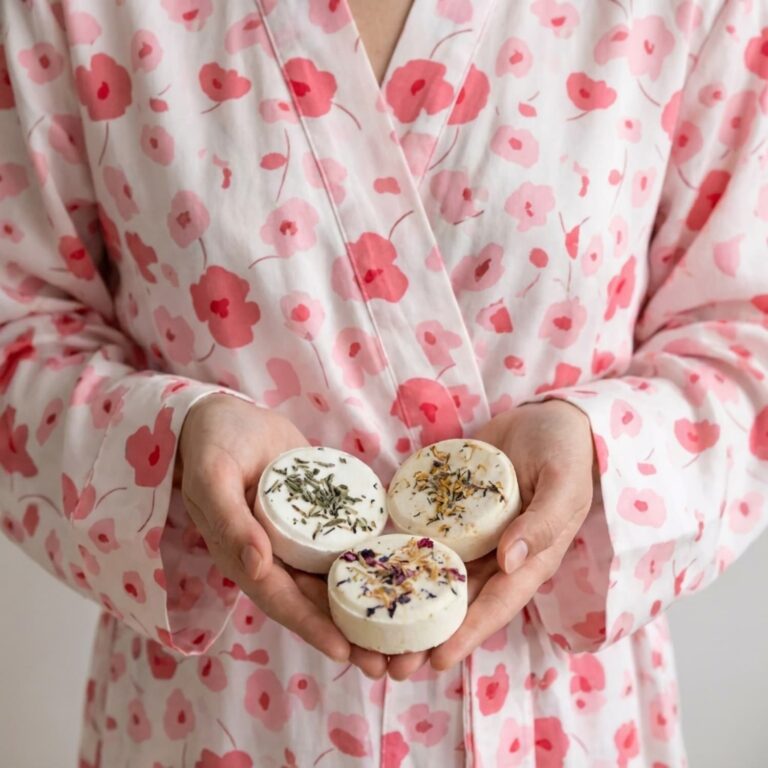
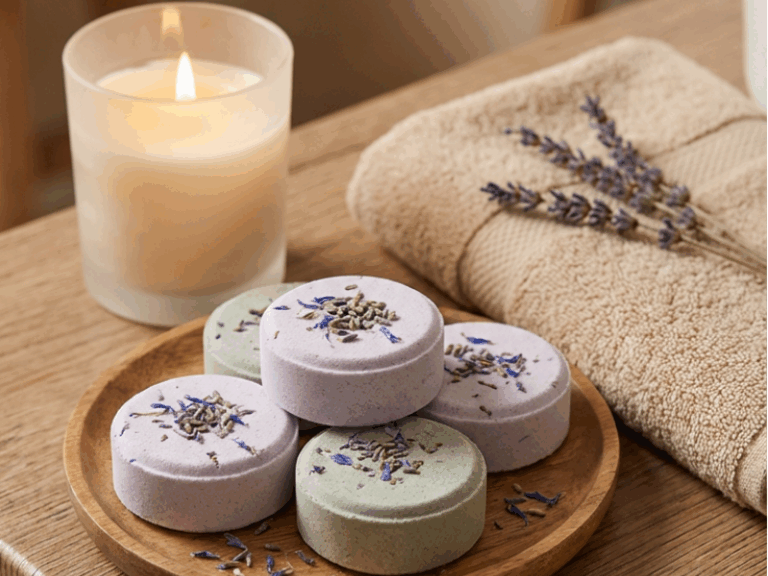
Self-Care Sunday tends to be where products creep in, since a long bath feels like it needs supplies. Two easy upgrades: swap the plastic-bottled body wash for a bar or a refillable, and skip anything with “fragrance” as an unspecified ingredient. Our guide to shower steamers covers the no-bathtub version, and you can make your own with the DIY shower steamer recipe.
Self-Care Ideas by Mood
Matching self-care to your current state works better than a fixed routine, because an anxious nervous system and an exhausted one need opposite things: one needs downregulating, the other needs gentle activation.
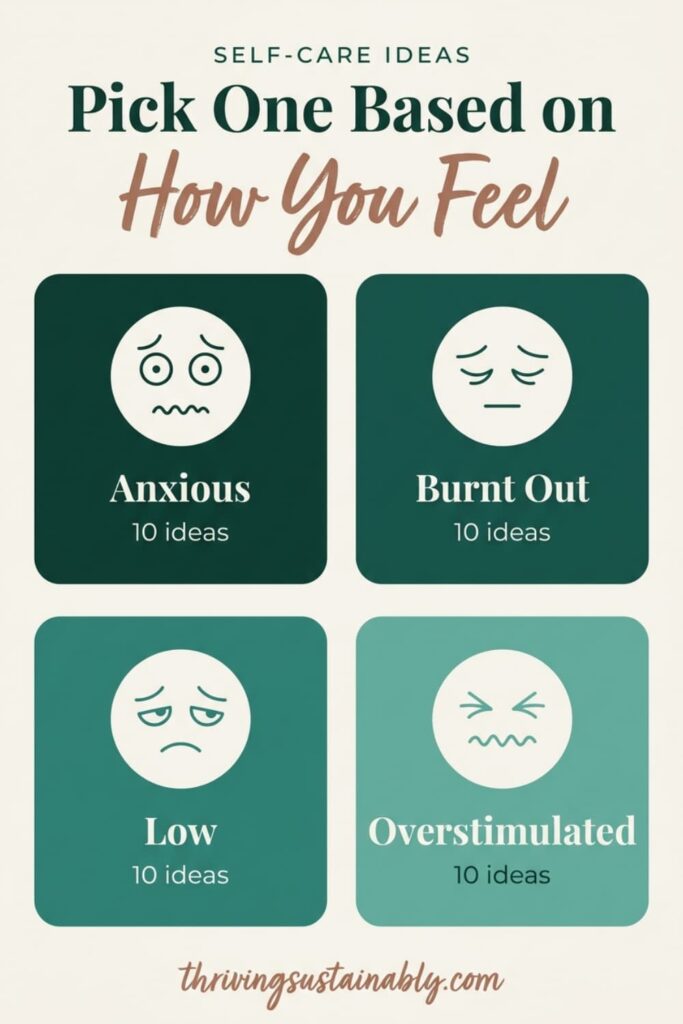
When you’re anxious
- Splash cold water on your face to trigger the dive reflex
- Lengthen your exhale so it lasts twice as long as your inhale
- Hold something cold and heavy, like a glass of ice water
- Name five things you can see out loud
- Go for a fast walk to burn off the adrenaline
- Write the worry down in full, including the worst case
- Put on weight: a heavy blanket, a hug, a firm pillow across your lap
- Hum or sing, which stimulates the vagus nerve
- Set a 10-minute worry window and postpone everything to it
- Reduce caffeine for the rest of the day
When you’re burnt out
- Delegate exactly one thing today
- Cancel the next optional commitment on your calendar
- Take a real lunch break away from your desk
- Sleep in without apologizing for it
- Do something with your hands that has no outcome attached
- Say no to the next request without explaining yourself
- Take a screen fast for one evening
- Lower a standard on purpose, like eating cereal for dinner
- Ask for help with something specific and small
- Book the time off, even if it’s a single day
💫 now you know
What is burnout, officially?
Burnout is a recognized occupational phenomenon, not a medical condition. The World Health Organization added it to the ICD-11 in 2019, defining it as “a syndrome conceptualized as resulting from chronic workplace stress that has not been successfully managed,” with three dimensions: energy depletion, mental distance from your job, and reduced professional efficacy. That third one is why burnout feels like incompetence when it is actually exhaustion.
When you’re sad or low
- Get sunlight on your face within an hour of waking
- Move your body, even badly, for 10 minutes
- Let someone know you’re having a hard week
- Eat something warm rather than something fast
- Make your bed so the room stops arguing with you
- Watch something you loved as a kid
- Get in water: shower, bath, lake, pool
- Do one small task to completion
- Sit with an animal, yours or someone else’s
- Put on real clothes even if you’re staying home
When you’re overstimulated
- Turn off every light except one lamp
- Take a silent walk with no podcast and no music
- Put in earplugs for 20 minutes
- Clear the visual clutter from one room
- Sit in your car in the driveway before going inside
- Take a cool shower in a dim bathroom
- Cancel background noise: no TV, no radio, nothing
- Wrap up in something soft and heavy
- Close your eyes for 5 minutes without falling asleep
- Go somewhere with a long sightline, like a field or a beach
Self-Care Ideas by Category
Sorting self-care by dimension catches the gaps a mood-based list misses, because the area you neglect most is usually the one you never think to check.
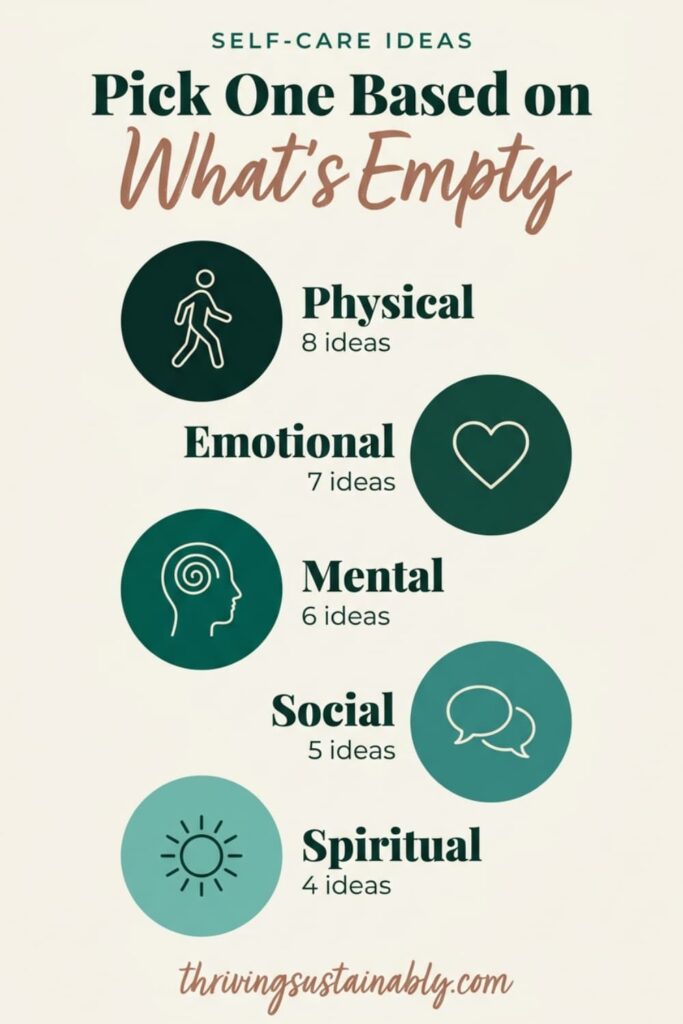
Physical self-care
- Set a consistent wake time, even on weekends
- Keep the bedroom cool, dark, and screen-free
- Walk after dinner instead of sitting straight down
- Drink water from a bottle that isn’t plastic
- Book the appointment you keep postponing
- Simplify your skincare to fewer, cleaner products
- Stretch for 5 minutes before bed
- Eat one meal a day sitting down with no screen
Two of those deserve a footnote. On water, single-use plastic bottles shed particles into what you drink, and heat makes it worse, which is why a stainless or glass bottle is the single easiest swap on this list. Our researched picks are in plastic-free water bottles. On skincare, simplifying does more than any 12-step routine, and it also cuts your exposure to the ingredients we cover in parabens and phthalates.
Emotional self-care
- Journal without a prompt for 10 minutes
- Name the feeling out loud instead of managing it silently
- Set one boundary you’ve been avoiding
- Let yourself cry rather than pushing it down
- Talk to a therapist, or start looking for one
- Write a letter you never send
- Forgive yourself for one specific thing
Mental self-care
- Take a full day off social media
- Read something long enough to require attention
- Learn a skill with no productive purpose
- Do a puzzle, crossword, or anything analog
- Turn off non-essential notifications permanently
- Meditate for 10 minutes, badly, without judging it
Social self-care
- Schedule a recurring standing date with a friend
- Leave the group chat that drains you
- Say yes to one invitation you’d normally decline
- Reach out to someone you’ve lost touch with
- Join something local, even once
Spiritual and sensory self-care
- Write down three specific things you’re grateful for
- Spend 20 minutes in nature with no goal
- Light a beeswax or coconut wax candle in the evening
- Build one small ritual you repeat weekly
Free Self-Care Ideas When Money Is Tight
Every self-care idea with the strongest research behind it costs nothing: sleep, movement, sunlight, time outdoors, and social connection are all free, and together they outperform any product you can buy.
- Borrow books, films, and audiobooks from the library
- Follow a free workout or yoga video at home
- Rearrange a room instead of buying anything for it
- Take a different route on your usual walk
- Have a picnic with food already in your fridge
- Do a free museum or park day in your city
- Sit outside and watch the sky change
- Give away three things you don’t use
- Make a playlist for the mood you want to be in
- Take a full day where you buy nothing at all
That last one has a side effect worth naming. A no-spend day interrupts the loop where stress leads to a cart full of things that promise calm and arrive wrapped in plastic. Slowing the buying down is its own kind of care, which is the idea behind slow living.
Self-Care Ideas for Bad Mental Health Days
On a genuinely bad day, the goal is not a routine, it is the smallest possible action: one glass of water, one open window, one warm thing to eat. Lower the bar until you can step over it.
Most self-care lists quietly assume you have energy. Some days you don’t, and being handed a 12-step morning routine makes it worse. These are survival-mode versions, pulled from the list above.
- Sit down in the shower. Getting clean counts even if you don’t stand up for it
- Eat one warm thing, whatever it is
- Open a window instead of going outside
- Drink one glass of water (idea 3)
- Change your pillowcase rather than the whole bed
- Text one person the words “rough day” and nothing else (idea 63)
- Put your legs up the wall for 5 minutes (idea 14)
- Let the dishes wait and lower the standard on purpose (idea 58)
If bad days are stacking up rather than passing, that’s worth telling a doctor or therapist about. Self-care supports treatment, it doesn’t replace it.
Self-Care Ideas to Avoid
Some things sold as self-care actively work against it: doom-scrolling framed as rest, revenge spending framed as treating yourself, and plastic-heavy wellness products that add synthetic fragrance and microplastics to your home.
This is the section no one else on this topic writes, and it might be the most useful one. Not everything marketed as self-care earns the name.
❌ Habits that feel like rest but aren’t
- Doom-scrolling in bed. Passive, stimulating, and it delays sleep, which is the opposite of recovery
- Revenge spending. The relief lasts about as long as checkout, and the bill arrives later
- Alcohol as decompression. Sedation is not rest, and it fragments sleep for hours afterward
- Wellness perfectionism. A routine you feel guilty about failing has become another job
- Cancelling every plan. Rest helps, isolation doesn’t, and the two look identical from inside
✅ Products worth replacing, and what to use instead
- Paraffin candles. A petroleum byproduct burned in a closed room during your wind-down. Beeswax, coconut, or soy in glass or tin does the same job
- Plastic-bristle face and body brushes. Plastic abraded against skin in a steamy bathroom. Sisal, natural bristle, and wood alternatives last longer anyway
- Single-use sheet masks. Usually a synthetic fiber sheet in a plastic sachet, used once. A reusable cloth and a jar-packaged mask replaces the whole category
- Plastic-bottled body wash. A bar or a refillable removes the bottle entirely, and bars travel better
- Anything listing fragrance with no detail. That single word can hide dozens of undisclosed ingredients, including phthalates
If you want to check a product before you buy it, every item we’ve researched and scored sits in the Plastic Footprint Directory, rated 1 to 10 on how much plastic it actually puts into your life. For the label-reading version, how to spot greenwashing covers the tricks that make plastic-heavy products look clean.
How to Build a Self-Care Routine That Sticks
Self-care routines fail when they are added as new tasks. Attaching one small habit to something you already do every day, a method called habit stacking, is what makes it survive a busy week.
Pick one idea from this list. Just one. Then attach it to an anchor that already happens without effort: after I pour my coffee, I step outside for 5 minutes. After I brush my teeth, I stretch for 2 minutes. The anchor does the remembering so you don’t have to.
Give it two weeks before adding anything else. Then run the wheel audit from earlier and let the lowest-scoring dimension choose your second habit. Most people stack physical care on top of physical care and wonder why they still feel flat, when social or emotional care was the empty one all along.
Don’t Miss: Self-Care Routines for Better Sleep: 14 Night Rituals That Actually Work Evening is the easiest place to anchor a new habit, and sleep is the one that improves everything else. Read more →FAQs About Self-Care Ideas
The seven pillars, often shown as the self-care wheel, are physical, emotional, mental, social, spiritual, professional, and financial. Each one covers a different kind of need, which is why a routine that only feeds one of them can still leave you depleted. Auditing all seven takes about a minute and usually points straight at the gap.
Self-care leaves you better resourced afterward, while self-indulgence borrows against later. A long walk, an early night, and a hard conversation you have been avoiding are all self-care even when they don’t feel luxurious. Buying something to escape a feeling usually is not, since the feeling is still there once the box arrives.
Daily, in small amounts, beats a big session once a month. Ten to twenty minutes a day is enough to shift stress levels, and consistency matters more than duration. Think of it as maintenance rather than repair.
No. Looking after your own health is what makes you able to look after anyone else, and running on empty tends to cost the people around you more than a rested version of you ever would. Guilt about it is common and worth questioning.
Take a real lunch break away from your desk, step outside once during the day, turn off non-essential notifications, and protect one boundary such as not checking email after a set hour. Small workplace changes matter because chronic workplace stress is exactly what the World Health Organization identifies as the root of burnout.
Start with one habit that takes under five minutes and attach it to something you already do daily, such as stepping outside right after your morning coffee. Adding one anchored habit works far better than scheduling a routine you will abandon in a week. Build the second habit only after the first survives two weeks.
Final Thoughts About Self-Care Ideas
The best self-care idea is the one you will actually repeat this week, and almost all of the ones with real evidence behind them are free.
You don’t need all 120. Pick one from whichever section matched how you feel right now, attach it to something you already do, and let it be small enough that a bad week can’t kill it. The wellness industry will keep selling calm in plastic packaging, and you can keep opting out of that part while taking the good bits. Sleep, sunlight, movement, and people who know you. That’s most of it.
📚 References
- Centers for Disease Control and Prevention. (2023). Benefits of physical activity. https://www.cdc.gov/physical-activity-basics/health-benefits/adults.html
- National Institute of Mental Health. (n.d.). Caring for your mental health. https://www.nimh.nih.gov/health/topics/caring-for-your-mental-health
- University at Buffalo School of Social Work. (n.d.). Self-care starter kit. https://socialwork.buffalo.edu/resources/self-care-starter-kit.html
- World Health Organization. (2019). Burn-out an occupational phenomenon: International Classification of Diseases. https://www.who.int/news/item/28-05-2019-burn-out-an-occupational-phenomenon-international-classification-of-diseases
- World Health Organization. (n.d.). Self-care health interventions. https://www.who.int/health-topics/self-care
More Non-Toxic Self-Care Reads
- Simple Self-Care Inspiration for Low-Energy and High-Stress Days
- Self-Care Routines for Better Sleep: 14 Night Rituals That Actually Work
- Self-Care Quotes Every Woman Needs for a Toxic-Free Life
- How to Use Shower Steamers: A Step-by-Step Guide
- The Ultimate Guide to Eco-Friendly Beauty Products
- How to Exfoliate Face at Home: Safe, Natural DIY Guide