
Key Takeaways
- The best compost bins for a low-plastic home are made of steel, cedar, or ceramic, and the Greenes Fence Cedar Composter is our top overall pick for most backyards.
- Most tumblers, worm bins, and bokashi buckets are still made of plastic, so when plastic is the only option, choose recycled plastic from a brand that names its materials.
- Food waste makes up about 24% of what goes into US landfills and causes an estimated 58% of the methane those landfills leak, so the bin you will actually use beats the perfect one you never buy.
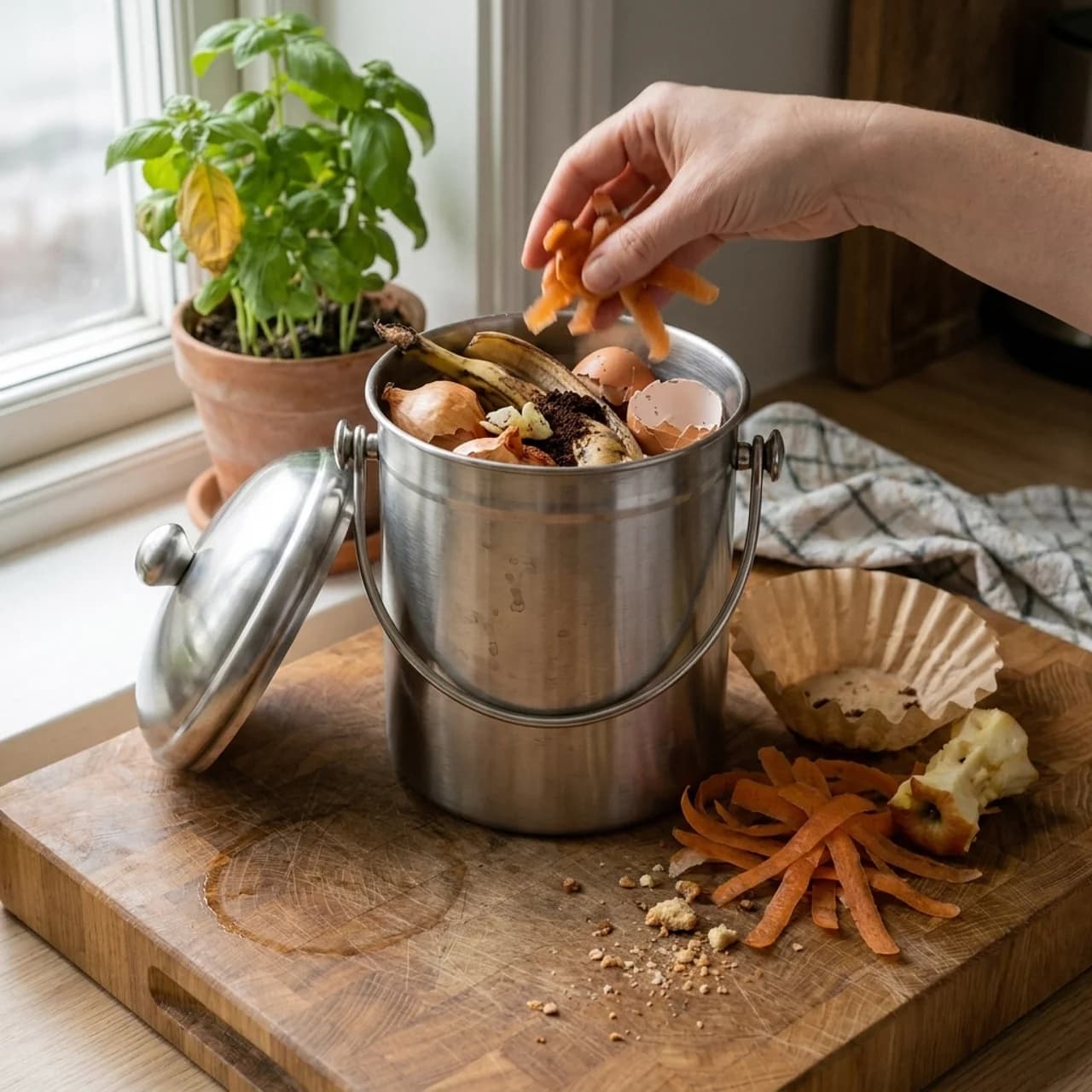
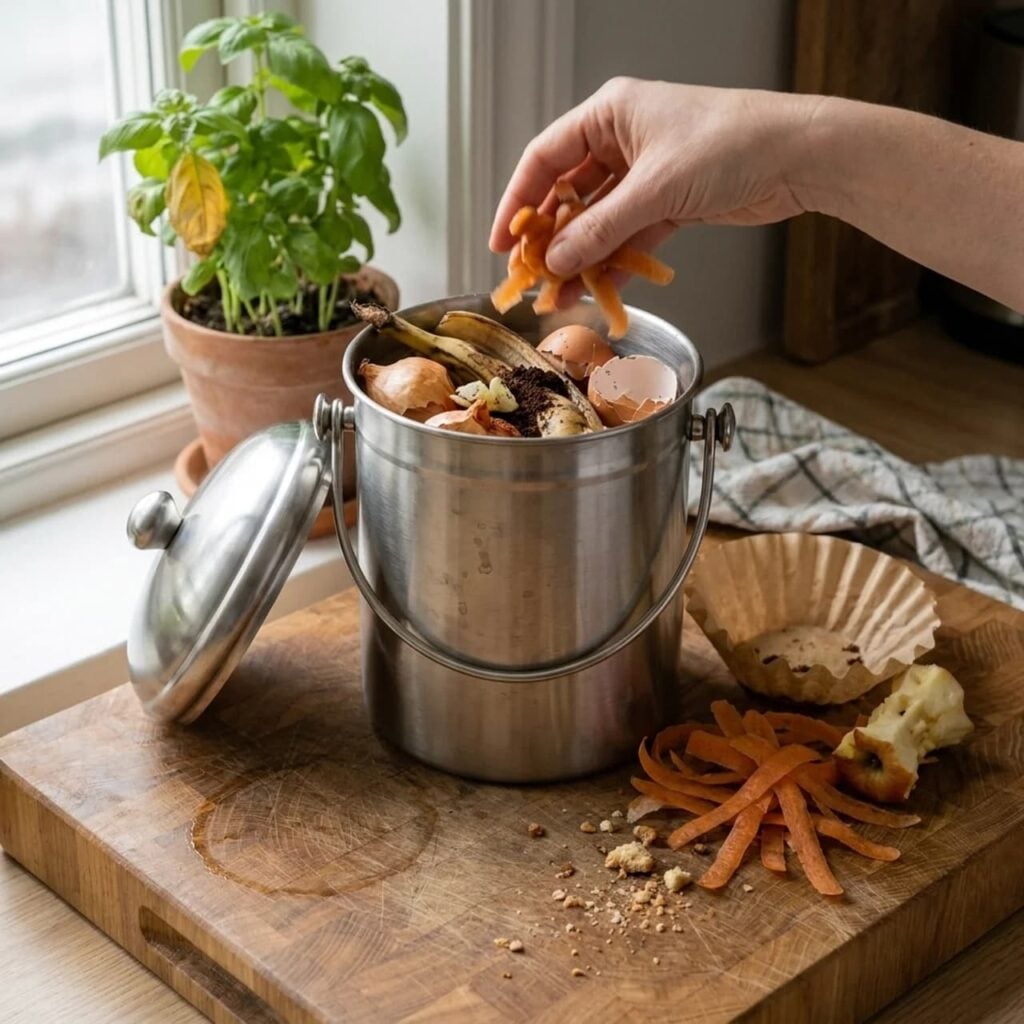
That little pile of coffee grounds, carrot peels, and eggshells by your sink is one of the easiest things in your house to keep out of the trash. Give it the right bin and, a few months later, it comes back to you as dark, crumbly soil for your garden beds and houseplants. Skip the bin, and it rides a garbage truck to a landfill where it slowly turns into methane. The best compost bins for a low-plastic home are made of steel, cedar, or ceramic, and our top pick for most backyards is the Greenes Fence Cedar Composter.
The tricky part is that most compost bins on the market are made of plastic. Tumblers, worm farms, kitchen caddies, and bokashi buckets are usually molded from polyethylene or polypropylene, and that plastic sits outside in the sun and rain for years. If you came to composting to cut down on plastic, buying a big new plastic barrel can feel a little backward.
Don’t Miss: Composting for Beginners Brand new to composting? Start here for the simple greens and browns basics before you pick a bin. Read more →This guide sorts the best compost bins by what they are made of, so you can see right away which ones are steel, wood, or ceramic and which ones still use plastic. We considered material, capacity, how each bin handles odors and pests, and how much space and effort it asks of you. Where no plastic-free option exists yet, we picked the version from a brand that is open about its plastic and labeled it clearly.
Note: steel, cedar, and ceramic picks come first. Plastic picks only made the list when there was no good plastic-free bin in that category. Grab your scrap bowl and scroll on through.
Our Top Picks at a Glance
The best compost bins for most homes are the 174-gallon Greenes Fence cedar composter for big backyards, the 33-gallon Jora JK125 steel tumbler for a sealed bin that is easy to turn, and the 1.3-gallon Epica stainless steel bin for the kitchen counter.
Here is the quick version, with each pick, the job it does best, and what it is made of. Price tiers run from $ (under about $15) to $$$ (over about $35).
How We Picked the Best Compost Bins
We ranked each compost bin by what it is made of, part by part, using the maker’s own spec sheet, so the 4 fully plastic-free bins come first, the steel tumbler with some plastic insulation comes next, and the 3 plastic bins come last.
We started with the compost bin brands people search for most, then added smaller makers that build in steel, wood, and ceramic. From there, we checked each bin against the manufacturer or retailer spec sheet to see what it is made of, part by part, and dropped any bin that hid plastic behind a natural-sounding name.
That check knocked out a few popular picks. A bamboo kitchen bin turned out to be bamboo fiber bound with melamine, which is a type of plastic. A fabric worm bag uses a polyurethane coating and plastic connectors. One well-known tumbler only says it is made from “BPA-free materials,” without naming the plastic at all, and we could not confirm what it is.
After material, we looked at the things that decide whether a bin gets used: capacity for different household sizes, how well the lid and vents keep out rats and raccoons, and whether the design makes it easy to keep the mix balanced. We leaned on composting guidance from the EPA, Cornell Waste Management Institute, and university extension programs for what a good bin needs to do.
The Best Compost Bins for 2026
The best compost bins for 2026 are the Greenes Fence, Jora JK125, Behrens, Epica, Norpro, FCMP IM4000, SCD Probiotics, and Subpod, plus a free DIY pallet bin, listed from the least plastic to the most.
Each card below shows what the bin is made of, who it suits, and the trade-offs to know before you buy. The DIY option comes last.
Greenes Fence Cedar Composter
A cedar box that holds a whole season of scraps and leaves
$$$
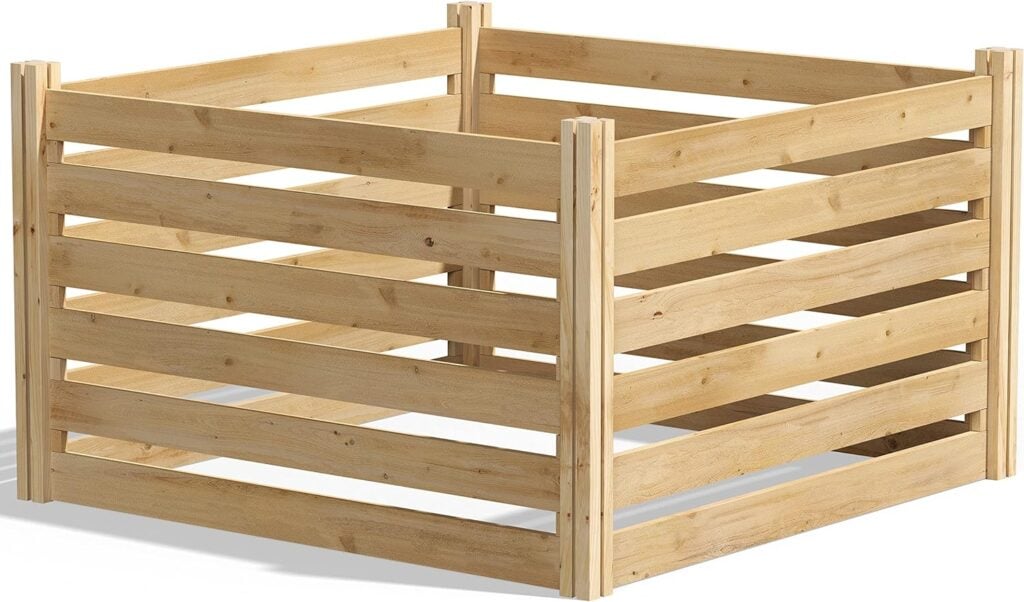
Greenes Fence makes this bin from North American cedar, a wood that naturally resists rot and insects, and it goes together with nothing but a rubber mallet. The kit is all cedar, from the boards to the small spacer blocks on four corner posts, so air moves through the sides and you are not relying on a plastic shell.
At 36 by 36 by 31 inches, it holds about 174 gallons, which is plenty for a family that cooks at home and rakes leaves every fall. You add scraps as you go and turn the pile with a pitchfork every week or two. If rats are common where you live, line the bottom with hardware cloth and bury fresh scraps under leaves.
Body Material
Cedar
✓ Plastic FreeCapacity
174 Gallons
✓ Big YardsType
Stationary Bin
✓ OutdoorPrice
$$$
✓ Mid RangePros
- Natural cedar instead of a plastic shell
- Huge 174-gallon capacity
- Tool-free assembly with a mallet
- Open sides let air flow through the pile
Cons
- Needs hardware cloth to keep rats out
- Turning by hand takes some muscle
- Takes up a 3 by 3 foot spot
- Wood wears out over many years outdoors
If you have a yard and want one bin that handles kitchen scraps and fall leaves, this is the one to start with. The best compost bin for most backyards.
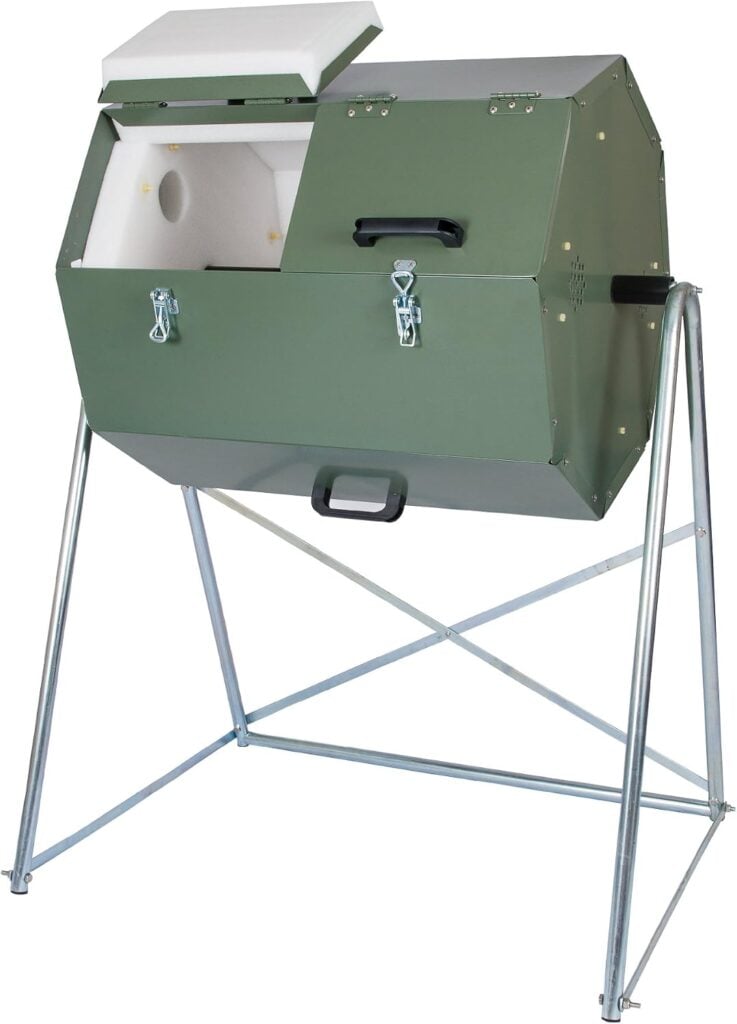
Jora JK125
An insulated steel tumbler that keeps working in the cold
$$$
Jora builds the JK125 from galvanized, powder-coated steel panels on a galvanized steel stand, with stainless steel hardware. It is not fully plastic-free, because the walls are insulated with a 2.16-inch layer of polyethylene, but it is one of the few tumblers built mostly from metal.
That insulation holds heat, so the pile keeps breaking down in colder weather. The drum is split into two 16.5-gallon chambers, so one side can finish while you fill the other. Jora rates it for 2 to 4 gallons of scraps a week, about right for one to four people.
Body Material
Steel + PE Insulation
⚠ Some PlasticCapacity
33 Gallons
✓ 1 to 4 PeopleType
Two-Chamber Tumbler
✓ OutdoorPrice
$$$
✓ SplurgePros
- Galvanized steel body and stand
- Insulated for cold-weather composting
- Two chambers for batch composting
- Sealed drum keeps critters out
Cons
- Insulation layer is polyethylene
- Priciest pick on the list
- Smaller than a stationary bin
- Lids can stick in freezing weather
If you want a sealed tumbler that keeps composting through winter and you would rather not buy a plastic barrel, this is worth saving for. The most metal you can get in a tumbler.
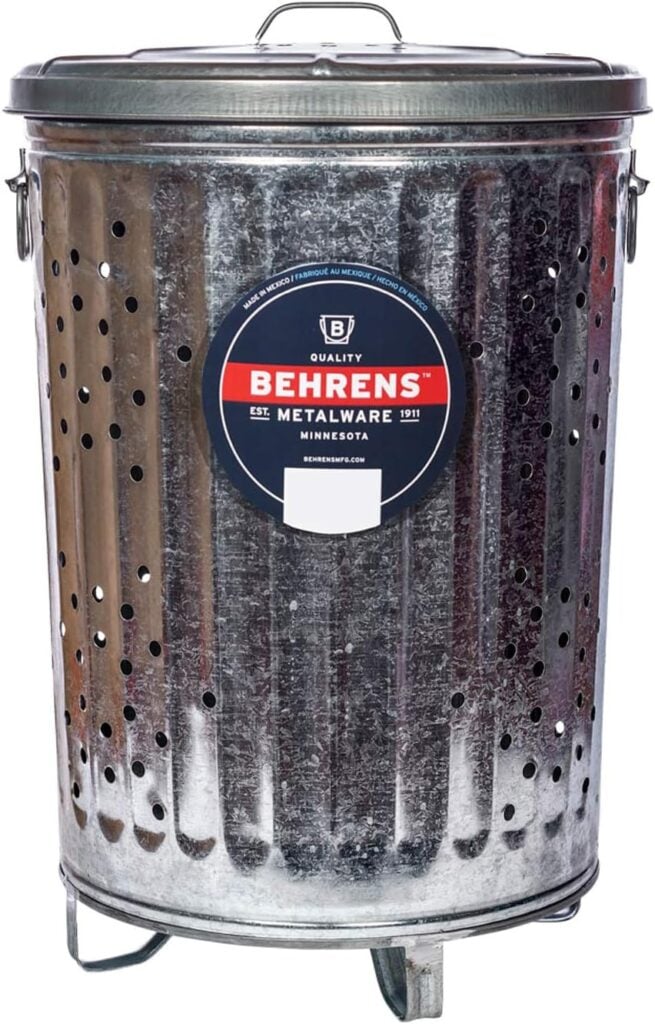
Behrens 20 Gal Composter
An all-steel can that rats cannot chew through
$$$
Behrens makes this composter entirely from galvanized steel, with a heavy lid and holes for airflow. The Cornell Cooperative Extension notes that rats can chew through plastic bins, usually starting at the vents, so an all-metal bin closes that door.
At 20 gallons, it works best as a food-scrap bin next to a bigger leaf pile, or for a small household with a patio or side yard. Set it on hardware cloth and gravel and very little can dig its way in.
Body Material
Galvanized Steel
✓ Plastic FreeCapacity
20 Gallons
✓ Small YardsType
Stationary Can
✓ OutdoorPrice
$$$
✓ Mid RangePros
- All galvanized steel, no plastic
- Chew-proof walls and heavy lid
- Small footprint for patios
- Large handles make it easy to move
Cons
- Only 20 gallons
- No built-in way to turn the pile
- Sold as a burner and composter
- Needs a mesh base to stop diggers
If rats or raccoons keep raiding your compost, swapping to an all-metal can is the simplest fix. The best plastic-free bin for critter problems.
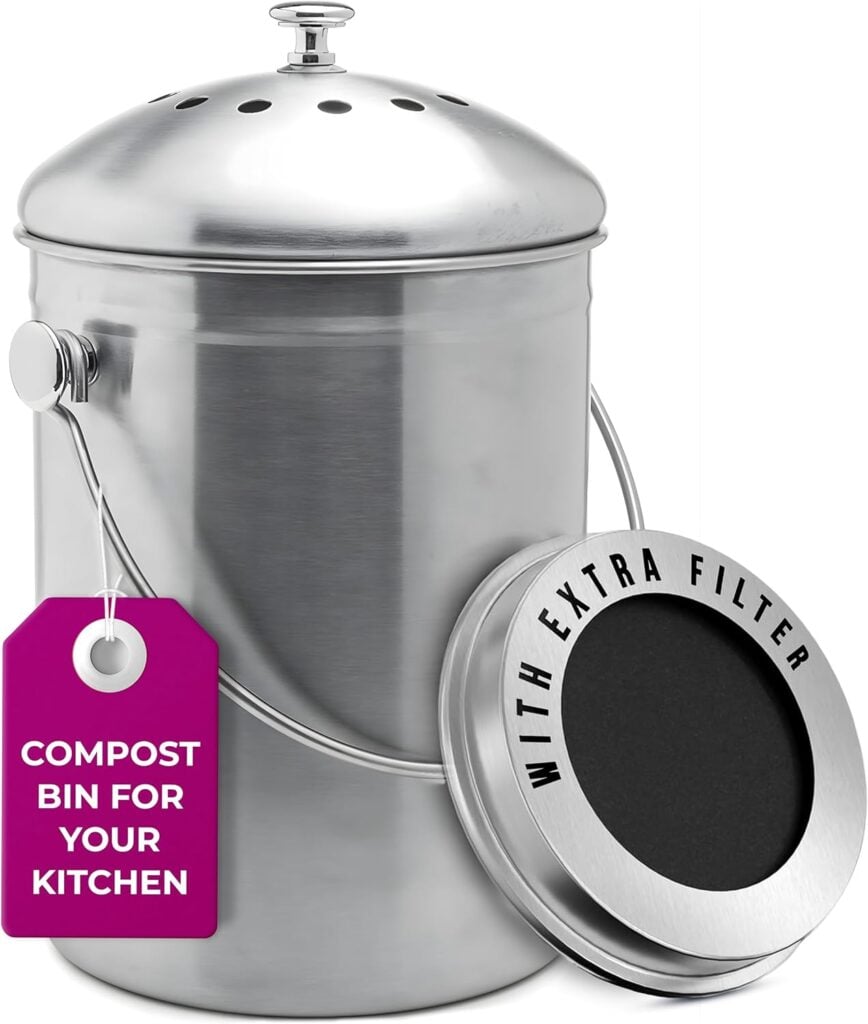
Epica Compost Bin
A seamless stainless steel caddy for the kitchen counter
$$
Epica molds the body of this 1.3-gallon bin from a single piece of stainless steel, so there are no seams for gunk to hide in. The stainless steel lid holds a replaceable activated charcoal filter to keep smells down between trips outside.
Most households fill it every few days. Empty it into your outdoor bin or drop-off bag, rinse it, and it goes right back on the counter. Unlike plastic caddies, stainless steel will not hold onto stains or onion smells over time.
Body Material
Stainless Steel
✓ Plastic FreeCapacity
1.3 Gallons
✓ CountertopType
Kitchen Caddy
✓ IndoorPrice
$$
✓ Mid RangePros
- One-piece stainless steel body
- Charcoal filter cuts odors
- Easy to rinse clean
- Will not stain or hold smells
Cons
- Lid can dent if dropped
- Filters need replacing
- Fills fast for big families
- Only one filter included
If you want a kitchen bin that looks good, cleans easily, and skips plastic, this is the one to set by the sink. The best countertop compost bin.
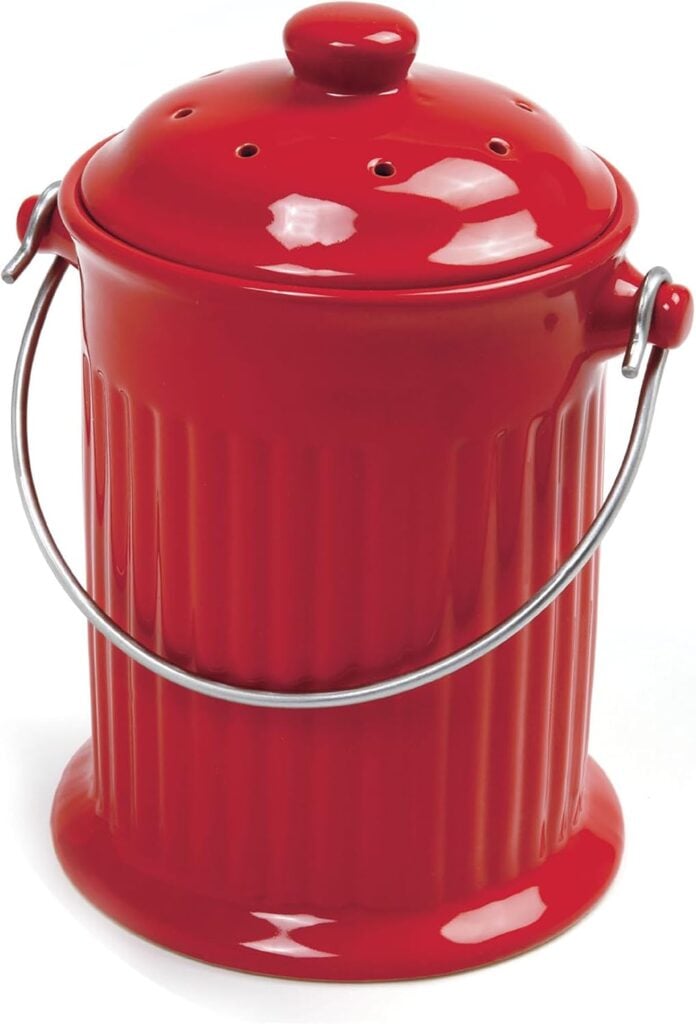
Norpro Ceramic Compost Keeper
A pretty ceramic crock for small kitchens and drop-off composting
$$
Norpro makes this one-gallon keeper from ceramic with a sturdy stainless steel handle and a molded ceramic lid that holds a charcoal filter. It looks nice enough to leave out on a small counter, which matters when your kitchen is tiny.
No yard? Collect scraps here, then take them to a city drop-off, a community garden, or a curbside pickup program. One gallon fills quickly, which keeps you emptying it before anything gets funky. Replacement filters are sold separately.
Body Material
Ceramic
✓ Plastic FreeCapacity
1 Gallon
✓ CountertopType
Kitchen Crock
✓ IndoorPrice
$$
✓ BudgetPros
- Ceramic body and lid, stainless handle
- Charcoal filter cuts odors
- Small enough for tiny counters
- Looks nice left out on the counter
Cons
- Ceramic can chip or break
- Only holds 1 gallon
- Filters sold separately
- Needs a drop-off or outdoor bin
If you live in an apartment and compost through a drop-off or pickup program, this is all the bin you need. The best compost bin for small spaces.
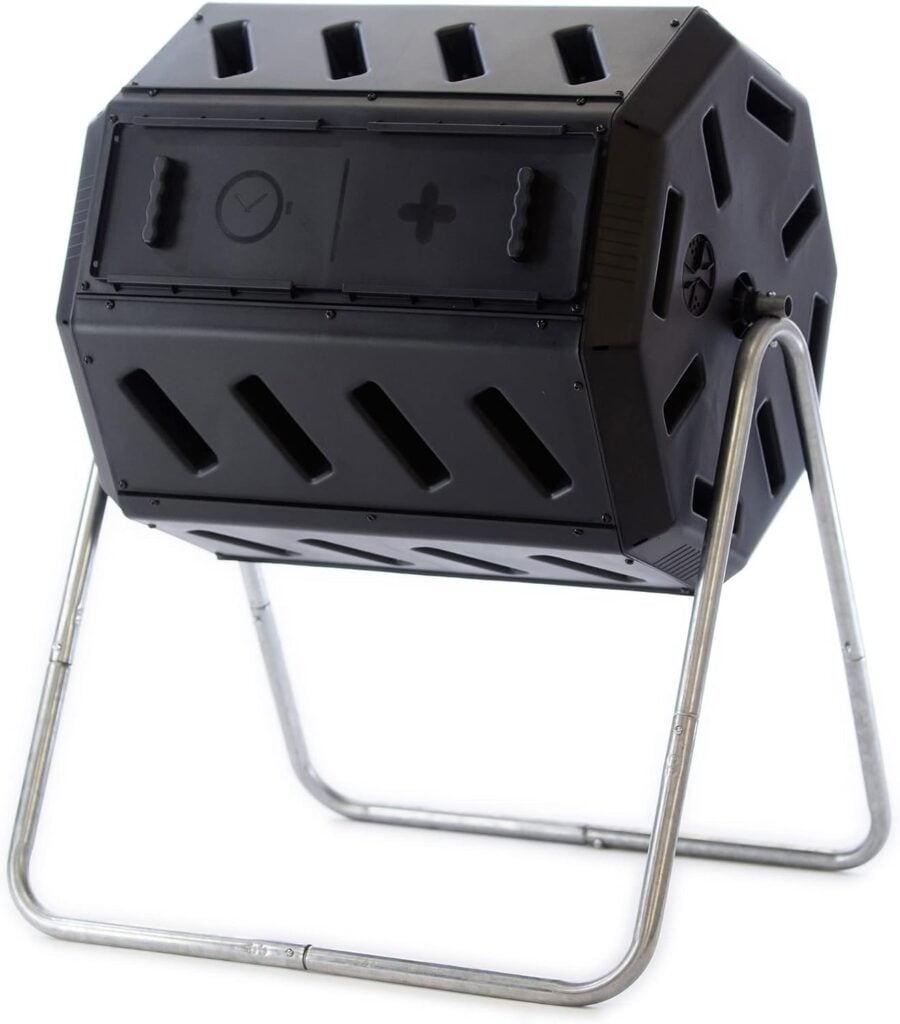
FCMP Outdoor IM4000
A two-chamber tumbler made from recycled plastic
$$$
FCMP Outdoor makes the IM4000 from 100% post-consumer recycled plastic that is BPA-free, so no new plastic goes into it. It holds about 37 gallons across two chambers, so you can let one batch finish while you fill the other side.
This is the plastic tumbler we would choose if the Jora is out of your budget. Plastic left outside in the sun breaks down over the years, and anything that flakes off can end up in your finished compost, so park it somewhere with some shade and replace it when the drum gets brittle.
Body Material
Recycled Plastic
⚠ Compost ContactCapacity
37 Gallons
✓ Mid-Size YardsType
Two-Chamber Tumbler
✓ OutdoorPrice
$$$
✓ Mid RangePros
- 100% post-consumer recycled plastic
- Two chambers for batch composting
- Easy to turn with the handle
- Double doors for easy loading
Cons
- Plastic touches your compost
- Sun exposure wears it down
- Not insulated for cold weather
- Gets heavy to turn when full
If you want an easy-turning tumbler on a tighter budget, this is the most responsible plastic option. The best plastic tumbler if steel is out of reach.
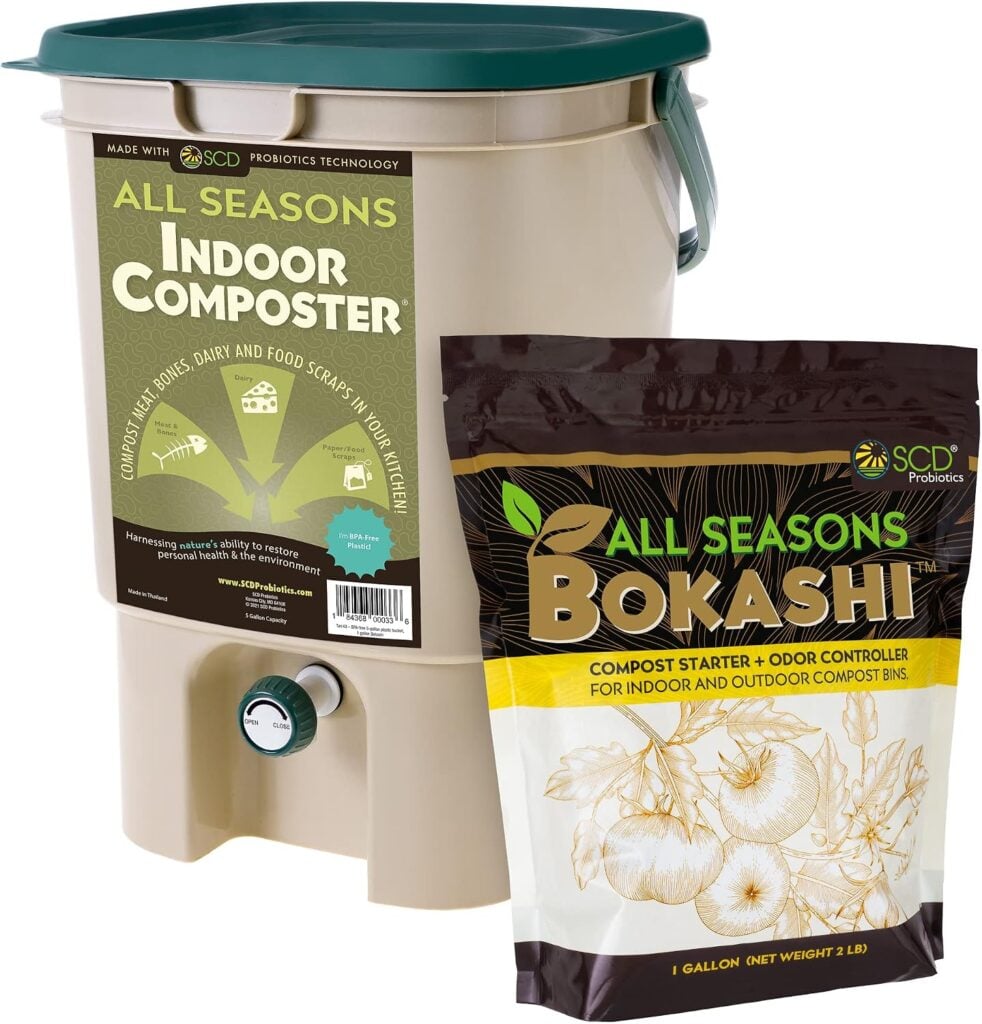
SCD Probiotics All Seasons
A sealed indoor bucket that can ferment meat and dairy
$$$
SCD Probiotics makes this 5-gallon bokashi bucket, where scraps ferment with a bran full of helpful microbes. According to Washington State University Extension, bokashi can safely handle meat, dairy, and cooked food that most backyard piles cannot, and a full bucket is ready in about 10 to 14 days.
We looked hard for a plastic-free bokashi bin, but the only stainless steel version we found does not ship to the US. What comes out is fermented pre-compost, not finished soil, so you still need to bury it in a garden bed or mix it into a regular pile.
Body Material
Plastic
⚠ Compost ContactCapacity
5 Gallons
✓ IndoorsType
Bokashi Bucket
✓ IndoorPrice
$$$
✓ Mid RangePros
- Takes meat, dairy, and cooked food
- Sealed bucket works indoors
- Ferments in about two weeks
- Pairs with any outdoor pile
Cons
- Bucket is plastic
- Output still needs burying
- Needs a steady supply of bran
- No US plastic-free option yet
If you want to keep meat and dairy scraps out of the trash too, bokashi is the only home method that handles them. The best bokashi bin you can buy in the US.
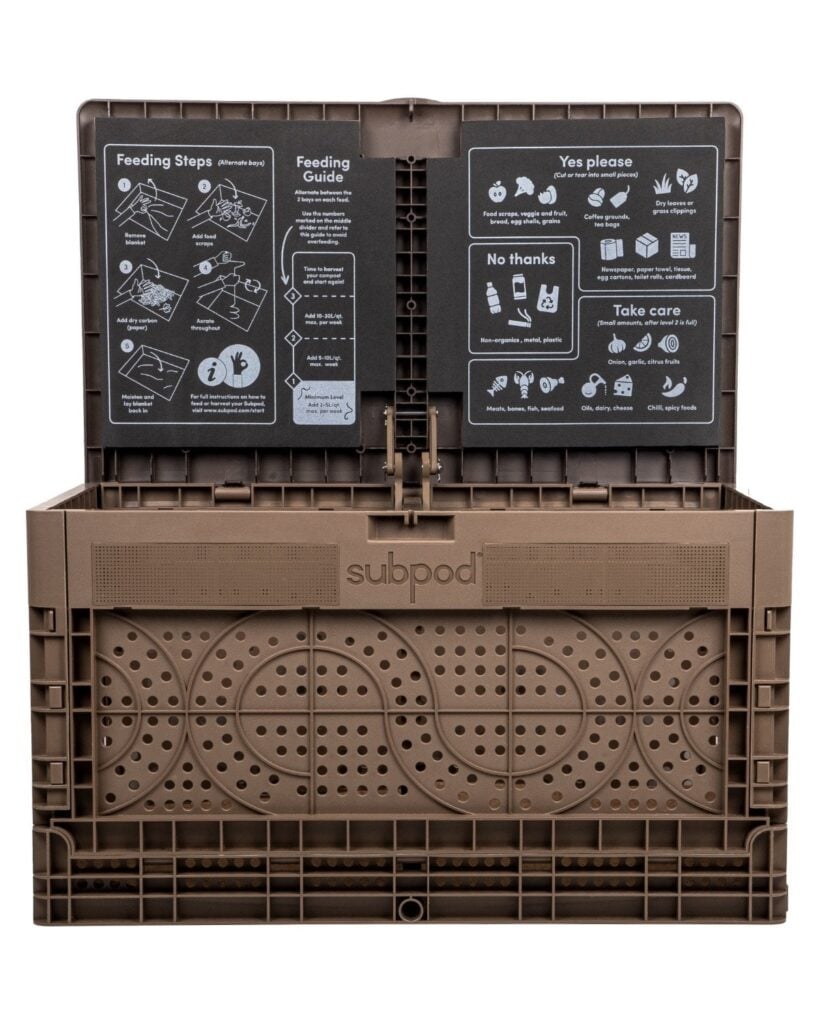
Subpod
An in-ground worm farm that feeds your garden bed
$$$
Subpod is made from polypropylene and sits partly buried in a garden bed, so worms can move between the bin and the soil around it. It has about 30 gallons of internal space and turns scraps into worm castings, one of the richest soil boosters you can make at home.
It is plastic, and we want to be upfront about that. If you would rather skip plastic entirely, a wooden worm bin is easy to build in an afternoon with our DIY worm composting bin guide.
Body Material
Polypropylene
⚠ Compost ContactCapacity
30 Gallons
✓ Garden BedsType
Worm Farm
✓ OutdoorPrice
$$$
✓ SplurgePros
- Worms feed the soil around the bin
- Makes rich worm castings
- Partly buried, so it stays tidy
- 30 gallons of working space
Cons
- Made of polypropylene
- Needs a garden bed to sit in
- Costs more than a DIY worm bin
- Recycled content not disclosed
If you have a raised bed and want worms doing the work right where your plants grow, this is the worm bin to get. The best worm bin for gardeners.
Best Budget Pick: DIY Wood and Wire Bin
The cheapest compost bin is often the one you build. Four untreated wood pallets tied together at the corners make a sturdy open bin, and a roll of hardware cloth turns it into one that rats cannot get into. Cornell Cooperative Extension suggests half-inch hardware cloth or welded wire for the walls and quarter-inch to half-inch galvanized hardware cloth underneath.
Stick with plain, untreated wood. The EPA lists treated or painted wood on its do-not-compost list, so you don’t want it holding your compost either. A circle of wire mesh held with a few garden stakes also works as a quick, nearly free leaf bin.
Don’t Miss: What Not to Compost Some scraps cause smells, pests, and slimy piles. Here is what to keep out of your new bin. Read more →How to Choose a Compost Bin
Choose a compost bin by your space and how much you toss: a countertop bin around 1 gallon for kitchen scraps, a 20 to 33 gallon can or tumbler for a small yard, and a big box bin like the 174-gallon Greenes Fence if you also compost leaves and yard waste.
Picking a compost bin comes down to four things: where you will put it, how much you will feed it, what it is made of, and how well it keeps odors and pests out.
Which Type of Compost Bin Fits Your Space?
- Stationary bins sit on the ground and take scraps continuously. They hold the most and cost the least, and they work best in a yard.
- Tumblers are drums on a stand that you turn with a handle. They are tidy and pest-resistant, but they hold less and work in batches.
- Countertop bins are small kitchen containers for collecting scraps between trips outside or to a drop-off.
- Worm bins use red worms to eat scraps and leave behind castings. They can live in a garage, on a patio, or in a garden bed.
- Bokashi buckets ferment scraps in a sealed container indoors. They take meat and dairy, but the result still needs to be buried.
What Size Compost Bin Do You Need?
For a kitchen caddy, about one gallon is right for most households, since you want to empty it every few days. Outdoors, size depends on how much you cook and how much yard you have. A tumbler like the Jora, which holds 125 liters (about 33 gallons), is sized for 2 to 4 gallons of scraps a week. If you also rake leaves or mow, a bigger stationary bin like the 174-gallon (about 23 cubic feet) Greenes cedar box gives you room for all those browns.
Bigger piles also tend to compost faster. Hot composting needs enough mass to hold heat, and SARE notes that temperatures from 110°F up to 160°F help kill weed seeds and disease organisms. Rodale Institute recommends a pile at least 3 feet wide, deep, and tall, which is about 27 cubic feet, so it can hold onto that heat. A tiny pile rarely gets there.
Why Compost Bin Material Matters for Microplastics
Compost is supposed to go back into your soil, and anything that ends up in the bin ends up in your garden. Researchers at the University of Bayreuth found plastic particles in compost made from household biowaste, mostly the same types used in food packaging. That points to packaging that slipped in with the scraps, so the biggest fix is watching what goes into your bin.
Still, a plastic bin is one more piece of plastic sitting outdoors, getting baked by the sun for years. Steel, untreated cedar, and ceramic avoid that question entirely. If you go with plastic, choose recycled plastic, keep it out of harsh afternoon sun, and replace it once it starts to get brittle. Our guide to microplastics in soil covers the bigger picture.
How to Keep Compost Odors and Pests Away
A well-built bin does most of the work for you. Look for a tight-fitting lid, vents covered with mesh, and a base that animals cannot dig under. Cornell Cooperative Extension recommends wrapping a bin in quarter-inch to half-inch wire mesh, setting it on a mesh-covered pallet or gravel base, and keeping meat, fish, oily leftovers, and cheese out of the pile.
Indoors, a charcoal filter in the lid of a countertop bin soaks up smells between trips outside. Emptying it every few days helps even more.
✨tip
Keep a Bag of Browns Next to Your Bin
Every time you add a bowl of food scraps, cover it with a scoop of dry leaves, shredded cardboard, or plain brown paper. It keeps the pile balanced, blocks smells, and hides the food from flies and critters.
How Much Does a Compost Bin Cost?
A compost bin costs anywhere from free for a DIY pallet bin to about $450 for an insulated steel tumbler, and most countertop compost bins cost about $20 to $40.
Compost bins range from almost free to several hundred dollars. Here is what the picks on this list were selling for in October 2026, so you can see where each type usually lands.
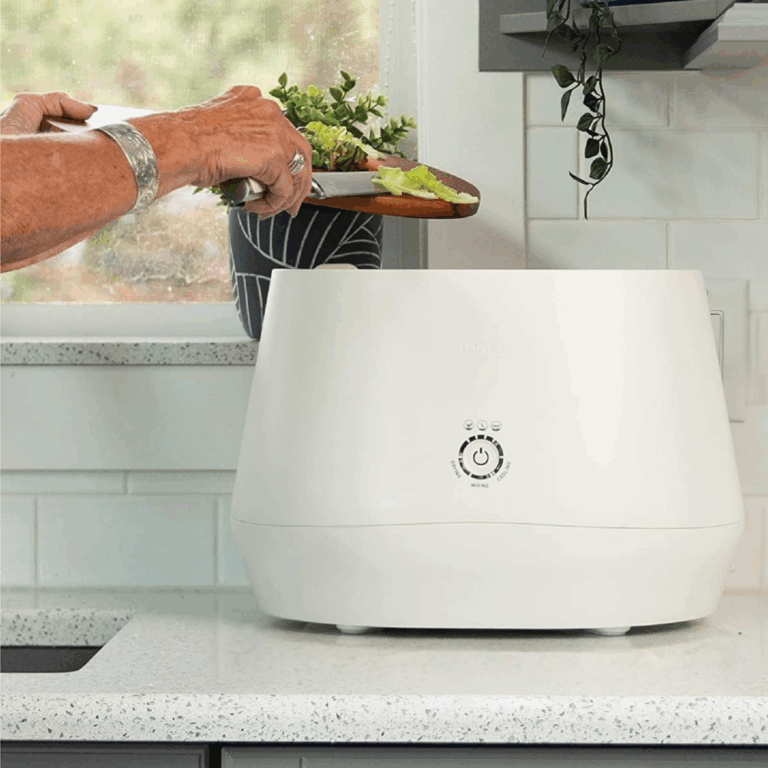
If you are on a tight budget, start with a DIY bin outside and any lidded container you already own in the kitchen. Electric food recyclers like the Lomi sit at the very top of the price range, and our Lomi review breaks down whether that one is worth it.
Tumbler or Box Bin: Which Works Better?
A compost tumbler is best if you want a sealed, pest-resistant bin that is easy to turn, while a stationary box bin is best if you have lots of leaves and yard trimmings, since it holds more and lets you keep adding scraps.
Neither one is better across the board. They fit different people.
A tumbler is the tidier choice. The sealed drum keeps out most animals, and turning it is as easy as giving the handle a few spins. The downside is size. Tumblers hold less, they get heavy to turn when full, and most work in batches, so you need a second chamber or a second bin to keep adding scraps while one finishes.
A stationary box bin is bigger, cheaper, and easier to keep feeding. You add scraps on top, turn the pile with a pitchfork, and pull finished compost from the bottom. It takes a bit more muscle and needs more care to keep pests out, but it is the better choice if you have a lot of leaves and yard trimmings.
A Consumer Reports editor who tried one of each in 2025 landed in the same place. He found the barrel far easier to churn, but the box bin was cheaper and easier to load, and it was the one he preferred overall.
If you mostly compost kitchen scraps in a small yard, a tumbler is easier to live with. If you have a garden, trees, and room to spare, go with a box bin.
What Can You Put in a Compost Bin?
A compost bin needs a mix of greens, like fruit and vegetable scraps and coffee grounds, and browns, like dry leaves, at about two to three parts browns to one part greens.
A healthy compost pile is a mix of greens and browns. The EPA recommends two to three parts browns to one part greens, and the Cornell Waste Management Institute puts the ideal carbon-to-nitrogen ratio at around 30:1.
- Greens: fruit and vegetable scraps, coffee grounds and paper filters, paper tea bags with no staples, crushed eggshells, and grass clippings.
- Browns: dry leaves, plant stalks and twigs, shredded plain paper and brown bags, shredded cardboard with no tape or wax, and untreated wood chips.
- Keep out: meat, fish, bones, dairy, oils, pet waste, treated wood, glossy paper, weeds with seeds, and produce stickers.
Watch for hidden plastic, too. Many tea bags contain plastic, and the EPA also says to keep “compostable” bags and foodservice ware out of a home pile, since most only break down in industrial facilities. Our guide on biodegradable vs. compostable explains why, and you can find plastic-free tea bags here.
Common Compost Bin Problems and Fixes
Most compost bin problems have a quick fix: add dry browns and turn the pile if it smells or feels soggy, add water and fresh greens if it will not heat up, and bury scraps under browns with meat and dairy kept out to stop pests.
Most compost problems come down to too much of one thing and not enough of another. Here is how to fix the most common ones.
👃 Why Does My Compost Bin Smell?
A rotten-egg or garbage smell usually means the pile is too wet and packed down, so air cannot get in. Mix in a big handful of dry browns and turn the pile to open it up. An ammonia smell means too many greens, and the fix is the same: more browns.
🌡️ My Compost Isn’t Heating Up
A cold pile is usually too small, too dry, or short on greens. SARE says the ideal moisture is 40% to 60%, about as damp as a wrung-out sponge. Add water if it feels dusty, add fresh greens if it is mostly leaves, and turn it to move the outside material into the middle. A cold pile will still break down. It just takes longer.
A long-stem compost thermometer takes out the guesswork. The USDA Natural Resources Conservation Service says a hot pile runs from 110°F to 160°F and suggests turning it once the center peaks around 130°F to 140°F, since turning gives the microbes the air they need. If you would rather skip the fuss, cold composting works too. You keep adding scraps and let the pile sit, though NRCS notes it can take a year or more and will not kill weed seeds, so keep weedy plants out.
🐀 Pests Keep Getting Into My Bin
Rats, raccoons, and flies go after exposed food. Bury every new batch of scraps under browns, keep meat and dairy out, and close up any gaps with hardware cloth. If a plastic bin keeps getting chewed, switching to a metal bin like the Behrens or a tumbler on legs usually ends it.
💧 Too Wet or Too Dry
A slimy, soggy pile needs browns and a few turns to dry out, plus a lid if rain is getting in. A dry pile that is not doing anything needs a sprinkle of water and some fresh greens. Squeeze a handful. It should feel moist but not drip. If dark liquid is seeping out the bottom of the bin, that is leachate, and it means the pile is holding too much water.
Is a Compost Bin Worth It?
A compost bin is worth it for most people, since food waste makes up about 24% of what goes into US landfills and composting turns those scraps into free garden soil instead of methane.
For most people, yes. The EPA estimates that food waste makes up about 24% of what goes into US landfills, and that landfilled food causes about 58% of the methane those landfills leak into the air. Composting your scraps keeps them out of that cycle and gives you free soil for your garden in return.
It can save you money, too. If your town does not pick up food scraps for free, a subscription adds up fast. Longmont, Colorado charges $9.90 a month for curbside compost, and in Cohasset, Massachusetts, a private hauler charges $15 a month plus a $36 setup fee. That works out to about $119 to $216 a year, which is more than a Behrens bin or a countertop pail costs one time. Some cities, like Renton, Washington, roll food and yard waste pickup into the regular garbage rate, so check your hauler’s page before you pay for anything extra.
It also helps you use less plastic. Food scraps are the wet, heavy part of your trash, so composting them means fewer plastic garbage bags and less leaking. Our post on why composting is important goes deeper on the benefits.
A bin is worth it as long as you have somewhere to use the compost and a few minutes a week to feed and turn it. If you have no yard and no garden, a countertop bin and a local drop-off or curbside program will get you most of the benefit without a backyard bin. When your first batch is ready, here is how to use garden compost to feed your soil.
Compost Bins We Left Off the List
We left off compost bins like the Bamboozle, the Urban Worm Bag, and the Simplehuman Compost Caddy because they hide plastic in the body, the coating, or the inner tub.
A few well-known bins did not make it once we checked what they are made of.
- Bamboozle Food Composter: sold as a bamboo bin, but it is made of bamboo fiber and melamine, a plastic resin.
- Urban Worm Bag: a fabric worm bin with a polyurethane coating and plastic connectors on the frame.
- Envirocycle Composter: the brand describes it only as “BPA-free materials” and does not name the plastic.
- Simplehuman Compost Caddy: stainless steel on the outside, but the scraps sit in a plastic inner tub.
- OXO Easy-Clean and Joseph Joseph Stack: both made of plastic, and we had steel and ceramic options that do the same job.
- Exaco Aerobin 400: an insulated bin with a polypropylene and polyethylene shell wrapped around polystyrene foam, so it is plastic inside and out.
- Worm Factory 360: a popular stacking worm bin made from recycled plastic trays. We kept one worm bin on the list, and the Subpod got that spot.
- Full Circle Fresh Air: a countertop bin made mostly of recycled plastic with a little steel, and our steel and ceramic picks do the same job.
FAQs on Best Compost Bins
Set your bin on bare soil or hardware cloth in a spot that is easy to reach, then start with a layer of browns like dry leaves or shredded cardboard. Add food scraps on top and cover each batch with more browns. Keep the pile about as damp as a wrung-out sponge and turn it every week or two. Our composting for beginners guide walks through each step.
According to the EPA, a well-maintained pile is usually finished in about three to five months. A pile you leave alone can take a year or more. Turning it often, keeping it moist, and balancing greens and browns all speed it up.
Yes, plain bread breaks down quickly. It can draw rodents, so tear it into small pieces and bury it in the middle of the pile under browns. Skip bread with butter or oily toppings.
Not in a regular backyard bin. The EPA says home piles generally do not get hot enough to break down meat, fish, and bones, and they attract animals. A bokashi bucket can ferment meat first, or you can check whether your city compost program accepts it.
Not in the bin you use for garden compost. The EPA lists pet waste on its do-not-compost list, and Cornell Cooperative Extension warns against adding feces from carnivorous pets, including cat litter, because it can carry parasites and germs.
You can compost in an open pile if you have the room and few animals around. A bin keeps things neater, holds in heat and moisture, and makes it much harder for rats and raccoons to get at your scraps, which is why most people in neighborhoods choose one.
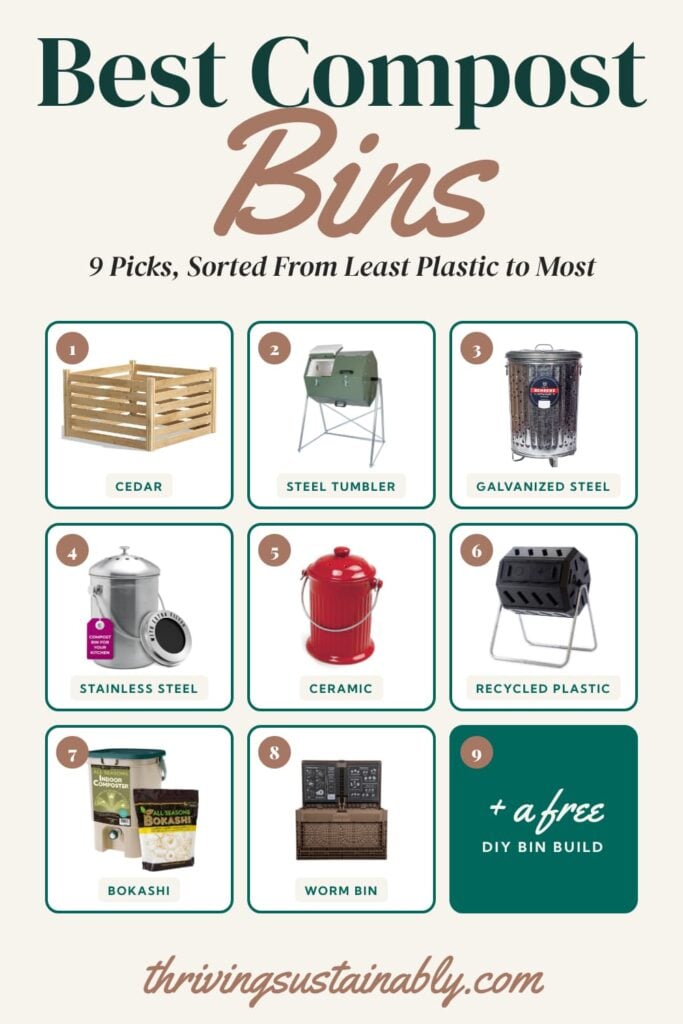
Save This Before You Pick Your Compost Bin 📌
Final Thoughts About the Best Compost Bins
The best compost bin is the one that fits your space and that you will feed every week, and for most backyards that is a simple cedar box like the Greenes Fence composter.
The best compost bin is the one that fits your space and that you will actually feed every week. For most backyards, that is a simple cedar box like the Greenes Fence composter. If you want something sealed and easy to turn, the steel Jora tumbler is worth saving for, and the Epica or Norpro will handle scraps on the kitchen counter.
Choosing steel, wood, or ceramic keeps one more piece of plastic out of your yard and out of the soil you are trying to build. Start with a kitchen bin and one outdoor bin, add a bag of browns, and you will have your first batch of homemade compost by spring.
📚 References
- Carr, R. (2019, January 4). Backyard composting basics: A cheatsheet. Rodale Institute. https://rodaleinstitute.org/blog/backyard-composting-basics-a-cheatsheet/
- City of Longmont. (n.d.). Composting. https://longmontcolorado.gov/trash-recycling-composting-3/composting/
- City of Renton. (2026). 2026 solid waste utility rates. https://www.rentonwa.gov/City-Services/Utilities/Utility-Systems/Utility-Rate-Information/2026-Solid-Waste-Utility-Rates
- Cornell Cooperative Extension of St. Lawrence County. (n.d.). Composting: Preventing animal nuisances. https://stlawrence.cce.cornell.edu/resources/composting-preventing-animal-nuisances
- Cornell Waste Management Institute. (n.d.). Compost chemistry. Cornell University. https://www.css.cornell.edu/cwmi/compost/chemistry.html
- Hope, P. (2025, May 22). Compost bin face-off: Rotating barrels vs. box-style composters. Consumer Reports. https://www.consumerreports.org/home-garden/compost-bins/rotating-barrels-vs-box-style-compost-bins-a7824343506/
- Magdoff, F., & van Es, H. (2021). Making and using composts. In Building soils for better crops (4th ed.). Sustainable Agriculture Research and Education. https://www.sare.org/publications/building-soils-for-better-crops/making-and-using-composts/
- Town of Cohasset. (n.d.). Curbside food waste collection. https://www.cohassetma.gov/1101/Curbside-Food-Waste-Collection
- U.S. Department of Agriculture, Natural Resources Conservation Service. (2021). Composting [Fact sheet]. https://www.nrcs.usda.gov/sites/default/files/2022-09/Texas_Conservation_in_Your_Backyard_Composting_Accessible.pdf
- U.S. Environmental Protection Agency. (n.d.). Composting at home. https://www.epa.gov/recycle/composting-home
- U.S. Environmental Protection Agency. (2023). Quantifying methane emissions from landfilled food waste. https://www.epa.gov/land-research/quantifying-methane-emissions-landfilled-food-waste
- Washington State University Extension Kitsap County. (n.d.). Bokashi composting. https://extension.wsu.edu/kitsap/bokashi-composting/
- Weithmann, N., Möller, J. N., Löder, M. G. J., Piehl, S., Laforsch, C., & Freitag, R. (2018). Organic fertilizer as a vehicle for the entry of microplastic into the environment. Science Advances, 4(4), eaap8060. https://doi.org/10.1126/sciadv.aap8060
More Composting & Plastic-Free Living Reads
- Composting for Beginners: Turn Kitchen Scraps Into Garden Gold
- What Not to Compost: Common Mistakes That Ruin Your Compost
- Worm Composting Bin DIY: Step-by-Step Guide for Beginners
- Garden Compost: How to Use It for Healthier Soil and Stronger Plants
- Microplastics in Soil: Hidden Pollution in Your Garden
- Lomi Composter Review: Is It Worth $549?