
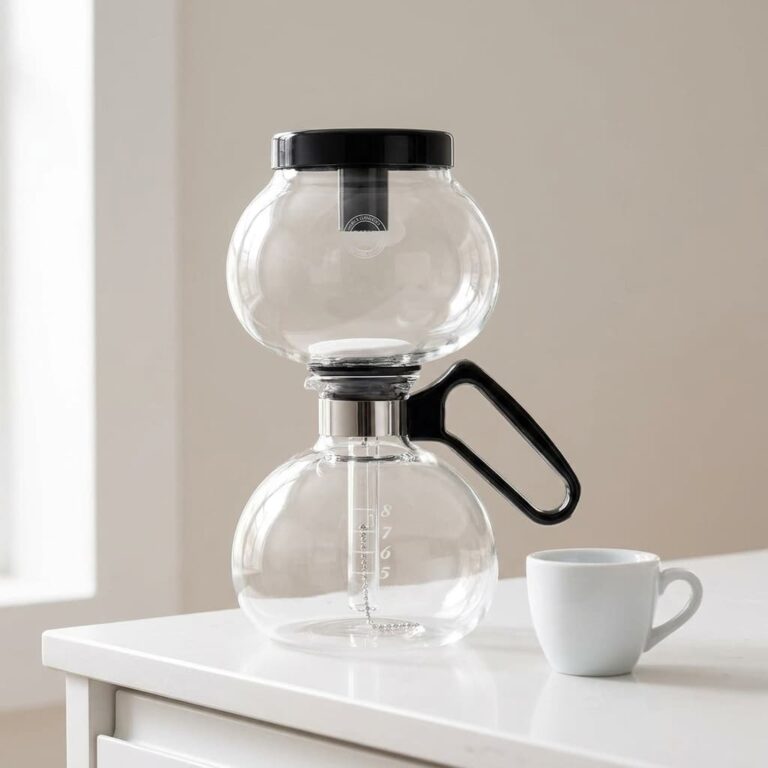
Yama Glass Stovetop Coffee Siphon
Yama Glass
Stovetop Coffee Siphon
Beautiful hand blown glass at a fair price, but the seal that hot water crosses twice per brew has no published material, several parts look like plastic with nothing stated, and the US page shows a lead notice while the factory claims heavy metal free glass. Until Yama documents its parts, the fully disclosed Hario Technica is the better siphon buy.
Hand blown Taiwanese borosilicate siphon with a reusable cloth filter, at a friendlier price than the Japanese competition. The gasket in the brew path has no published material, and the US product page carries a lead notice.
How this score breaks down
Strengths
- Chambers are hand blown borosilicate glass from a Taiwanese glassworks founded in 1978
- Reusable cloth filter, no paper consumable required
- Replacement glass, filters, and lids are sold, so breakage is not the end
- Costs meaningfully less than the Japanese siphons
Trade-offs
- The gasket in the brew path has no published material
- Handle, lid and stand, scoop, and spoon materials are not stated and appear to be plastic
- US product page displays a California Proposition 65 lead notice while the manufacturer claims tested heavy metal free glass; the two are unreconciled
- Manufacturer safety testing claims are not verifiable in any public registry
Scored on our durable-goods method (durables-v1, 2026-08-16). How we rank →
What's inside
Top and bottom chambers are hand blown borosilicate glass, brewed through a reusable cloth covered filter on a metal assembly. The gasket sealing the chambers has no published material. The heat resistant handle, the convertible lid and stand, and the included scoop and measuring spoon also have no stated materials; a silicone lid part is sold as a replacement.
| Part | Material |
|---|---|
| Top and bottom chambers | Hand blown borosilicate glass |
| Filter | Reusable cloth on a metal assembly |
| Gasket between chambers | Not stated, in the brew path |
| Handle | Heat resistant, material not stated |
| Lid and stand | Not stated; a silicone bottom beaker lid is sold separately |
| Scoop and measuring spoon | Not stated |
Free of PFAS, PTFE, nonstick coatings, electronics
- Packaging
- Not stated by the brand.
- Microplastics
- Glass sheds nothing; the undisclosed gasket in the brew path is the open question, along with the unstated fiber of the cloth filter
Attributes
What this product is, at a glance.
Certifications
None listed. We only show independent third-party certifications we can verify with the issuing body, and this product does not currently hold any.
About Yama Glass
Yama has been hand blowing heatproof borosilicate glass in Toufen, Taiwan since 1978, when founder Chen Zong-xiong set out to break into the glass industry. The factory runs Taiwan's first all electric glass melting furnace and still hand blows its siphon chambers. In the US the brand is operated by Espresso Parts in Lacey, Washington, which sells the stovetop siphon alongside replacement glass and cloth filters. The manufacturer states its glass is tested free of lead, cadmium, and arsenic residue, though the US product page displays a California Proposition 65 lead notice, a state law requiring warnings about certain chemical exposures, and the seal between the chambers has no published material. It is the affordable way into siphon brewing, with disclosure that trails the Japanese competition.
Categories: