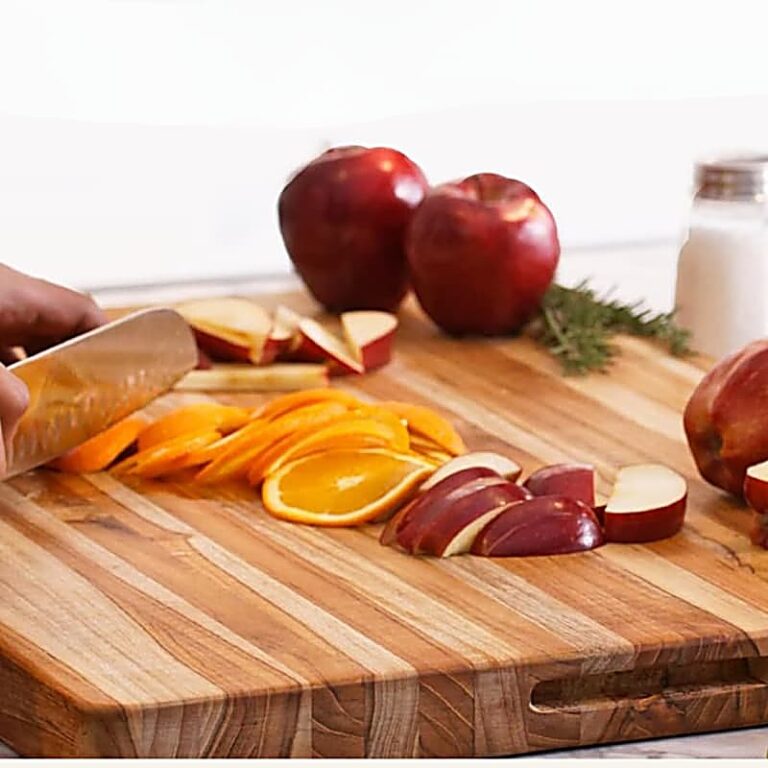
Teakhaus by Proteak Edge-Grain Teak Cutting Board
Teakhaus (by Proteak)
Edge-Grain Teak Cutting Board
One of the best-documented wood boards in this list: FSC-certified teak, an adhesive the brand states is formaldehyde and VOC free, and a disclosed mineral-oil-and-beeswax finish. Made in Vietnam from teak grown on managed plantations.
An FSC-certified teak board with the two things most laminated boards leave out: an adhesive the maker states is free of formaldehyde and VOCs, and a mineral-oil-and-beeswax finish, both disclosed.
How this score breaks down
Strengths
- FSC-certified plantation teak, tracked by chain of custody
- Adhesive stated to be free of formaldehyde and VOCs, which most bamboo and laminated boards never disclose
- Naturally oil-rich teak resists water without any plastic sealant
- Ships pre-finished with mineral oil and beeswax
Trade-offs
- It is a glued edge-grain board, so it is low-plastic rather than a single solid slab
- Packaging is not described on the brand site
- Teak is grown in Latin America and the boards are manufactured in Vietnam, so there is shipping distance built in
Scored on our durable-goods method (durables-v1, 2026-08-19). How we rank →
What's inside
The board is FSC-certified plantation teak, a dense tropical hardwood naturally high in oils, so it resists water without a plastic sealant. The strips are joined with an adhesive the brand states is free of formaldehyde and VOCs, and the board is pre-finished with mineral oil and beeswax. No plastic sits anywhere in the board or its finish.
| Part | Material |
|---|---|
| Board | FSC-certified plantation teak |
| Adhesive | Formaldehyde-free, VOC-free (brand-stated) |
| Finish | Mineral oil and beeswax |
Free of BPA, BPS, phthalates, PFAS, plastic coatings
- Packaging
- Not stated
- Microplastics
- None; solid teak sheds wood fibers, not microplastics, and the adhesive sits inside the glue lines, not on the cutting surface
Attributes
What this product is, at a glance.
Certifications
Independent, third-party certifications only. Tap any badge to see what it verifies.
About Teakhaus (by Proteak)
Teakhaus is the housewares line of Proteak, a company founded in 2000 that grows and sources teak from responsibly managed plantations and manufactures its finished boards in Vietnam. Proteak's whole premise is plantation forestry rather than old-growth logging, and every product carries Forest Stewardship Council certification, an independent chain-of-custody system that tracks the wood from a well-managed forest to the finished board. The brand states its boards use an adhesive free of formaldehyde and VOCs and ship pre-finished with a blend of mineral oil and beeswax. Teak's natural oils make it water-resistant, which is why it has long been a counter-top favorite. It is a mid-to-upper price board, and the sustainability case rests on the FSC certification rather than a recycled story.
Categories: